

A startup’s tax needs go beyond filing its first return. Small-business tax preparation experts can tailor federal tax compliance and consulting to a company’s structure, reporting needs, and goals. Specialized support can help coordinate business and owner returns, LLC reporting, payroll, and tax planning as the business takes shape.
It’s understandable to want accurate filings without losing focus on building a business. The right support can help bring those priorities together by clarifying what information is needed and how business decisions connect to tax reporting.
This article explains when startups may benefit from specialized tax services in Greensboro and what support can cover, from business formation and bookkeeping to tax returns and IRS representation. You’ll also learn how professional guidance can clarify tax responsibilities as your business grows.
Key Takeaways
- Evaluate a preparer’s credentials and experience with the tax issues your business actually faces.
- Businesses may claim the research and development tax credit by filing IRS Form 6765, according to the Internal Revenue Service.
- Corporate estimated tax obligations can depend on the tax a corporation expects to owe when it files its return.
- A single-member LLC is generally treated as a disregarded entity for federal tax purposes, which affects how its business income is reported.
- Professional IRS representation can help a business respond to tax matters with organized records and informed support.
Assessing a tax preparer’s credentials and history
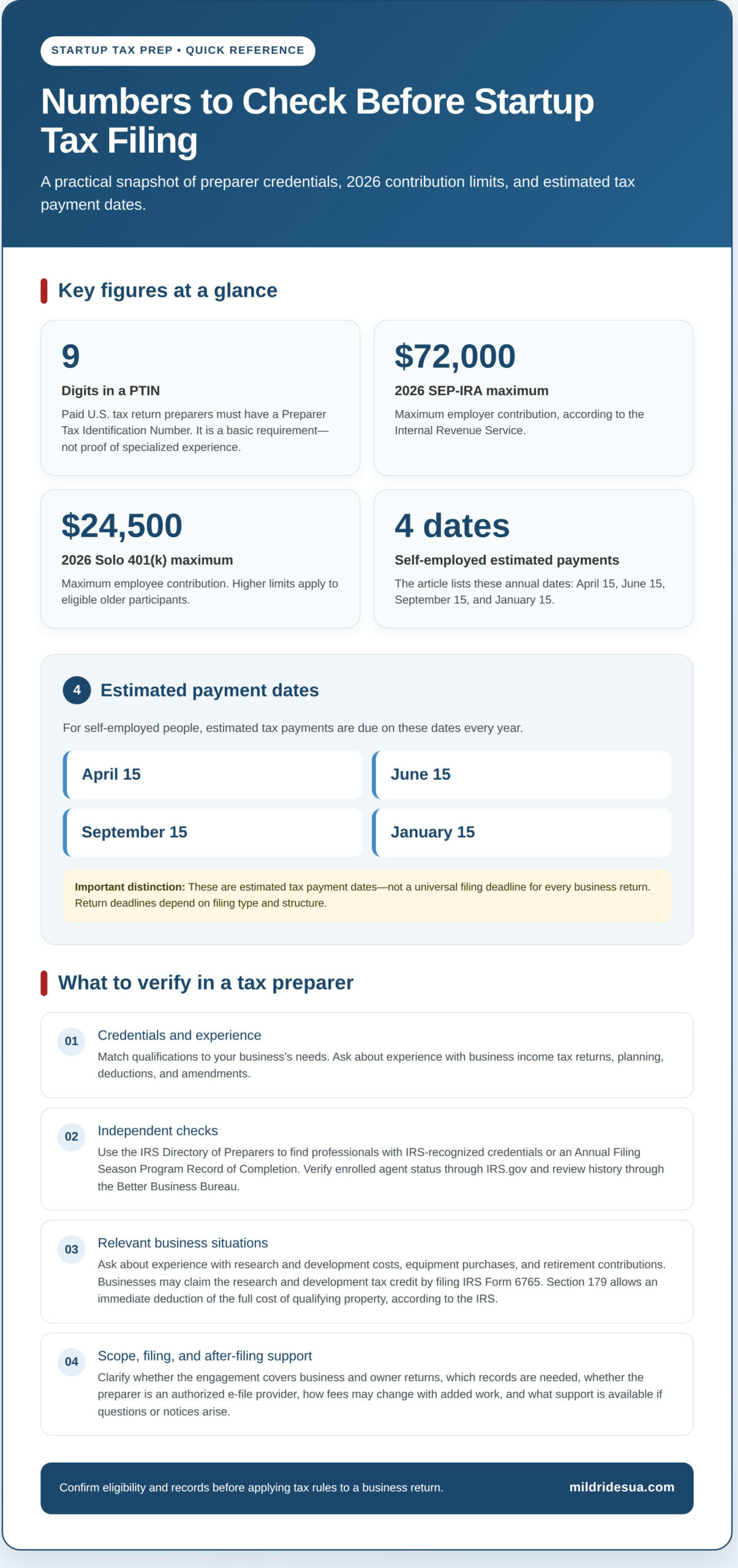
Start by matching a preparer’s qualifications to your business’s tax needs. Paid tax return preparers in the United States must have a Preparer Tax Identification Number, or PTIN, which is 9 digits long. That identifier is a basic requirement, not proof of specialized experience. Ask how the preparer handles business income tax returns, tax planning, deductions, and amendments when a filed return needs correction.
Credentials and relevant experience both matter. Small businesses can use the IRS Directory of Preparers to find professionals with IRS-recognized credentials or an Annual Filing Season Program Record of Completion. You can verify an enrolled agent’s status through IRS.gov and review a preparer’s history through the Better Business Bureau. These steps help distinguish formal qualifications from claims about experience.
Ask about the business situations the preparer has handled, such as research and development costs, equipment purchases, or retirement contributions. Businesses may claim the research and development tax credit by filing IRS Form 6765, according to the Internal Revenue Service. Section 179 of the Internal Revenue Code allows an immediate deduction of the full cost of qualifying property, according to the Internal Revenue Service. For 2026, the maximum SEP-IRA employer contribution is $72,000, according to the Internal Revenue Service. For 2026, the maximum Solo 401(k) employee contribution is $24,500, with higher limits for eligible older participants, according to the Internal Revenue Service. These rules make careful review of records and eligibility central to sound preparation.
Professional e-file authorization is another practical point to discuss. Find out whether the preparer is an authorized e-file provider and how the office handles transmission, acceptance notices, and filing issues. A clear process keeps the return organized from document intake through submission. Ask about fees before work begins, including how added schedules, amended returns, or bookkeeping affect the engagement. The cost depends on the return’s complexity and the services required.
Preparation should account for related business and owner filings. For example, a business return may need to align with the owner’s income, deductions, and tax payments. Integrating those records can help identify inconsistencies before filing. Clarify whether the engagement covers both returns or only the business return, and which documents are needed to prepare each accurately.
Finally, clarify what support is available after filing. Tax questions can arise outside filing season, especially when a notice arrives or a business decision changes reported income. A preparer who remains available year-round can explain how a filed return relates to later questions. For an amendment, the preparer should identify the affected information, review supporting records, and explain how the correction changes the return.
Federal, state, and local small-business tax obligations
A business’s filing responsibilities depend on its structure, income, payroll, and activities. Coordinated preparation connects federal returns with state and local obligations, notices, and tax planning.
Federal, State, and Local Compliance
Federal compliance can involve income tax returns, employment tax returns, and estimated payments. Self-employed people’s estimated tax payments are due April 15, June 15, September 15, and January 15 every year. State and local requirements depend on where the business operates and the activities it conducts. Coordinated accounting helps connect reported income, payroll records, and filing responsibilities across jurisdictions.
For Greensboro businesses, preparation should consider North Carolina obligations alongside federal reporting and any applicable local requirements. Reviewing state and local requirements can identify where registrations, returns, or payments may apply. The analysis should reflect the business’s locations, employees, sales activity, and operations, rather than assume one filing pattern fits every company.
Required Federal Forms and Filing Deadlines
Which federal tax forms must small businesses file by business structure? A sole proprietor generally reports business income on Schedule C of Form 1040. Other structures have different return requirements, so the preparer matches forms to the entity and its tax treatment.
What are the 2026 federal tax filing deadlines for small businesses? The available estimated-payment dates for self-employed people are April 15, June 15, September 15, and January 15 every year. These are estimated tax payment dates, not a universal deadline for every business return. Return deadlines depend on filing type and structure.
Federal Deductions and Credits
Which federal tax deductions and credits may be available to a small business? Eligibility depends on the business’s expenses, activities, records, and tax situation. A preparation review can identify potentially relevant deductions and credits, then connect each claim to supporting documents and the correct return.
For example, a business’s development work or equipment purchases may warrant closer tax analysis. The preparer should examine the purpose, timing, and records behind each expense before determining how it may be reported. Thoughtful tax planning can identify opportunities without assuming every purchase or project qualifies.
Filing Errors, Delays, and Penalties
What are the risks and penalties of inaccurate or late federal business tax filings? Errors can lead to incorrect tax calculations, follow-up notices, amended returns, or underpayment penalties. Missing records, misclassified income, and overlooked filing obligations can also complicate later accounting and tax preparation.
When an IRS or state notice arrives, the response should begin with identifying the tax period, issue, and requested action. A state tax nexus analysis can also examine where a business operates, employs people, or conducts sales, helping determine which jurisdictions need attention. Tax planning and preparation can bring these compliance questions into a coordinated review.
Corporate and owner individual tax returns
A business return and an owner’s individual return report related financial activity, but serve different purposes. Preparation starts with organizing the company’s income, expenses, payroll records, and supporting documents. The preparer then reviews how the business structure affects reporting and which details belong on each return. This coordinated review can help owners understand how business results affect their personal tax picture.
For a corporation, the review should reconcile accounting records with reported revenue, deductible expenses, and any tax payments already made. Corporations generally have to make estimated tax payments if they expect to owe tax of $500 or more when their return is filed, according to the Internal Revenue Service. The preparer considers the corporation’s expected tax and payments together, rather than treating the return as an isolated filing. Interest and other financial entries should also be classified consistently with the records.
Owner returns require a separate review of personal income and business-related information. For an owner with consulting income, the 2026 combined Social Security and Medicare tax rate is 15.3% on net earnings up to the Social Security wage base of $184,500. That calculation makes accurate income and expense records important. The preparer can examine the owner’s business activity, compare relevant figures with the business records, and identify items needing clarification before filing.
Employees add another layer to corporate reporting. Payroll records, compensation information, and employment tax filings should align with the accounting records used to prepare the company return. If reported payroll does not match the books, the preparer needs to investigate the difference before finalizing the filing. A review can also separate business expenses from personal spending, such as a company purchase from an owner’s personal transaction.
Preparation involves more than assembling forms. The preparer should inspect the books and records to help ensure the business reports income and claims available deductions and credits. Owners should review the business return before signing, paying particular attention to reported income, major expenses, and owner-related entries. For example, a change in revenue that does not match the accounting records deserves attention before submission.
The return should reflect the business’s actual structure and circumstances, not simply repeat last year’s filing. Changes in ownership, payroll activity, or business income may affect which records and calculations need attention. A careful review connects the company’s accounting, its tax return, and the owner’s individual filing. This gives owners a clearer basis for understanding tax obligations and making informed business decisions.
Federal tax treatment and reporting for single-member LLCs
For federal tax purposes, a single-member LLC is generally treated as a disregarded entity. Its owner reports business income as a sole proprietor on Schedule C of Form 1040. The LLC’s legal form and federal tax treatment are distinct considerations, so preparation begins by identifying the entity and its reporting classification.
How do federal tax rules differ for sole proprietorships, partnerships, LLCs, and corporations? A single-member LLC is generally reported like a sole proprietorship, with business income reported by its owner on Schedule C of Form 1040. Partnerships and corporations follow different entity-specific reporting, so a preparer first establishes the business’s structure and applicable federal tax treatment.
For an LLC owner, accurate Schedule C reporting depends on clear records of business income and expenses. A preparer can organize sales records, receipts, bookkeeping entries, and payment records, then compare them for consistency. For example, if bank deposits show customer income missing from the accounting records, that difference needs review before preparing the return.
Expense review matters, too. The preparer examines the nature and documentation of each business cost, distinguishing business activity from personal spending. A purchase used for both personal and business purposes needs careful treatment, not an unsupported claim that the full amount is a business expense. Organized records connect each reported amount to its source and help resolve questions before filing.
Business tax payments are another part of the overall picture. Self-employed people’s estimated tax payments are due April 15, June 15, September 15, and January 15 every year. A preparer can consider reported income and payments together, helping the owner understand how business activity relates to the individual return. Accurate records make that review more coherent across the tax year.
Credits and deductions require a separate review of the business’s activities and supporting records. A preparer can assess whether an expense or business activity may qualify, then determine how it fits the LLC owner’s return. For instance, a development project or equipment purchase may warrant closer examination, but the tax treatment depends on the facts and documentation.
Federal classification can also change if an LLC’s ownership or tax election changes. The preparer should compare the current structure with prior filings and identify what changed before carrying forward reporting assumptions. This step helps prevent an outdated return approach from obscuring current income, credits, or payments. A disciplined review gives owners a clearer view of how the entity’s activity reaches Form 1040.
IRS representation
An IRS notice can raise questions about reported income, a deduction, payroll records, or missing returns. Start by identifying the tax period and issue described in the notice. A qualified tax professional may represent a business if the IRS contacts it about a tax matter. The advisor’s role begins with understanding the notice and the business records behind it.
Careful preparation helps create a clear response. The professional reviews the notice alongside the filed return, accounting records, receipts, and relevant payment history. For example, if the IRS asks about a business expense, the review can connect the deduction to receipts and the underlying transaction. This creates an organized record of what was reported and which documents support it.
Different questions call for different records. A notice about reported income may require comparing sales records with bank deposits and bookkeeping entries. A payroll issue may call for reviewing payroll records and employment tax filings. A question about a deduction may require invoices, receipts, and an explanation of the expense’s business purpose. The response should address the specific issue, not include unrelated paperwork.
When records do not align, the professional can identify the discrepancy and determine what information may clarify it. For instance, a payment recorded in one accounting period but reported differently on a return may need reconciliation. The business should preserve relevant documents and provide a complete account of the transaction. Clear documentation helps the advisor assess the IRS’s request and prepare a focused response.
IRS representation can also involve organizing communications and tracking next steps. The professional reviews correspondence, notes requested information, and coordinates the business’s response. If the issue involves unfiled returns or back taxes, those matters can be included in the same case assessment. Tax resolution support may help when the business needs to address outstanding tax issues or a tax lien.
Businesses operating across states may also need to distinguish an IRS matter from a state tax notice. Review each notice on its own terms, identifying the issuing authority, tax period, and requested records. Keeping federal and state correspondence organized reduces confusion when several matters overlap. An accountant or tax advisor can connect the notice to the company’s filings and bookkeeping.
Before representation proceeds, the business should provide the notice and records relevant to the stated issue. The professional can then explain the matter, organize supporting documents, and guide the response process. If the IRS has contacted your business, request IRS representation to address the notice with structured, informed support.
Mildrid Esua, CPA, PLLC
Mildrid Esua, CPA, PLLC helps small-business owners coordinate tax preparation, accounting, and planning. As small-business tax preparation experts, the firm tailors federal tax compliance and consulting to each business’s needs and strategic goals, connecting financial records with filing requirements and business decisions.
Turn to the firm when you’re starting a business, organizing records, preparing returns, or responding to an IRS matter. Small-business tax preparation experts can also help address unfiled returns, back taxes, or tax liens through tax resolution and IRS representation. The right support depends on your priorities, from bookkeeping to a specific tax concern.
For guidance tailored to your business, contact Mildrid Esua, CPA, PLLC.
Build a stronger financial foundation for what comes next
Tax decisions can shape how confidently you plan investments, manage cash flow, and respond to new opportunities. Treating tax preparation as part of ongoing business planning can turn financial records into a clearer basis for decisions, rather than a task revisited only at filing time.
The right small-business tax preparation experts can tailor federal compliance and consulting to your business needs and strategic goals. As your operations change, a considered approach can help keep tax responsibilities aligned with your priorities and support informed choices for the next stage of growth.
Mildrid Esua, CPA, PLLC provides tax preparation, planning, bookkeeping, accounting, and tax resolution support for small businesses. If you’re ready to discuss how professional guidance could fit your business, contact Mildrid Esua, CPA, PLLC. A thoughtful next step can bring greater clarity to the decisions ahead.
Frequently Asked Questions
Do startups need specialized tax services?
Specialized tax support can help a startup connect early business decisions with reporting and recordkeeping. For example, an owner setting up a company while beginning payroll may need coordinated accounting, tax preparation, and planning. Guidance can also clarify how the chosen business structure affects tax reporting. In Greensboro, support can help a new business move from formation into regular operations and prepare for its first filings.
What do small business tax services include?
Small-business tax services can combine tax preparation and planning with accounting support. Depending on the business’s needs, support may include preparing business and owner returns, bookkeeping, payroll, business formation guidance, and IRS representation. A business with outstanding tax issues may also need help with unfiled returns, back taxes, or tax liens. The scope should reflect the company’s structure, records, and priorities rather than a standard package.
What tax records should a business keep and for how long?
Businesses generally should keep tax records for 3-7 years, depending on the record type and situation. Useful files can include income and expense documentation, receipts, payroll records, filed returns, and records of tax payments. For example, keeping an invoice with its payment record can make a business expense easier to substantiate later. An organized record system also helps a preparer connect transactions to the figures reported on returns.
What’s the difference between tax planning and tax preparation?
Tax planning looks ahead at how business choices may affect tax reporting, while tax preparation organizes completed financial activity into returns. For example, an owner considering a change in operations can discuss its tax implications before acting. Preparation then reviews records and reports relevant activity for filing. Together, these services connect forward-looking decisions with accurate reporting, rather than treating tax work as a once-a-year task.
When should a small business hire a tax professional?
A business can engage a tax professional when it launches, changes its structure, begins payroll, or needs help organizing business and owner filings. Professional support can also help when records are incomplete, a return needs correction, or an IRS notice arrives. For example, an owner who has fallen behind on filings can get help assessing unfiled returns and related tax issues before deciding on next steps.
What federal tax compliance services do small business tax preparers provide?
Federal tax compliance support may include preparing business and owner returns, reviewing bookkeeping records, and helping organize payroll information for reporting. A preparer can also discuss tax planning and assist with IRS representation when a business receives an IRS inquiry. The exact work depends on the company’s tax situation and records. For example, a business with unfiled returns may need a different preparation process than one filing routinely.
How much do small business tax preparation and consulting services cost in the United States?
The cost depends on the case and is provided after a quote request. Factors include the business’s structure, the number and complexity of returns, the condition of its records, and whether it needs bookkeeping, payroll support, planning, or IRS representation. A business with several unresolved filings may require a different scope from one seeking routine return preparation. Clarifying the work involved helps define an appropriate engagement.
How can a tax advisor help with tax planning and business growth goals?
A tax advisor can connect business goals with financial records and tax planning considerations. For example, an owner considering expansion can review projected income, hiring plans, and bookkeeping needs before making commitments. This supports informed decisions without treating a tax outcome as guaranteed. Mildrid Esua, CPA, PLLC serves small businesses in Greensboro and nearby communities, including High Point, Burlington, Kernersville, Jamestown, Oak Ridge, Summerfield, and Winston-Salem.




1 Comment
Leave your reply.