


Living abroad doesn’t automatically determine whether you need international tax support. The key question is whether your U.S. filing and reporting obligations, foreign income, accounts, or business interests create issues that require coordinated planning. For U.S. individuals and entities with foreign financial assets above certain thresholds, Form 8938 reporting is annual, according to the Internal Revenue Service.
A move overseas or a new international venture can make tax responsibilities more complex. The right guidance can help clarify those obligations before you decide where to live, how to structure a business, or when to move money across borders.
This guide explains how international tax planning, reporting, entity elections, and repatriation strategies can apply to cross-border activity and living abroad. It also outlines when a CPA with international tax expertise may help, based on your circumstances.
Key Takeaways
- Identify how your tax residency, income sources, foreign accounts, and business interests shape cross-border filing and planning.
- Assess international reporting and risk considerations before expanding operations or establishing a foreign business structure.
- Compare entity classification and repatriation choices in light of how you plan to operate and move business funds.
- Prepare for an informed conversation with an international tax professional by clarifying your cross-border activities and decisions ahead.
- Learn how Winston-Salem tax support can connect international planning with preparation, bookkeeping, and small-business accounting.
Tax planning for foreign inbound and outbound transactions
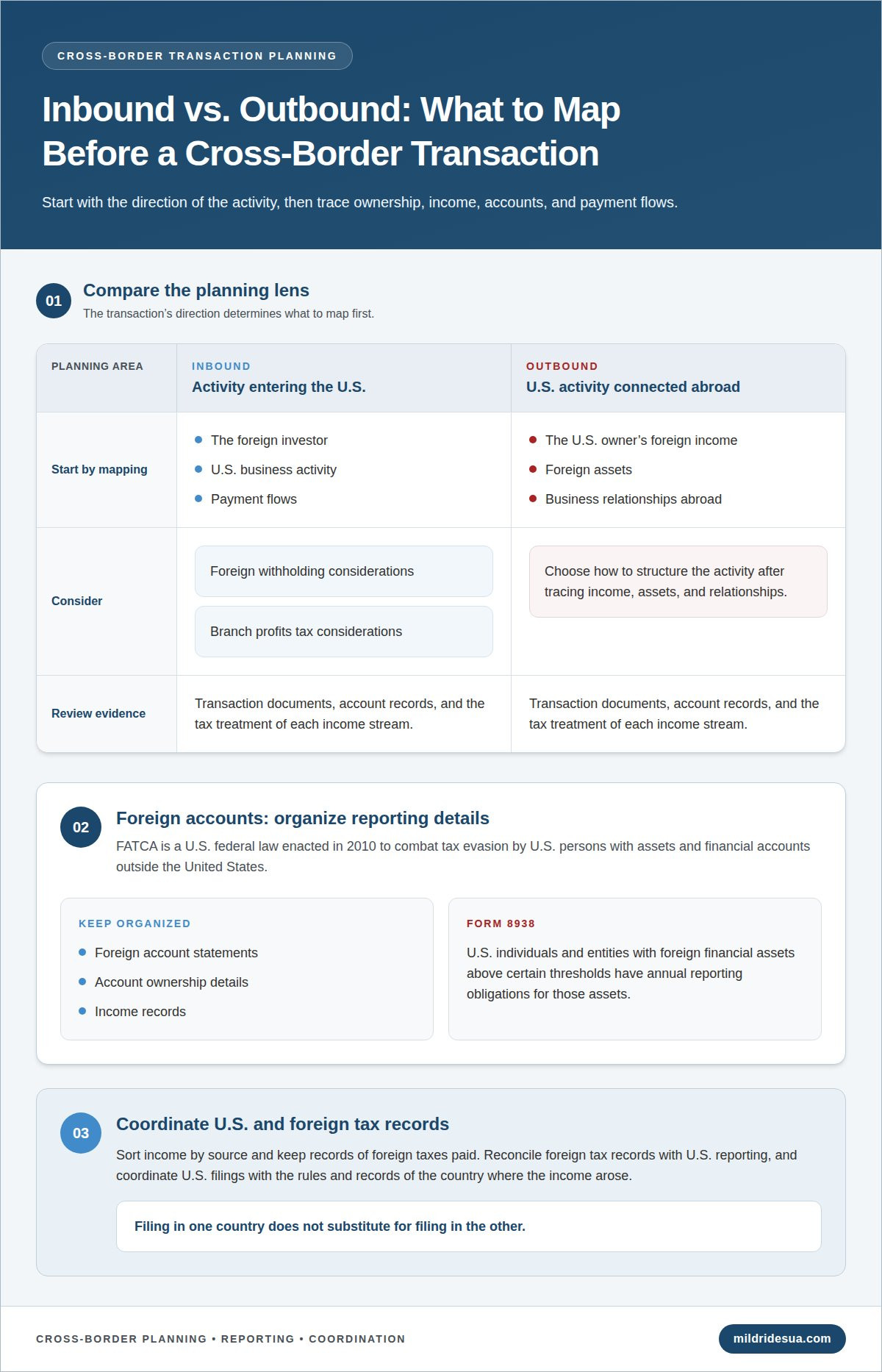
Inbound planning considers money, people, and business activity entering the United States. Outbound planning examines U.S. taxpayers’ income, accounts, and operations connected to another country.
Inbound and Outbound Transaction Planning
For an inbound transaction, map the foreign investor, U.S. business activity, payment flows, and any foreign withholding or branch profits tax considerations. For an outbound transaction, trace the U.S. owner’s foreign income, assets, and business relationships before choosing how to structure the activity.
When choosing international tax services in Winston-Salem, look for experience with cross-border reporting and coordinated U.S. and foreign obligations. Ask how the CPA will review transaction documents, account records, and the tax treatment of each income stream.
FATCA and Foreign Account Reporting
FATCA is a U.S. federal law enacted in 2010 to combat tax evasion by U.S. persons with assets and financial accounts outside the United States. For people moving to the United States or holding accounts abroad, account ownership and financial records are important reporting considerations.
According to the Internal Revenue Service, U.S. individuals and entities with foreign financial assets above certain thresholds have annual reporting obligations for those assets on Form 8938. Keep foreign account statements, ownership details, and income records organized so each account can be assessed for relevant reporting.
U.S. and Foreign Tax Coordination
Foreign income, foreign tax credits, and foreign earned income exclusions are reported through the applicable U.S. return and supporting forms. Start by sorting income by source and keeping records of foreign taxes paid. This helps distinguish income from amounts that may qualify for credit or exclusion treatment.
Coordinate U.S. filings with the rules and records of the country where income arose. For example, a U.S. taxpayer working abroad may need to reconcile employer statements and foreign tax records with U.S. reporting. Filing in one country does not substitute for filing in the other.
Expatriate and Foreign National Services
Expatriates and foreign nationals may have different U.S. tax considerations depending on residency, income sources, account ownership, and business connections. A cross-border review can organize these details and identify which income and transactions need attention in U.S. reporting.
Winston-Salem firms with foreign business, estate, or cross-border investment questions can review ownership, income flows, and related records. For an investment involving a foreign company, for example, the review can map who owns the interest, where income is generated, and which reporting issues may arise.
Cross-border tax analysis, reporting, and risk management
A structured review maps income, ownership, accounts, and business activity across each relevant border. This helps taxpayers identify overlapping reporting needs, assess available credits, and organize decisions before a transaction or filing.
Pillar Two and Multinational Reporting
The OECD’s Pillar Two rules concern global minimum taxes for multinational enterprises. Requirements apply to multinational groups with consolidated revenue over €750 million. Affected groups need a coordinated view of entities, income, and tax paid across jurisdictions. Country-by-country reporting organizes those details by country, helping identify differences between where a group operates and where it reports profits.
U.S. international reporting can involve global intangible low-taxed income. Review entity ownership, foreign earnings, and relevant records together rather than treating each return separately. This analysis helps clarify reporting responsibilities and supports planning around foreign tax credits.
Accounts, Income, and Filing Coordination
If you have foreign financial accounts, assess whether FBAR or FATCA-related reporting applies. Gather account ownership details, statements, and income records, then include them in the U.S. reporting review. A foreign account held jointly or through a business may require closer analysis of ownership and reporting responsibilities.
Taxpayers can report abusive tax preparers to the IRS using Form 14157, according to the Internal Revenue Service. Keep copies of filed returns and communications if a preparer’s conduct raises concerns. Those records help explain what happened and support a clear report.
Deadlines and Risk Management
International filing deadlines and extension procedures depend on the return or report involved and the taxpayer’s circumstances. Build a calendar listing each applicable filing, its due date, and any extension steps. Track payment obligations separately from filing dates.
Start a practical risk review by matching each income source to its supporting documents. Reconcile foreign tax records with U.S. reporting and note unresolved differences for review. For a multinational group, compare entity-level records with the country-by-country picture. This process can reveal missing documents, inconsistent figures, or reporting gaps before submission.
Cross-border transaction reviews may also need to account for the Mandatory Disclosure Regime as a reporting requirement. Controlled foreign company reporting is another area connected with the EU Anti-Tax Avoidance Directives. Consider both within the wider compliance review.
International tax considerations for global expansion
Global expansion creates opportunities, but each new country can change how income, ownership, and operations are taxed. Start by mapping where the business sells, hires, holds assets, and makes strategic decisions.
Begin with the proposed operating model. Identify whether the company will sell across borders, establish a foreign entity, hire local staff, or work through a distributor. Each arrangement creates different accounting records and tax questions. For example, a business selling remotely should map customer locations, payment flows, and the teams doing the work before choosing an expansion structure.
The OECD’s Base Erosion and Profit Shifting project affects business supply chains around the world. Examine how goods, services, intellectual property, and payments move between related operations. A clear transaction map can help leaders assess where income is generated and whether internal pricing decisions align with actual business activity.
International tax structures also need to account for anti-avoidance measures. The OECD Multilateral Instrument includes a principal purpose test and other measures relevant to international tax structures. The European Union’s DAC 6 is a mandatory disclosure rule covering cross-border arrangements for taxpayers and intermediaries. Businesses considering an arrangement should identify its purpose, participating parties, and relevant countries early.
A practical expansion review can proceed in stages. Document the business goal and planned operating structure, then map the countries involved and the flow of revenue, costs, and ownership. Assess accounting processes, reporting responsibilities, and how the structure may operate as the business grows. This sequence helps decision-makers compare alternatives before committing resources.
To verify a tax professional’s credentials in North Carolina, use the IRS Directory of Federal Tax Return Preparers with Credentials and Select Qualifications. Assess international experience by discussing relevant cross-border examples, such as foreign entities, overseas income, or reporting across multiple countries.
Accounting readiness deserves equal attention. A company expanding into a foreign market should separate local transactions from domestic activity and retain records supporting revenue, expenses, and intercompany payments. Consistent records help tax professionals analyze the structure and prepare reporting from a coherent set of business information.
Consider a U.S. company weighing direct sales against a local subsidiary. Compare the operational responsibilities, ownership arrangements, payment flows, and accounting needs of each option. An international tax assessment can help leadership understand these considerations before expansion decisions become part of day-to-day operations.
Repatriation strategies and entity classification elections
Moving foreign earnings to the United States involves more than choosing when to transfer funds. A sound plan considers the business purpose, ownership structure, foreign tax already paid, and expected U.S. obligations. These factors help determine whether a proposed transfer supports operating needs, investment plans, or distributions to owners.
Begin by mapping the cash path. Identify which entity earned the funds, where they are held, who owns that entity, and how the U.S. business expects to use the money. For example, funds intended for U.S. operations may require different planning from funds intended for an owner distribution. Keep the transaction purpose aligned with the supporting accounting records.
Foreign tax treatment is another key consideration. Compare foreign tax records with the income and entity records connected to the funds. This review can show where taxes have been paid and which details need attention in U.S. reporting. A global tax plan should connect the transfer decision to the wider business structure rather than treating each payment as an isolated event.
Entity classification elections also merit careful review. Classification describes how an entity is treated for tax purposes, and an election can affect how its activity appears in tax reporting. Before making or changing an election, examine the entity’s ownership, business purpose, income flows, and relationship to other entities. For example, a U.S. owner with a foreign operating company should consider that entity alongside any domestic business structure.
Use a practical decision sequence:
- Document the entity’s owners, location, operations, and intended role.
- Trace income and proposed transfers through the relevant accounts.
- Review foreign tax records and current reporting responsibilities.
- Compare classification choices against the business’s operating and distribution plans.
- Record the reasoning and coordinate implementation with the accounting process.
These steps connect the business structure and cash strategy. A classification decision made without considering repatriation may not align with later operating plans. Similarly, a transfer planned without reviewing entity ownership can complicate documentation and reporting. A coordinated assessment links the proposed action, relevant regulations, and the business’s ongoing obligations.
For a U.S. small business owner, an S corporation election may be relevant to domestic business planning, but it does not replace analysis of foreign entities or cross-border flows. Review the election in the context of the owner’s full business structure, then align implementation and bookkeeping records with the decision. This creates a clearer view of domestic and foreign activity.
Which firms offer international tax services in Winston-Salem, NC?
For cross-border tax help in Winston-Salem, focus on the work a firm can address, not its general tax label. An individual with foreign income may need coordinated return preparation, while a business expanding abroad may need entity, transaction, and reporting analysis. Define your situation first, then look for a professional whose experience matches those needs.
The Internal Revenue Service’s Directory of Federal Tax Return Preparers with Credentials and Select Qualifications can help you review a preparer’s listed credentials. According to the Internal Revenue Service, paid preparers must have a Preparer Tax Identification Number and include it on returns they sign. These checks help establish who is preparing a return, but cross-border experience matters too.
Use a focused discussion to understand how an accountant approaches international work. Describe a specific issue, such as foreign wages, ownership in an overseas company, or an investment crossing borders. Ask how the professional would organize records, identify relevant reporting, and coordinate foreign tax information with U.S. filings. Clear explanations of the process can help you assess whether the firm’s expertise fits the work.
- For an expatriate return, ask how foreign income and tax records enter the U.S. filing process.
- For a business expansion, discuss ownership, payment flows, and the intended operating structure.
- For overseas accounts, explain who owns each account and how it connects to income or business activity.
- For prior filing concerns, clarify which returns and supporting records need review.
A practical comparison starts with scope. A firm focused on individual tax preparation may address a different need from one advising on international business activity. For example, a U.S. owner with foreign business income may need both an accurate return and analysis of the underlying entity and transactions. Ask how the work connects those pieces instead of considering each filing in isolation.
Keep the engagement conversation specific. Summarize the countries involved, the type of income, the relevant accounts or entities, and the decision you need to make. A Winston-Salem listing gives the phone number 336-690-1775, but a number alone does not describe a firm’s international tax capabilities. Match the professional’s stated scope to your facts and the decisions ahead.
If cross-border income or business activity is shaping a tax decision, discuss your international tax questions as a next step.
Mildrid Esua, CPA, PLLC: International Tax Services
Mildrid Esua, CPA, PLLC helps individuals and small businesses address tax questions connected to foreign income, accounts, and business activity. Its International Tax Services supports planning and preparation when you live abroad, receive income across borders, or are preparing to expand operations internationally.
For small-business owners, international tax questions may overlap with entity decisions, bookkeeping, and U.S. reporting. Coordinating these details can bring business records and tax preparation into a clearer process. Individuals with unresolved filing concerns can also discuss tax resolution and IRS representation.
If cross-border activity is affecting your tax decisions, contact Mildrid Esua, CPA, PLLC to discuss your situation and the support you need.
Make your next cross-border decision with clarity
International growth is not a one-time tax decision. As your plans evolve, changes in ownership, income sources, or business activity may make earlier assumptions worth revisiting. Treat each major move as an opportunity to align tax planning with the direction you want your work and investments to take.
For international tax services in Winston-Salem, bring your immediate decision into focus: a move abroad, a new foreign investment, or an expansion plan. A clear conversation about that decision can connect tax preparation with the broader planning questions that matter to you. Mildrid Esua, CPA, PLLC offers a thoughtful starting point for individuals and small businesses seeking guidance on international tax matters.
Contact Mildrid Esua, CPA, PLLC to discuss your cross-border tax needs and the next decision ahead. With a thoughtful plan, you can move forward with greater clarity and confidence.
Frequently Asked Questions
Do I need an international tax CPA if I live abroad?
You may benefit from international tax services if you still have U.S. income, investments, business interests, or financial accounts while living overseas. For example, a U.S. citizen working abroad and receiving income from an employer and a rental property may need help organizing records for U.S. reporting. A CPA can assess your situation and coordinate tax preparation. Relevant factors include your tax status, income sources, and financial activity.
What is an international tax accountant?
An international tax accountant works with tax matters involving more than one country. This can include individuals with foreign income or businesses with overseas operations, investments, or owners. For example, an accountant might help organize a company’s records when it earns revenue abroad and pays foreign tax. The work connects accounting information with tax preparation and reporting, clarifying how cross-border activity affects U.S. tax responsibilities.
What international tax services do Winston-Salem CPAs and tax firms provide?
Services can include international tax planning, tax preparation, and help with cross-border compliance. This work may suit an individual with foreign income or a small business considering overseas activity. For international tax services in Winston-Salem, match the scope to your need, such as preparing a return, assessing a business decision, or addressing an IRS issue. Mildrid Esua, CPA, PLLC provides international tax services, tax planning, and tax preparation.
Which Winston-Salem tax professionals specialize in expat and foreign income tax returns?
Mildrid Esua, CPA, PLLC provides international tax services for individuals and businesses with global financial interests. An expatriate with foreign wages, for example, can discuss how those earnings and supporting records fit into tax preparation. The firm also provides tax planning and preparation, so individuals can address return-related concerns alongside broader tax questions. Share the nature of your foreign income and filing situation when discussing the work.
What are the FBAR and FATCA reporting requirements for foreign accounts?
FBAR and FATCA involve U.S. reporting considerations for foreign financial accounts, but they are not interchangeable terms. FATCA is a U.S. federal law enacted in 2010 to combat tax evasion by U.S. persons with assets and financial accounts outside the United States. The Internal Revenue Service says Form 8938 reporting is annual for U.S. individuals and entities whose foreign financial assets exceed certain thresholds.
What penalties can result from unreported foreign income or financial accounts?
Consequences depend on what was omitted, which reporting requirement applies, and the facts surrounding the filing. Unreported income and unreported accounts can involve different issues, so one correction may not address both. Gather prior returns, income statements, and account records to establish what was reported and when. If you find a possible omission, tax resolution assistance can help you understand the matter and address IRS concerns.




Leave a Reply
Your email is safe with us.