


A U.S. tax return can look complete even when overseas income, accounts, or business interests raise additional reporting questions. An international tax accountant in High Point can help assess how cross-border activity affects your U.S. filings and whether foreign tax credits or treaty provisions may help address double taxation.
It’s understandable to want clear advice before a move, investment, overseas work arrangement, or business expansion adds another layer to tax planning. Look for a professional whose credentials and experience fit your situation and who can explain reporting obligations and potential tax consequences in practical terms.
This guide explains when cross-border tax advice may be useful, what to look for in an accountant, and how careful reporting and tax planning can help avoid errors and address double taxation. It also outlines individual and business situations where international tax services may be relevant.
Key Takeaways
- Match an accountant’s credentials and cross-border tax experience to the issues you face, such as foreign income, overseas assets, or an international business.
- Reporting obligations can apply even when a business has modest activity; according to the Internal Revenue Service, a foreign-owned U.S. LLC may have to file Form 5472 with a pro forma Form 1120.
- According to the Financial Crimes Enforcement Network (FinCEN), a U.S. person must file an FBAR when the aggregate value of their foreign financial accounts exceeded $10,000 at any time during the year.
- Foreign tax credits and treaty provisions may help address double taxation, but treaties don’t automatically apply to every taxpayer’s circumstances.
- Cross-border tax advice can help individuals and businesses understand reporting duties and consider tax implications before making international decisions.
Credentials and experience when choosing an accountant
For cross-border tax work, distinguish professional credentials from international tax experience. Under 31 CFR 10.3, CPAs, enrolled agents, and attorneys have unlimited rights to represent clients before the IRS. That authority matters if an IRS examination or tax dispute involves a foreign account, income, or business interest. It doesn’t, by itself, demonstrate that a professional regularly handles international returns.
Ask how the accountant’s experience relates to your situation. A U.S. citizen earning wages abroad faces different questions from a High Point business with a foreign subsidiary. Someone holding foreign investments may need a different analysis from a person receiving rental income overseas. Relevant experience includes identifying which income, ownership, and account details affect U.S. reporting, then explaining the consequences clearly.
Technical familiarity also matters. For example, Form 8621 is used to report Passive Foreign Investment Company holdings. An adviser should be able to explain whether a foreign investment raises reporting questions and how it fits into your tax return. For a business, experience with related-party transactions, foreign entities, and required information returns may be more relevant than routine domestic bookkeeping alone.
What documents should you bring to an international tax accountant in High Point? Bring recent U.S. tax returns, foreign income statements, account records, and documents showing ownership of overseas assets or entities. Include foreign tax payment records, prior international filings, and IRS correspondence so the accountant can review your reporting history and assess whether foreign tax credits may apply.
- For an employee abroad: provide wage statements, dates and locations of work, and records of foreign income taxes paid.
- For foreign investments: bring account statements and documents identifying the investment and its ownership.
- For a business: provide entity formation records, ownership details, financial statements, and information about transactions with related foreign parties.
- For earlier filing issues: include prior returns, filed information forms, and IRS notices, rather than relying on memory.
Use the first discussion to assess the accountant’s approach, not just their title. Ask how they identify U.S. reporting issues in your situation, explain filing decisions, and coordinate information across personal and business returns. If foreign-country tax rules also matter, clarify how they fit into the work, since U.S. tax advice generally focuses on U.S. obligations. A careful review can show whether the proposed work suits your circumstances, whether foreign tax credits may apply, and which records are relevant. Paying tax abroad does not automatically qualify you for a credit. Choose an adviser whose credentials support the representation you need and whose international tax experience matches your income, assets, or business structure.
Cross-border tax filing mistakes and penalties
A cross-border filing mistake may involve an omitted information return, incorrect ownership details, or a missed deadline. These issues can arise even when foreign income appears on a U.S. tax return. The relevant forms depend on your status, business structure, assets, and transactions. Reviewing these details together can help identify missing filings before they lead to notices or penalties.
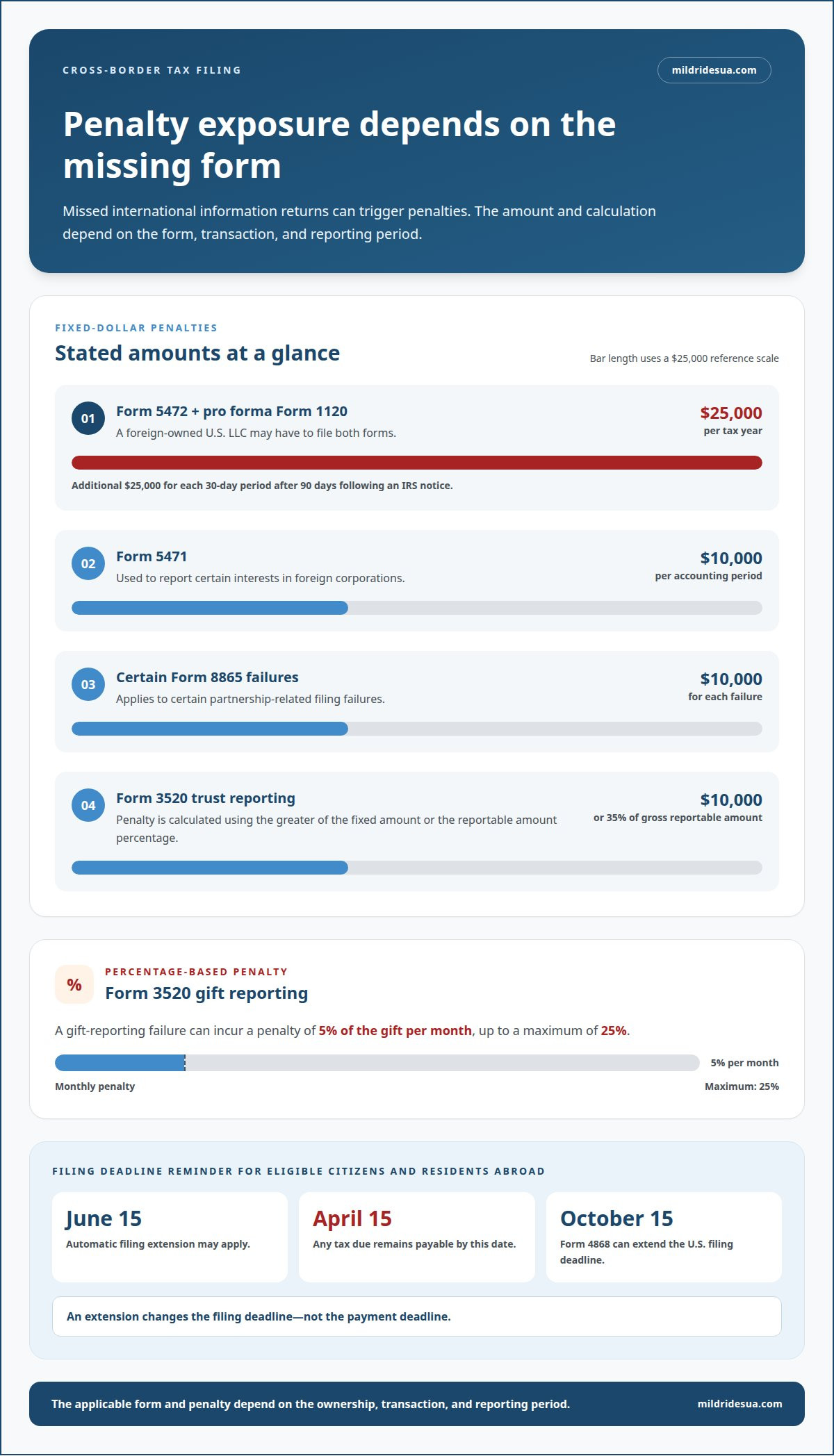
Foreign business ownership deserves particular attention. According to the Internal Revenue Service, a foreign-owned U.S. LLC may have to file Form 5472 with a pro forma Form 1120. A filing error can carry a $25,000 penalty per tax year, plus $25,000 for each 30-day period after 90 days following an IRS notice. The LLC’s ownership and reportable transactions help determine which filings apply.
Another common exposure involves Form 5471, used for reporting certain interests in foreign corporations. Failure to file can result in a $10,000 penalty for each accounting period. A business with several years of missed filings can therefore face multiple penalty assessments. The accountant’s review should connect the company’s ownership records, financial statements, and filing history to the applicable reporting periods.
Partnership and gift reporting can also create consequences. Certain Form 8865 filing failures carry a $10,000 penalty for each failure. A Form 3520 gift-reporting failure can incur a penalty of 5% of the gift per month, up to 25%. Trust reporting under Form 3520 has a separate penalty rule: failure can be penalized at the greater of $10,000 or 35% of the gross reportable amount. The form and penalty depend on the transaction involved.
U.S. citizens and resident aliens living overseas can have U.S. filing obligations alongside obligations in their country of residence. An automatic extension may give eligible citizens and residents abroad until June 15 to file, while any tax due remains payable by April 15. Form 4868 can extend a U.S. expat filing deadline to October 15. An extension changes the filing deadline, not the payment deadline.
When a filing is late or missing, an international tax professional can review the documents, identify affected years, and determine which forms and payment obligations require attention. The IRS generally has until 3 years after an information return is furnished to assess tax on the related return when a covered information return is missing. That timing makes a complete filing history important, especially when earlier years included foreign corporations, partnerships, gifts, or overseas income.
Clear records help an accountant assess the situation. Entity ownership documents, foreign income statements, prior tax returns, and IRS notices can reveal gaps. For example, a change in LLC ownership may affect the information reported on a filing. Addressing an unfiled return or responding to a tax notice calls for a careful review of the relevant forms and deadlines, not simply adding the income to a later return.
FBAR and FATCA reporting
FBAR and FATCA reporting are separate obligations, and one filing doesn’t replace the other. According to the Financial Crimes Enforcement Network (FinCEN), a U.S. person must file an FBAR when the aggregate value of their foreign financial accounts exceeded $10,000 at any time during the year. The FBAR, also known as FinCEN Form 114, reports foreign financial accounts. A tax professional considers account ownership and balances when assessing whether filing applies.
FATCA concerns disclosure of specified foreign financial assets on Form 8938. For an unmarried person living in the United States, Form 8938 reporting generally starts when specified foreign financial assets exceed $50,000 at year-end or $75,000 at any time during the year, according to the Internal Revenue Service. These thresholds differ from the FBAR test, so meeting one filing threshold doesn’t automatically establish whether the other form is required.
The forms also cover different information. An FBAR reports foreign financial accounts, while Form 8938 reports specified foreign financial assets. Depending on the person’s circumstances, an asset may be relevant to one filing, both filings, or neither. A foreign bank account is a useful example: its value can matter for the FBAR test, while the Form 8938 analysis follows its own asset rules and thresholds.
U.S. citizens living or working abroad generally remain subject to U.S. filing obligations, and they may also have tax or return obligations in their country of residence. The Internal Revenue Service says U.S. citizens and residents abroad receive an automatic two-month extension to file, with a June 15 deadline. Foreign earnings and assets still need review under the applicable U.S. reporting requirements.
Filing dates matter, too. An FBAR is due April 15, with an automatic extension to October 15. That timing is separate from the June 15 filing extension for eligible citizens and residents abroad. A tax professional can coordinate the forms and deadlines while reviewing foreign account statements, ownership records, and the taxpayer’s U.S. return.
Can High Point accountants prepare Form 1040, an FBAR, and Form 8938? A tax professional with international reporting experience can prepare or coordinate these filings, assessing how income, residency, account ownership, and asset types affect each form. The return and information filings should be reviewed together so reporting details align.
- Account statements: show account ownership and values relevant to FBAR and FATCA reporting.
- Asset records: help identify which specified foreign financial assets may belong on Form 8938.
- Prior filings: allow the professional to compare earlier reporting with the current situation.
Required FBAR or FATCA reporting failures can result in penalties of up to $10,000 per violation, with higher penalties possible when a failure is deemed willful. A timely review of FinCEN Form 114 and Form 8938 helps identify which reporting obligations apply and keeps the filings connected to the broader U.S. tax return.
Tax treaties and reducing double taxation
Double taxation can arise when the United States and another country tax income connected to both jurisdictions. For example, a U.S. resident working abroad may pay foreign tax on wages while reporting that income on a U.S. return. The Foreign Tax Credit can provide credits for taxes paid to other governments and may help prevent the same income from being taxed twice. Whether it applies depends on the income and foreign tax involved.
A treaty may also affect the treatment of a cross-border tax issue, but it does not automatically apply to every taxpayer. The analysis depends on the treaty provisions, your circumstances, and the income involved. Someone earning consulting income in one country, for instance, may face a different treaty analysis from someone receiving foreign dividends or rental income.
The source of income is an important part of the review. Where work takes place, where property is located, and how income is earned can affect which countries claim taxing rights. A U.S. employee working while living abroad has a different situation from a U.S. business owner earning income through a foreign operation. These distinctions shape the review of returns and potential relief.
Foreign tax credits and treaty provisions are separate tools, not interchangeable labels. A credit addresses foreign taxes paid and may reduce U.S. tax on qualifying income. A treaty can affect the treatment of specific cross-border income or circumstances. An accountant’s analysis should establish which approach fits, whether the income and taxes align, and how the position should appear on the relevant returns.
Records support that analysis. Foreign tax assessments, payment confirmations, wage statements, investment records, and prior returns help connect income to foreign tax paid. For someone with wages and investment income abroad, separating those categories can clarify which taxes relate to each type of income. Currency, payment timing, and income source can also matter when reconciling records across countries.
A coordinated review can reduce errors that occur when foreign filings and U.S. returns are prepared in isolation. If wages reported on a foreign return are omitted from U.S. reporting, the filings may not tell a consistent story. Likewise, treating all foreign taxes as automatically creditable can overlook whether a particular tax and income qualify. The preparer reviews the records and applicable rules before determining the treatment.
For a High Point individual with foreign income, practical advice means a clear explanation of potential relief and its limits. An accountant can compare the income source, foreign tax records, treaty considerations, and U.S. filing position. Rather than assuming a treaty eliminates double taxation, the review can identify whether a credit, treaty provision, or neither addresses your situation.
What international tax services do High Point accountants offer?
International tax work can include U.S. filings, business planning, and reporting for cross-border transactions. The right scope depends on whether the situation is inbound or outbound. Inbound transactions involve foreign taxpayers engaging in U.S. transactions. Outbound transactions involve a U.S. taxpayer engaging in foreign transactions. Each direction can raise different questions about income, ownership, and reporting.
For individuals, an accountant may prepare U.S. returns that account for foreign income and assets. For businesses, the work may include reviewing foreign ownership, related-party dealings, and the tax consequences of operating across borders. A foreign-owned U.S. LLC with revenue under $100K may need international tax compliance support. The entity’s ownership and activity help define the reporting work involved.
Business structure planning is another area of cross-border advice. An accountant can help assess whether a company should establish a foreign branch, subsidiary, or partnership, then consider each option’s tax and reporting implications. For example, a business planning to serve customers overseas can examine how each structure affects its U.S. filings and ongoing accounting needs before choosing a direction.
Related-party transactions can also require analysis. Transfer pricing determines the appropriate price for goods, services, or intellectual property exchanged among related entities. According to the Internal Revenue Service, U.S. transfer pricing rules under IRC §482 apply to cross-border transactions between related parties regardless of business size. An accountant may review transaction details and supporting business records to assess the pricing approach and reporting implications.
Cross-border real estate creates a separate set of considerations. When a foreign person sells U.S. real property, FIRPTA requires buyers to withhold 15% of the gross sale price, according to the Internal Revenue Service. An accountant can help assess the withholding issue and the transaction’s U.S. tax reporting. The sale details and seller’s circumstances inform the work involved.
International tax services may therefore include distinct kinds of support, such as:
- Individual tax preparation: preparing U.S. returns that account for foreign income and relevant tax information.
- Business compliance: reviewing cross-border ownership, transactions, and filing requirements for an entity.
- Planning: evaluating how a proposed foreign branch, subsidiary, or partnership could affect tax and reporting.
- Transaction analysis: assessing transfer pricing or U.S. real estate withholding considerations.
The scope should follow the facts, not a generic international package. A High Point business expanding overseas may need structure and transaction planning, while a foreign owner of U.S. property may need help with withholding and U.S. reporting. An accountant can organize the work around the taxpayer, entity, income, and transaction involved.
Mildrid Esua, CPA, PLLC: Accountant & Tax Advisor for Small Businesses
Mildrid Esua, CPA, PLLC provides International Tax Services for individuals and small businesses with cross-border tax questions. The firm’s small-business accounting support includes tax planning and preparation, bookkeeping, and IRS representation. Turn to the firm when foreign income, overseas business activity, or reporting concerns need to be considered alongside U.S. tax obligations.
For a business owner, connecting tax preparation with bookkeeping can bring financial records and filing decisions into clearer focus. For individuals, international tax support can help assess cross-border tax matters and related reporting. Contact Mildrid Esua, CPA, PLLC to discuss your international tax needs.
Build a clearer path for future cross-border decisions
International tax planning is most useful when it informs decisions before they become filing questions. A new overseas contract, investment, or business arrangement can change what information matters and how a U.S. tax position should be prepared. Working with an international tax accountant in High Point can connect those decisions to future reporting, rather than treating each return as an isolated task.
For your first conversation, focus on upcoming cross-border activity, not only the forms already filed. Explain what has changed, what you’re considering, and where income or ownership crosses borders. This context helps shape a practical discussion about the appropriate tax work and the records needed to support it.
If you’re ready to discuss your situation, contact Mildrid Esua, CPA, PLLC. A considered next step can bring greater clarity to your international tax decisions.
Frequently Asked Questions
What is cross-border tax advice, and when do I need it?
Cross-border tax advice connects U.S. tax decisions with income, assets, or business activity involving another country. It may be useful before accepting a foreign job, changing where you live, investing overseas, or forming an entity abroad. For example, an employee receiving compensation from a foreign employer may need advice on how that income and its records fit into U.S. filings. Getting guidance before a change can support coordinated planning.
Who actually needs an international tax accountant?
People and businesses with international financial connections may benefit from specialized tax support. Examples include a U.S. resident with overseas investments, an individual receiving foreign rental income, or a small business entering a foreign market. A foreign owner involved in U.S. real estate may also face U.S. tax considerations. The relevant work depends on income, ownership, and transactions, not simply on whether someone lives abroad.
What can a missed international form cost?
The consequences depend on the form, the type of reporting failure, and the circumstances. A missed information return may lead to a penalty, follow-up correspondence, and additional work to reconstruct records or address affected filings. For example, missing ownership details can complicate a company’s filing history. Organizing prior returns, entity records, and notices promptly helps an accountant assess the exposure and identify an appropriate response.
What is the difference between an international tax specialist and a regular CPA?
A CPA credential establishes professional status, while international tax experience reflects the types of cross-border matters an accountant handles. A routine domestic return may not involve foreign entities, overseas investments, or international reporting. Taxpayers with these issues benefit from an adviser who can explain how the relevant facts affect U.S. filings and planning. The key is finding a professional whose experience fits your circumstances.
What should you ask, and what are the red flags?
Clarify which tax years, returns, and information filings the engagement covers, and how the accountant will handle missing records or prior notices. A sound explanation should connect the work to your income, ownership, and transactions. Red flags include treating every foreign tax payment as automatically creditable, overlooking business ownership details, or promising a particular tax result before reviewing the facts. Clear scope and reasoned explanations support informed decisions.
Who are international tax accountants in High Point, North Carolina?
Mildrid Esua, CPA, PLLC provides International Tax Services, tax planning, and preparation for individuals and small businesses. For a High Point taxpayer, a useful starting point is the cross-border issue, such as foreign income, overseas business activity, or a U.S. transaction involving a foreign owner. The firm also provides small-business accounting and IRS representation for related business or tax-resolution needs.
Can a High Point tax accountant help with foreign business ownership, trusts, or investments?
An accountant can assess how foreign ownership, trust interests, or overseas investments affect U.S. reporting and tax planning. For example, a business owner with an interest in a foreign entity may need the ownership structure reviewed alongside company records and transactions. Investment documents can help distinguish asset types. The specific analysis depends on the taxpayer’s role, the entity or asset involved, and the relevant reporting history.
How do High Point international tax accountants compare in experience, credentials, and reviews?
Compare relevant international tax experience with the issues you need addressed, then consider professional credentials and how clearly the accountant explains the work. Mildrid Esua, CPA, PLLC is a CPA firm offering international tax services. Reviews can offer perspective on communication and client experience, but they do not establish expertise in a particular cross-border issue. Look for a clear explanation of how the professional’s experience aligns with your circumstances.




Leave a Reply
Your email is safe with us.