

The business structure that minimizes taxes today may not fit the company you’re building for tomorrow. Entity selection tax advice starts with a practical rule: compare how each structure is taxed, how it affects personal liability, and whether it supports your growth plans. An LLC can provide limited liability and pass-through taxation, while a C corporation pays tax at the corporate level and shareholders may also owe tax on dividends.
It’s reasonable to focus on the tax bill, but the right choice also shapes ownership, administration, and access to investment. This guide explains how sole proprietorships, partnerships, LLCs, S corporations, and C corporations differ, when an LLC may suit your business, and when C corporation status may align with future plans. You’ll also see why it’s worth revisiting the decision as your business grows, changes ownership, or prepares to raise capital.
Key Takeaways
- Compare tax treatment alongside liability protection, administrative demands, ownership plans, and growth goals.
- An LLC can provide a flexible starting point, but its tax classification influences how business income is reported and taxed.
- Consider a C corporation when investment plans or future stock offerings align with its structure, while weighing potential taxation at both the corporate and shareholder levels.
- Match liability protection to your business risks: sole proprietors and general partners can face personal exposure for business debts.
- Revisit your entity choice as the business evolves, since ownership, operations, and long-term plans can change the best fit.
What factors should I consider when selecting an entity type?
Compare each business entity’s income tax treatment, liability exposure, administrative demands, and fit with your growth plans. Your goals, industry practices, risk tolerance, and ownership plans can point to different structures.
For a concise comparison of LLC, S corporation, and C corporation tax considerations, watch this video:
Entity Choice for Widely Held Businesses
A widely held business has ownership distributed among multiple investors, sometimes through publicly traded shares. Its entity type matters because investor expectations, stock options, and plans to raise capital can shape its practical choices.
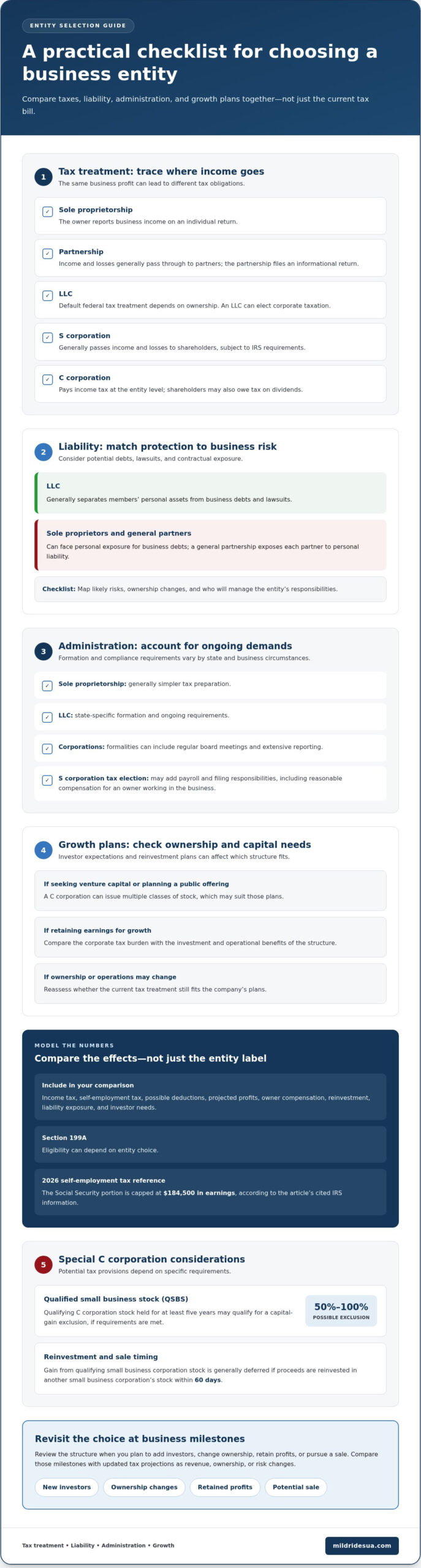
A C corporation can issue multiple classes of stock, which may suit a company seeking venture capital or preparing for a public offering. Qualified small business stock (QSBS) may offer a significant tax consideration: qualifying C corporation stock held for at least five years may qualify for a capital-gain exclusion of 50% to 100%, if requirements are met. A sale’s tax treatment may also depend on reinvestment: gain from qualifying small business corporation stock is generally deferred if proceeds are reinvested in another small business corporation’s stock within 60 days.
Modeling Choices Against Business Goals
Modeling compares the tax and operational effects of each entity type against the company’s plans. It matters because projected profits, owner compensation, reinvestment, liability exposure, and investor needs can change which structure best supports the business.
Compare how income tax, self-employment tax, and possible deductions affect funds available to owners or the company. Section 199A eligibility can depend on entity choice. For 2026, the Social Security portion of self-employment tax is capped at $184,500 in earnings, according to the Internal Revenue Service. Use business projections to compare current distributions with earnings retained for growth, then revisit the assumptions as revenue, ownership, or risk changes.
Formation and Ongoing Compliance Costs
Formation and compliance costs include the filing, recordkeeping, and reporting required to start and maintain an entity. These demands matter because administrative work affects a business’s budget and owners’ capacity to manage operations.
There is no single formation or annual compliance cost that applies to every entity type; state requirements and business circumstances affect the total. Sole proprietorships generally involve simpler tax preparation, while partnerships file an informational return. LLCs face state-specific formation and ongoing requirements. Corporations must manage formalities such as regular board meetings and extensive reporting, which add administrative work.
Consider operational risk alongside those demands. An LLC generally separates members’ personal assets from business debts and lawsuits, while a general partnership exposes each partner to personal liability. A business with higher contractual or legal exposure may weigh that distinction differently from a low-risk solo operation. Map likely risks, ownership changes, and administrative responsibilities before choosing.
Reassess the structure when the business plans to add investors, change ownership, retain profits, or pursue a sale. For example, an LLC’s original tax treatment may no longer fit a venture capital plan or potential public offering. Comparing these milestones with tax projections helps owners identify when their current entity type may need to evolve.
When is the right time to change an existing business from an LLC to a C-Corporation?
A move may make sense when the company’s capital, ownership plans, or reinvestment strategy no longer fit its current tax treatment. Compare the corporate tax burden with the investment and operational benefits before changing the structure.
Tax Treatment Across Entity Types
Tax treatment describes how business income and losses reach owners or are taxed within the business. It matters because the same profit can produce different tax obligations under different structures.
A sole proprietor reports business income on an individual return; a partnership generally passes income and losses to its partners. An LLC’s default federal tax treatment depends on its ownership, but it can elect corporate taxation. An S corporation generally passes income and losses to shareholders, subject to IRS requirements. A C corporation pays income tax at the entity level, and shareholders may pay tax again on dividends.
LLC Pass-Through and Corporate Taxation
Pass-through taxation generally means the LLC’s taxable income is reported by its owners rather than taxed at the corporate level. An LLC can also elect C corporation tax treatment, a relevant option when the business wants to retain earnings or attract investors.
An LLC taxed as an S corporation may let an owner who works in the business take a reasonable salary, then receive remaining profits as distributions that aren’t subject to self-employment tax. The trade-off is added payroll and filing responsibilities, along with the requirement to pay reasonable compensation. This election may be advantageous when projected tax savings justify the extra administration; it isn’t automatically beneficial for every owner.
For example, a C corporation with $1 million in profit pays $210,000 in federal income tax in the cited example. If the remaining $790,000 is distributed as a dividend taxed at 20%, shareholders owe another $158,000, leaving $632,000 after those taxes. Retaining earnings can defer shareholder-level dividend tax until distribution, but it doesn’t remove the potential second layer of tax.
When to Seek Professional Advice
Professional advice means reviewing tax, ownership, and legal consequences with a CPA or tax attorney before making an entity election or conversion. It matters most when investment, sale, or compensation plans could change the tax result.
Seek that analysis before accepting investor capital, issuing stock options, changing owner compensation, or converting an LLC. An S corporation has ownership restrictions, while a C corporation can support multiple stock classes and broader investment plans. Compare projected taxes, retained earnings, compliance responsibilities, and conversion consequences together, rather than choosing by tax rate alone.
A focused small business tax planning review can help connect the entity decision with projected income and owner compensation. Revisit the analysis when ownership or growth plans shift, rather than relying on an election made for an earlier stage of the business.
Choosing an entity based on liability protection and tax considerations
Compare liability exposure with how each structure handles income, losses, and owner distributions. The right choice depends on business risks, tax goals, and the owners’ roles in daily operations.
LLC Liability Protection and Tax Flexibility
An LLC generally separates members’ personal assets from company debts and lawsuits while offering choices in federal tax treatment. That combination matters when owners want a liability boundary without locking the business into one tax classification.
An LLC can be taxed as a partnership or elect corporate tax treatment, including S corporation or C corporation treatment. For example, a member-managed LLC may value pass-through taxation, while an LLC planning to retain earnings may compare corporate treatment. Tax flexibility doesn’t itself create stronger liability protection; these are separate aspects of the business structure.
Assess both sides independently. List the business’s main exposure, such as customer claims, debt obligations, or contractual disputes, then identify who owns and manages the company. An advisor can compare the likely tax treatment with how each entity assigns responsibility. This avoids choosing an entity solely because its tax label sounds favorable.
- Liability: Identify which owners could be personally responsible for business obligations under the proposed structure.
- Tax: Compare pass-through income with corporate taxation and consider whether profits will be distributed or retained.
- Operations: Review who controls decisions, signs agreements, and bears management responsibilities.
Liability Protection by Entity Type
Liability protection varies by entity type and the owners’ roles, so compare legal exposure separately from tax treatment. This distinction matters because two businesses with similar profits can place different responsibilities on their owners.
A general partnership makes each partner personally liable for business debts. In a limited partnership, general partners have personal liability, while limited partners generally have liability limited to their investment and usually don’t manage daily operations. An LLC generally separates members’ personal assets from company obligations. Corporations, including S corporations, combine corporate legal protection with their applicable tax treatment.
Restructuring may be worth evaluating when the current arrangement no longer matches the company’s risk or management needs. For instance, partners who want limited partners to invest without daily control may compare a limited partnership with an LLC. A business moving from a partnership to an LLC should consider both the liability structure and the tax consequences.
Before restructuring, map owners, management duties, business debts, and the tax treatment of income. Then compare how each entity handles those specific features. Limited liability is a structural consideration, not a substitute for examining contracts, ownership responsibilities, and the company’s actual exposure. This comparison gives owners a practical basis for choosing protection and taxation together.
What is the main benefit of choosing an LLC over a sole proprietorship?
An LLC generally separates members’ personal assets from business debts and lawsuits, while a sole proprietorship doesn’t create that liability boundary. Entity choice also affects how owners report income, allocate ownership, and pursue fundraising.
Sole Proprietorship Liability and Taxation
A sole proprietorship is an unincorporated business owned by one individual, with business activity reported on the owner’s personal tax return. This arrangement can simplify tax preparation, but it doesn’t separate the owner’s personal assets from business obligations.
The owner reports business income and expenses on IRS Form 1040, Schedule C. Business losses also flow into the individual’s tax picture, subject to applicable tax rules. For example, a consultant operating alone may value simple reporting, but should weigh that against personal exposure if the business faces debt or a lawsuit.
LLC Taxation and Liability Protection
An LLC is a state-created business structure that generally provides limited liability and can use different federal tax classifications. This matters because owners can consider liability protection separately from how income is taxed.
A single-owner LLC is generally treated as a sole proprietorship for federal income tax unless it elects another classification. A multi-owner LLC is generally treated as a partnership by default and can elect corporate tax treatment. The LLC’s legal structure and tax classification are related decisions, but they aren’t the same choice.
For example, an LLC can retain its legal form while electing S corporation tax status. That may change how owners receive compensation and how remaining profits are treated. Owners who work in the business must consider reasonable salary requirements and payroll responsibilities when evaluating potential self-employment tax effects.
Taxation of Income, Losses, and Distributions
Taxation of income, losses, and distributions depends on whether a business passes results through to owners or pays tax as a corporation. This distinction matters when owners plan to withdraw profits, retain capital, or bring in investors.
Federal C corporation income tax is 21%, while individual federal rates on pass-through income can reach 37% or more. These figures don’t settle the comparison: eligible pass-through owners may qualify for deductions, while dividends from a C corporation can face a second tax at the shareholder level.
Venture capital plans can also affect the choice. Investors often prefer C corporations because they can issue multiple classes of stock, while an LLC’s ownership flexibility may better suit a closely held business. Compare expected income, losses, distributions, liability exposure, and fundraising plans together. This side-by-side analysis helps owners judge whether an LLC’s protection and tax flexibility suit their next stage.
Legal and tax considerations in entity selection
Entity selection affects legal responsibilities, federal tax treatment, and state obligations. Careful entity selection tax advice compares these factors before a business forms or changes its tax classification.
State Tax Considerations
State tax considerations include taxes and filing rules that apply where a business operates. They matter because state treatment can differ from federal rules and change the company’s overall tax picture.
For example, some states impose entity-level taxes on S corporations, while others may not recognize S corporation status. A business operating across state lines may also have filing obligations in multiple states, depending on its activities and applicable rules. Review the states where the business has employees, property, or customers, then compare their entity-specific taxes and filing requirements.
State law also shapes the legal structure. An LLC is a business structure authorized by state statute, so formation and ongoing requirements depend on the state. Owners should compare applicable state rules with federal tax treatment before selecting an entity, particularly if the business operates in multiple states.
Federal and State Tax Elections
Federal and state tax elections determine how an eligible entity is taxed without necessarily changing its legal structure. This distinction matters because an LLC can elect corporate tax treatment while remaining an LLC under state law.
To form an entity, choose a structure and state, then complete the required state formation filing. Next, identify the federal tax classification and elections that fit the ownership and income plans. An S corporation must meet IRS criteria and affirmatively elect that tax treatment. State filings or elections may also apply.
For calendar-year taxpayers, an entity tax election is generally due by March 15, according to the Internal Revenue Service. The Internal Revenue Service says an S corporation in the United States can have up to 100 stockholders. These requirements make ownership, election timing, and state treatment practical formation considerations, not paperwork details to leave until operations begin.
Tax treatment also influences owner compensation and cash planning. According to the Internal Revenue Service, self-employment tax is 15.3% for sole proprietors and partners, with the Medicare portion applying to 92.35% of active income. An S corporation election brings different compensation considerations for owners who work in the business. Compare projected income, owner wages, distributions, and state obligations. For entity selection tax advice, align those projections with the business’s formation and operating plans.
Review formation and election choices with small business tax planning so the legal structure and tax treatment support the same operating plan.
Mildrid Esua, CPA, PLLC: Tax Planning & Tax Preparation, Bookkeeping, IRS Representation, Small Business Accounting, Tax Resolution, Unfiled Tax, Tax Lien, Payroll Services
Mildrid Esua, CPA, PLLC helps small business owners connect entity decisions with tax planning, preparation, bookkeeping, and business formation. Turn to the firm when choosing a structure, considering an S corporation election, or reassessing how your business reports income and manages owner compensation.
As your operations develop, small business accounting and bookkeeping can help you maintain records that support tax preparation and ongoing planning. The firm also provides payroll services and IRS representation, including tax resolution support for unfiled returns and tax liens. If back taxes or an IRS issue complicates your business decisions, tax resolution services and back-tax relief are relevant areas of support.
For guidance tailored to your business structure and tax priorities, contact Mildrid Esua, CPA, PLLC or visit mildridesua.com.
Build an Entity Strategy That Can Grow With You
Your entity choice is not a one-time administrative decision. Treat it as part of your business’s ongoing governance: revisit it when ownership changes, investment plans develop, or the way you use profits shifts. A deliberate review can help keep tax planning aligned with the company you are building, rather than the company you started.
Thoughtful entity selection tax advice can turn those changes into a structured decision, connecting tax planning with preparation, bookkeeping, and your business’s operating needs. Mildrid Esua, CPA, PLLC also provides small-business accounting and tax resolution services, supporting owners as they address forward planning and existing tax matters.
Take the next step by discussing your business’s direction and priorities with Mildrid Esua, CPA, PLLC. Contact the firm about entity selection and move forward with a clearer plan for your company’s next stage.
Frequently Asked Questions
How do different business structures impact my taxes?
Business structure affects who reports taxable income, where it is taxed, and how owners handle business losses. A sole proprietor reports business activity on an individual return, while a C corporation pays tax at the company level. For example, a business deciding whether to distribute or retain profits should compare the tax consequences of each approach alongside its cash needs and future investment plans.
What are the advantages and disadvantages of popular entity types?
Popular entity types balance owner liability, tax treatment, and administrative responsibilities differently. A sole proprietorship offers straightforward reporting but leaves the owner personally exposed to business obligations. An LLC can separate members’ personal assets from company liabilities and offers tax flexibility. Corporations may suit businesses seeking outside capital, while general partners face personal liability. A founder should weigh these trade-offs against ownership and operating plans.
What is the biggest tax difference between an S-Corporation and a C-Corporation?
The central difference is how business income is taxed: an S corporation generally passes income and losses to shareholders, while a C corporation pays tax at the company level. C corporation shareholders may also owe tax on dividends. An S corporation shareholder who works for the business must receive reasonable compensation. Owners comparing the two should consider whether profits will be distributed, retained, or used to fund expansion.
Why Change Entity?
Change an entity when the current structure no longer supports the business’s ownership, financing, risk, or tax plans. For example, a company preparing to seek venture capital may consider a structure that supports multiple classes of stock. A change in owners or plans to retain earnings can also prompt a review. Compare the intended strategic benefit with conversion effects, tax treatment, and new compliance responsibilities.
What business entity types are available in the United States?
Common business forms in the United States include sole proprietorships, partnerships, corporations, and S corporations. An LLC is another state-authorized structure, and its federal tax classification may differ from its legal form. Limited partnerships distinguish between general partners, who manage the business and face personal liability, and limited partners, who generally have limited liability. The right comparison depends on ownership and management plans.
How does entity choice affect federal income tax and self-employment tax?
Entity choice affects whether business income is reported by owners or taxed at the business level, and whether owner earnings are subject to self-employment tax. According to the Internal Revenue Service, self-employment tax is 15.3% for sole proprietors and partners, with the Medicare portion applying to 92.35% of active income. Owners considering an S corporation election should also account for reasonable compensation and payroll responsibilities.
What are the eligibility rules and deadlines for electing S corporation tax status?
An entity must meet IRS eligibility criteria and affirmatively elect S corporation tax treatment. According to the Internal Revenue Service, an S corporation in the United States can have up to 100 stockholders. For calendar-year taxpayers, the election is generally due by March 15, according to the Internal Revenue Service. Ownership plans matter, so assess stockholder eligibility and the proposed ownership structure before making the election.
How do state taxes, franchise taxes, and annual fees vary by business entity and state?
State tax obligations and recurring entity fees depend on the state, business activities, and chosen structure. A business based in Greensboro should include North Carolina requirements in its projections and review obligations in any other state where it operates. Compare income taxes, franchise taxes, annual fees, and filing duties for each candidate entity. The resulting state-level costs can affect which structure best supports the company’s operating plans.




Leave a Reply
Your email is safe with us.