


Could your FIRPTA withholding be far larger than the U.S. tax you ultimately owe? For some foreign sellers, withholding based on a property’s gross sale price may exceed the tax due on the actual gain. FIRPTA withholding certificate help can clarify whether applying to reduce or eliminate withholding may fit your circumstances. A certificate isn’t automatic, and timing matters.
If you’re concerned about the amount withheld or unsure how to prepare an application, plan before closing. Form 8288-B asks the IRS to determine an appropriate withholding amount, and supporting tax and transaction records help explain the request. The buyer also has withholding responsibilities, so coordinate the application with the closing timeline.
This guide explains when a certificate may be worth pursuing, what the application process involves, which documents to prepare, and how IRS processing time can affect your plans. Mildrid Esua, CPA, PLLC provides specialized FIRPTA and international tax guidance for sellers in Greensboro, High Point, Burlington, Kernersville, Jamestown, Oak Ridge, Summerfield, Winston-Salem, and surrounding North Carolina communities.
Key Takeaways
- A FIRPTA withholding certificate may adjust the amount withheld, but it doesn’t guarantee an exemption or a particular IRS decision.
- Understand how Form 8288-B fits into the sale timeline and plan for preparing and tracking an application.
- Compare standard withholding with a certificate application based on the transaction facts, estimated tax position, available evidence, and timing.
- Organize transaction and tax records, then check that the details are consistent before submitting a well-supported application.
- FIRPTA withholding certificate help from a CPA can bring structure to the tax analysis and application preparation before closing.
What FIRPTA withholding certificate help can, and cannot, do
For a seller, the concern is straightforward: the amount withheld from the sale proceeds at closing may not match the U.S. tax ultimately owed. Under the Foreign Investment in Real Property Tax Act of 1980 (FIRPTA), withholding is generally collected when a foreign person disposes of a U.S. real property interest. The general withholding rate is 15% of the gross sales price, although exceptions and other rates may apply.
A withholding certificate is an IRS determination that may adjust the amount required to be withheld for a transaction. It does not decide the seller’s final tax bill or, by itself, remove tax-filing responsibilities. Withholding is collected at the sale, while the seller’s eventual U.S. tax is determined through the applicable tax calculation and return.
For a high-level introduction to how the withholding process works, watch this overview:
When might a seller seek a certificate?
A seller may consider applying when standard withholding appears higher than the estimated U.S. tax on the sale, or when transaction-specific facts may support reduced or zero withholding. The analysis can involve the expected gain, the seller’s tax position, and details such as the property, ownership, and sale terms. A certificate request asks the IRS to assess the evidence; it does not guarantee a reduction or approval. Review each transaction on its own facts.
Does a certificate eliminate the seller’s tax obligations?
No. A certificate addresses withholding at the transfer, not the seller’s final reporting obligations. The buyer, or another party acting as withholding agent, generally has responsibility for withholding and related FIRPTA reporting and payment. The seller may still need to report the disposition on an applicable U.S. tax return, calculate the actual tax, and claim any allowable refund if too much was withheld. The final result depends on the seller’s facts and tax position.
Cross-border property sales can also raise questions beyond the closing calculation. Coordinating the certificate analysis with the seller’s broader U.S. tax picture helps keep the closing-stage request and later reporting aligned.
How Form 8288-B fits into a FIRPTA property sale
Form 8288-B is the IRS application used to request a withholding certificate for a FIRPTA transaction. It gives the IRS information to evaluate whether the amount withheld should be adjusted. The application is one part of the sale process, so coordinate the seller’s tax position with the closing arrangements.
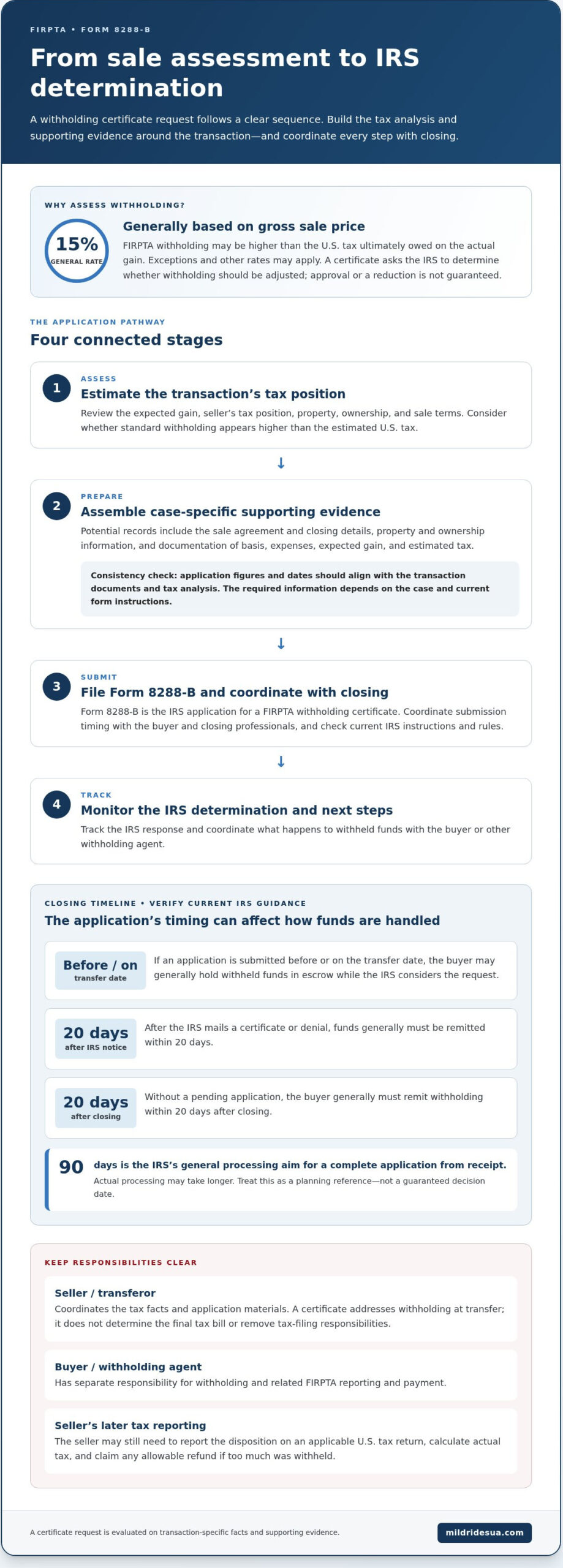
A practical sequence is: assess the transaction, assemble supporting evidence, submit Form 8288-B, and track the IRS determination. The seller or transferor generally coordinates the tax facts and application materials. The buyer, as withholding agent, has separate responsibilities for withholding and remitting tax. Review the IRS FIRPTA withholding rules and the current Form 8288-B instructions to confirm the requirements that apply to the transaction.
What information and documents may support the application?
The application’s supporting information should explain the transaction and the requested withholding amount. Depending on the facts, useful records may include the sale agreement and closing details, property information, ownership records, and documentation of basis, expenses, expected gain, and estimated tax. This is a guide to potential evidence, not a universal IRS document checklist. The required information depends on the case and current form instructions.
Check that the figures and dates in the application align with the transaction documents and tax analysis. A CPA can help organize the calculation and supporting records so the request clearly explains how the seller arrived at the requested amount.
How does the application interact with closing?
Timing can affect how withheld funds are handled. Under current IRS guidance, when an application is submitted before or on the transfer date, the buyer may generally hold the withheld funds in escrow while the IRS considers the request. After the IRS mails a certificate or denial, the funds generally must be remitted within 20 days. Without a pending application, the buyer generally must remit withholding within 20 days after closing. Confirm these rules and deadlines against current IRS guidance before relying on them.
The IRS generally aims to process a complete application within 90 days of receipt, but actual processing may take longer. Treat that period as a planning reference, not a guaranteed decision date. Early coordination among the seller, buyer, closing professionals, and tax adviser can help align submission, escrow arrangements, and closing expectations.
Application sequence, with timing to verify:
- Assess: Review the sale and estimate the relevant tax position.
- Prepare: Gather transaction details and case-specific supporting records.
- Submit: File Form 8288-B according to the current instructions and timing rules.
- Track: Monitor the IRS determination and coordinate next steps with the withholding agent.
Mildrid Esua, CPA, PLLC provides FIRPTA withholding guidance to help sellers organize the tax analysis and application evidence. Explore FIRPTA withholding guidance as you plan for closing.
FIRPTA certificate or standard withholding: how to assess the situation
The choice isn’t simply between paying tax and avoiding it. Standard withholding follows the applicable FIRPTA rules, while a withholding certificate asks the IRS to determine whether a different amount is appropriate for the specific transaction. A pending request is not an approval. The seller and buyer should not treat a proposed reduction as authorized unless the relevant IRS determination and instructions support that treatment.
Compare the practical implications of each path, then assess the transaction’s facts and timing. The IRS’s Form 8288-B application page provides official information about requesting a certificate.
| Consideration | Standard withholding | Seeking an IRS certificate |
|---|---|---|
| Basis for the amount | Withholding is calculated under the rules that apply to the transfer. | The seller asks the IRS to determine whether withholding should be adjusted based on the application and supporting facts. |
| Preparation | The parties coordinate the transaction details and withholding process. | The seller prepares an application with relevant tax and transaction evidence; the buyer’s withholding-agent duties remain separate. |
| Timing consideration | Applicable withholding and remittance obligations follow the transaction schedule. | The IRS may not decide the request before transfer, so the parties need a plan for a pending application. |
| Outcome | Withholding is handled under the applicable standard rules. | A reduction depends on the IRS determination. Applying alone doesn’t authorize one. |
When might an application merit professional review?
Review may be warranted if the expected withholding appears out of proportion to the seller’s anticipated tax liability. That’s a reason to examine the numbers, not a promise that the IRS will reduce withholding. Ownership structure, the property’s use, adjusted basis, sale terms, and other transaction details can change the analysis. FIRPTA withholding certificate help can organize these facts and identify what evidence supports the request before the seller chooses a course of action.
What if the certificate is not issued before transfer?
A delayed decision doesn’t automatically suspend the buyer’s responsibilities. Under current IRS guidance, if Form 8288-B is submitted before or on the transfer date, the buyer may generally hold the withheld amount in escrow while the IRS considers the application. If no timely application is pending, withholding and remittance requirements may apply on the usual schedule. Confirm current instructions and deadlines for the specific transfer; don’t assume a request alone changes the buyer’s obligations.
If withholding is remitted, the seller may later report the sale on an applicable U.S. tax return and claim any refund due based on the final tax calculation. A refund isn’t automatic, and the outcome depends on the facts and filing. Preserve the closing statement, sale documents, basis records, IRS correspondence, and proof of withholding. A tailored review can help align the closing record with subsequent tax reporting. Mildrid Esua, CPA, PLLC provides FIRPTA withholding guidance to help sellers assess the facts and plan next steps.
Prepare a stronger FIRPTA withholding certificate application
A well-organized application starts with a reliable account of the sale, ownership, and expected tax position. Before drafting Form 8288-B, identify the anticipated transfer date and confirm the current IRS submission instructions, required information, and processing guidance. Build the application schedule around verified requirements rather than assumptions, since timing can affect how the request fits into closing.
The records below are useful preparation categories, not a universal IRS checklist. The documents required for a particular application depend on its facts and the current form instructions.
Build a transaction file before drafting
Gather records that establish who owns the property, how it was acquired, and what the sale terms provide. Note the transfer date and the people coordinating the closing so the application timeline can be discussed early.
- Transaction documents: Purchase and sale agreements, amendments, and available closing information.
- Ownership and taxpayer details: Ownership records and identification information requested by the current IRS instructions.
- Property and cost records: Documents that may substantiate acquisition cost, improvements, and other relevant property expenses.
- Closing coordination: The anticipated transfer date and contact details for the buyer, closing professionals, and tax adviser.
Check the application instructions for the taxpayer identification information and supporting documents required for the seller’s circumstances. Collecting records before drafting makes it easier to identify gaps while there’s still time to address them.
Review calculations and submission details
Reconcile the expected sale proceeds, adjusted basis, and relevant transaction costs using substantiated records. The tax analysis should explain how the figures support the requested withholding determination. Don’t rely on rough estimates when source documents are available, and don’t assume that every expense reduces the taxable gain.
Before submission, compare each form entry with the supporting documents. Names, ownership details, dates, sale figures, and calculations should align. Confirm the current IRS filing method and timing instructions against the applicable form guidance, then retain a complete copy of the submission and evidence of delivery.
- Keep copies of the completed application and supporting records.
- Save proof of submission and all IRS correspondence.
- Preserve closing documents and the final transaction statement for later tax reporting.
Complete, internally consistent information gives a tax adviser a clearer basis for reviewing the request and identifying questions before filing. It cannot guarantee a particular IRS decision, but a disciplined file supports a more focused analysis. For broader context, read our article on international real estate tax and FIRPTA basics alongside this application checklist.
For professional support organizing the tax analysis and application records, get FIRPTA withholding application guidance from Mildrid Esua, CPA, PLLC.
Get FIRPTA withholding certificate help from a North Carolina CPA
A FIRPTA certificate request brings together a property transaction, a tax calculation, supporting evidence, and a closing timeline. CPA guidance can help organize those pieces, assess whether the records support the requested withholding determination, and identify questions to address before the transfer. It can also keep the certificate analysis connected to the seller’s broader U.S. tax filing responsibilities.
Mildrid Esua, CPA, PLLC provides international tax services, including FIRPTA withholding guidance. Sellers in Greensboro, High Point, Burlington, Kernersville, Jamestown, Oak Ridge, Summerfield, Winston-Salem, and surrounding North Carolina communities can get help with the U.S. tax considerations involved in a cross-border property sale. Federal FIRPTA rules govern the transaction regardless of the property’s location.
What can professional FIRPTA application support involve?
Support may begin with reviewing the ownership and sale facts, then identifying the tax records relevant to the application. A CPA can help reconcile the estimated tax position with transaction documents, organize information for the current form instructions, and map key dates around closing. Depending on the engagement, assistance may also include coordinating form preparation, IRS correspondence, and communication with closing participants. No review can guarantee IRS approval, a particular processing time, or a reduced withholding amount.
What should a seller do next?
Start with a concise file: the anticipated closing date, sale documents, ownership details, and prior property records. Add a short summary of how the property is held and the seller’s U.S. tax circumstances, including any relevant filing history or identification details. These materials give the tax adviser a practical foundation for reviewing the transaction and identifying what may still be needed.
Sellers with questions beyond the certificate, such as reporting income or property interests across borders, can also explore the firm’s global tax services article for broader context. Addressing connected obligations alongside the sale can help create a more complete planning picture.
Because application timing can affect closing coordination, begin the discussion before the transfer date. Discuss FIRPTA withholding certificate help with Mildrid Esua, CPA, PLLC and bring your transaction details into a focused review.
Plan Your FIRPTA Steps Before Closing
A FIRPTA withholding certificate may help align the amount withheld at closing with the seller’s tax circumstances, but it’s an IRS determination, not an automatic reduction or a substitute for required U.S. tax filings. The application depends on transaction facts, supporting records, and timing. Preparing early can help sellers make informed decisions and coordinate with the buyer and closing team.
Thoughtful FIRPTA withholding certificate help also considers the wider cross-border picture. Mildrid Esua, CPA, PLLC provides FIRPTA withholding and international tax services, along with tax planning and compliance guidance for complex circumstances. A clear review can help organize the tax analysis and application evidence without promising a particular IRS outcome.
If a U.S. property sale is approaching, start by gathering the expected closing date, sale documents, ownership information, and relevant property records. Then discuss your FIRPTA withholding certificate needs with the firm before closing. With a considered plan and professional guidance, you can approach the process with greater clarity.
Frequently Asked Questions
What is a FIRPTA withholding certificate?
A FIRPTA withholding certificate is an IRS determination that may reduce or eliminate the amount withheld from a qualifying U.S. real estate transfer. The seller requests the determination by submitting Form 8288-B with relevant transaction and tax information. It addresses withholding at the time of sale, not the seller’s final U.S. tax bill. The seller may still need to report the transaction on an applicable U.S. tax return.
Can a foreign seller apply for a FIRPTA withholding certificate?
Yes. A foreign seller may apply for a certificate related to a U.S. real property disposition by filing Form 8288-B, provided the request meets applicable IRS requirements. The seller needs a U.S. taxpayer identification number, such as an ITIN, to file; a seller without one generally applies using Form W-7. Eligibility for a reduced withholding amount depends on the transaction facts and supporting tax analysis, not simply foreign status.
How do I apply for a FIRPTA withholding certificate?
Start by reviewing the sale, ownership, and estimated tax position, then complete Form 8288-B using the current IRS instructions. Assemble supporting records that substantiate the transaction details and explain the requested withholding amount. Check that names, dates, sale figures, and calculations agree across the form and attachments. Submit the application as instructed and retain proof of submission and IRS correspondence. FIRPTA withholding certificate help can support this preparation without guaranteeing an IRS decision.
When should I submit Form 8288-B before closing?
Prepare and submit the application as early as practical, allowing time to assemble complete evidence and coordinate with the buyer and closing team. There isn’t a universal lead time that guarantees an IRS decision before closing. The IRS generally aims to process a complete application within 90 days of receipt, but actual timing can vary. Under current guidance, submitting before or on the transfer date may affect how the buyer handles withheld funds while the request is pending.
What happens if the IRS has not decided before the property sale closes?
If Form 8288-B was submitted before or on the transfer date, the buyer may generally hold the withheld funds in escrow while awaiting the IRS determination. After the IRS mails a certificate or denial, the funds generally must be remitted within 20 days. If no timely application is pending, the usual withholding and remittance rules may apply. Confirm current IRS procedures, and keep closing records for the seller’s later tax filing.
Does a FIRPTA withholding certificate eliminate U.S. tax on the sale?
No. A certificate determines whether withholding at the transfer should be adjusted; it doesn’t itself erase tax on the sale or replace the seller’s U.S. filing obligations. The final tax calculation depends on the seller’s circumstances and applicable tax rules. The seller may still need to report the disposition on an applicable U.S. return, calculate the tax due, and reconcile that amount with any withholding already paid to the IRS.
Can FIRPTA withholding be more than the final tax due?
Yes. FIRPTA withholding is generally calculated using the gross sales price, while the seller’s final U.S. tax is determined through a separate tax calculation that considers the transaction’s relevant facts. As a result, withholding can exceed the tax ultimately owed. A seller may be able to claim a refund of excess withholding through an applicable U.S. tax return, but the refund isn’t automatic and depends on proper reporting and the seller’s tax position.
Can a North Carolina CPA help with a FIRPTA withholding certificate?
Yes. A CPA with international tax and FIRPTA expertise can help organize the transaction facts, review the tax analysis and supporting records, and plan around application and closing timelines. Mildrid Esua, CPA, PLLC provides this guidance to sellers in Greensboro, High Point, Burlington, Kernersville, Jamestown, Oak Ridge, Summerfield, Winston-Salem, and surrounding North Carolina communities. Local advisory support can clarify the process, while federal FIRPTA rules apply to the transaction.




Leave a Reply
Your email is safe with us.