


Could the amount withheld at closing be much larger than your final U.S. tax bill? If you’re searching for foreigner selling US property tax help, start with this distinction: FIRPTA withholding is generally a prepayment, not the final tax. The standard withholding rate is 15% of the gross sales price, though certain residence sales may qualify for reduced or no withholding.
It’s understandable to worry that withholding could sharply reduce your proceeds, especially when you’re coordinating paperwork with the buyer and closing team. The buyer generally handles withholding, but your tax position depends on the facts of the sale. The amount withheld does not, by itself, determine what you ultimately owe.
This article explains how FIRPTA withholding works, which seller and property details can affect your actual tax liability, and what documents to gather before closing. You’ll also learn how a CPA can help coordinate tax analysis and transaction paperwork, assess whether a withholding certificate may be relevant, and prepare for the U.S. tax return used to calculate your final liability. Mildrid Esua, CPA, PLLC provides FIRPTA and international tax support to help foreign sellers approach a U.S. property sale with greater clarity.
Key Takeaways
- FIRPTA can apply based on the seller’s status and the property transaction, so clarify the relevant facts early.
- Understand the withholding process, from assessing applicability through paperwork and final tax reporting, before closing approaches.
- Purchase records, improvement costs, selling expenses, and ownership history can inform the tax analysis. Gather supporting documents as you prepare for the sale.
- Use foreigner selling US property tax help to coordinate tax questions and transaction documents with the closing team.
- A CPA can review your seller information and records, helping you prepare for closing and the tax reporting that follows.
Selling U.S. Property as a Foreigner: Why FIRPTA Tax Help Matters
A U.S. real estate sale can involve tax questions before the seller receives the proceeds. The Foreign Investment in Real Property Tax Act (FIRPTA) is a federal withholding regime that may apply when a foreign person disposes of U.S. real property. It links the property transfer to U.S. tax collection, so the buyer and closing team need accurate seller and transaction information to handle withholding correctly.
Withholding is not automatically the seller’s final tax bill. It is collected during the transaction as a prepayment toward potential U.S. tax, while the seller’s actual liability is determined through applicable tax reporting. Understanding this distinction early helps with planning for closing proceeds and avoids treating the withheld amount as a final calculation. For foreigner selling US property tax help, begin by clarifying who owns the property and how the seller is classified.
For a concise overview of FIRPTA’s background and provisions, watch this video:
Who may be treated as a foreign seller for FIRPTA purposes?
“Foreign seller” is a tax classification, not simply a description of someone who lives outside the United States. Citizenship, immigration status, U.S. tax residency, and the legal form that owns the property are distinct facts. For example, immigration status alone does not settle a person’s tax classification. Entity ownership adds another layer because the seller may be a corporation, partnership, trust, or other entity rather than an individual.
Assess the relevant classification under current IRS rules and in light of the specific ownership structure. A CPA can help organize those facts so the buyer and closing team receive consistent information before the transaction proceeds.
Why withholding is different from the final tax calculation
Withholding is a collection mechanism tied to a real-property disposition. The amount collected at closing may not match the tax ultimately due because the seller’s final calculation depends on the transaction details and may require a later U.S. tax return.
Closing withholding is a prepayment, not the seller’s final U.S. tax liability. The seller’s position is determined through applicable tax calculation and reporting, not by the withholding alone. Mildrid Esua, CPA, PLLC provides FIRPTA withholding and international tax support to help sellers coordinate tax analysis and transaction documents. The outcome depends on the seller, property, transaction, and rules in effect, so review the details before closing.
How FIRPTA Withholding Works When a Foreign Owner Sells U.S. Property
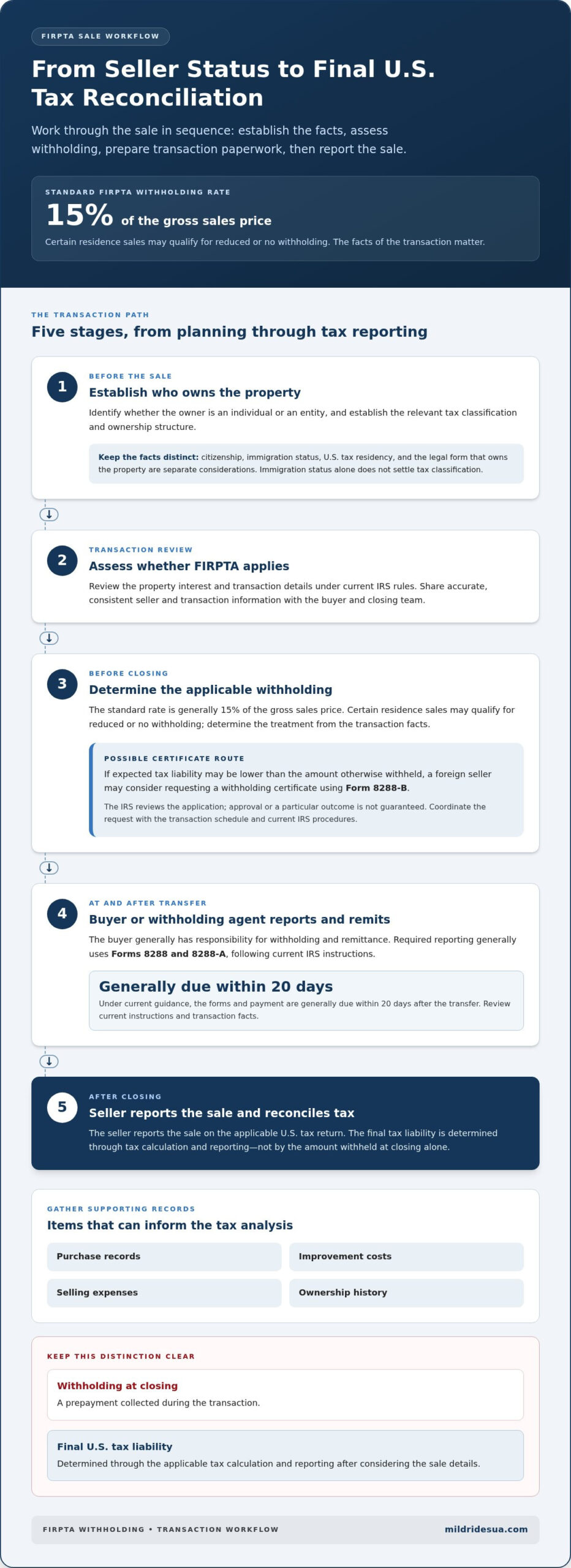
Handle FIRPTA as part of the transaction workflow, not as a last-minute formality. The parties need to establish who owns the property, assess whether the sale falls under the rules, determine the applicable withholding, prepare required documents, and later reconcile withholding with the seller’s U.S. tax reporting. Starting early gives the buyer and closing team time to work from consistent information.
- Determine seller status: Identify whether the owner is an individual or an entity and establish the relevant tax classification.
- Assess applicability: Review the property interest and transaction details under current IRS rules.
- Calculate withholding: Apply the relevant rate or exception based on the facts. The standard rate is generally 15% of the gross sales price, while qualifying transactions may be treated differently.
- Prepare and submit forms: The buyer or withholding agent generally reports and remits the amount using Forms 8288 and 8288-A, following current IRS instructions.
- Reconcile the tax: The seller reports the sale on the applicable U.S. tax return and determines actual liability.
The buyer generally has the withholding and remittance responsibility, so missing or inconsistent information can affect both sides of the transaction. The IRS explains the FIRPTA withholding rules, including buyer obligations and reporting. Under current guidance, Forms 8288 and 8288-A and payment are generally due within 20 days after the transfer. Review the applicable instructions and transaction facts rather than assuming one timeline fits every sale.
What happens between contract, closing, and IRS reporting?
Raise FIRPTA questions during transaction planning, not on signing day. The seller can organize ownership and tax details while the buyer and closing team coordinate the information and withholding documents required for the transfer. After closing, the buyer or withholding agent handles required reporting and remittance. The seller’s later tax filing reconciles withholding with the final tax calculation.
When might a withholding certificate be relevant?
If the expected tax liability may be lower than the amount otherwise withheld, a foreign seller may consider requesting a withholding certificate using Form 8288-B. The IRS reviews the application, and approval or a particular outcome is not guaranteed. Coordinate the request with the transaction schedule and review current IRS procedures before relying on a certificate to change closing arrangements.
For foreigner selling US property tax help, a CPA can coordinate the seller’s tax analysis with transaction documents and raise relevant questions before closing. Mildrid Esua, CPA, PLLC provides FIRPTA withholding and international tax support to sellers in Greensboro, High Point, Burlington, Kernersville, Jamestown, Oak Ridge, Summerfield, and Winston-Salem. Explore FIRPTA withholding support as you prepare for the transaction.
FIRPTA Withholding Versus Final Tax: What Determines the Seller’s Position?
FIRPTA withholding is calculated during the property transfer, but the seller’s final U.S. tax position is determined through applicable tax reporting. The figures can differ because withholding is collected as a prepayment, while the final calculation considers the transaction and the seller’s circumstances. The IRS FIRPTA Withholding Rules explain the federal withholding framework, but they do not replace a review of the seller’s complete tax facts.
The final calculation considers the amount realized from the sale alongside factors such as adjusted tax basis, eligible selling expenses, ownership history, and seller classification. A withholding amount based on gross price does not account for every fact that may affect taxable gain. As a result, the amount withheld may be more or less than the seller’s eventual federal tax liability. Any excess withholding may be addressed through the seller’s applicable U.S. tax return.
Which sale details can affect the final tax calculation?
Organize records that establish how the property was acquired, owned, improved, and sold. Useful documents may include:
- Purchase and acquisition records, including documents showing how the property was acquired
- Invoices or other support for capital improvements
- Records of selling expenses and transaction costs
- Ownership documents that identify the seller and ownership structure
- The closing statement showing sale proceeds and amounts paid or withheld
These records help substantiate basis and the transaction details used in the tax calculation. Whether a cost is included and how it affects the result depend on the documentation and rules that apply to the seller’s situation. The closing withholding figure alone does not establish the seller’s final tax owed. This distinction is central to foreigner selling US property tax help: transaction paperwork supports the closing process, while tax reporting determines the final position.
What should North Carolina property sellers consider?
Federal FIRPTA withholding is separate from potential state or local tax obligations. If the property is in North Carolina, state tax treatment may also be relevant, depending on the property’s location, transaction, and seller’s circumstances. Assess state requirements separately from federal withholding, using current North Carolina guidance rather than assuming federal treatment resolves every question.
Mildrid Esua, CPA, PLLC serves Greensboro, High Point, Burlington, Kernersville, Jamestown, Oak Ridge, Summerfield, and Winston-Salem. A property’s location remains relevant to the tax analysis, wherever it is. Coordinating the closing statement, ownership records, and supporting expense documents can help connect withholding at closing with the later tax calculation.
A Foreign Seller’s Pre-Closing Checklist for FIRPTA Tax Help
Preparation can help prevent a scramble to resolve tax questions while closing documents are being signed. Start gathering records as soon as a sale is planned, then coordinate with the closing team so everyone is working from consistent ownership and transaction information. This step-by-step preparation is central to foreigner selling US property tax help.
Documents to assemble before the sale closes
Build a file that supports the seller’s identity, ownership, property history, and expected sale. The exact records vary, but a useful starting set includes:
- Identification and tax details for the individual seller, or formation and ownership documents for an entity
- Purchase agreements, settlement statements, deeds, and other acquisition or ownership records
- Receipts and invoices for property improvements that may be relevant to the tax basis
- The sale contract, anticipated closing statement, and information about expected transaction expenses
- Prior U.S. tax returns or IRS correspondence that may help clarify the seller’s reporting history or tax details
- Copies of FIRPTA forms, withholding certificate applications, IRS notices, and related correspondence as the transaction progresses
Keep a record of what was sent, to whom, and when. A complete file helps the tax professional compare withholding documents with the seller’s later tax reporting. If the sale connects to wider U.S. business or investment activity, international tax services for foreign-owned U.S. businesses may provide useful context for broader cross-border compliance questions.
Questions to resolve before the closing date
Before signing or approaching the scheduled closing, clarify the seller’s tax classification, whether FIRPTA applies, and who is coordinating the required withholding documents and IRS submissions. Confirm that the closing team has consistent information about the seller and ownership structure. Identify missing documents that could affect preparation.
If the expected tax liability may be lower than the amount withheld, discuss whether a withholding certificate request using Form 8288-B is appropriate. Timing matters, and an application does not guarantee approval or a particular withholding result. Review current IRS procedures and the transaction schedule before relying on a certificate to affect closing arrangements.
After closing, keep copies of the executed closing statement and all filed forms for the later tax return. Mildrid Esua, CPA, PLLC provides FIRPTA withholding and international tax support to sellers in Greensboro, High Point, Burlington, Kernersville, Jamestown, Oak Ridge, Summerfield, and Winston-Salem. Explore international tax support to coordinate tax analysis and transaction documentation.
How a CPA Can Help a Foreigner Selling U.S. Property
A CPA can bring the seller’s tax facts and transaction documents into one coordinated review. For someone seeking foreigner selling US property tax help, that means examining ownership and seller classification, reviewing anticipated sale information, and addressing FIRPTA withholding and tax reporting considerations before filing decisions are made. A tailored review can help identify missing information early without promising a particular tax result or savings.
What tailored FIRPTA support can address
Mildrid Esua, CPA, PLLC provides FIRPTA withholding and international tax services. CPA support can help organize the facts relevant to the transaction, review available documents, and coordinate withholding questions with the closing process. It can also help the seller understand which records may be needed for later U.S. tax reporting. A proactive review is especially useful when individual or entity ownership, prior filings, or cross-border tax considerations make the situation less straightforward.
Some property sales are part of a wider set of U.S. investments, business interests, or international tax obligations. In those circumstances, broader planning may be relevant alongside immediate FIRPTA questions. Explore global tax solutions for Greensboro businesses and residents for additional context on international tax support.
What to prepare for an initial tax discussion
Bring a clear picture of the property and its ownership, along with documents showing how it was acquired and what the sale is expected to involve. Helpful materials may include:
- Deeds, ownership agreements, or entity documents showing who owns the property
- Purchase records and available documentation for improvements
- The sale contract, anticipated closing statement, and expected transaction expenses
- Prior U.S. tax returns or relevant IRS correspondence
- An accurate summary of residency, entity structure, and prior U.S. tax filing history
These details help a CPA assess which questions need attention and what documentation may support the transaction and later tax reporting. You do not need to resolve every issue before beginning the discussion, but complete and accurate information makes the review more useful.
Mildrid Esua, CPA, PLLC serves clients in Greensboro, High Point, Burlington, Kernersville, Jamestown, Oak Ridge, Summerfield, and Winston-Salem. The property itself does not have to be located in Greensboro for international tax guidance to be relevant. If you’re preparing for a U.S. property sale, get tax guidance for your U.S. property sale and discuss the transaction with a clear view of its cross-border tax considerations.
Prepare for Your U.S. Property Sale with Greater Clarity
A clearer FIRPTA process starts with understanding the difference between withholding at closing and your final U.S. tax liability. Seller classification, ownership records, property costs, and transaction documents can all inform the review. Organizing them early helps you approach closing with a better understanding of the relevant facts.
With foreigner selling US property tax help, you can coordinate withholding questions and paperwork before they become last-minute concerns. A CPA can also help connect the transaction details to the tax reporting that follows. The review should reflect your seller status, property, and circumstances.
Mildrid Esua, CPA, PLLC is based in Greensboro, North Carolina, and provides FIRPTA withholding support and international tax services. The firm serves clients in Greensboro, High Point, Burlington, Kernersville, Jamestown, Oak Ridge, Summerfield, and Winston-Salem. Whether your property is in North Carolina or elsewhere in the U.S., informed preparation can help you move forward with greater confidence. Discuss your U.S. property sale with Mildrid Esua, CPA, PLLC to take the next step with a clearer tax plan.
Frequently Asked Questions
Does FIRPTA apply to every foreigner selling U.S. property?
No. FIRPTA can apply when a foreign person disposes of a U.S. real property interest, but the outcome depends on the seller’s tax classification, property, and transaction. Citizenship, immigration status, and U.S. tax residency are not interchangeable, and entity ownership can change the analysis. Certain transactions may qualify for an exception or reduced withholding. Review the seller’s facts and current IRS rules before assuming withholding applies or does not apply.
Is FIRPTA withholding the same as the final tax owed?
No. FIRPTA withholding is generally a prepayment collected in connection with the sale, not the seller’s final tax bill. The seller’s actual U.S. tax position is determined through applicable tax reporting, which may take account of basis, eligible expenses, and other facts. If withholding exceeds the final liability, the seller may be able to claim a refund through the relevant tax return. The withholding amount alone does not settle the final calculation.
Who is responsible for withholding FIRPTA tax at closing?
Generally, the buyer, also known as the transferee, is responsible for withholding the required amount and ensuring it is reported and remitted to the IRS. The closing team may coordinate transaction paperwork, but the buyer’s obligation makes accurate seller and property information important before closing. Clarify who is preparing and submitting the forms, and review current IRS instructions and timelines for the specific transaction.
Can a foreign seller reduce or avoid FIRPTA withholding?
Possibly, depending on the transaction and whether an exception, reduced rate, or withholding certificate applies. For qualifying residence purchases, withholding may be zero when the price is $300,000 or less, or reduced to 10% when the price is between $300,001 and $1,000,000, subject to buyer-use requirements. A seller may also request a certificate if eligible. These outcomes depend on the facts and current rules, so do not assume a reduction applies automatically.
What is IRS Form 8288-B, and when might a seller use it?
Form 8288-B is used to apply to the IRS for a FIRPTA withholding certificate. A foreign seller may consider applying when the expected U.S. tax liability is lower than the withholding otherwise required. The IRS must review the application, and approval or a particular reduction is not guaranteed. Consider the request early, coordinate it with the closing schedule, and follow the current form instructions.
How much is withheld when a foreign person sells U.S. real estate?
The standard FIRPTA withholding rate is generally 15% of the gross sales price, not 15% of the seller’s profit. Some qualifying residence sales have different treatment: no withholding may apply at $300,000 or less, and a 10% rate may apply from $300,001 to $1,000,000, subject to the buyer’s planned use of the home. Seller type and transaction details can also matter, so verify the applicable rate before closing.
Do foreign sellers have to file a U.S. tax return after selling property?
Generally, a foreign seller reports the sale on the applicable U.S. tax return to determine actual tax and claim any refund of excess withholding. Individuals commonly use Form 1040-NR; filing requirements and deadlines depend on their circumstances. An individual without a Social Security number may need an ITIN to file and claim a refund. Keep closing records and withholding documents together, and confirm the correct filing requirements for the sale year.
Can a Greensboro CPA help with a U.S. property sale by a foreign seller?
Yes. A CPA can review seller classification, ownership and sale documents, FIRPTA withholding questions, and tax reporting considerations, then help coordinate relevant information with the closing process. Mildrid Esua, CPA, PLLC provides FIRPTA withholding and international tax services. The firm serves Greensboro and nearby communities, including High Point, Burlington, Kernersville, Jamestown, Oak Ridge, Summerfield, and Winston-Salem. This foreigner selling US property tax help can be tailored to the seller’s circumstances, wherever the property is located.




Leave a Reply
Your email is safe with us.