


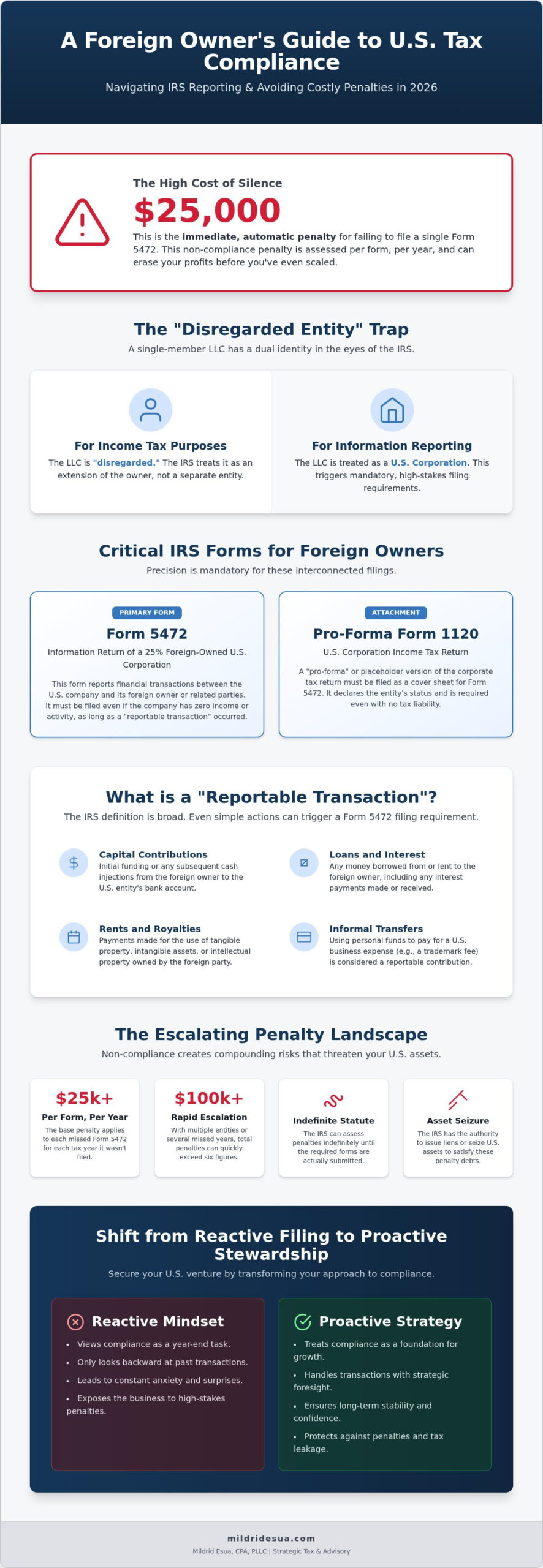
For the IRS, silence isn’t just golden; it’s a $25,000 invitation for an audit. Failing to file a single Form 5472 can trigger an immediate penalty that erases your hard-earned margins before you’ve even scaled. You’ve likely felt the weight of this complexity as you try to reconcile your international growth with the rigid demands of US reporting. It’s a high-stakes disclosure game where the penalty for silence is often greater than the tax itself. At Mildrid Esua, CPA, PLLC, we believe that tax compliance for foreign owned US business should be a foundation for growth, not a source of constant anxiety.
Unlike reactive firms that only look backward at tax time, we act as your vigilant guide to ensure every cross-border transaction is handled with strategic foresight. This 2026 guide provides a clear roadmap to navigate IRS reporting, avoid those crushing $25,000 penalties, and resolve the confusion surrounding “disregarded entity” status. You’ll learn how to secure your ITINs and EINs efficiently while utilizing treaty benefits to minimize tax leakage. We’ll examine the critical reporting forms and the latest 2026 transparency requirements, giving you the confidence to build a stable, compliant structure that stands up to any level of scrutiny.
Key Takeaways
- Identify the mandatory filing requirements for Form 5472 and the pro-forma Form 1120 to shield your entity from the $25,000 non-compliance penalty.
- Navigate the critical distinction between “Effectively Connected Income” and passive income to ensure you’re utilizing treaty benefits and minimizing tax leakage.
- Master the complexities of tax compliance for foreign owned US business by understanding how “disregarded entity” status impacts your federal reporting obligations.
- Secure your real estate investments by implementing a strategic approach to FIRPTA withholding and professional IRS representation during property dispositions.
- Transition from a reactive filing mindset to a model of continuous stewardship that prioritizes long-term stability and proactive growth.
The High Stakes of Tax Compliance for Foreign Owned US Business
At Mildrid Esua, CPA, PLLC, we’ve observed the IRS fundamentally shift its approach toward international transparency, moving from a reactive posture to one of aggressive enforcement. For the foreign entrepreneur, this means that tax compliance for foreign owned US business is no longer a simple annual task but a high-stakes disclosure requirement. The Treasury Department views these entities as primary conduits for cross-border capital, leading to a regulatory environment where silence is often interpreted as a deliberate attempt to bypass federal oversight.
Understanding these obligations requires a deep dive into the U.S. corporate tax system, which applies specific, rigorous standards to any domestic entity with significant foreign ownership. Unlike domestic businesses that may enjoy simpler reporting with minimal activity, your US structure is subject to a transparency mandate designed to expose every financial link between the company and its foreign owners. To better understand how these mandatory filings work in practice, watch this helpful video:
Understanding the Disregarded Entity Status
Many foreign owners choose a single-member LLC for its simplicity, but they often fall into the “transparency trap” of the disregarded entity (DE) status. While the IRS disregards the LLC for income tax purposes, treating it as an extension of the owner, it treats the same LLC as a corporation for information reporting. This dual identity is where many mistakes happen. Your US entity isn’t invisible; it’s a high-priority reporting target. Even if your company has zero income, you’re still required to file if “reportable transactions” occurred, such as the owner paying for a US trademark or funding the LLC’s initial bank account.
The 2026 Penalty Landscape
The 2026 tax year marks a new era of enforcement following the “One Big Beautiful Bill Act,” which has significantly tightened transparency requirements. The current penalty for failing to file Form 5472 or filing an incomplete return is $25,000 per form. Because this penalty is assessed on a “per form” basis, a business owner with multiple entities or missed years can quickly face liabilities exceeding $100,000. Beyond the immediate financial sting, the IRS has the authority to issue liens or seize assets to satisfy these debts. Achieving consistent tax compliance for foreign owned US business is the only way to close the door on these risks. The statute of limitations for the IRS to assess penalties on unfiled international information returns remains open indefinitely until the required forms are actually submitted.
The ‘Big Three’ IRS Forms for Foreign Owners
Mastering tax compliance for foreign owned US business requires moving beyond conceptual risks to the technical precision of specific filings. The IRS monitors these entities through an interconnected web of forms designed to capture every dollar that crosses the border. For most owners, the primary burden rests on three specific documents. Precision is mandatory. The IRS doesn’t accept “I didn’t know” as a valid defense when IRS international business tax compliance standards aren’t met.
Form 5472: Reportable Transactions Explained
Any US corporation or LLC with at least 25% foreign ownership must file Form 5472 if a reportable transaction occurred during the tax year. These aren’t just high-value sales. The IRS defines reportable transactions broadly to include:
- Capital Contributions: Initial funding or subsequent cash injections by the owner.
- Loans and Interest: Any money borrowed from or lent to the foreign owner, regardless of the interest rate.
- Rents and Royalties: Payments for the use of property or intellectual property.
- Informal Transfers: Even using personal funds to pay for a business expense counts as a reportable event.
Informal transfers are a common audit trigger. If you use your personal credit card to pay for a US trademark filing, that is a reportable transaction. Maintaining contemporaneous documentation is the only way to satisfy a “Vigilant Guide” standard of stewardship. Consulting with a specialized accountant and tax advisor for small businesses ensures these technicalities are managed with precision.
The Pro Forma 1120 Requirement
A frequent point of confusion for non-residents is the Pro Forma 1120. If your LLC is a single-member disregarded entity, it doesn’t file a standard corporate tax return. Instead, it uses Form 1120 as a “wrapper” for Form 5472. This means you submit a nearly blank return with only basic identifying information and the critical “Foreign-owned US DE” notation. For the 2025 tax year, the deadline for these filings is April 15, 2026. If you need more time, filing Form 7004 by that date can extend your window to October 15, 2026.
While federal forms are the priority, businesses operating in North Carolina must remain alert to state-level nexus rules. Unlike domestic firms, foreign-owned entities in Greensboro or High Point often face unique scrutiny regarding their physical or economic presence in the state. Maintaining consistent tax compliance for foreign owned US business involves more than just checking boxes; it requires a strategic understanding of how these forms interact. Partnering with a firm like Mildrid Esua, CPA, PLLC provides the intellectual rigor needed to manage these filings. Their team offers specialized international tax services that cover both federal mandates and North Carolina state requirements simultaneously.
ETBUS vs. Passive Income: Determining Your Tax Liability
Determining your actual tax liability is the next strategic hurdle after establishing your reporting protocols. Many foreign owners operate under the dangerous assumption that a lack of a physical US office automatically equals a zero-tax bill. In reality, the IRS uses two distinct categories to capture revenue: Effectively Connected Income (ECI) and Fixed, Determinable, Annual, Periodical (FDAP) income. While ECI relates to active business operations, FDAP covers passive streams like royalties or dividends. Unlike domestic firms that simply report total profit, your tax compliance for foreign owned US business hinges on correctly classifying every dollar to avoid overpayment or under-reporting.
The ETBUS Test for Foreign Entrepreneurs
To be taxed on business profits, you must be “Engaged in a Trade or Business in the United States” (ETBUS). The IRS applies a “continuous and regular” standard rather than a simple day-count test. For instance, a foreign-owned e-commerce business using a US-based 3PL warehouse in Greensboro would likely meet the ETBUS threshold due to its physical inventory and local fulfillment agents. Conversely, a remote consulting firm with no US-based staff or equipment might avoid ETBUS status, provided its services are performed entirely abroad. In the 2026 digital economy, the IRS is increasingly scrutinizing “dependent agents” and digital nexus, meaning your software or automated US-based servers could trigger a tax obligation you didn’t anticipate.
Passive Income and Withholding Rules
If your income isn’t effectively connected to a US business, it’s likely FDAP. This passive income is generally subject to a flat 30% withholding tax at the source. It’s a steep price to pay for those who fail to utilize tax treaties. By correctly filing Form W-8BEN or W-8BEN-E, you can often reduce this rate to 15%, 10%, or even 0%, depending on your home country’s agreement with the US. At Mildrid Esua, CPA, PLLC, we act as a Vigilant Guide to ensure these forms are not only filed but maintained with the strategic depth required to protect your margins from unnecessary tax leakage.
Don’t ignore the state-level implications. Even if you don’t meet the federal ETBUS standard, you might still trigger “nexus” in North Carolina. The state’s Department of Revenue has its own criteria for what constitutes doing business in Winston-Salem or High Point. Unlike competitors who focus solely on federal forms, we provide a holistic view that accounts for these localized tax traps. This proactive stewardship is what separates a basic filing service from a true growth partnership. Maintaining tax compliance for foreign owned US business requires this level of localized expertise to ensure your global structure remains stable and profitable. Foreign-owned entities with a physical or economic presence in the Triad region should also review our small business tax preparation Winston-Salem guide to understand how North Carolina’s 2026 corporate rate changes and state-specific deductions apply to their structure. For entrepreneurs who have also established S corporation structures in the region, understanding how entity classification intersects with state obligations is equally critical, as detailed in our guide to s corp tax preparation charlotte businesses rely on for 2026 strategic filing.
FIRPTA and Real Estate Compliance for Foreign Sellers
Real estate occupies a distinct, high-scrutiny category in the U.S. tax system. While most business profits are reported annually, the Foreign Investment in Real Property Tax Act (FIRPTA) allows the IRS to exert immediate control over capital at the moment of sale. For an international investor, this means that tax compliance for foreign owned US business isn’t just about paperwork; it’s about protecting your liquidity. Without a proactive strategy, a significant portion of your gross proceeds can be frozen by the IRS for months, regardless of whether you actually realized a profit on the transaction. Investors navigating these cross-border complexities will find that a comprehensive approach to tax planning for international clients is essential to safeguarding equity at every stage of a US property transaction.
The FIRPTA Withholding Process
Under Section 1445, the buyer of a U.S. real property interest from a foreign person is legally required to act as a withholding agent. The standard withholding rate is 15% of the gross sales price. It’s vital to recognize that this is not a tax on your gain, but a mandatory deposit against potential taxes owed. The process follows a rigid timeline:
- Status Identification: The buyer must determine if the seller is a “foreign person” or a foreign-owned disregarded entity.
- Withholding Calculation: The 15% rate applies to the total contract price. A reduced 10% rate may apply if the property is a personal residence sold for between $300,001 and $1,000,000.
- IRS Submission: The withheld funds must be reported and paid using Forms 8288 and 8288-A within 20 days of the closing date.
Reducing Withholding with a FIRPTA Accountant
You don’t have to accept a 15% reduction in your closing proceeds. By working with a specialized FIRPTA accountant at Mildrid Esua, CPA, PLLC, you can apply for a Withholding Certificate via Form 8288-B. This application asks the IRS to reduce or eliminate the withholding based on your actual maximum tax liability. If your gain is minimal, or if you’re selling at a loss, this certificate is the only way to keep your capital in your hands rather than in a government account.
Timing is everything. The application must be submitted on or before the date of closing to allow for an “escrow holdback.” This strategic maneuver allows the closing attorney in Greensboro or Winston-Salem to hold the 15% in their trust account while the IRS reviews your request, rather than sending it immediately to the Treasury. Unlike generalist firms, we provide the localized expertise necessary to manage these North Carolina real estate nuances. If you’re preparing for a property disposition, you need a partner who acts as a vigilant steward of your equity. Secure your investment by engaging our specialized FIRPTA withholding services before you sign the closing documents. This level of foresight is the hallmark of effective tax compliance for foreign owned US business in the 2026 market.
Choosing a Strategic Tax Partner: The Mildrid Esua Advantage
Unlike a traditional bookkeeper who focuses solely on historical record-keeping, a specialized international tax advisor acts as a strategic architect for your global interests. For the foreign entrepreneur, tax compliance for foreign owned US business is more than just a seasonal filing; it’s a year-round commitment to vigilant stewardship. Relying on a generalist often leads to the very $25,000 penalties and “transparency traps” we’ve explored. At Mildrid Esua, CPA, PLLC, we provide a proactive partnership that integrates bookkeeping, payroll, and complex international reporting into a single, seamless US presence. Foreign owners expanding their North Carolina footprint will find that the same proactive, architect-driven philosophy behind a small business accountant Charlotte growth study applies equally to managing cross-border compliance obligations.
Proactive IRS Representation
If you’re currently facing tax anxiety due to unfiled returns or existing tax liens, you need more than a clerk; you need an advocate. Our firm specializes in tax resolution services and professional IRS representation, serving as the direct line of communication between your business and federal authorities. This is particularly critical for foreign owners who cannot easily navigate the bureaucracy from abroad. Because we are based in Greensboro, we offer a unique advantage for North Carolina nexus issues, ensuring that your state-level obligations in Winston-Salem or High Point are managed with the same intellectual rigor as your federal filings. We don’t just react to IRS notices; we anticipate them, providing the stable hand required to navigate past compliance failures into a future of strategic growth.
Your 2026 Compliance Roadmap
Success in the 2026 regulatory environment requires a methodical approach that begins long before the April 15th deadline. Our “Vigilant Guide” methodology follows a logical progression designed to eliminate surprises and minimize tax leakage. This roadmap ensures that your cross-border structure remains a vehicle for expansion rather than a liability. A compliant year follows this steady cadence:
- Initial Setup: We manage EIN acquisition and critical entity classification elections to ensure your business is structured for maximum treaty benefits.
- Ongoing Stewardship: Our team provides monthly bookkeeping for small businesses and quarterly estimated tax reviews to maintain real-time clarity on your US obligations.
- Annual Disclosure: We handle the comprehensive preparation of Form 5472, the Pro Forma 1120, and Form 1040-NR, ensuring every reportable transaction is documented with precision.
Transitioning from a reactive posture to an informed, proactive strategy is the most effective way to protect your US investment. NC-based entrepreneurs looking to go further can explore how strategic tax planning for businesses transforms annual obligations into a year-round growth engine. By centralizing your international tax services with a firm that understands the nuances of foreign ownership, you gain the freedom to focus on your core business objectives. We invite you to move beyond the fear of penalties and embrace a model of continuous engagement. Secure your US business future with a Strategic Tax Consultation and ensure your tax compliance for foreign owned US business is managed by a dedicated growth partner.
Securing Your Global Growth in 2026
The US tax landscape for international owners has evolved into a high-stakes environment where transparency is the primary currency. Maintaining tax compliance for foreign owned US business involves more than just submitting annual forms; it’s about building a stable cross-border structure that protects your capital from $25,000 penalties and aggressive IRS enforcement. From mastering mandatory disclosure forms like 5472 to navigating the complexities of FIRPTA withholding, your success depends on foresight rather than reaction. It’s the difference between constant anxiety and informed decision-making.
Unlike standard bookkeeping services, Mildrid Esua, CPA, PLLC acts as a Strategic Tax Architect for your enterprise. We bring specialized expertise in international tax and a proven track record in IRS tax resolution to every partnership. By integrating your federal reporting with localized North Carolina expertise, we ensure your business remains a source of growth. Your global vision deserves a steady hand and the intellectual rigor of a partner who stays continuously engaged in your success. Schedule an International Tax Compliance Review with Mildrid Esua, CPA today and build your future on a foundation of professional authority.
Frequently Asked Questions
Do I need to file a US tax return if my foreign-owned LLC made no money?
Yes, you likely have a filing obligation even with zero income. If any “reportable transactions” occurred, such as the owner paying for US trademark fees or funding the LLC’s bank account, you must file Form 5472 and a Pro Forma Form 1120. The IRS views these disclosures as mandatory transparency tools. Failing to report these non-income events can trigger the same $25,000 penalty as a high-revenue business.
What is the penalty for not filing Form 5472 in 2026?
The initial penalty for failing to file a timely or complete Form 5472 is $25,000 per form. If the IRS issues a notice of non-compliance and you don’t respond within 30 days, the penalty increases by an additional $25,000 for every subsequent 30-day period. This makes consistent tax compliance for foreign owned US business a critical priority for protecting your company’s long-term financial stability.
Can a foreign person own a US LLC without an ITIN?
You can legally own the entity, but you’ll eventually need an Individual Taxpayer Identification Number (ITIN) to fulfill your federal obligations. Without an ITIN or EIN, you can’t file the mandatory informational returns or open a US business bank account. Establishing proper tax compliance for foreign owned US business requires these identifiers to link your global identity with your domestic reporting requirements and treaty benefit claims.
How do I avoid the 15% FIRPTA withholding when selling US property?
You can reduce or eliminate this withholding by applying for a Withholding Certificate via Form 8288-B before your closing date. This allows the IRS to calculate the withholding based on your actual anticipated tax gain rather than the gross sales price. It’s a strategic move that preserves your liquidity. Most investors use an “escrow holdback” to keep these funds in a trust account while the IRS reviews the application.
What is the difference between a Disregarded Entity and a Corporation for tax purposes?
A disregarded entity passes its income directly to the owner’s tax return, whereas a corporation is taxed as a separate legal person. However, for international disclosure purposes, the IRS treats a foreign-owned single-member LLC as a corporation. This means you’re subject to the same rigorous Form 5472 reporting standards as a major US subsidiary, a nuance that often catches foreign entrepreneurs off guard during their first filing season. Foreign owners who later elect S corporation status for a domestic entity face an entirely different set of obligations, and our S corp tax preparation Charlotte guide outlines those strategic 2026 filing requirements in detail.
Do I have to pay taxes in North Carolina if my LLC is registered there but I live abroad?
You may owe North Carolina taxes if your business establishes “nexus” within the state. This physical or economic presence can be triggered by holding inventory in Greensboro, having dependent agents in Winston-Salem, or reaching specific revenue thresholds from North Carolina customers. State-level compliance is distinct from federal rules. It requires a localized CPA to navigate the specific Department of Revenue requirements that apply to your international structure. Businesses operating in the Triad area will find our Winston-Salem small business tax preparation guide for 2026 particularly useful for understanding how state corporate rate changes and NC-specific deductions affect foreign-owned entities registered in North Carolina.
How long does it take to get a FIRPTA Withholding Certificate?
The IRS typically takes 90 to 120 days to process a Withholding Certificate application. Because this timeline often exceeds the standard closing window, your specialized CPA will coordinate with the closing attorney to hold the funds in escrow. This proactive stewardship ensures the money isn’t sent to the Treasury prematurely, allowing you to retain more of your equity once the IRS issues its final determination letter.
Can I use TurboTax for my foreign-owned US business compliance?
No, standard consumer software platforms don’t support the complex international forms required for foreign-owned entities. TurboTax and similar tools are designed for domestic taxpayers and lack the functionality for Form 5472, Pro Forma 1120, or Form 1120-F filings. Relying on these platforms creates a significant risk of incomplete reporting. This often leads to the $25,000 per-form penalty that a licensed CPA firm is specifically trained to help you avoid. Foreign owners seeking a broader framework for managing their US obligations will benefit from reviewing our 2026 US tax compliance guide for international clients, which outlines a proactive, stewardship-driven approach to protecting global wealth.