

What if your tax return served as a strategic blueprint for your company’s growth rather than just a backward-looking administrative chore? For many Charlotte entrepreneurs, s corp tax preparation charlotte is often approached with a reactive mindset, focusing on deadlines instead of long-term financial health. You likely understand that the S Corp structure offers significant advantages, yet the fear of IRS scrutiny over “reasonable salary” figures or confusion regarding North Carolina’s specific filing mandates can be paralyzing. It’s common to feel that you’re managing a complex regulatory landscape without a clear map or a vigilant ally like Mildrid Esua, CPA, PLLC.
This guide is designed to transform that uncertainty into a position of strategic strength, helping you master your 2026 obligations with professional precision. We’ll examine the critical balance between distributions and salary, provide a roadmap for state-level compliance, and reveal how proactive planning ensures you keep more of what you earn. By moving beyond simple filing and embracing a philosophy of continuous engagement, you can secure your business’s trajectory and ensure every deduction, including the QBI, is utilized to its fullest potential.
Key Takeaways
- Understand the dual role of being both a shareholder and an employee to ensure your business structure remains compliant with federal and North Carolina regulations.
- Secure your standing with the IRS by mastering the March 15th deadline for s corp tax preparation charlotte, ensuring all financial statements are meticulously reconciled.
- Mitigate audit risks by establishing “reasonable compensation” that aligns with Charlotte market standards while optimizing your distribution-to-salary ratio.
- Streamline your 2026 filing process through proactive reconciliation of payroll records, shareholder loans, and capital contributions to maintain a clear audit trail.
- Transition from reactive filing to a strategic partnership that identifies potential tax liabilities before they impact your long-term stability.
Understanding S Corp Tax Compliance in the Charlotte Business Landscape
An S corporation isn’t a separate legal entity but a specific tax designation that fundamentally changes how the IRS views your business income. Unlike a standard C corporation, which faces taxation at both the corporate and individual levels, an S Corp operates as a pass-through entity. This structure allows profits, losses, and credits to flow directly to shareholders, who then report these items on their personal tax returns. For a detailed look at the historical context and federal rules, this S corporation overview provides a solid foundation for understanding the framework.
In the Charlotte market, successful entrepreneurs must master a dual identity. You’re no longer just the owner; you’re also an employee of your own company. This distinction is the cornerstone of S Corp compliance. It requires a disciplined approach to payroll and documentation to satisfy both federal and North Carolina Department of Revenue standards. Maintaining this “corporate veil” involves more than just a title change. It demands rigorous record-keeping and a clear separation of personal and business interests to protect your limited liability status.
To better understand how these tax strategies can benefit your specific situation, watch this helpful video:
The Self-Employment Tax Advantage Explained
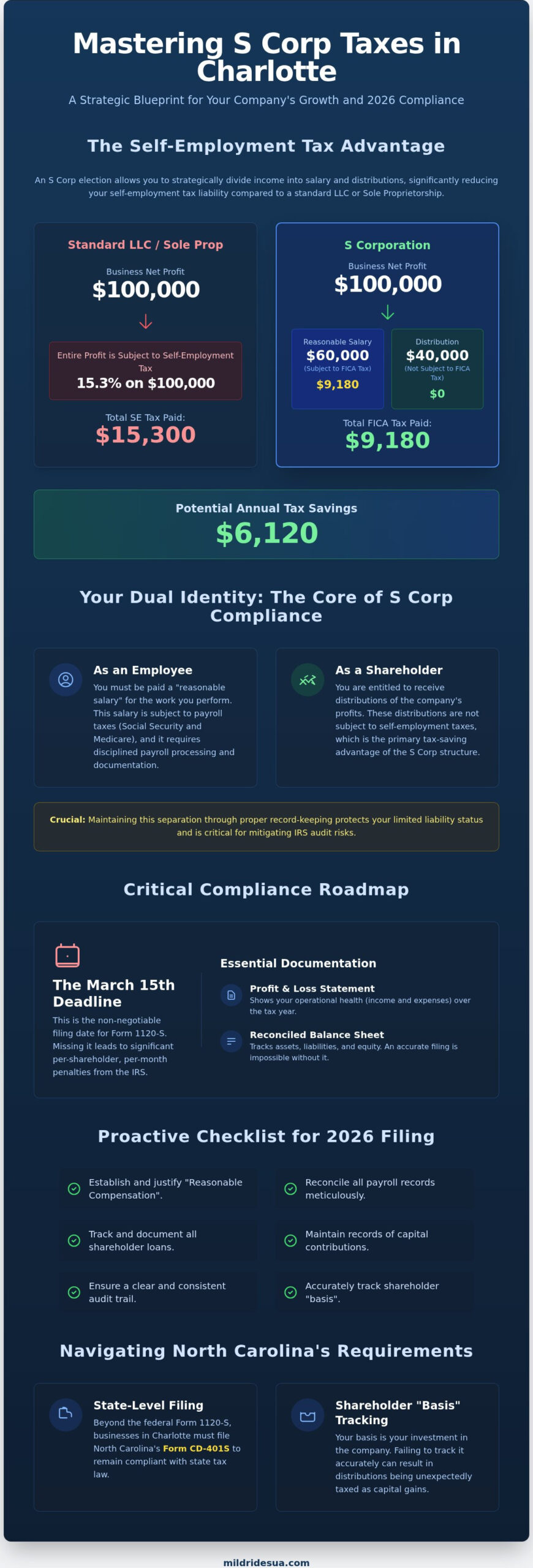
The primary reason local business owners transition to this model is the significant reduction in self-employment tax liability. In a standard LLC, the IRS typically assesses the 15.3% self-employment tax on the entire net profit of the business. An S Corp allows you to split your income into two distinct categories: a “reasonable salary” and shareholder distributions. While the salary portion is subject to FICA taxes, the distributions are not. For a growing Charlotte firm, this strategic division can result in substantial annual savings, keeping more capital available for reinvestment and personal wealth building.
Why Charlotte Businesses Need Specialized S Corp Preparation
Effective s corp tax preparation charlotte requires a vigilant guide who understands the nuances of North Carolina tax law. Beyond the federal Form 1120-S, businesses here must navigate state-specific requirements like Form CD-401S and manage the complexities of “basis” tracking. Your basis represents your investment in the company, and failing to track it accurately can lead to distributions being taxed as capital gains. We move beyond a reactive “tax season” mindset, focusing instead on proactive quarterly management. This ensures that your payroll, bookkeeping, and tax planning remain synchronized, preventing the common pitfalls that trigger IRS audits or state-level penalties.
Essential Deadlines and Documentation for Form 1120-S
The March 15th deadline is a non-negotiable anchor in the business calendar. While individual taxpayers focus on April, s corp tax preparation charlotte requires an earlier, more disciplined start. Failing to file Form 1120-S or a valid extension by this date can lead to significant per-month, per-shareholder penalties that quickly erode your profit margins. According to the IRS S Corporation Guidelines, this timeline ensures that individual shareholders receive their Schedule K-1 in time to include it on their personal returns. This pass-through mechanism is what allows the corporation to avoid double taxation, but it relies entirely on the timely and accurate distribution of these forms.
Your preparation hinges on two critical documents: the Profit and Loss statement and the Balance Sheet. A Profit and Loss statement shows your operational health, while the Balance Sheet tracks your assets, liabilities, and equity. Without a reconciled balance sheet, it’s impossible to verify the accuracy of your filing or track the complex movements of shareholder equity. We treat these documents as more than just tax records; they’re the diagnostic tools we use to protect your business’s financial integrity.
The 2026 S Corp Filing Calendar
Effective tax management is a year-round commitment rather than a seasonal sprint. For 2026, Charlotte business owners should mark their calendars for these essential dates:
- March 15: Deadline for Federal Form 1120-S and North Carolina Form CD-401S.
- Quarterly Estimates: April 15, June 15, September 15, and January 15 for federal and state payments.
- September 15: The final deadline for businesses that filed a six-month extension in March.
Initiating your s corp tax preparation charlotte in early January isn’t just a best practice; it’s a defensive strategy against the stress of the March deadline. If you find the documentation process overwhelming, partnering with a dedicated accountant and tax advisor for small businesses ensures you stay ahead of these critical dates.
The Shareholder Basis Trap
One of the most frequent oversights in S Corp management is the failure to track shareholder basis. Shareholder basis is the cumulative investment of the owner in the corporation. This figure is vital because it determines whether a distribution is tax-free or if it triggers an unexpected capital gains tax. If your business incurs a loss, you can only deduct that loss on your personal return to the extent of your basis. When basis hits zero, further losses are suspended, and distributions become taxable events. We prioritize basis tracking to ensure you don’t inadvertently trigger a tax bill or lose out on valuable deductions that you’ve earned through your hard work.
Optimizing the S Corp Advantage: Reasonable Compensation and Distributions
The most significant risk in s corp tax preparation charlotte involves the delicate calculation of shareholder-employee compensation. While the primary appeal of the S Corp is the reduction of self-employment taxes, the IRS remains acutely aware of this incentive. An unreasonably low salary is the leading trigger for audits, as it directly reduces the amount of FICA taxes paid into the system. Unlike a standard payroll approach, determining a “reasonable” figure requires a deep analysis of your specific role, the complexity of your business, and the economic conditions of the Charlotte market.
We act as your strategic architect, moving beyond the dangerous “rule of thumb” splits often suggested by less specialized firms. A simple 50/50 split between salary and distributions often fails to withstand IRS scrutiny. Instead, our approach to s corp tax preparation charlotte utilizes a proactive methodology that justifies your compensation through clear, defensible data. This vigilant stewardship protects your business from the costly reclassification of distributions as wages, which often results in back taxes, interest, and severe penalties.
Determining Your Reasonable Salary in 2026
Your compensation must reflect what a similar business would pay for a non-owner to perform the same duties. We rely on Bureau of Labor Statistics (BLS) data specific to the Charlotte metropolitan area to establish these benchmarks. To build a robust defense, you should document your daily responsibilities and the exact time commitment you dedicate to the firm. It’s vital to follow the “Salary First” rule: the IRS mandates that you must pay yourself a reasonable wage before taking any distributions from the company’s profits.
Managing Distributions and Fringes
Strategic management extends to how you handle fringe benefits and expense reimbursements. For 2% shareholders, the treatment of health insurance premiums is unique. These premiums must be reported as wages on your W-2 to remain deductible by the corporation, though they are typically not subject to FICA taxes. Establishing an “accountable plan” is also essential for reimbursing yourself for business expenses paid with personal funds. Without this formal structure, reimbursements can be treated as taxable income, undermining your tax-saving efforts.
- Avoid Shareholder Loans: Improperly documented loans can be reclassified as distributions or wages by the IRS.
- Consistent Payroll: Maintain a regular payroll schedule rather than taking sporadic lump sums.
- Document Everything: Keep board minutes that authorize salary levels and distribution amounts.
By balancing these elements with professional foresight, you ensure your S Corp remains a vehicle for growth rather than a source of regulatory liability.
Charlotte Business Tax Checklist: Preparing for Your 2026 Filing
As the 2026 filing season approaches, s corp tax preparation charlotte evolves from a series of administrative tasks into a rigorous verification process. You’ve already established a reasonable salary and tracked your basis. Now, you must ensure your financial infrastructure is airtight. Start by reconciling every dollar moved between the business and its shareholders. Shareholder loans and capital contributions aren’t just entries on a ledger; they’re potential audit triggers if left unreconciled or undocumented. We view this reconciliation as a defensive wall, protecting your corporate veil from IRS scrutiny.
Your 2025 and 2026 payroll records must perfectly mirror your W-2 filings. Any discrepancy between your corporate tax return and your payroll reports invites unwanted attention. This is the stage where we verify that health insurance premiums for 2% shareholders were correctly included in gross wages, ensuring you don’t lose out on those valuable deductions. If your bookkeeping hasn’t been maintained with this level of detail, our bookkeeping for small businesses service can help bring your records into full compliance before the March deadline.
North Carolina PTET: A Strategic Opportunity
North Carolina offers a powerful mechanism for pass-through entities that many reactive tax preparers overlook. The NC Pass-Through Entity Tax (PTET) election allows your S Corp to pay state income taxes at the entity level. This move is a strategic masterstroke because it allows you to bypass the federal $10,000 SALT cap on your personal return. Instead of losing deductions for the state taxes you pay, the business deducts them as a business expense, effectively lowering your federal taxable income. For Charlotte entrepreneurs with high state tax liabilities, making this election in 2026 can result in substantial federal savings.
QBI Deduction Deep Dive
The Section 199A deduction remains one of the most potent tools in your tax-saving arsenal. It offers a 20% deduction on your qualified business income, effectively lowering your tax rate on corporate profits. However, it’s not a guaranteed benefit. For high-earning owners, the deduction is often limited by the amount of W-2 wages the corporation pays. This creates a strategic tension: while you want to minimize salary to save on FICA, you must maintain enough salary to maximize your QBI deduction. The QBI deduction is a significant federal tax break for S Corp owners, provided wage requirements are met. We carefully model these scenarios to find the “sweet spot” where your total tax liability is at its absolute minimum.
To ensure you’re utilizing every available strategic advantage, consider a comprehensive review of your current standing. Our firm acts as a tax planning and tax preparation partner, providing the foresight needed to navigate these complex federal and state interactions.
Strategic S Corp Tax Solutions with Mildrid Esua, CPA, PLLC
Mildrid Esua, CPA, PLLC offers more than a seasonal filing service; we provide a sophisticated framework for long-term stability. Unlike traditional firms that view s corp tax preparation charlotte as a yearly transaction, we adopt the role of a vigilant guide. This proactive partnership ensures that your business interests are managed with constant attention and high-level expertise. We believe that a successful tax strategy is built on a foundation of year-round engagement, where every financial decision is weighed against its future tax implications.
The Mildrid Esua Proactive Methodology
Our methodology is designed to eliminate the uncertainty that often accompanies complex corporate filings. We maintain a continuous loop of bookkeeping and payroll monitoring to ensure your S Corp remains in full compliance with both federal and North Carolina standards. Quarterly strategy sessions allow us to adjust salary and distribution levels dynamically as your revenue fluctuates. This vigilant stewardship prevents the common “reasonable salary” pitfalls that trigger IRS scrutiny. While reactive firms are busy looking backward at previous years, we’re already anticipating the regulatory changes expected for 2026 and beyond.
Partnering for Charlotte Business Growth
As your strategic architect, we integrate S Corp election advice with your broader objectives for wealth preservation and business expansion. We don’t just prepare forms; we build a defensive perimeter around your business through meticulous documentation and professional IRS representation. Our commitment to your business extends to providing comprehensive tax resolution services and defense. If your 1120-S filing is ever challenged, you’ll have a seasoned ally ready to defend your position with rigorous market data and technical expertise. We act as a protective shield, ensuring that any inquiries from the IRS or the NC Department of Revenue are handled with professional authority and strategic intent.
A steady hand and a forward-looking perspective are essential when handling the complexities of s corp tax preparation charlotte. We invite you to transition from a reactive mindset to a strategy of informed decision-making. To begin your journey toward optimized compliance and maximized savings, Schedule your 2026 S Corp strategy consultation today.
Building a Resilient Financial Future for Your Charlotte Business
Strategic management of your S Corp is more than a compliance obligation; it’s a powerful mechanism for wealth preservation and operational stability. By mastering the delicate balance between reasonable salary and shareholder distributions, you protect your business from IRS scrutiny while significantly reducing your self-employment tax liability. Integrating local opportunities like the North Carolina PTET election further ensures you bypass federal deduction caps, keeping more capital within your company for future expansion. Effective s corp tax preparation charlotte requires this level of foresight and technical depth to transform annual filings into a proactive growth strategy.
Mildrid Esua, CPA, PLLC stands as your dedicated growth partner, offering specialized S Corp election strategies and expert IRS representation for tax resolution. Our deep expertise in the Charlotte and Greensboro markets allows us to act as a strategic architect for your financial interests, ensuring every regulatory requirement is met with precision. Don’t leave your 2026 savings to chance or reactive filing. Secure your 2026 S Corp tax strategy with Mildrid Esua, CPA, PLLC and move forward with the calm confidence that your business is in expert hands. Your long-term stability is our primary focus.
Frequently Asked Questions
What is the deadline for S Corp tax filing in Charlotte for 2026?
The filing deadline for your S Corp’s 2025 tax year is March 16, 2026, because the standard March 15th date falls on a Sunday. This applies to both federal Form 1120-S and North Carolina Form CD-401S. While you can request a six-month extension until September 15, 2026, this only extends the time to file the paperwork, not the time to pay any taxes owed. Proactive preparation ensures you avoid costly late-payment interest.
How much should I pay myself as an S Corp owner to avoid an IRS audit?
You should pay yourself a salary that reflects what a non-owner would earn for performing the same duties in the Charlotte market. The IRS uses market data to determine if your compensation is “reasonable” before you take any distributions. We utilize Bureau of Labor Statistics data to establish a defensible figure that minimizes audit risk. Setting your salary too low is a primary trigger for federal scrutiny, making a data-driven approach essential for compliance.
Can I change my LLC to an S Corp mid-year in North Carolina?
You can elect S Corp status for an existing LLC, but the IRS generally requires Form 2553 to be filed within the first 75 days of the tax year. For a mid-year election to be effective immediately, your business must usually be a newly formed entity or meet specific late-election relief requirements. Otherwise, the change will typically take effect on January 1 of the following year. This transition requires a vigilant adjustment of your payroll and accounting systems.
What happens if I miss the March 15th S Corp tax deadline?
Missing the March 15th deadline without a valid extension results in significant per-month, per-shareholder penalties from the IRS. These fines accumulate quickly and can become a heavy financial burden for businesses with multiple owners. North Carolina also imposes its own late-filing and late-payment penalties. If you’ve missed a deadline, our tax resolution services can help you navigate the process of restoring your standing with the authorities and potentially mitigating these accumulated costs.
Does North Carolina recognize the federal S Corp election automatically?
North Carolina automatically recognizes your federal S Corp status once the IRS approves your Form 2553 election. There is no requirement to file a separate state-level election form to be treated as an S Corp for North Carolina tax purposes. However, your business must still adhere to state-specific filing mandates, including the submission of Form CD-401S. Consistent documentation at both levels is vital for maintaining your pass-through status and ensuring long-term stability for your firm.
What is the North Carolina Pass-Through Entity Tax (PTET) and should my S Corp pay it?
The North Carolina PTET is an optional tax that allows your S Corp to pay state income taxes at the entity level. This election is a strategic tool designed to help shareholders bypass the federal $10,000 SALT deduction cap. By paying the tax through the corporation, it becomes a deductible business expense that lowers your federal taxable income. We analyze your specific income thresholds to determine if this election provides a clear financial advantage for your company.
Do I need a separate bank account for my S Corp in Charlotte?
You must maintain a separate business bank account to protect your corporate veil and ensure accurate s corp tax preparation charlotte. Commingling personal and business funds is a major regulatory red flag that can jeopardize your limited liability protection. A dedicated account provides the transparent audit trail necessary for professional bookkeeping and compliant tax filing. This separation is a fundamental requirement for proving that your corporation operates as a distinct legal entity from its shareholders.
How does the QBI deduction work for S Corp shareholders in 2026?
The QBI deduction allows eligible S Corp shareholders to deduct up to 20% of their qualified business income on their personal tax returns. For 2026, this federal tax break is subject to specific income thresholds and W-2 wage limitations that can restrict the deduction for high-earning owners. Professional s corp tax preparation charlotte involves modeling your salary and distributions to find the optimal balance that maximizes this deduction. We ensure your payroll is structured to meet these complex requirements.