

Your bank balance is often the most deceptive metric in your entire North Carolina enterprise. While it’s tempting to equate cash-on-hand with success, true stability requires a deeper, more vigilant stewardship of your data. Many owners in the Triad feel that small business financial statement preparation is merely a seasonal chore. However, accurate reporting is actually your primary defense against IRS audits and the essential prerequisite for sophisticated tax savings. Unlike a reactive approach that only looks backward, proactive financial management transforms raw numbers into a protective shield for your hard-earned assets.
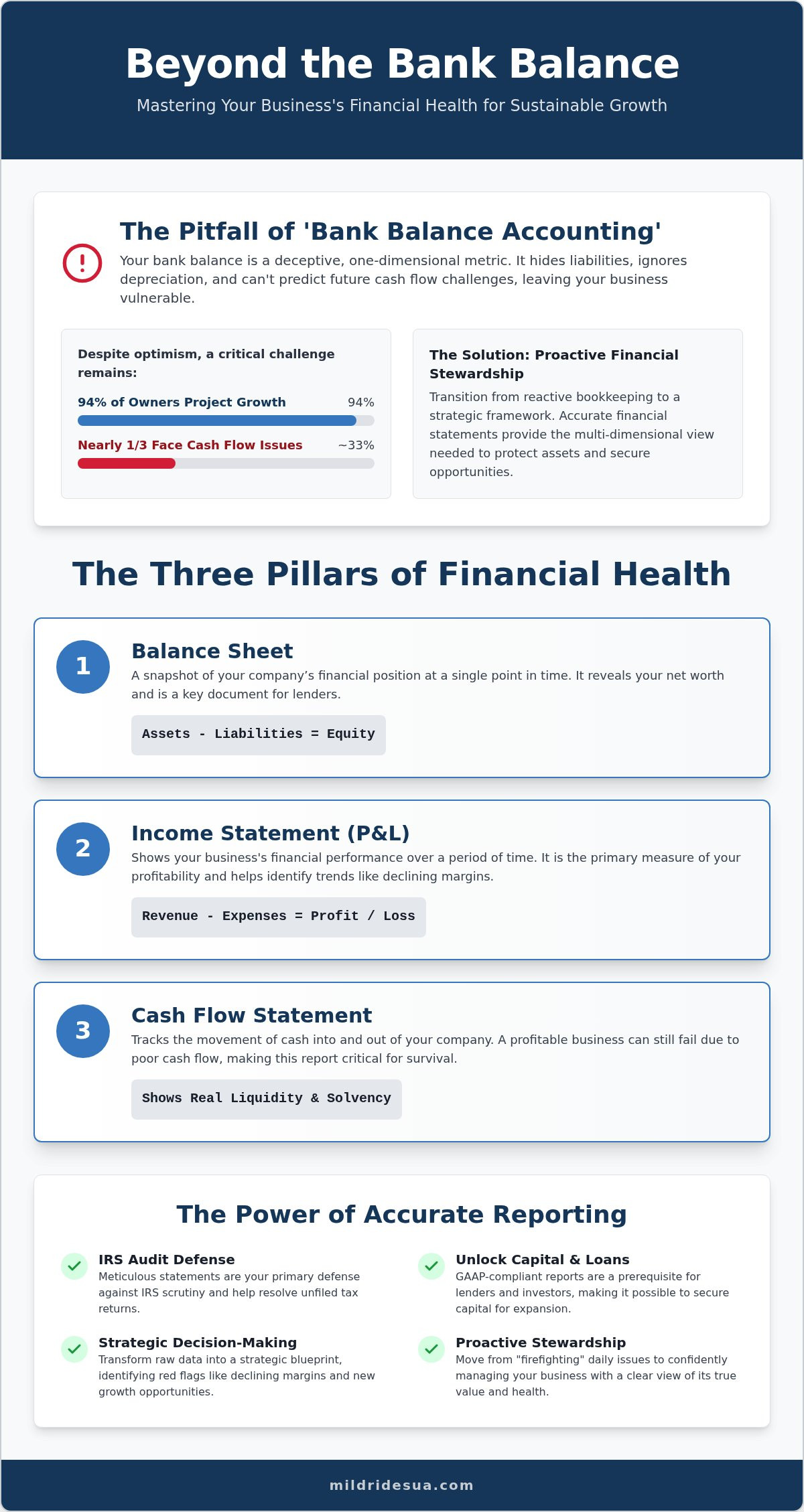
We understand the underlying anxiety that comes with potential IRS liens or the confusion of distinguishing daily cash flow from actual business net worth. You’re not alone; while 94% of business owners project growth in 2026, nearly a third remain concerned about persistent cash flow challenges. This guide promises to replace that uncertainty with a framework for informed, data-driven decisions. We’ll examine the core financial statements that protect your business from scrutiny and provide the strategic blueprint necessary for sustainable expansion in Greensboro, High Point, and Winston-Salem.
Key Takeaways
- Learn why your bank balance is a deceptive metric and how to utilize financial statements as a multi-dimensional scorecard for business health.
- Master the “Three Pillars” of financial health, including the Balance Sheet, Income Statement, and Cash Flow Statement, to gain clarity on your actual net worth.
- Discover how meticulous small business financial statement preparation serves as your primary defense during IRS audits and helps resolve unfiled tax returns.
- Identify critical red flags, such as declining gross margins, to transform raw data into a strategic blueprint for sustainable growth.
- Transition from reactive bookkeeping to proactive stewardship by ensuring your financial records are always prepared for expansion and lending opportunities.
Understanding the Meaning of Financial Statements for Small Businesses
Think of your financial statements as the definitive scorecard for your enterprise. While a bank statement tells you what you have today, a comprehensive set of financial reports reveals how your business has performed over a specific duration. Understanding Financial Statements is the first step for any Greensboro business owner who wants to move beyond reactive management. These documents provide a multi-dimensional view of your health, capturing assets, liabilities, and equity in a way that a simple cash-in-bank figure never can. By adopting this structural approach, you transform raw data into a strategic blueprint for your next stage of growth.
To better understand how these documents are constructed from the ground up, watch this helpful tutorial:
Many entrepreneurs rely on “bank balance accounting,” which only reflects liquidity at a single moment. It doesn’t account for upcoming tax liabilities, unbilled expenses, or the gradual depreciation of your equipment. In 2026, standardized reporting is more than a formality; it’s a requirement for credibility. North Carolina lenders in the Triad increasingly demand GAAP-compliant reports before they’ll even consider a line of credit. Without these formal documents, your business remains a “black box” to the outside world, making it nearly impossible to secure the capital needed for expansion.
The Purpose of Financial Reporting in 2026
In the current economic environment, 94% of small business owners project growth, but that progress is only sustainable if it’s documented. Effective reporting establishes a clear audit trail for IRS compliance, which is your primary defense against unwanted scrutiny. It also provides a common language for partners, investors, and local NC lenders. By maintaining these records, you move from “firefighting” daily crises to making proactive, data-driven decisions that safeguard your long-term stability.
Bookkeeping vs. Financial Statements: The Critical Link
It’s vital to distinguish between the two: bookkeeping is the daily recording of transactions, while financial statements are the strategic output. Professional small business financial statement preparation relies on the integrity of your underlying data. Messy books lead to misleading and dangerous financial conclusions that can result in tax liens or missed opportunities. A vigilant guide ensures that every entry is categorized correctly, allowing your statements to serve as an accurate architectural drawing of your firm’s true value.
The Three Pillars of Financial Health: Balance, Income, and Cash Flow
Mastering your firm’s trajectory requires a high level of fiscal clarity that a single ledger cannot provide. To protect your assets and plan for long-term stability, you must look at three distinct reports that function as the structural support for your enterprise. Professional small business financial statement preparation isn’t just about recording history; it’s about synthesizing these three pillars to see the full picture of your operations. As noted in the SEC Guide to Financial Statements, these reports provide the essential data for making informed management decisions and ensuring your business remains a viable entity.
The Balance Sheet: Your Business Net Worth
The balance sheet acts as a static snapshot of your company’s health at a specific moment in time. It’s built on a simple yet profound equation: Assets minus Liabilities equals Equity. Assets include your cash, equipment, and accounts receivable, while liabilities cover your debts and upcoming obligations. Banks in High Point prioritize this document because it reveals if your firm is over-leveraged or built on a foundation of solid equity. If your liabilities outweigh your assets, your business may be in a precarious position regardless of how much cash is currently in the bank.
The Income Statement: Profitability and Performance
Unlike the snapshot of a balance sheet, the Income Statement, or P&L, measures your ability to generate profit over a set duration. It tracks revenue, the Cost of Goods Sold (COGS), and operating expenses to arrive at your net income. It’s vital to distinguish between gross profit and net income, as the latter is what truly determines your tax liability. A detailed P&L is also a strategic tool for identifying hidden tax deduction opportunities that might otherwise go unnoticed. If you find these reports overwhelming, consulting a tax advisor for small businesses can help you interpret the story your data is telling.
The Cash Flow Statement: The Lifeblood of Operations
A profitable business can still fail if it runs out of currency to meet its daily obligations. The Cash Flow Statement tracks the actual movement of money in and out of your firm, categorized into operating, investing, and financing activities. This report is particularly crucial for planning for seasonal dips in Greensboro business cycles, where revenue might fluctuate while fixed costs remain steady. In 2026, with cash flow cited as a top challenge for 29% of small businesses, maintaining a vigilant watch on your liquidity is more than a chore; it’s a survival strategy. These three reports must be reviewed in tandem to ensure your growth is both profitable and sustainable.
Why Accurate Financial Statements are Your Best Defense Against the IRS
In the eyes of the IRS, undocumented claims are effectively non-existent. Rigorous small business financial statement preparation serves as your primary evidence during an audit or dispute, providing a verified narrative of your company’s fiscal activities. If you’re currently managing unfiled tax returns, these statements are the essential tools used to reconstruct your history and resolve outstanding liabilities. For firms in Greensboro or High Point dealing with a tax lien, accurate reporting is often the only path toward a favorable settlement or levy release. Vigilant stewardship through monthly reporting ensures you catch discrepancies before they trigger a red flag, keeping your business off the agency’s radar.
IRS Resolution and Compliance Strategies
Presenting financial data to the IRS requires more than just handing over a ledger of transactions. To approve an installment agreement or an Offer in Compromise, the agency demands standardized statements that clearly demonstrate your firm’s financial capacity or hardship. Without professional CPA representation to interpret this data, you risk overstating your ability to pay or failing to meet strict compliance standards. A seasoned expert acts as a vigilant guide, ensuring that your Income Statement and Balance Sheet align with IRS expectations. This level of preparation is vital for successful tax resolution services, as it provides the intellectual depth needed to negotiate from a position of strength rather than desperation.
Optimizing for the S Corp Election
For many North Carolina business owners, the S Corp election is a sophisticated tool for self-employment tax optimization. However, this strategy relies entirely on the precision of your reporting. Accurate financial statements are the prerequisite for determining a “reasonable salary” for officers, a metric the IRS scrutinizes closely to prevent tax avoidance. By tracking distributions versus wages with surgical precision, you can minimize your tax burden while remaining fully compliant with federal and state regulations. An S Corp election often collapses without the foundation of rigorous financial statement preparation, as errors in recording shareholder equity or payroll can lead to costly reclassifications and penalties in the Triad area. With the 2026 S-Corporation filing deadline of March 17 in mind, establishing this framework now is a critical step for long-term stability.
Interpreting Your Data: Identifying Red Flags and Growth Opportunities
Reading a report tells you where you’ve been; interpreting it predicts where you’re going. Unlike a simple scan of the bottom line, a sophisticated analysis looks for discrepancies that signal future instability. For instance, if your top-line sales are climbing but your gross margins are thinning, you’re effectively running faster just to stay in the same place. Another warning sign is when your accounts receivable grow at a higher rate than your actual revenue. This suggests your Greensboro firm is “profitable” on paper but failing to collect the currency needed for daily operations. Perhaps the most dangerous red flag is reporting a net profit while consistently experiencing negative operating cash flow. This often indicates that your growth is consuming more cash than it generates, a scenario that requires immediate strategic intervention.
Key Financial Ratios for the Non-Accountant
To maintain vigilant stewardship, you don’t need to be a CPA, but you must understand three critical metrics. First, the Current Ratio measures your short-term liquidity by comparing current assets to current liabilities. If this falls below a certain threshold, your business may struggle to meet its 2026 obligations. Second, the Debt-to-Equity ratio reveals if your expansion is built on a house of cards or sustainable investment. Finally, your Net Profit Margin shows the percentage of every dollar you keep after all expenses and taxes are settled. These ratios provide the clarity needed for making high-level decisions about new hires or equipment purchases in High Point or Winston-Salem.
The Hidden Dangers of DIY Financial Statements
Relying solely on automated software for small business financial statement preparation is a common pitfall. While tools like QuickBooks are helpful, they often hide significant liabilities if not overseen by a professional. Before deciding between software and professional help, it’s worth understanding the full strategic implications of QuickBooks vs outsourced bookkeeping for your North Carolina business. Common errors, such as “phantom” undeposited funds or incorrect expense categorization, can create a false sense of financial security. Unlike a software algorithm, a seasoned expert catches these errors before they lead to an audit or a tax lien. Proactive oversight ensures your data is “bank-ready” and reflects the true intellectual depth of your business strategy. If you suspect your current reports are hiding risks rather than revealing opportunities, it’s time to partner with a small business accounting expert who can decode the story behind your numbers.
Professional Financial Statement Preparation in Greensboro: Beyond Data Entry
Unlike a distant software clerk or a faceless algorithm, a local Greensboro CPA serves as a Strategic Architect for your firm. Professional small business financial statement preparation is more than just data entry; it’s a high-level intellectual exercise that transforms raw transactions into clear financial blueprints. By maintaining monthly bookkeeping, you ensure your statements are always “bank-ready” for expansion, allowing you to seize opportunities as they arise. This proactive approach shifts the focus from historical record-keeping to strategic financial forecasting. You’re no longer just looking at what happened; you’re projecting what’s possible, giving you the foresight to navigate the complexities of the North Carolina market with total confidence.
Local expertise in Winston-Salem, Burlington, and the surrounding Triad is essential for maintaining NC state compliance. State-specific regulations often differ from federal standards, particularly regarding payroll and local tax nexus. A vigilant guide ensures your reporting meets every local requirement, catching errors before they become liabilities. This specialized knowledge provides a steady hand in a complex environment, safeguarding your firm’s long-term stability against the threat of state audits or liens. It’s about building a foundation that supports your vision rather than just meeting a minimum filing requirement.
Continuous Engagement vs. Annual Tax Prep
Reviewing your financial statements only once a year is a reactive strategy that invites unnecessary risk. By the time tax season arrives, it’s often too late to correct inefficiencies or implement significant tax-saving maneuvers. Continuous engagement transforms your data into a competitive advantage. Imagine making strategic capital moves in July based on the clarity provided by your June statements. This year-round advisory relationship allows for precise tax planning, ensuring you never pay more than your fair share while staying fully compliant with IRS standards. It’s the difference between being a passive observer and an active driver of your company’s success.
Take the Next Step Toward Financial Clarity
It’s time to audit your current reporting process. Are your financial statements providing a clear path forward, or are they a source of confusion and anxiety? Aligning your reporting with your long-term growth and exit goals is the hallmark of a sophisticated enterprise. Whether you’re looking to optimize your S Corp election or resolve unfiled tax returns, having a steady hand at the helm makes all the difference. Partner with Mildrid Esua, CPA, PLLC for strategic financial statement preparation and secure the vigilant stewardship your business deserves.
Navigating Your Fiscal Future with Strategic Precision
Transitioning from reactive record-keeping to a philosophy of vigilant stewardship is the most significant move a Greensboro business owner can make. By mastering the three pillars of financial health and moving beyond simple bank balance metrics, you transform your data into a protective shield and a strategic blueprint. Accurate small business financial statement preparation isn’t just a compliance requirement; it’s the intellectual foundation for S Corp tax optimization and long-term stability. Whether you’re decoding red flags or preparing for a major expansion, having a steady hand to interpret your net worth ensures you stay ahead of both market shifts and IRS scrutiny.
Our firm provides the high-level expertise needed to navigate these complexities, offering expert IRS representation and comprehensive bookkeeping tailored to the unique North Carolina environment. Don’t leave your company’s trajectory to chance or automated software alone. Schedule a Strategic Financial Review with Mildrid Esua, CPA, PLLC today to gain the clarity and confidence your vision requires. We’re ready to help you turn your financial data into a powerful tool for lasting success.
Frequently Asked Questions
What is the most important financial statement for a small business?
All three pillars are essential, but the Cash Flow Statement is the most critical for immediate survival. It tracks the actual movement of currency, ensuring you have the liquidity to meet daily obligations. While an income statement measures profitability, it doesn’t reflect the timing of cash arrivals. This distinction is vital for maintaining stability and foresight in the competitive North Carolina market.
How often should a small business owner review their financial statements?
You should review your reports at least once a month to transition from reactive bookkeeping to proactive management. Monthly analysis allows you to identify trends and adjust your strategy in real time. This consistent engagement ensures your business remains agile and prepared for expansion opportunities as they arise in Greensboro or Winston-Salem. It’s about staying ahead of challenges before they become liabilities.
Can I prepare my own financial statements using accounting software?
While software provides the raw tools, professional oversight is necessary to ensure the integrity of your data. Automated systems often fail to account for complex tax regulations or specific industry nuances. Investing in professional small business financial statement preparation transforms basic data entry into a high-level strategic blueprint that protects your assets from future audits and ensures your records are bank-ready.
Why does the IRS require financial statements for tax resolution?
The IRS requires these reports to verify your company’s financial capacity during the resolution of back taxes or liens. Standardized statements serve as the primary evidence for negotiating installment agreements or an Offer in Compromise. They provide a transparent, verified narrative that protects you from arbitrary assessments. This level of detail ensures the agency doesn’t overestimate your business’s actual ability to pay.
What is the difference between a balance sheet and an income statement?
A balance sheet represents a snapshot of your net worth at a specific point in time, while an income statement details your performance over a duration. The balance sheet focuses on assets and liabilities to show what you own versus what you owe. Conversely, the income statement tracks revenue and expenses to determine profitability. You need both reports to understand your firm’s overall health.
How do financial statements help in reducing self-employment tax?
Precise reporting allows you to implement an S Corp election, which optimizes how you’re taxed on business income. By using financial data to set a reasonable salary, you can distribute remaining profits without incurring self-employment tax. This sophisticated strategy depends entirely on the accuracy of your small business financial statement preparation throughout the year to ensure you remain fully compliant with federal and state regulations.
What are the four main financial statements required for GAAP compliance?
GAAP compliance requires the Balance Sheet, Income Statement, Cash Flow Statement, and the Statement of Shareholders’ Equity. Together, these reports provide the intellectual depth required by lenders and sophisticated investors. Maintaining these four pillars ensures your firm speaks the universal language of business credibility. It’s a hallmark of a professional enterprise that’s focused on long-term stability and transparent reporting standards.
What should I do if my financial statements show a loss but I have cash in the bank?
You should seek a professional review immediately to identify why your liquidity doesn’t align with your reported profitability. This gap often stems from unrecorded liabilities, recent loan proceeds, or timing differences in accounts receivable. A vigilant guide will help you decode this mystery. This ensures that a temporary surplus of cash doesn’t hide a structural deficit that could threaten your company’s future.