

What if the hours you spend wrestling with spreadsheets are actually exposing your business to a catastrophic IRS audit? For many entrepreneurs in the North Carolina Triad, the transition to outsourced payroll services for small business isn’t just about saving time; it’s about shifting from a reactive state of “hoping for the best” to a proactive strategy of vigilant stewardship. You likely feel the weight of every manual entry, knowing that a single oversight in North Carolina withholding rules could trigger a devastating tax lien. It’s an exhausting burden that keeps you tethered to administrative minutiae instead of looking toward the future.
We understand that you’ve built your business on hard work, and you’re right to expect that your financial systems should support your growth rather than hinder it. This guide empowers you to master the transition from manual data entry to strategic payroll management, ensuring your compliance is bulletproof. We’ll examine how to trade administrative complexity for the clarity of informed decision-making, positioning you for long term stability and the peace of mind that comes with professional oversight.
Key Takeaways
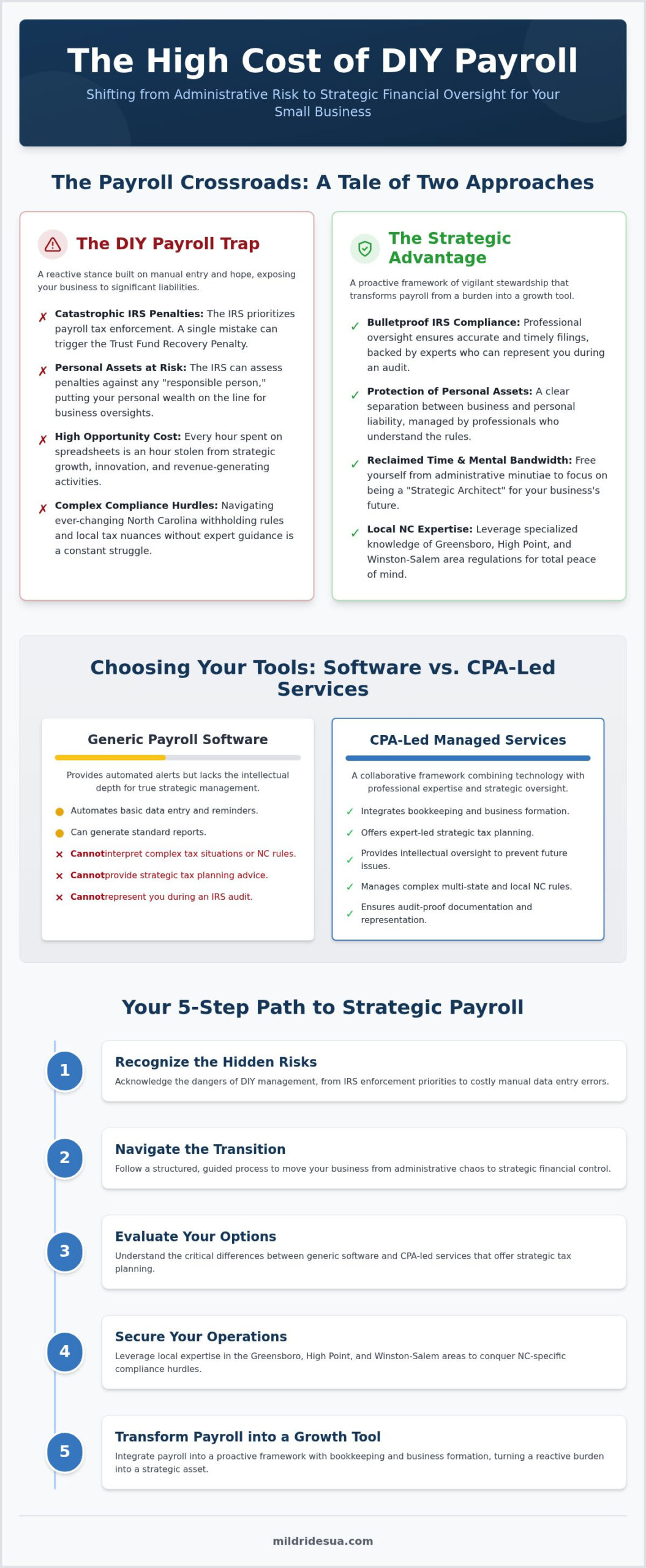
- Recognize the hidden risks of DIY management, including how the IRS prioritizes payroll tax enforcement and the dangers of manual data entry errors.
- Navigate the transition by following a structured 5-step guide designed to move your business from administrative chaos to strategic financial oversight.
- Evaluate the critical differences between generic software and outsourced payroll services for small business that offer CPA-led strategic tax planning.
- Secure your operations against North Carolina specific compliance hurdles by leveraging local expertise in the Greensboro, High Point, and Winston-Salem areas.
- Transform payroll from a reactive burden into a proactive growth tool through a collaborative framework that integrates bookkeeping and business formation.
The Hidden Risks of DIY Payroll Management for Small Businesses
Managing payroll manually often starts as a cost-saving measure, yet it frequently evolves into a significant liability for the growing enterprise. Unlike larger corporations with dedicated departments, small business owners often act as their own compliance officers, assuming a role they aren’t fully trained to execute. This reactive stance creates a fragile foundation. When you’re buried in manual data entry, you aren’t just losing time; you’re losing the strategic foresight necessary to scale. Transitioning to professional outsourced payroll services for small business transforms this dynamic by replacing administrative drudgery with expert-led stewardship.
The Reality of IRS Payroll Tax Penalties
The IRS views payroll taxes as money held in trust for the government. If these funds aren’t handled correctly, the agency can invoke the Trust Fund Recovery Penalty. This isn’t just a business problem. It’s a personal one. The IRS can assess this penalty against any “responsible person,” meaning your personal assets could be at risk for business oversights. The timeline is unforgiving. A single missed filing can quickly escalate into a federal tax lien, damaging your credit and your reputation. While many software platforms provide automated alerts, they lack the intellectual depth to interpret complex North Carolina withholding rules or represent you during an audit.
Opportunity Cost: What Your Time is Really Worth
Every hour you spend reconciling spreadsheets is an hour stolen from your role as a Strategic Architect. Consider the true cost of being a “clerk” for your own company. If your goal is long-term stability, your focus must remain on revenue-generating activities and high-level growth. Vigilant management means looking forward, not just backward at last month’s errors. By moving toward outsourced payroll services for small business, you reclaim your mental bandwidth. This shift allows you to lead with a steady hand, knowing that your compliance is being managed with professional precision. You trade the anxiety of “what if” for the clarity of “what’s next,” ensuring your business remains a healthy, growing entity in the Greensboro, High Point, and Winston-Salem areas.
Beyond the simple act of cutting a check, the complexity of multi-state filings and local tax nuances can overwhelm even the most diligent owner. A reactive approach to bookkeeping is a risk to your stability. True growth requires a partner who stays continuously engaged, helping you navigate future challenges before they become crises. This proactive methodology ensures that your financial interests are protected with constant attention and high-level expertise.
How Outsourced Payroll Services Function: A Deep Dive into the Process
Unlike traditional, siloed processing, outsourced payroll services for small business operate as a collaborative framework. It’s a synchronized flow where your operational data meets professional expertise. This isn’t just about moving numbers from one column to another; it’s about building a single, integrated stream of information that encompasses time-tracking, benefits, and tax obligations. This proactive methodology ensures your complex interests are managed with constant attention. By establishing this partnership, you transition from a reactive state of “catching up” to a position of vigilant stewardship over your company’s financial health.
The Automated Lifecycle of a Pay Period
The process begins with seamless employee onboarding and flows through to direct deposit. One of the most protective features of this workflow is tax impounding. By setting aside tax liabilities as payroll is processed, you eliminate the risk of a massive, unexpected bill at the end of the quarter. This methodology protects your cash flow and ensures that funds are ready when the IRS requires them. Additionally, automated reporting streamlines workers’ compensation and 401(k) audits, providing a clear trail of documentation that stands up to scrutiny. It transforms a chaotic pay cycle into a methodical, steady, and reassuringly consistent rhythm that supports your long-term stability.
Strategic Oversight vs. Simple Data Entry
While many platforms focus on “real-time data,” they often fail to provide the intellectual oversight needed for future challenges. A Vigilant Guide does more than just watch the data flow. They verify its accuracy before it ever reaches a government agency. This professional review prevents year-end tax surprises that can derail your financial planning. Managing taxable perks and fringe benefits requires a nuanced understanding of current regulations to avoid triggering red flags. If you’re ready to move beyond basic automation, exploring comprehensive payroll and tax advisor services can provide the strategic depth your business deserves.
This transition from complexity to informed decision-making is the hallmark of a true growth partner. Continuous engagement means your advisor is looking forward, identifying potential hurdles before they impact your bottom line. Modern outsourcing is more than a software subscription; it’s an advisory relationship that stays engaged year-round. This means that when you hire a new team member or adjust benefits, the impact on your overall tax strategy is considered immediately. Unlike reactive systems that only flag errors after they occur, a managed service provides a protective layer of human expertise that guards your business trajectory.
Evaluating Your Options: Payroll Software vs. CPA-Led Managed Services
Choosing the right architecture for your financial operations is a pivotal decision for any growing firm. Many owners believe a software subscription is the final step in securing their compliance, yet automation alone often falls short of genuine strategic planning. True outsourced payroll services for small business involve more than just a digital interface; they require the intellectual oversight of a professional who understands your long-term trajectory. Unlike a reactive software platform, a CPA-led partnership offers a proactive methodology that transforms payroll from a monthly chore into a tool for tax optimization.
The Limits of Standalone Software
Automated platforms excel at repetitive tasks but lack the capacity for intellectual depth. When the IRS sends a notice or a complex question arises regarding North Carolina withholding rules, software support often directs you to a generic help article. This leaves you to navigate the crisis alone. Generic systems also suffer from the “garbage in, garbage out” phenomenon. If you misclassify an employee or enter data incorrectly, the software processes the error without hesitation. It won’t question the logic or warn you about potential audit triggers. For business owners in the Greensboro, High Point, and Winston-Salem areas, this lack of tailored care can lead to costly oversights that a subscription fee simply cannot cover.
The CPA Advantage: Proactive Partnership
A CPA-led approach integrates your payroll with a broader strategic vision. For example, implementing an S Corp election can significantly reduce your self-employment tax liabilities, but this strategy requires a precise balance between a “reasonable salary” and shareholder distributions. Software-only platforms won’t advise you on these nuances. By acting as a Strategic Architect, a CPA ensures your payroll, bookkeeping, and tax planning work in harmony. This holistic view provides a level of vigilant stewardship that protects your personal and professional assets.
Transitioning to a managed service provides the calm confidence that comes from professional IRS representation. You gain a steady hand in a complex environment, ensuring that your business formation and growth strategies are supported by accurate, compliant data. More than a mere transactional service, this partnership focuses on future-proofing your business. You trade the administrative burden for the clarity of informed decision-making, allowing you to focus on the trajectory of your company while experts manage the complexity of the regulatory landscape. Accurate small business financial statement preparation is a critical component of this holistic strategy, ensuring your reported numbers align with your payroll data and support sound tax planning.
5-Step Guide to Transitioning to Outsourced Payroll
Migrating your financial operations is a deliberate process that demands more than a simple data transfer. Unlike generic checklists that oversimplify the setup, a strategic transition to outsourced payroll services for small business ensures every historical detail is accounted for before your first live run. This methodical progression protects your long-term stability by identifying systemic issues early. By following a structured framework, you move from a reactive state of administrative clutter to a position of informed decision-making and vigilant stewardship.
Step 1 & 2: The Audit and Cleanup
Before moving a single record, you must assess your current financial architecture. This initial audit identifies unfiled returns or discrepancies that could haunt your future growth. A Vigilant Guide doesn’t just import data; they validate previous filings to ensure your historical records are bulletproof. Collecting accurate Year-to-Date (YTD) totals is essential for generating correct W-2s at year-end. If your current bookkeeping is messy, this is the moment for professional cleanup. This phase transforms complexity into a steady foundation, ensuring that you don’t carry old errors into your new, streamlined system.
Step 3: Navigating the NC Department of Revenue
Navigating the North Carolina Department of Revenue requires specific local expertise. You’ll need to register for an NC withholding ID and an Unemployment Insurance account if you haven’t already. Assigning a “Reporting Agent” is a critical step that allows your professional partner to handle filings on your behalf, providing you with much-needed relief from administrative drudgery. This ensures compliance with both state-wide rules and Greensboro-specific business requirements, maintaining your standing as a responsible employer in the Triad. If you’re ready to secure your business with expert oversight, contact us for specialized North Carolina payroll and tax support today.
Step 4 & 5: Communication and the Parallel Run
Phase four focuses on your team. A clear employee onboarding and communication strategy prevents confusion during the shift. You should explain the benefits of the new system, such as improved portal access or more reliable direct deposits. Finally, the “Parallel Run” serves as your ultimate safety net. By running your new system alongside your old one for at least one pay cycle, you verify accuracy before going live. This proactive methodology guarantees a seamless transition, giving you the calm confidence that your team will be paid correctly and your taxes will be filed on time. This final verification is what separates a Strategic Architect from a simple data entry clerk.
Navigating NC Payroll Compliance with a Strategic Growth Partner
North Carolina small businesses operate within a regulatory environment that demands specific local awareness. Unlike generic national providers, a regional partner understands that North Carolina withholding rules and unemployment insurance requirements aren’t mere checkboxes. They’re critical components of your financial architecture. When you choose outsourced payroll services for small business with a local focus, you gain an ally who understands the intersection of payroll, bookkeeping, and business formation. This holistic approach ensures your legal structure supports your tax strategy, particularly if you’re navigating the complexities of an S Corp election in the Triad.
Mildrid Esua, CPA, PLLC acts as a protective steward for entrepreneurs across Greensboro, High Point, and Winston-Salem. We don’t just process checks; we provide a vigilant oversight that shields you from the risks of unfiled taxes and IRS liens. This partnership allows you to move beyond the reactive “founder” mindset where you handle every administrative task yourself. Instead, you ascend to the role of CEO, focusing on high-level growth while we manage the intricate details of your compliance. It’s a transition from being a clerk of your own records to becoming a Strategic Architect of your company’s future.
Local Expertise in Greensboro and Winston-Salem
Our firm deepens its commitment to the local labor markets by supporting businesses in High Point, Burlington, and Kernersville. We understand the specific economic landscape of the Triad, which allows us to provide tailored advice that software-only solutions simply cannot replicate. Having a local CPA means you have a steady hand nearby to handle North Carolina specific withholding changes or local business requirements. This proximity fosters a year-round advisory relationship that feels like a proactive partnership rather than a distant, transactional service. We stay continuously engaged with your business trajectory, ensuring that as your team grows, your payroll strategy evolves alongside it.
Your Next Steps: From Complexity to Clarity
The path to long-term stability begins with a single, informed decision. If you’re currently overwhelmed by manual data entry or the fear of a payroll tax audit, it’s time to request a consultative review of your current process. We invite you to experience the calm confidence that comes from professional stewardship. By shifting to a proactive methodology, you trade administrative complexity for the clarity of expert-led management. This is your opportunity to secure your business with a growth partner who is as invested in your success as you are. Let us handle the complexity so you can reclaim your time and focus on the strategic intent of your enterprise.
Secure Your Growth Through Strategic Stewardship
Transitioning your operations from manual data entry to a professional framework is a pivotal step toward long-term stability. You’ve learned that the risks of DIY management, from IRS liens to missed North Carolina withholding deadlines, are simply too high to ignore. By embracing outsourced payroll services for small business, you don’t just offload a task; you gain a Strategic Architect who integrates payroll with S Corp optimization and year-round tax planning. This shift allows you to lead with a steady hand, focusing on the trajectory of your enterprise while experts handle the regulatory complexity.
Mildrid Esua, CPA, PLLC serves as a vigilant guide for entrepreneurs across Greensboro and the wider Triad area. We provide expert IRS representation and dedicated local support, ensuring your business remains compliant and your personal assets stay protected. It’s time to move from administrative drudgery to the clarity of informed decision-making. Schedule a Consultation with Mildrid Esua, CPA, PLLC to Optimize Your Payroll and experience the calm confidence of professional stewardship today. Your business deserves a partner who is as forward-looking as you are.
Frequently Asked Questions
Is it cheaper to do payroll myself or outsource it?
Outsourcing often proves more cost-effective when you factor in the value of your time and the price of potential IRS penalties. While DIY software seems inexpensive, the “clerk” hours you invest subtract from revenue-generating activities. Professional outsourced payroll services for small business provide a protective layer that prevents expensive errors. You trade a predictable fee for the prevention of catastrophic tax liens and the mental bandwidth to grow your company.
What is the difference between a payroll service and a PEO?
A Professional Employer Organization (PEO) enters into a co-employment relationship with your staff, often taking control over benefits and workers’ compensation. Conversely, a payroll service acts as your administrative and strategic partner without assuming ownership of your employees. This allows you to maintain full control over your culture and hiring decisions while offloading the complexity of compliance and tax filings to a Vigilant Guide who understands your specific goals.
Can an outsourced payroll service handle my North Carolina state taxes?
Yes, a specialized provider handles the registration and filing for North Carolina withholding and unemployment insurance. They manage the specific requirements of the NC Department of Revenue, ensuring your accounts in Greensboro or Winston-Salem remain in good standing. This local expertise is vital because North Carolina has unique reporting cycles and rules that generic, national software platforms might miss or misinterpret during a busy season.
What happens if my payroll provider makes a mistake with the IRS?
Legally, the IRS holds the business owner responsible for all tax liabilities, regardless of who processed the data. However, when you partner with a CPA for outsourced payroll services for small business, you gain a representative who can advocate on your behalf. Unlike software companies that offer limited support, a CPA firm provides expert IRS representation to resolve discrepancies and mitigate penalties, acting as a steady hand in a complex environment.
How long does it take to switch to a new payroll provider?
A thorough transition generally requires four to six weeks to ensure historical data is validated and tax accounts are correctly linked. This timeline allows for a “parallel run” where your new system is tested against the old one to verify accuracy. Rushing this process can lead to messy bookkeeping and unfiled returns. A methodical, steady approach guarantees that your first live pay cycle is seamless and compliant.
Do I still need a bookkeeper if I have a payroll service?
Yes, you still require bookkeeping to manage the broader financial health of your enterprise. While payroll handles employee compensation and taxes, bookkeeping tracks your overall cash flow, expenses, and vendor payments. Integrating these two functions creates a comprehensive financial architecture. This synergy allows your Strategic Architect to provide clearer insights into your profitability and helps you make informed decisions about future business expansion or equipment investments.
Can a CPA help me resolve back payroll taxes while managing my current payroll?
Absolutely. A CPA firm specializing in tax resolution can address unfiled returns and existing tax liens while simultaneously establishing a compliant payroll system for your current team. This dual approach stops the cycle of reactive management. By resolving past debts and implementing proactive stewardship, you transition from a state of financial crisis to long-term stability, protecting your business trajectory from further IRS scrutiny.
How does S Corp election affect how I pay myself through payroll?
An S Corp election requires you to pay yourself a “reasonable salary” through a formal payroll system before taking shareholder distributions. This strategy significantly reduces your self-employment tax burden, but it must be managed with precision to avoid IRS red flags. Your CPA ensures the balance between your W-2 wages and distributions meets regulatory standards. This proactive methodology transforms a complex tax requirement into a powerful tool for wealth preservation.