

The structural integrity of your new enterprise is not determined by your first successful sale, but by the tax architecture you establish behind the scenes. For many entrepreneurs in the Greensboro and Winston-Salem area, the transition from a visionary idea to a functional business is often shadowed by the persistent fear of an IRS audit or the overwhelming complexity of disorganized bookkeeping. It’s a common feeling; the weight of compliance can feel like a barrier to the very growth you’re working so hard to achieve. Unlike a reactive approach that only addresses problems during tax season, a proactive strategy ensures your business remains protected and profitable year-round.
By identifying common tax mistakes for new businesses early on, you can transform these potential liabilities into a strategic advantage. This 2026 guide is designed to provide you with a clear understanding of compliance requirements and a roadmap for significant tax savings. We’ll explore the critical pitfalls that often derail new owners, from the nuances of quarterly estimated tax payments to the substantial benefits of an S Corp election. You will gain the peace of mind that comes from professional stewardship, allowing you to focus on your long-term trajectory with confidence and clarity.
Key Takeaways
- Understand why entity selection is more than a formality and how the right structure protects your venture from being classified as a hobby by the IRS.
- Discover why maintaining separate financial accounts is a non-negotiable step to preserve your legal liability protection and simplify your recordkeeping.
- Learn to identify and avoid common tax mistakes for new businesses by implementing an S Corp election to reduce your self-employment tax liability.
- Master the quarterly estimated tax schedule to eliminate the stress of underpayment penalties and ensure your business remains in good standing year-round.
- Transition from reactive filing to a proactive, strategic partnership that integrates Greensboro-specific compliance into your long-term growth plan.
Overlooking the Structural Foundation: Entity Selection and EIN Errors
Establishing the foundation of your business requires more than a visionary mindset; it demands a deliberate architectural choice regarding your legal and tax structure. Many entrepreneurs in the Greensboro and Winston-Salem area launch their ventures as sole proprietorships by default, unaware that this lack of formal structure is one of the most common tax mistakes for new businesses. Choosing an entity type without a strategic assessment of your long-term goals often leads to missed opportunities for tax optimization and increased vulnerability to personal liability.
The Default Entity Trap
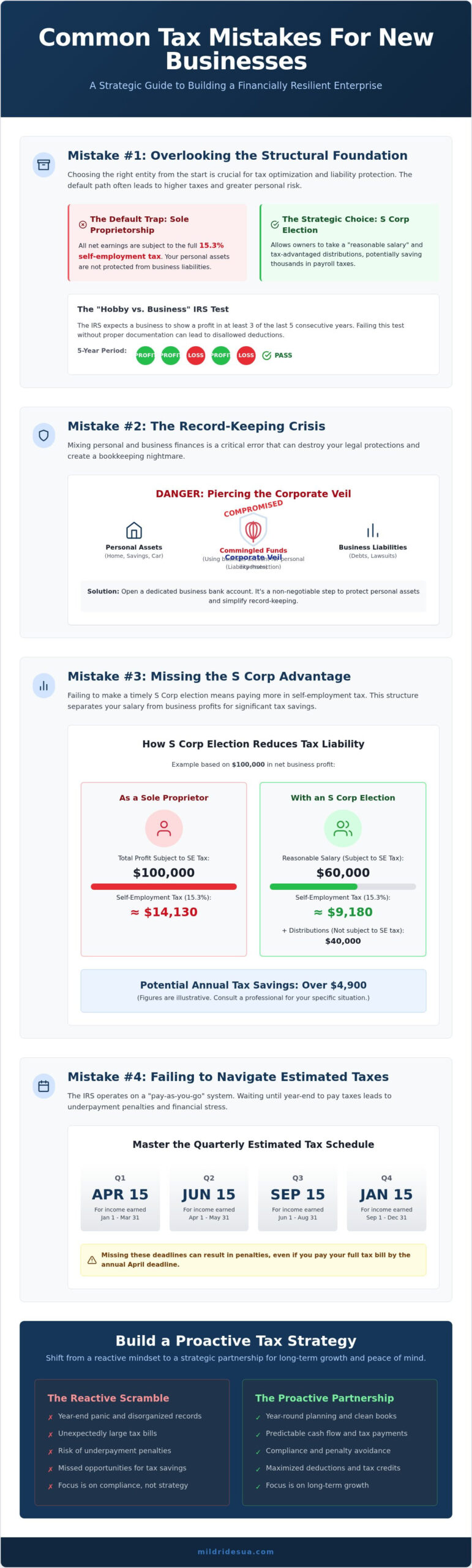
While a sole proprietorship is the simplest structure to initiate, it often results in a heavier tax burden compared to more sophisticated options. Unlike an LLC or a corporation, a sole proprietor is subject to the full 15.3% self-employment tax on all net earnings. For growing businesses in High Point, transitioning to an S Corp election can be a transformative strategy. This election allows owners to separate business profits from a “reasonable salary,” potentially saving thousands in payroll taxes. A deep dive into understanding corporate tax in the U.S. reveals that while initial filings aren’t permanent, the timing of an entity change is critical to avoid double taxation or administrative penalties. A proactive approach ensures your structure evolves alongside your revenue.
Establishing an IRS-Compliant Profit Motive
The IRS maintains a vigilant watch over new ventures to distinguish between legitimate commercial enterprises and personal hobbies. This “Hobby vs. Business” trap is a significant risk for those who fail to demonstrate a clear profit motive. Generally, the IRS applies the “3 out of 5 years” rule, expecting a business to show a profit in at least three of the last five consecutive years. To safeguard your deductions, you must maintain meticulous records that prove your commercial intent. This includes preserving a separate business plan, marketing materials, and evidence of professional consultation. When your venture consistently reports losses without these supporting documents, the IRS may reclassify your business as a hobby, retroactively disallowing your business deductions and triggering a complex resolution process.
Structural integrity also extends to your identification with federal authorities. A frequent error involves owners using their personal Social Security Number (SSN) for business transactions instead of a dedicated Employer Identification Number (EIN). Relying on an SSN creates an unnecessary link between your personal identity and business liabilities, which can compromise your asset protection. Obtaining an EIN is a foundational step that signals to the IRS that you’re operating a distinct, professional entity. Avoiding these early structural errors is the first step in building a resilient business that’s prepared for growth rather than sidelined by avoidable scrutiny.
The Recordkeeping Crisis: Mixing Personal and Business Finances
Maintaining a distinct separation between personal and professional finances is a fundamental requirement for any serious enterprise. While the initial excitement of a new venture often leads to a “spend now, sort later” mentality, this lack of financial boundaries is among the most frequent common tax mistakes for new businesses. A separate business bank account isn’t merely a convenience; it’s a non-negotiable pillar of your business architecture that ensures every dollar is accounted for with professional precision.
Piercing the Corporate Veil
When an owner uses business funds for personal rent, groceries, or entertainment, they are engaging in “commingling.” This practice provides a direct path for the IRS or legal adversaries to “pierce the corporate veil.” Once this veil is compromised, your personal assets, including your home and savings, may no longer be shielded from business liabilities. The IRS frequently identifies common tax errors involving the use of business accounts for personal expenses, which often results in the immediate disqualification of related deductions. Establishing a rigorous audit trail from your first transaction ensures that your business remains a protected, independent entity in the eyes of the law.
Maximizing Deductions Through Vigilant Tracking
Disorganized recordkeeping doesn’t just invite scrutiny; it causes you to leave significant capital on the table. Many entrepreneurs miss out on legitimate deductions because they lack a systematic way to capture their costs. In 2026, the IRS increasingly emphasizes digital recordkeeping over physical receipts, making real-time tracking essential for compliance. Commonly overlooked deductions include:
- Dedicated home office space and associated utilities.
- Continuing education, professional development, and certifications.
- Business travel and the standard mileage rate, which is 72.5 cents per mile for the first half of 2026.
Relying on “reconstructive bookkeeping” during an audit is an expensive and high-stress endeavor. It involves paying a professional to piece together a historical narrative from fragmented data while facing the pressure of an active inquiry. Strategic owners recognize that monthly bookkeeping for small businesses is a strategic investment that pays dividends in clarity and peace of mind. By maintaining constant attention to your ledger, you transform your financial records from a source of anxiety into a tool for informed decision-making. If you’re currently managing a backlog of receipts, our team can help you establish a clean, compliant system that protects your interests.
Missing the S-Corp Advantage: Timing and Self-Employment Tax Traps
Many entrepreneurs in the Triad area operate under the assumption that their initial entity structure is sufficient for long-term growth. However, failing to optimize for tax efficiency is among the most persistent common tax mistakes for new businesses. As a sole proprietor or single-member LLC, you’re responsible for the full 15.3% self-employment tax on every dollar of net profit. This consists of 12.4% for Social Security up to the $184,500 income ceiling for 2026 and 2.9% for Medicare. Unlike a standard LLC, an S Corp election allows you to bifurcate your income into a salary and a shareholder distribution, where only the salary portion is subject to payroll taxes.
Timing is the most critical variable in this strategic transition. For calendar-year businesses, the deadline to file Form 2553 for the 2026 tax year is March 16, 2026. Missing this narrow window can cost thousands in avoidable tax liabilities, effectively forcing you to wait an entire year before you can implement these savings. Proactive planning ensures you don’t fall victim to this rigid administrative timeline.
The Mechanics of Self-Employment Tax Reduction
The core of the S Corp strategy lies in establishing “Reasonable Compensation.” The IRS requires that owner-employees pay themselves a salary consistent with what they’d pay a third party for the same professional services. Determining this figure is a delicate balance; set it too low, and you invite an audit; set it too high, and you erode your tax savings. For a Greensboro startup generating consistent revenue, the delta between your total profit and your reasonable salary represents a pool of capital that remains exempt from self-employment tax. You can find a detailed breakdown of these specific thresholds in our S Corp election for self employment tax 2026 guide. Consulting the IRS Tax Guide for Small Business provides further context on how the federal government distinguishes between business income and earned wages.
The Risks of Incorrect S Corp Implementation
While the benefits are substantial, a DIY approach to S Corp management often results in severe payroll compliance failures. An S Corp isn’t just a one-time filing; it’s an operational shift that requires a formal payroll system even for one-person businesses. Common errors, such as failing to file quarterly Form 941s or neglecting to withhold the appropriate taxes, can void your status and trigger significant penalties. Mildrid Esua, CPA, PLLC acts as a “Strategic Architect” for your transition, ensuring your entity remains compliant while maximizing your capital retention. We provide the vigilant oversight necessary to navigate these complex requirements, allowing you to focus on scaling your Greensboro enterprise without the shadow of administrative error.
Compliance Failure: Navigating Estimated Taxes and Payroll Deadlines
The transition from an employee mindset to an ownership perspective requires a fundamental shift in how you view the calendar. Unlike a traditional salary where taxes are withheld automatically, business owners must navigate the “Tax Gap” by making payments throughout the year. Waiting until April to settle your total liability is one of the most frequent common tax mistakes for new businesses, often resulting in a liquidity crisis that could’ve been avoided with proactive planning. The IRS expects you to pay as you earn; failing to do so triggers underpayment penalties that, in 2026, hover between 7% and 8%.
Mastering the Quarterly Payment Cycle
Establishing a methodical rhythm for your 2026 estimated tax payments is essential for maintaining business stability. The quarterly deadlines for this year are April 15, June 15, September 15, and January 15, 2027. To manage these successfully, we recommend a four step process: review your net profit monthly, calculate your projected annual liability, set aside 25% to 30% of your gross income in a dedicated tax reserve account, and submit your payments electronically through the EFTPS system. This disciplined approach protects your cash flow from the shock of a massive year end bill. If you’ve already missed a deadline, the best course of action is immediate, proactive communication with the IRS to mitigate accumulating interest.
The Critical Nature of Payroll Compliance
For Greensboro entrepreneurs who have begun hiring, payroll compliance represents the highest area of personal risk. The IRS is particularly vigilant regarding the “Trust Fund Recovery Penalty.” This allows the government to hold business owners personally liable for unpaid payroll taxes, regardless of your corporate structure. If your business fails to remit withheld taxes, the IRS can pursue your personal bank accounts and assets to settle the debt. This danger is often compounded by the misclassification of workers. Treating a regular employee as a 1099 contractor to avoid payroll taxes is a high risk strategy that frequently leads to audits and severe financial penalties.
Maintaining a clear distinction between W-2 employees and independent contractors is a non-negotiable requirement for long term survival. When administrative errors occur or deadlines are missed, the situation requires immediate professional intervention. Our firm provides expert tax resolution in North Carolina to help owners navigate back tax issues and negotiate with the IRS from a position of strength. Don’t wait for a formal notice to arrive; secure a strategic review of your payroll systems today to ensure your venture remains on a path of compliant, sustainable growth.
Beyond the Scramble: Building a Proactive Tax Strategy in Greensboro
Most entrepreneurs view tax season as a seasonal hurdle to be cleared. This reactive mindset is a primary driver of common tax mistakes for new businesses, as it focuses on historical data rather than future opportunities. Unlike a traditional, transactional relationship that only activates in April, a proactive strategy involves year-round vigilant stewardship. It transforms tax compliance from a source of anxiety into a structural advantage, allowing you to retain more capital for reinvestment and growth. By treating your tax plan as a living document, you ensure that every business decision is made with an understanding of its long-term fiscal impact.
In regions like Greensboro and High Point, local tax nuances can significantly impact your bottom line. Whether it’s navigating privilege licenses or understanding the specific sales and use tax requirements for your industry, a generic approach often falls short. A proactive partnership ensures these local obligations are integrated into your broader financial architecture from day one. This level of foresight is what separates a struggling startup from a resilient, profitable enterprise.
Local Expertise for North Carolina Entrepreneurs
Navigating the North Carolina Department of Revenue (NCDOR) requires a high degree of involvement and specific regional knowledge. While software can help with federal forms, it rarely accounts for the intricacies of state-level filings or the specific economic climate of the Triad. Partnering with a small business accountant in Charlotte or Greensboro provides a protective layer of expertise. This local presence means your advisor understands the unique challenges facing North Carolina business owners, from state-specific tax credits to evolving regulatory changes. We act as a “Vigilant Guide,” ensuring you remain compliant at every level of government while staying focused on your regional growth goals.
Your Next Steps for 2026 Growth
As you navigate the 2026 tax year, the transition from DIY software to a professional partnership is a hallmark of business maturity. Software is a tool for data entry, but it cannot offer the strategic depth or foresight required to navigate complex IRS regulations. A mid-year tax health check is an essential first step in this transition. It allows us to identify potential red flags, optimize your current structure, and ensure your estimated payments are on track before the year-end rush. This proactive methodology provides a clear logical progression from complexity to informed decision-making.
We invite you to consult with Mildrid Esua, CPA, PLLC to build a tailored strategic roadmap for your venture. By moving beyond the scramble of reactive filing, you establish a resilient foundation that supports long-term stability. Let us serve as the steady hand that guides your Greensboro business through the complexities of the modern tax environment, turning potential liabilities into a strategic catalyst for your continued success.
Architecting Long-Term Stability for Your Enterprise
The transition from a visionary startup to a resilient market leader depends on the strategic foundation you build today. Navigating the complexities of entity selection, meticulous recordkeeping, and strict compliance schedules ensures your venture remains protected from avoidable IRS scrutiny. Unlike a reactive approach that only addresses problems after they arise, proactive management allows you to optimize your structure through specialized S Corp election strategies and year-round financial oversight. By identifying and correcting common tax mistakes for new businesses early in your journey, you transform potential liabilities into a sustainable competitive advantage.
Your growth deserves a partner who provides more than just data entry. At Mildrid Esua, CPA, PLLC, we offer expert IRS representation and local, Greensboro based professional stewardship designed to safeguard your long-term interests. We invite you to secure your business’s financial future with a strategic tax consultation from Mildrid Esua, CPA, PLLC. With a steady hand and a forward-looking perspective, we’ll help you navigate the 2026 tax landscape with confidence. Your success is a marathon, and we’re committed to being your vigilant guide every step of the way.
Frequently Asked Questions
What is the most common tax mistake for new business owners in North Carolina?
The most frequent error for Greensboro entrepreneurs is neglecting North Carolina specific requirements, such as the privilege license or local business personal property tax filings. Unlike federal obligations, these local mandates are often overlooked during the initial scramble of business formation. Failing to register with the North Carolina Department of Revenue (NCDOR) creates immediate compliance gaps that can lead to administrative penalties and unnecessary scrutiny during your first year of operation.
Do I really need to pay taxes quarterly if my business isn’t profitable yet?
You aren’t required to make estimated payments if you expect to owe less than $1,000 in tax for the year after withholding and credits. However, if your venture is part of a larger financial picture with other income sources, you might still face underpayment penalties. We recommend a mid-year review for High Point startups to ensure you aren’t building a significant liability that could disrupt your cash flow when you finally reach profitability.
Can I deduct my home office if I also use the room for personal activities?
No, the IRS maintains a strict “exclusive use” policy for the home office deduction. The space must be used solely for your trade or business; using the room as a guest bedroom or for personal storage disqualifies the claim. For business owners in Winston-Salem, it’s vital to document the dedicated area accurately. You can choose between the simplified method or the actual expense method to maximize your return while maintaining audit-ready records.
How do I fix a tax mistake I made in my first year of business?
Correcting common tax mistakes for new businesses typically involves filing an amended return, such as Form 1040-X, to rectify the oversight before it triggers an IRS inquiry. If the error involves structural issues or unpaid payroll taxes, it is essential to seek professional IRS representation immediately. Taking a proactive stance by disclosing the error demonstrates good faith and can often result in reduced penalties. Our firm specializes in resolving these early-stage discrepancies to restore your business’s standing in the Greensboro area.
What is the difference between an LLC and an S Corp for tax purposes?
An LLC is a legal business structure, while an S Corp is a specific tax election made with the IRS. While a standard LLC is taxed as a pass-through entity where you pay self-employment tax on all profits, an S Corp allows you to pay yourself a reasonable salary and take the remaining profit as a distribution. This strategic separation can significantly reduce your 15.3% self-employment tax burden as your Burlington enterprise grows.
How long should I keep my business tax records and receipts?
You should generally maintain your business records and receipts for at least three years from the date you filed your original return. However, we advise our clients in Kernersville to keep records for seven years if they claim a loss for worthless securities or bad debt deductions. In 2026, the IRS increasingly favors digital recordkeeping; ensure your electronic backups are organized and accessible to satisfy any future requests for verification or audit support.
What happens if I can’t afford to pay my business taxes on time?
If you cannot settle your liability immediately, you should still file your return on time to avoid the 5% per month failure-to-file penalty. Once filed, you can pursue tax resolution services such as an installment agreement or an offer in compromise. For business owners in Jamestown, acting quickly to address back taxes prevents the IRS from issuing tax liens or levies against your professional assets and preserves your long-term financial stability.
Is it better to use tax software or hire a CPA for a new small business?
While software is a useful tool for basic data entry, it lacks the intellectual depth and foresight of a dedicated CPA. A professional advisor serves as a “Strategic Architect,” looking beyond the current filing to identify long-term savings and structural optimizations. For new ventures in Oak Ridge and Summerfield, the customized guidance of a growth partner far outweighs the transactional nature of DIY software, providing the peace of mind necessary for scaling.