


The standard 15% FIRPTA withholding taken from your gross proceeds isn’t a final bill; it’s simply an aggressive security deposit held by the IRS. When managing the tax on the sale of U.S. real estate by foreign sellers, treating that massive deduction at settlement as an unavoidable loss is an expensive mistake.
Selling residential property across Greensboro or High Point often triggers genuine anxiety, especially when you’re caught navigating missing ITIN paperwork, confusing withholding calculations, and the dread of lengthy IRS refund delays. It’s deeply frustrating to watch your liquidity get locked away simply because statutory withholding rates ignore your actual net capital gain.
Unlike reactive approaches that leave your funds tied up for months, strategic planning lets you protect your equity before closing day arrives. You’ll discover how to legally minimize the cash withheld at closing, ensure airtight compliance to eliminate penalty risks, and accelerate your refund timeline. Here is the clear framework foreign property owners need to turn cross-border tax complexity into confident financial control.
Key Takeaways
- The standard 15% FIRPTA deduction applies to your gross sales proceeds rather than your net capital gain, making early calculation vital to preserving liquid capital.
- Strategic planning around the tax on the sale of U.S. real estate by foreign sellers can reduce withholding to 10% or even eliminate it entirely for qualifying residential properties under $300,000.
- Submitting IRS Form 8288-B before closing authorizes settlement agents to hold funds in escrow, preventing unnecessary capital transfers to the IRS while your certificate is reviewed.
- Securing an Individual Taxpayer Identification Number (ITIN) early eliminates costly remittance freezes and ensures the IRS properly credits your withheld funds.
- Filing a timely Form 1040-NR with dedicated international tax support accelerates the recovery of your excess withholding while ensuring full state and federal compliance.
Understanding FIRPTA: Why the IRS Withholds Funds from Foreign Sellers
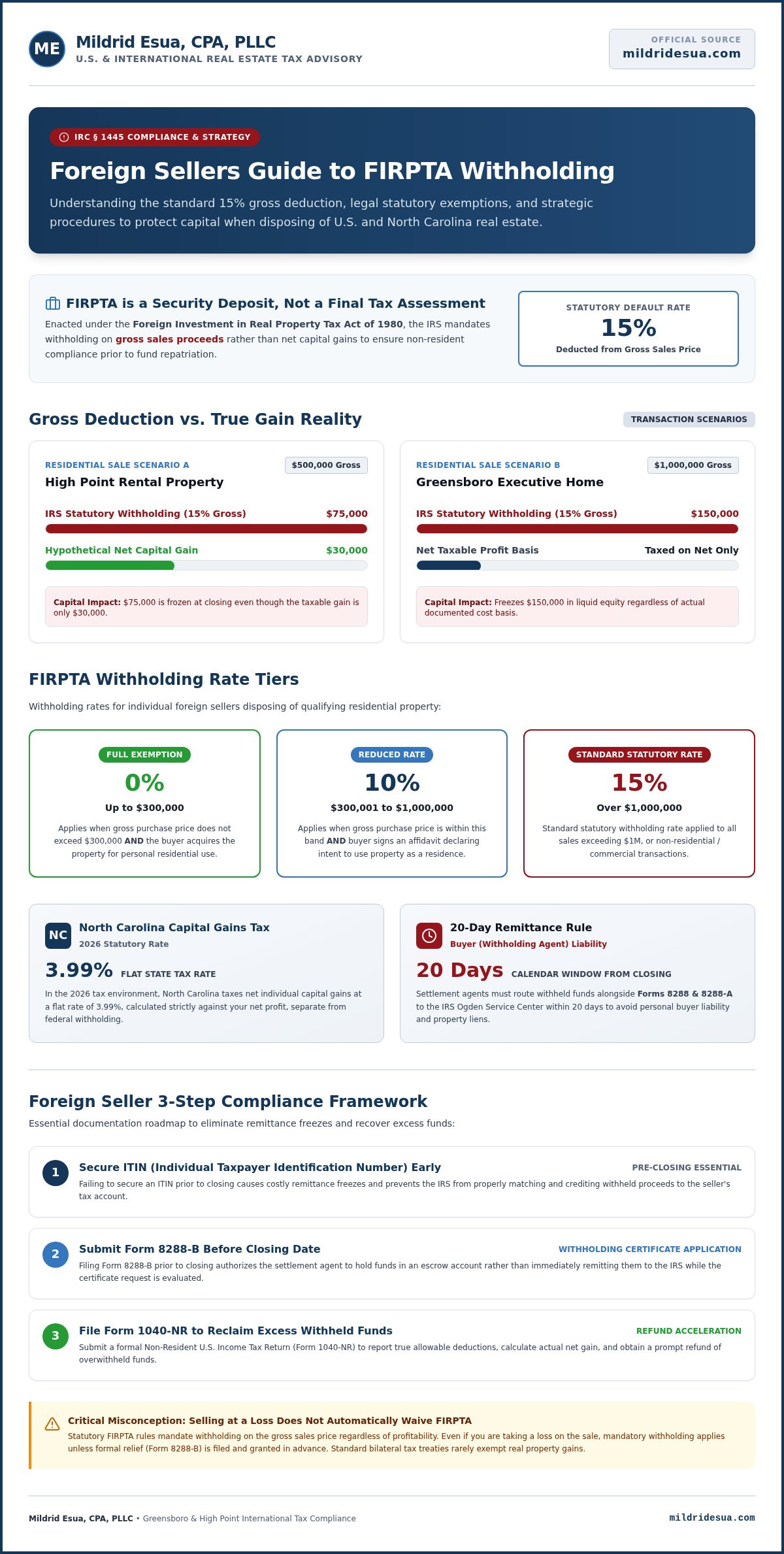
When non-resident individuals dispose of property in North Carolina, the statutory deduction applied at closing frequently comes as a shock. Enacted under the Foreign Investment in Real Property Tax Act (FIRPTA) of 1980, this federal framework was created to ensure that foreign persons fulfill their capital gains obligations before liquidating their domestic holdings. Under Internal Revenue Code § 1445, an automatic 15% withholding applies directly to the gross sales price, not your net profit. Think of this mechanism as an escrowed security deposit. The IRS retains these funds temporarily to guarantee you file a formal return, returning any excess once your true liability is calculated.
To grasp how this framework applies during real estate settlements, review this helpful breakdown of the statutory withholding mechanics:
Under federal guidelines, a foreign person includes any non-resident alien individual, foreign corporation, foreign partnership, or foreign trust that does not pass the Green Card Test or the Substantial Presence Test. When structuring the tax on the sale of U.S. real estate by foreign sellers, identifying your correct tax status early prevents critical delays during closing.
The Mechanism of U.S. Real Estate Tax Withholding
Federal law establishes that the buyer, technically termed the withholding agent, is personally responsible for securing the mandatory funds from gross settlement proceeds. Within 20 calendar days of closing, the settlement agent must route these funds alongside IRS Forms 8288 and 8288-A directly to the IRS Ogden Service Center. If this requirement is ignored, the IRS can assess the full unremitted balance directly against the buyer and place a lien on the property. For this reason, settlement attorneys across Greensboro and High Point adhere strictly to statutory guidelines, demanding comprehensive documentation before disbursing seller proceeds.
Common Misconceptions About Foreign Seller Taxes
A widespread assumption among non-resident investors is that selling an asset at an economic loss removes withholding requirements entirely. Statutory rules mandate withholding on the gross sales price regardless of profitability, meaning a seller taking a loss still faces an immediate deduction unless formal relief is granted in advance. Additionally, standard bilateral tax treaties rarely provide exemptions for gains derived from real property interests. In practice, FIRPTA functions strictly as an administrative collection mechanism rather than a separate tax assessment on your capital gains.
Navigating the tax on the sale of U.S. real estate by foreign sellers requires moving beyond reactive compliance toward structured planning. Clear documentation protects your proceeds from unnecessary deductions.
The 15% Withholding Requirement: Calculating Your Potential Liability
Gross proceeds and net profits are entirely different figures, yet statutory withholding treats them as the same. Standard IRS FIRPTA withholding requirements demand that settlement agents withhold 15% of the total purchase price, regardless of your actual gain. For example, disposing of a High Point rental for $500,000 diverts $75,000 straight into IRS custody. Selling an executive home in Greensboro for $1,000,000 freezes a staggering $150,000 at closing. If your original purchase price and documented capital additions left you with only $30,000 in net gain, this statutory deduction vastly exceeds what you actually owe.
In the 2026 tax environment, North Carolina taxes net individual capital gains at a flat 3.99%, while federal capital gains rates apply strictly to your net profit. Managing the tax on the sale of U.S. real estate by foreign sellers requires calculating these liabilities upfront so that excessive capital isn’t held hostage by federal clearinghouses.
The 10% Reduced Withholding Rate for Residences
You can lower statutory withholding from 15% down to 10% if the property sells for more than $300,000 but does not exceed $1,000,000, provided the purchaser intends to use it as a residence. The buyer must formally certify their commitment by signing an intent-to-reside affidavit at closing. Under federal regulations, the buyer or their family must occupy the home for at least 50% of the days the home is used during each of the first two 12-month periods post-transfer. On a $600,000 transaction, this single document preserves $30,000 of immediate liquid capital.
Withholding vs. Final Income Tax Liability
Determining your actual tax exposure involves calculating your adjusted tax basis: original purchase price, closing fees, and unrecovered structural capital improvements. For rental properties, accounting for mandatory depreciation recapture is critical. Maintaining clear financial tracking through structured monthly bookkeeping for small businesses ensures you capture every deductible dollar to determine your true excess withholding. Proactive sellers protect their capital before signing closing paperwork by coordinating directly with our international tax advisors to document basis and secure appropriate withholding relief.
Strategic Exceptions: How to Reduce or Eliminate FIRPTA Withholding
Median home prices in Greensboro and High Point hover between $275,000 and $295,000. Because local values sit directly beneath key statutory thresholds, foreign investors can often eliminate withholding entirely rather than forfeiting liquidity at the settlement table. Understanding these statutory carve-outs shifts the tax on the sale of U.S. real estate by foreign sellers from an unavoidable cash drain into a manageable closing detail.
The Withholding Certificate (Form 8288-B) Strategy
Unlike traditional transactions where funds immediately transfer to the IRS, a proactive seller can submit a Form 8288-B withholding certificate application. This filing requests IRS approval to withhold only the maximum tax actually owed on the net capital gain rather than a blanket percentage of gross revenue.
You must file this application on or before the closing date. Timely submission legally authorizes the settlement attorney to hold the funds in escrow instead of remitting them to the IRS within the standard 20-day window. For transactions resulting in zero tax liability, such as properties sold at a loss or qualifying under Section 1031 non-recognition provisions, this approach keeps your equity intact. Acting as your Strategic Architect, a seasoned advisor constructs the calculation package, guiding the submission through the standard 90-day IRS review without unnecessary disruptions.
The Buyer’s Affidavit of Residence
The cleanest path to full exemption applies to residential dispositions priced at $300,000 or below. If an individual buyer purchases the property to use as a home and executes an intent-to-reside affidavit, the statutory withholding rate drops to zero percent automatically.
Some purchasers hesitate to execute this paperwork because they worry about personal liability if their relocation plans shift. To meet the legal test, the buyer or their direct family must occupy the home for at least 50% of the days the residence is used during each of the first two 12-month cycles following closing. When transactions surpass the threshold or buyers decline to sign, securing an official withholding certificate remains the most reliable mechanism to manage the tax on the sale of U.S. real estate by foreign sellers.
The Role of ITINs and Form 8288-B in Real Estate Transactions
Securing an Individual Taxpayer Identification Number (ITIN) is non-negotiable for foreign property owners. If your identification number is missing from Form 8288-A at settlement, the IRS Ogden Service Center will refuse to date-stamp Copy B. Without that stamped form, you can’t substantiate your withheld funds on your year-end return or claim your refund. When orchestrating the tax on the sale of U.S. real estate by foreign sellers, submitting your Form W-7 ITIN application concurrently with Form 8288-B establishes tax standing and avoids administrative gridlock.
Step-by-Step: Securing a Withholding Certificate
Aligning your withholding with your true tax liability requires disciplined preparation well before closing:
- Compile Cost Basis Documentation: Gather the original purchase settlement statement, closing fees, and invoices documenting capital improvements to substantiate your net position.
- Execute Concurrent Filings: Submit Form 8288-B alongside Form W-7 to the IRS Austin ITIN Operation on or before the closing date.
- Formalize Escrow Instructions: Direct the closing attorney to hold the estimated tax liability in trust pending official IRS determination.
The statutory IRS review target for Form 8288-B is 90 days. During this window, your funds remain securely in local escrow. Once the IRS issues an approved certificate or notice of denial, the settlement agent has until the 20th day after the mailing date to disburse or remit the funds.
Avoiding Common Filing Errors
Timing errors routinely undermine foreign transactions across the Triad. Missing the closing date by even twenty-four hours forfeits your ability to suspend remittance; closing attorneys are then legally obligated to send the full 15% to Ogden within 20 calendar days. Mismatched taxpayer names between the deed, passport, and tax forms also lead to summary rejections.
An ITIN serves as the foundational key to unlocking withheld funds from IRS holding accounts.
Protect your equity from protracted clearing delays; partner with Mildrid Esua, CPA for dedicated FIRPTA withholding support to coordinate your filing before closing day arrives.
Navigating the Refund Process with a Greensboro International Tax Expert
Recovering excess funds requires closing the compliance loop through formal year-end reporting. Completing a U.S. Nonresident Alien Income Tax Return (Form 1040-NR) alongside North Carolina Form D-400 serves as your legal mechanism to reclaim overwithheld capital. While federal authorities reconcile gross withholding against your net capital gain, North Carolina assesses real estate profit at a flat 3.99% rate for the 2026 tax year. Local transactions also factor in Guilford County conveyance fees of $2.00 per $1,000 of value. Integrating these local requirements into a broader 2026 strategic tax planning guide positions foreign investors to preserve portfolio returns across the Triad.
Recovering Your Equity: The Final Refund Cycle
Foreign transferors without domestic wage income must submit Form 1040-NR by June 15 following the calendar year of sale. If you choose standard post-closing reconciliation rather than an early Form 8288-B withholding certificate, the IRS processes the return and issues your excess funds via direct deposit or mailed check. Tracking these funds demands persistent oversight. Processing queues at international service centers can stall returns for months if documentation shows the slightest variance. When administrative friction or unexpected IRS notices delay your recovery, securing expert tax resolution in North Carolina provides direct IRS representation to resolve disputes swiftly.
Why Mildrid Esua, CPA is Your Vigilant Guide
Unlike conventional accounting firms that treat foreign sales as routine paperwork, Mildrid Esua, CPA, PLLC acts as an active growth partner. We transition clients from transactional shock to long-term strategic stability, coordinating international tax services directly with local closing attorneys across Greensboro, High Point, and Winston-Salem. Successfully managing the tax on the sale of U.S. real estate by foreign sellers requires foresight, meticulous record-keeping, and continuous advocacy. Protect your real estate equity with a FIRPTA consultation to safeguard your capital before closing day arrives.
Secure Your Capital Before Closing Day
Managing the tax on the sale of U.S. real estate by foreign sellers doesn’t require forfeiting your liquidity to IRS holding accounts. Treating statutory deductions as unavoidable closing costs ties up substantial capital for months. By calculating your true net position upfront, executing timely withholding certificate applications, and securing your ITIN before settlement, you keep your equity protected from contract to final disbursement.
As a local Greensboro CPA with global reach, Mildrid Esua, CPA, PLLC acts as your vigilant guide through high-stakes cross-border transactions. Our specialized expertise in FIRPTA withholding and international tax compliance eliminates procedural guesswork, shielding you from penalties and unnecessary escrow freezes. Should the IRS issue unexpected inquiries, our strategic IRS representation provides foreign nationals with steady, authoritative advocacy.
Take charge of your transaction before closing documents are finalized. Schedule a Strategic FIRPTA Consultation with Mildrid Esua, CPA today to preserve your hard-earned equity.
Frequently Asked Questions
What happens if I sell my U.S. property at a loss as a foreign person?
Selling at a financial loss doesn’t automatically exempt your transaction from the statutory 15% withholding. Because settlement agents are legally bound to withhold against gross sales proceeds, you must proactively submit Form 8288-B on or before closing to establish zero tax liability. Alternatively, you can allow the funds to transfer to the IRS and file a non-resident tax return the following year to claim a full refund.
How long does it take the IRS to issue a FIRPTA refund in 2026?
Reclaiming overwithheld funds by filing Form 1040-NR typically takes six to nine months through standard international processing queues. However, filing a withholding certificate via Form 8288-B prior to closing follows a statutory 90-day review target. Once the IRS approves your reduced liability, the closing attorney releases your escrowed funds within 20 days, returning your liquid capital far more efficiently.
Can I avoid the 15% withholding if I am doing a 1031 exchange?
You can defer withholding during a Section 1031 exchange by providing the buyer with a formal non-recognition notice before closing day. If the transaction involves taxable boot or partial deferral, you must file Form 8288-B to adjust the tax on the sale of U.S. real estate by foreign sellers to match actual liability. Coordinating early with qualified intermediaries protects the deferred status of your proceeds.
Is the 15% withholding based on the profit or the total sales price?
Statutory withholding applies directly to the gross sales price rather than your actual net capital gain. If you sell a residential property in Greensboro for $400,000, the mandatory deduction is $60,000, even if your taxable profit is only $10,000 after allowable basis deductions. This critical distinction is why foreign sellers must calculate adjusted basis early to avoid locking up unnecessary equity.
What is an ITIN and why do I need one to sell my U.S. home?
An Individual Taxpayer Identification Number is a dedicated processing number issued by the IRS for foreign individuals who don’t qualify for a Social Security Number. You need an ITIN so the IRS can properly credit your withheld funds in Ogden. Without a valid number, the agency won’t return date-stamped copies of Form 8288-A, preventing you from claiming credits or refunds on annual returns.
Who is responsible for sending the FIRPTA withholding to the IRS?
The buyer is legally classified as the withholding agent and carries personal liability for ensuring funds reach the government. Within 20 calendar days after closing, the settlement attorney remits the withheld funds alongside Forms 8288 and 8288-A to the IRS Ogden Service Center. If this requirement is ignored, the IRS can collect the unremitted balance directly from the buyer alongside interest and severe penalties.
Can a tax treaty reduce the 15% FIRPTA withholding rate?
International tax treaties almost never reduce or eliminate the withholding tax on the sale of U.S. real estate by foreign sellers. Nearly all bilateral treaties grant primary taxing jurisdiction over real property to the country where the physical asset is located. Foreign owners can’t rely on treaty provisions to avoid settlement withholding; relief requires leveraging statutory residential exceptions or an approved IRS withholding certificate.
What documents do I need to prove my ‘basis’ to the IRS for a refund?
Proving your adjusted basis requires your original closing disclosure, title fees, legal costs, and receipts for permanent capital renovations. If you operated a rental property in High Point, you must also provide depreciation schedules from previous returns. Meticulous documentation substantiates your true net gain, allowing your CPA to calculate maximum tax liability accurately and recover all excess funds from the IRS.




Leave a Reply
Your email is safe with us.