


A formal business taxes lien is not an operational death sentence; it’s a structural puzzle that demands decisive, strategic negotiation. When tax authorities docket a public claim against your enterprise, the instinct is pure dread. You worry that a sudden bank levy will freeze payroll accounts overnight, commercial lenders will immediately suspend credit lines, and personal assets won’t stay protected from company payroll liabilities. You’re right to treat the notice with urgency, because administrative delay only invites aggressive collection actions.
Unlike reactive approaches that treat tax enforcement as a desperate scramble for cash, strategic resolution preserves your long-term commercial viability. In this guide, you will discover how to protect active business assets, maintain operational capital, and navigate federal and state tax lien removals with proactive CPA representation. We will unpack the exact path from damaging public filings to structured relief and formal lien withdrawals, showing you how to secure your enterprise’s financial future.
Key Takeaways
- Understand the statutory mechanics behind a business taxes lien to separate passive asset encumbrances from imminent, operations-halting bank levies.
- Identify how a public filing disrupts commercial credit facilities and learn proactive strategies to preserve working capital lines with institutional lenders.
- Differentiate between administrative relief options—including lien withdrawal, subordination, and discharge—to select the exact remedy that protects your enterprise balance sheet.
- Execute a structured, multi-step compliance roadmap that resolves back-tax liabilities while shielding personal assets from company payroll exposure.
- Discover why dedicated local CPA representation provides an essential strategic barrier against aggressive regional revenue officers and state collection agents.
Understanding the Business Taxes Lien: Mechanics and Statutory Origins
A business taxes lien is a statutory legal encumbrance that the government places on company property to secure unpaid obligations. Unlike a bank levy, which actively seizes operating capital from your deposit accounts, a tax lien establishes a legal claim of priority against your assets. Grasping the statutory mechanics of a tax lien is critical for protecting corporate liquidity before collection officers move from passive claims to active administrative enforcement.
The Creation of a Tax Lien: Assessment to Public Filing
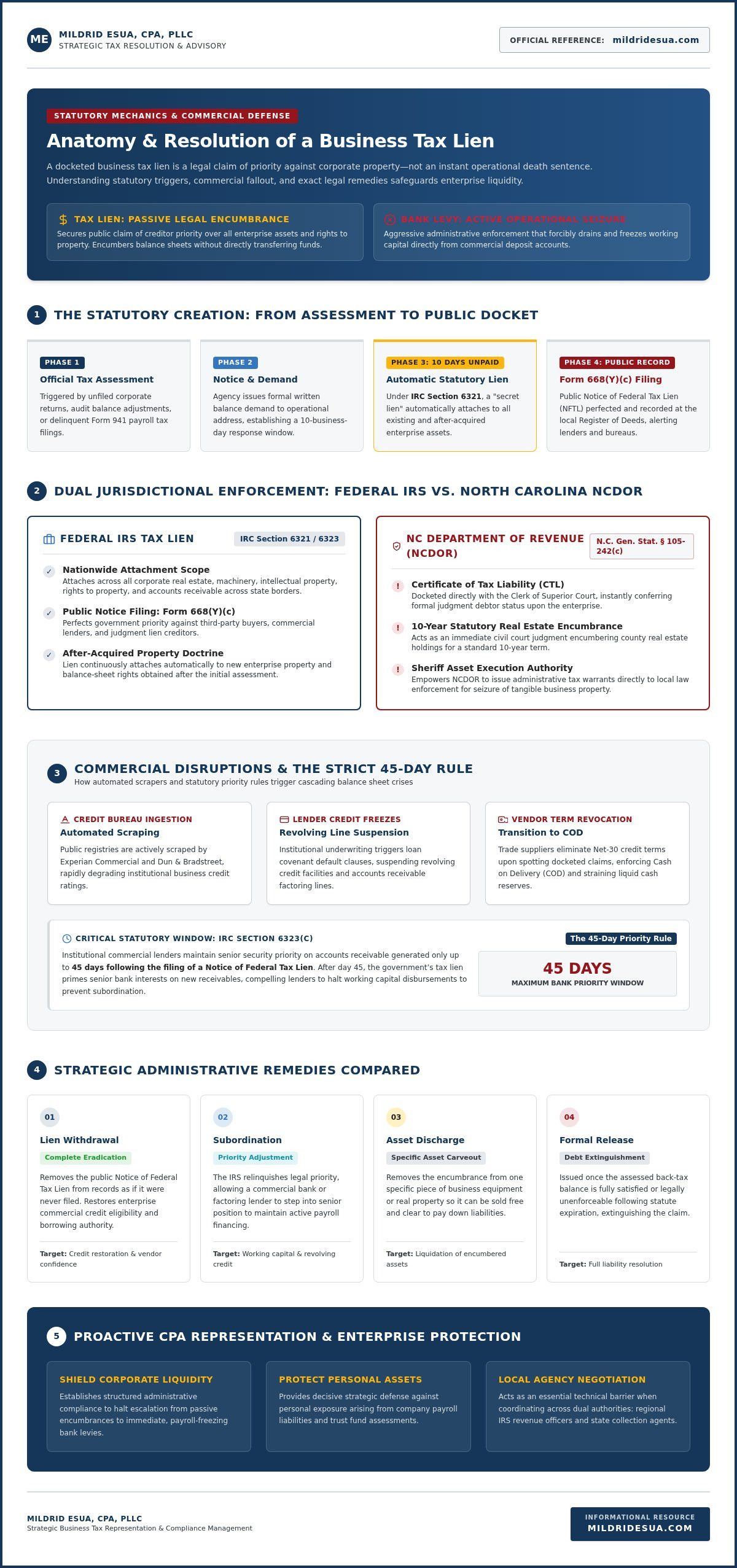
The lien process begins with an official assessment, typically triggered by unfiled corporate returns, audit adjustments, or delinquent Form 941 payroll filings. Once the taxing authority calculates the balance, it issues a formal Notice and Demand for Payment to your Greensboro operational address. If the liability remains unpaid after ten business days, an automatic statutory lien attaches to all current and after-acquired enterprise assets under IRC Section 6321.
Initially, this claim remains a “secret lien” between your enterprise and the agency. When the assessed debt surpasses administrative thresholds, the IRS perfects its claim against third parties by filing Form 668(Y)(c), the public Notice of Federal Tax Lien (NFTL). Once recorded at the Guilford County Register of Deeds, this public instrument alerts commercial lenders, damages credit ratings, and freezes conventional lines of credit.
Federal IRS Liens vs. North Carolina Department of Revenue Liens
Navigating dual-level tax compliance requires recognizing that federal and state tax claims operate through distinct legal mechanisms:
- Federal IRS Liens: Governed by the Internal Revenue Code, a federal business taxes lien attaches broadly across all company real estate, equipment, rights to property, and accounts receivable nationwide.
- North Carolina Department of Revenue (NCDOR) Liens: Rather than using a standard federal notice, NCDOR files a Certificate of Tax Liability (CTL) under N.C. Gen. Stat. § 105-242(c) with the Guilford County Clerk of Superior Court.
This state-level filing instantly gives your business judgment debtor status. A docketed CTL carries the immediate weight of a civil court judgment; it secures a ten-year encumbrance on Guilford County real estate and authorizes the state to dispatch tax warrants directly to the local sheriff for asset execution. Protecting your operations requires a coordinated legal defense that addresses both federal enforcement and state-level judgment dockets simultaneously.
Commercial Impact: How a Tax Lien Endangers Daily Business Operations
A docketed business taxes lien creates an instant shockwave throughout your enterprise’s financial ecosystem. While business leaders often hope the encumbrance stays sequestered between their entity and revenue authorities, automated public record scrapers immediately push the filing to credit bureaus like Experian Commercial and Dun & Bradstreet. According to authoritative IRS guidance on federal tax liens, this public instrument encumbers not only existing corporate property but also rights to future assets, triggering cascading operational disruptions.
Disruption of Commercial Banking and Working Capital Lines
Underwriting algorithms at Piedmont Triad financial institutions monitor UCC filings and Guilford County public land registries constantly. The moment a business taxes lien surfaces, commercial lenders frequently trigger loan default clauses, freezing revolving credit lines and factoring facilities. Under IRC Section 6323(c), institutional lenders face the rigid 45-day rule, where the tax lien takes priority over senior security interests on after-acquired accounts receivable. To avoid falling into a subordinate position, banks halt disbursements, starving payroll and daily operations.
Damage to Vendor Relationships and Supply Chains
Key trade suppliers monitor public records just as closely to safeguard their own inventory exposure. Upon spotting a docketed lien, vendors routinely revoke net-30 credit terms and demand cash on delivery (COD). This sudden contraction of trade credit crushes working liquidity precisely when cash reserves are already strained. For Greensboro contractors and suppliers, an active lien also disqualifies entities from bidding on municipal and state contracts, closing off essential commercial revenue streams.
Personal Exposure: The Trust Fund Recovery Penalty (TFRP)
Operating as an LLC or corporation provides zero shelter against unpaid employee withholding taxes. Under IRC Section 6672, the IRS aggressively assesses the Trust Fund Recovery Penalty against any “responsible person” deemed to have willfully neglected to collect and remit payroll withholdings. Revenue officers can assess 100% of the unpaid trust fund liability directly against corporate officers, placing personal residences, personal deposit accounts, and personal retirement funds in direct jeopardy. Reviewing proven payroll tax debt resolution strategies before an aggressive officer initiates Form 4180 interviews is essential to insulate personal wealth. If your company faces mounting payroll liabilities, partnering with the proactive tax resolution advisors at Mildrid Esua, CPA establishes a defensive perimeter around both corporate and personal assets.
Strategic Remedies: Discharge, Subordination, Release, and Withdrawal Compared
Most commercial owners assume that paying an assessed balance in full is the only remedy for a business taxes lien. In practice, waiting for complete debt satisfaction while an active encumbrance degrades your credit rating can bankrupt an otherwise solvent enterprise. Federal and state tax frameworks offer distinct administrative relief mechanisms tailored to preserve working capital while a formal resolution unfolds.
Lien Release vs. Complete Administrative Withdrawal
A lien release under IRC Section 6325 occurs when the tax obligation is fully settled, compromised, or lapses after the ten-year statutory collection window. While a release updates the public record to show zero balance, the historical filing remains visible on commercial credit profiles. In contrast, an administrative lien withdrawal via IRS Form 12277 expunges the public Notice of Federal Tax Lien entirely, legally treating it as though it were never filed.
Under the federal Fresh Start guidelines, small businesses with qualifying installment agreements can petition for complete withdrawal. Doing so instantly rehabilitates commercial standing with institutional lenders. Parallel remedies exist under North Carolina General Statutes § 105-242, where settling a Certificate of Tax Liability enables cancellation of the judgment docket in the Guilford County Clerk’s index.
Lien Subordination: Preserving Refinancing and Commercial Credit
When an enterprise requires working capital to stay operational, lien subordination under IRC Section 6325(d) provides a crucial lifeline. By submitting Form 14134, you request the IRS to surrender its priority position to an incoming commercial lender or factoring firm.
- Commercial Justification: You must demonstrate that subordinate financing injects capital that directly facilitates operations, ultimately increasing debt-service capacity.
- Asset Refinancing: Greensboro manufacturing or logistics firms often subordinate encumbered machinery to secure asset-backed funding dedicated to reducing delinquent tax rolls.
Discharge of Specific Business Property
If your enterprise plans to liquidate a specific asset to satisfy debt, requesting a Certificate of Discharge under IRC Section 6325(b) via Form 14135 clears the business taxes lien from that designated parcel or equipment. The remaining corporate assets stay encumbered, but the targeted asset transfers free of tax claims. Applying at least 45 calendar days before closing ensures transaction proceeds flow smoothly into negotiated debt reductions without title delays.
Step-by-Step Execution Plan: How to Systematically Resolve a Business Tax Lien
Resolving an active business taxes lien demands an organized, evidence-backed strategy rather than hurried telephone calls to collection call centers. Revenue agencies operate under rigid statutory protocols; negotiating relief requires matching their administrative sequence step for step. By deploying a systematic remediation plan, you replace panic with professional leverage, shielding operational cash flow from aggressive administrative seizures.
Phase 1: Establishing Full Filing and Deposit Compliance
The IRS and NCDOR refuse to entertain settlement discussions or lien modifications while missing returns remain on your record. Bringing your corporate accounts into strict filing compliance constitutes the non-negotiable first phase of defense. You must immediately file all delinquent Form 1120 corporate returns, state sales tax reports, and Form 941 payroll filings. Securing professional assistance with unfiled corporate tax returns allows you to reconcile back years rapidly and request formal collection holds while your accounts are brought current.
Simultaneously, your business must establish current-quarter federal tax deposits. Demonstrating that your enterprise can cover ongoing payroll withholdings stops revenue officers from treating your company as an escalating liability.
Phase 2: Compiling Corporate Financial Disclosures (Form 433-B)
Once current compliance is established, you must document your entity’s true financial condition using IRS Form 433-B (Collection Information Statement for Businesses). This exhaustive accounting covers tangible assets, accounts receivable, and allowable monthly operating expenses.
- Asset Valuation: Appraise machinery, vehicles, and inventory at net realizable equity rather than historical book values.
- Accounts Receivable Aging: Discount uncollectible invoices to avoid artificially inflating your enterprise liquidity.
- Cash Flow Caps: Accurately substantiate working overhead so the IRS does not siphon funds needed for essential payroll.
Phase 3: Structuring Payment Terms and Securing Public Relief
With an accurate Form 433-B established, your representative can negotiate sustainable resolution terms. Depending on cash flow, options include an In-Business Trust Fund Installment Agreement or an Offer in Compromise based on doubtful collectibility. If your aggregate unpaid balance is $25,000 or less, you can pair a Direct Debit Installment Agreement with an IRS Form 12277 petition for complete lien withdrawal after three consecutive automated payments.
Evaluating tailored IRS tax lien relief options in NC ensures your business secures the exact balance between statutory compliance and commercial flexibility. To protect your working capital and execute this roadmap with seasoned guidance, schedule a consultation with the tax defense team at Mildrid Esua, CPA today.
Partnering with a Local CPA for Decisive IRS Representation and Future Protection
Confronting an active business taxes lien requires more than clerical correspondence; it demands a dedicated strategic shield between your leadership team and revenue enforcement officers. When an IRS Revenue Officer appears at your facility or an NCDOR compliance agent demands immediate accounting records, direct conversations without representation expose your enterprise to significant operational risk. Partnering with a licensed Certified Public Accountant establishes an authoritative barrier, transforming an adversarial collection process into an orderly, professional negotiation.
The Shield of Professional Representation: Form 2848 in Action
Executing IRS Form 2848 (Power of Attorney) and North Carolina Form Gen-58 officially redirects all agency communications to your representative. Collection officers are legally barred from contacting you directly or showing up unannounced at your Greensboro job sites. Every formal information document request is screened, organized, and substantiated before submission. This strategic filter prevents inadvertent disclosures that could compromise entity protections or trigger personal assessment interviews. Exploring comprehensive tax resolution services in North Carolina ensures every administrative petition is structured for maximum debt mitigation and rapid asset protection.
Local Triad Advantage: Navigating Regional Enforcement Dynamics
Unlike distant, high-volume call centers that treat regional tax controversies as anonymous case files, local CPA representation offers distinct operational advantages:
- Direct Field Office Engagement: Direct familiarity with personnel at the NCDOR Greensboro Service Center on Pinecroft Road facilitates face-to-face negotiations that out-of-state mills cannot match.
- Synchronized State and Federal Defense: Regional CPAs resolve federal payroll tax defaults and North Carolina corporate assessments in parallel, preventing cross-agency audit escalations.
- Customized Continuity: You collaborate with a dedicated advisor committed to your firm’s long-term survival throughout Greensboro, Winston-Salem, and High Point.
Building Permanent Institutional Compliance Post-Resolution
True financial stewardship looks beyond extinguishing an active business taxes lien; it builds the accounting infrastructure necessary to prevent future liabilities. Our firm couples aggressive tax defense with precise small business bookkeeping, structuring automated federal tax deposits and real-time quarterly forecasting. By establishing disciplined financial protocols, your enterprise moves from reactive crisis management into sustainable commercial growth. Protect your enterprise today by scheduling a confidential tax resolution consultation to restore stability to your balance sheet.
Reclaim Operational Control and Secure Your Commercial Future
A docketed business taxes lien doesn’t have to compromise your company’s operational viability or destroy decades of hard work. By moving swiftly into compliance, exploring strategic remedies like subordination and administrative withdrawal, and presenting verified financials, you can protect essential credit lines and shield personal assets from payroll liabilities. Decisive action transforms an overwhelming enforcement threat into a structured, manageable path forward.
As a licensed Certified Public Accountant with comprehensive IRS representation authority, Mildrid Esua, CPA, PLLC stands as an authoritative barrier between your enterprise and aggressive revenue officers. Deeply rooted in the Piedmont Triad, serving businesses across Greensboro, High Point, Winston-Salem, and Burlington, our firm brings a proven track record of resolving complex payroll disputes and securing formal lien withdrawals. Don’t let tax enforcement dictate your company’s trajectory. Take control of your balance sheet today and Protect Your Business and Schedule a Tax Resolution Consultation with a dedicated local advocate.
Frequently Asked Questions
What is the immediate legal difference between a business tax lien and an IRS levy?
A business taxes lien secures the government’s legal claim against your enterprise assets, whereas an administrative levy is the actual legal seizure of those assets. While a lien attaches public encumbrances to accounts receivable and real property to establish creditor priority, a levy directly empties commercial bank accounts or intercepts customer payments. Understanding this distinction allows leadership to negotiate structured relief before passive encumbrances escalate into disruptive operational freezes.
Can an IRS business tax lien attach to the owner’s personal home or bank accounts?
An IRS lien against an incorporated entity generally attaches only to corporate assets, not personal holdings, unless authorities pierce the corporate veil or assess trust fund penalties. For sole proprietorships or general partnerships, business liabilities attach automatically to personal real estate and personal bank accounts. For LLCs and corporations, personal assets remain shielded until the IRS establishes individual culpability for trust fund payroll taxes or proves the entity operates as an alter ego.
How does an active business tax lien affect our ability to obtain commercial equipment financing?
An active lien severely restricts equipment financing because lenders refuse to accept a subordinate creditor position behind federal or state authorities. Commercial underwriters fear that statutory superpriority rights will encumber newly purchased machinery or after-acquired collateral. To secure financing under an active business taxes lien, your CPA must petition the IRS for formal lien subordination, proving that acquiring new equipment increases operating revenue and improves your long-term tax repayment capacity.
Is it possible to remove a business tax lien before the underlying tax balance is fully paid?
Yes, you can secure a formal lien withdrawal prior to total debt payoff through qualifying administrative programs like the IRS Fresh Start initiative. If your enterprise liability is $25,000 or less, you can establish a Direct Debit Installment Agreement and petition via Form 12277 after making three consecutive automated payments. A withdrawal expunges the public notice from Guilford County records, treating the lien as though it were never filed.
What is the Trust Fund Recovery Penalty, and how does it create personal liability for company executives?
The Trust Fund Recovery Penalty is an administrative assessment under IRC Section 6672 that transfers unpaid employee payroll taxes directly to company decision-makers. The IRS bypasses corporate liability shields to pursue any officer, partner, or check-signer deemed a responsible person who willfully failed to remit trust funds. This penalty equals 100% of the unpaid withholding tax and attaches directly to personal residences, private bank accounts, and personal income.
Can a business continue operating normally while negotiating a tax lien resolution with the IRS?
Yes, an enterprise can maintain daily operations while actively negotiating a resolution, provided it remains fully compliant with current tax deposit obligations. Establishing formal representation through a licensed CPA often secures a temporary enforcement hold, preventing surprise levies while settlement proposals are reviewed. As long as payroll withholdings are deposited on time and delinquent returns are processed, Greensboro businesses can service clients, make payroll, and stabilize commercial cash flow.
How does the North Carolina Department of Revenue handle business tax liens compared to the federal IRS?
The North Carolina Department of Revenue files a Certificate of Tax Liability rather than a Notice of Federal Tax Lien, creating an immediate civil judgment docketed in county court. Under state statute, this filing attaches directly to all real property in Guilford County for ten years and empowers the local sheriff to execute tax warrants against company bank accounts. Resolving state assessments requires coordinating directly with regional officers at the NCDOR Greensboro Service Center on Pinecroft Road.




1 Comment
Leave your reply.