
What if the most significant threat to your Greensboro or High Point business isn’t a market downturn, but a simple misunderstanding of the NC Department of Revenue’s calendar? Many entrepreneurs in the Piedmont Triad feel a lingering sense of unease when tax season approaches, worried that a missed franchise tax filing or a miscalculated local sales tax rate might trigger an intrusive audit. It’s exhausting to manage the growth of a company while simultaneously deciphering the shifting landscape of NC tax obligations, especially when city lines in High Point cross into four different counties with varying sourcing rules.
You deserve a strategy that moves beyond reactive filing toward vigilant stewardship. This guide simplifies the essentials of North Carolina business tax, providing the clarity you need to master deadlines and leverage strategic elections to reduce your liability. Unlike traditional accounting that only looks backward, we’ll explore how proactive planning ensures your long-term compliance and financial stability. From distinguishing between franchise and income tax to navigating the 2026 rate reductions, you’ll gain the peace of mind that comes from being a prepared and informed leader.
Key Takeaways
- Shift your perspective from reactive filing to proactive stewardship to secure your company’s long-term financial stability in the Piedmont Triad.
- Master the nuances of the 2026 corporate and franchise tax rates to ensure your NC business stays compliant while identifying opportunities for liability reduction.
- Pinpoint the essential filing deadlines you can’t afford to miss and learn how quarterly estimated payments keep the Department of Revenue at bay.
- Protect your assets by understanding the common triggers for state audits, including the dangerous overlap between federal tax issues and local obligations.
- Explore how continuous engagement and professional bookkeeping create an audit-ready environment that supports sustainable growth and peace of mind.
Navigating the North Carolina Business Tax Landscape in 2026
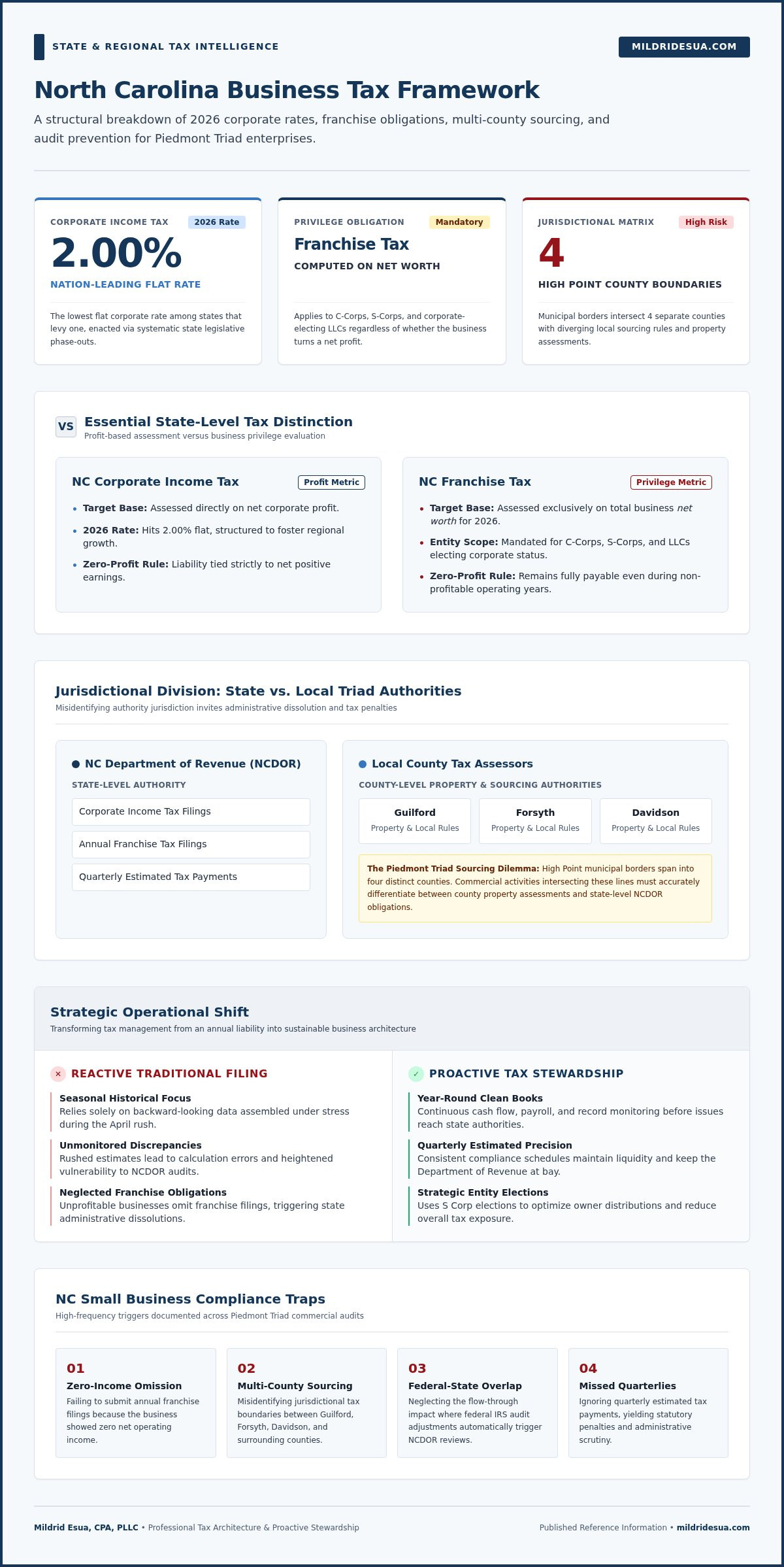
Starting a business in Greensboro or High Point offers access to a thriving regional economy, but the NC regulatory environment requires a steady hand. The state has systematically lowered rates, with the corporate income tax hitting a nation-leading 2.00% in 2026. This creates a competitive atmosphere for growth, yet the underlying complexity of multi-county obligations remains a significant hurdle. Navigating these waters requires more than just filling out forms; it demands a deep understanding of how state-level incentives interact with your specific industry.
Understanding the division of power is vital for long-term compliance. The North Carolina Department of Revenue manages state-level collections like corporate income and franchise taxes, while local county assessors in Guilford, Forsyth, or Davidson handle property-related assessments. In cities like High Point, where business operations often span county lines, misidentifying which authority has jurisdiction can lead to expensive penalties. Professional stewardship ensures you don’t confuse these distinct jurisdictions, preventing the administrative dissolutions that often plague Piedmont Triad startups.
To better understand the initial steps of setting up your business for tax success, watch this helpful video:
The Shift Toward Proactive Tax Management
Most owners view tax as a seasonal hurdle, but true stability comes from a year-round advisory relationship. Unlike reactive accounting that only looks at historical data, proactive bookkeeping identifies potential disputes before they ever reach the NCDOR. A vigilant guide monitors your cash flow and payroll throughout the year, ensuring your filings reflect reality rather than a rushed estimate during the April rush. This continuous engagement transforms tax from a source of anxiety into a manageable pillar of your business strategy. By maintaining clean records month-to-month, you’re always prepared for an inquiry, allowing you to focus on scaling your operations instead of fearing an audit.
Understanding Your Business Entity’s NC Status
Structure dictates your future liability and determines which deadlines apply to your firm. Whether you operate as a standard LLC or a professional PLLC, your entity choice impacts everything from self-employment tax to state-level reporting. For many Greensboro entrepreneurs, an S Corp election serves as a strategic tool to optimize distributions and reduce the total tax burden. Choosing the right framework early prevents costly reorganizations later. It’s about building a foundation that supports growth while remaining strictly compliant with both the Secretary of State and NCDOR requirements. A strategic architect ensures your entity choice aligns with your five-year growth plan, not just your current revenue.
Essential NC Tax Types: Income, Franchise, and Sales Obligations
The North Carolina tax structure is currently undergoing a significant legislative phase-out designed to foster a pro-growth environment. For 2026, the corporate income tax rate has dropped to a flat 2.00%, the lowest in the nation among states that levy one. While this headline rate is attractive, small business owners must remain vigilant about the specific mechanics of how these taxes are assessed. Unlike federal taxes that focus primarily on profit, North Carolina utilizes a multi-layered approach that includes obligations based on net worth and transaction volume. Success in the Piedmont Triad requires a strategic architect who can balance these various liabilities without sacrificing cash flow.
Franchise Tax: The Often Overlooked Obligation
Many entrepreneurs mistakenly assume that if their business isn’t profitable, they owe nothing to the state. However, the NC franchise tax is an annual privilege tax imposed on C corporations, S corporations, and LLCs electing corporate status, regardless of their net income. For 2026, this is computed exclusively on your business’s net worth. C corporations face a rate of $1.50 per $1,000 of the tax base, with a cap of $500 on the first $1,000,000. S corporations benefit from a flat $200 fee for that same initial million. Regardless of the calculation, a non-negotiable minimum of $200 applies. Managing your capital and assets proactively can prevent this obligation from becoming a surprise drain on your resources during the April filing cycle.
NC Sales and Use Tax Compliance
Retailers and service providers in Greensboro and High Point face a combined standard sales tax rate of 6.75%, consisting of the 4.75% state rate and the 2.00% Guilford County local tax. Compliance becomes particularly complex in High Point, where city limits cross into four different counties. Sourcing rules dictate that you collect and remit tax based on where the sale is delivered or where the brick-and-mortar location resides. Failure to maintain a valid certificate of registration or miscalculating these local rates can trigger an NCDOR audit. Integrating your month-to-month bookkeeping with sales tax reporting is the only way to ensure accuracy. If you are unsure about your specific nexus requirements, consulting with a professional tax advisor can help clarify these jurisdictional boundaries.
Finally, managing payroll requires a precise understanding of withholding requirements. As the individual income tax rate has reached a flat 3.99% in 2026, your payroll system must reflect this reduction to avoid under-withholding for your employees. Aligning these state-level adjustments with your federal business tax obligations is a critical component of year-round stewardship. By treating these various obligations as a unified strategy rather than isolated tasks, you protect your business from the compounding interest of 7.00% that the state applies to unpaid assessments.
Compliance Standards and Filing Deadlines for NC Entrepreneurs
Maintaining a business in Greensboro or High Point requires a vigilant approach to the calendar. While many owners focus on the traditional April rush, true compliance involves a year-round commitment to meeting both state and local obligations. In North Carolina, the filing landscape is unique because state deadlines for pass-through entities often diverge from federal requirements. Failing to recognize these differences can lead to administrative friction that distracts from your growth objectives. A strategic architect doesn’t just react to deadlines; they anticipate them to ensure the business remains in good standing with all regulatory bodies.
The Piedmont Triad Tax Calendar
One of the most common pitfalls for NC business owners is the deadline disparity for S corporations and partnerships. While federal returns like Form 1120-S and 1065 are due March 15, the corresponding North Carolina returns, such as Form CD-401S and D-403, aren’t due until April 15. This one-month gap often creates a false sense of security. Additionally, every LLC registered in the state must file an Annual Report with the Secretary of State by April 15, accompanied by a fee of approximately $202 for online filings. This is distinct from your tax return and is mandatory to avoid administrative dissolution. In Guilford and Forsyth counties, you must also account for business personal property tax listings, typically due in late January, which cover equipment and furniture used in your operations.
To stay ahead of the North Carolina Department of Revenue, quarterly estimated payments are essential. These payments, generally due in April, June, September, and January, act as a safeguard against large year-end liabilities. Setting up a proactive alert system helps you manage these recurring dates, ensuring that your cash flow is never compromised by an unexpected assessment. Unlike a reactive approach that scrambles for funds at the last minute, a proactive schedule allows for steady, predictable financial management through continuous engagement with your records.
Consequences of Non-Compliance
The cost of oversight in 2026 is high. The NCDOR applies a statutory interest rate of 7.00% per annum on tax underpayments and late payments throughout the year. Beyond the financial drain of interest, unfiled returns can quickly escalate into tax liens or levies, which freeze your commercial credit lines and damage your professional reputation. If you’ve fallen behind, seeking help with unfiled tax returns Greensboro is a critical step toward resolution. Addressing these gaps immediately through professional representation is the only way to transition from a state of risk back to a position of stability. By resolving past issues, you clear the path for future growth and long-term compliance.
Avoiding Costly NC Tax Pitfalls and IRS Overlap
Business ownership in the Piedmont Triad requires understanding that your relationship with the IRS and the NC Department of Revenue is interconnected. A common misconception among Greensboro entrepreneurs is that federal and state obligations exist in silos. In reality, the IRS frequently shares audit results with state authorities. If a federal examination uncovers unreported income or disallowed deductions, an NC state tax audit is often the immediate consequence. This overlap means that a single error can double your exposure to penalties and interest across both jurisdictions. Precision is not optional.
Employee misclassification represents one of the most significant risks for growing firms in High Point and Winston-Salem. Labeling a worker as an independent contractor when they meet the legal criteria for an employee can lead to back taxes, interest, and substantial penalties. Beyond simple misclassification, unfiled payroll taxes present a unique danger to leadership. Unlike corporate income tax, which offers some protection through the corporate veil, unpaid payroll taxes can lead to personal liability for owners. The state and federal governments view these funds as being held in trust. They will not hesitate to pursue personal assets to satisfy the debt.
Resolving State and Federal Tax Debt Simultaneously
When financial challenges arise, managing debt across two different agencies requires a sophisticated, unified strategy. Attempting to resolve an IRS issue without considering the state-level fallout often leads to incomplete protection. A professional CPA provides the necessary representation to negotiate with both the IRS and the NCDOR, ensuring that payment plans or settlements are sustainable. For those struggling with employment-related liabilities, resolving payroll tax debt through a structured approach is the only way to safeguard your personal financial future while keeping your business operational. Professional intervention stops the cycle of mounting interest.
International Interests in North Carolina
As Greensboro continues to attract global investment, complex cross-border financial needs are becoming more common. Foreign sellers involved in High Point real estate transactions must navigate FIRPTA withholding requirements, which can trap significant capital if not managed correctly. International tax planning is no longer reserved for large corporations; small businesses with global suppliers or customers require customized stewardship to avoid double taxation. Whether you’re dealing with FIRPTA or international income reporting, having a vigilant guide ensures that your global operations remain compliant with both federal and NC statutes. If you are facing complex tax challenges, you can schedule a strategic consultation with our team to secure your business’s trajectory.
Proactive Tax Stewardship with Mildrid Esua, CPA
Mildrid Esua, CPA, PLLC represents more than just a seasonal filing service; it’s a commitment to vigilant stewardship for the entire lifecycle of your business. Unlike traditional firms that only engage during the spring rush, we position ourselves as a continuous growth partner for entrepreneurs in the Piedmont Triad. This proactive methodology ensures that your complex financial interests are managed with constant attention and high-level expertise. By maintaining a steady hand in a shifting regulatory environment, we help Greensboro and High Point owners move from a state of reactive uncertainty to one of strategic intent.
Year-round bookkeeping is the foundation of an audit-ready business. It’s not simply about recording transactions; it’s about building a rigorous narrative of compliance that the NCDOR and IRS respect. Our firm acts as a vigilant guide, identifying potential discrepancies in real-time rather than months after the fact. This localized expertise allows us to tailor our approach to the specific economic landscape of our region. When your records are intellectually sound and meticulously maintained, you gain the freedom to focus on your core mission without the looming fear of an unexpected inquiry.
Your Growth Partner in Greensboro and High Point
Every industry carries its own unique financial burdens, and our tailored accounting services reflect that depth. Whether you are a medical professional navigating complex billing cycles or a small firm in High Point looking to scale, your strategy must be as unique as your business. We specialize in S Corp election strategies designed to optimize your self-employment tax, turning a mandatory obligation into a tool for wealth preservation. We invite you to schedule a consultation for a strategic financial review to see how customization can redefine your bottom line and improve your NC tax position.
Building Long-Term Financial Stability
The transition from financial complexity to informed decision-making is a hallmark of our advisory relationship. By protecting your business assets from the threat of state tax liens and levies, we provide the stability necessary for a successful long-term trajectory. Our role as a strategic architect is to look past the current tax year, navigating future challenges before they arrive. This foresight ensures that you aren’t just surviving the current climate but are actively building a legacy of growth. Informed leadership is the best defense against a complex tax code.
Secure your business future with Mildrid Esua, CPA.
Securing Your Business Legacy in the Piedmont Triad
Navigating the 2026 tax landscape requires more than just meeting deadlines; it demands a philosophy of continuous engagement. By mastering the distinction between franchise and income tax and implementing strategic S Corp elections to optimize your self-employment tax, you transform a mandatory obligation into a driver for growth. Maintaining audit-ready records through year-round bookkeeping ensures that your NC business remains resilient against the complexities of both state and federal oversight.
You don’t have to navigate these shifting regulatory waters alone. With localized Greensboro and High Point expertise and expert IRS representation, Mildrid Esua, CPA, PLLC acts as your vigilant guide. We help you move from the stress of reactive filing to the clarity of informed decision-making, protecting your assets while you focus on scaling your vision. It’s time to transition from financial complexity to a future of stability.
Partner with a Vigilant Strategic Architect for Your NC Business Taxes and secure your long-term trajectory today.
Frequently Asked Questions
Do I need to file a North Carolina state tax return if my business is an LLC?
Yes, but the specific form depends on how your entity is classified for tax purposes. Single-member LLCs generally report business income on the owner’s individual NC return, Form D-400. Multi-member LLCs taxed as partnerships must file Form D-403, while those with an S Corp election utilize Form CD-401S. Regardless of tax status, every LLC must file an annual report with the Secretary of State by April 15 to remain in good standing.
What is the NC franchise tax, and does it apply to my small business?
The NC franchise tax is an annual privilege tax imposed on C corporations and S corporations for the right to do business in the state. For 2026, it is calculated based exclusively on your company’s net worth. S corporations pay a flat $200 for the first $1,000,000 of their tax base. While standard LLCs taxed as partnerships don’t pay this tax, electing corporate status triggers this non-negotiable annual obligation.
How do I resolve unfiled NC business tax returns without losing my business?
Resolving unfiled returns requires a methodical approach that begins with reconstructing your financial records to ensure accurate reporting. You should file missing returns voluntarily before the Department of Revenue initiates aggressive collection actions or administrative dissolution. Engaging a CPA for professional representation allows you to negotiate installment agreements or settlements that protect your operational assets. Taking proactive steps immediately is the only way to stop the accumulation of the 7.00% statutory interest rate.
Are there specific tax incentives for businesses in Greensboro or High Point?
North Carolina offers a highly competitive environment for Piedmont Triad entrepreneurs, headlined by a corporate income tax rate that has dropped to 2.00% in 2026. While most incentives are managed at the state level through job creation grants and investment credits, Greensboro and High Point businesses benefit significantly from these systematic rate reductions. A vigilant guide can help you identify if your specific industry or location qualifies for targeted credits that further reduce your total liability.
What is the current corporate income tax rate in North Carolina for 2026?
The current corporate income tax rate in North Carolina for 2026 is a flat 2.00%. This represents a continued legislative phase-out from previous years, as the state moves toward a total elimination of this tax by 2030. This nation-leading low rate provides a stable foundation for growth in Greensboro and High Point, though owners must still remain diligent regarding their franchise tax and local property tax obligations to ensure full compliance.
Can a CPA help with both IRS and NC Department of Revenue disputes?
Yes, Mildrid Esua, CPA, PLLC provides expert representation for disputes involving both the IRS and the NC Department of Revenue. Because these agencies frequently share audit data and collection information, resolving a federal issue in isolation often leaves you vulnerable to state-level fallout. A strategic architect manages the communication with both authorities simultaneously, ensuring a unified resolution strategy that protects your personal and business assets from liens or levies.
How does an S Corp election affect my NC state taxes?
An S Corp election shifts the income tax burden from the entity to the shareholders, where profits are taxed at the individual flat rate of 3.99% for 2026. This structure is a powerful tool for Greensboro owners to optimize their self-employment tax through strategic distributions. However, it also triggers the NC franchise tax, requiring a minimum $200 payment. Balancing these factors requires a customized plan to ensure the tax savings outweigh the additional administrative requirements.
What should I do if I receive a notice of a tax lien in North Carolina?
You must act immediately to prevent the NCDOR from freezing your commercial credit lines or seizing your business equipment. A business taxes lien is a public claim against your property that can devastate your professional reputation and ability to secure financing. Contacting a tax resolution specialist allows you to challenge the assessment or negotiate a release through a structured payment plan. Swift, professional intervention is the only way to restore your business’s financial stability.




1 Comment
Leave your reply.