


Imagine closing the sale of your U.S. property only to discover that 15% of the total purchase price has been diverted directly to the IRS. For many foreign investors, this isn’t just a possibility; it’s a mandatory reality under the Foreign Investment in Real Property Tax Act. Managing the intricacies of international real estate tax FIRPTA regulations requires more than just basic accounting. It demands a proactive strategy to ensure your hard-earned equity doesn’t remain tied up in federal coffers indefinitely.
We recognize the frustration of seeing substantial proceeds withheld and the confusion surrounding ITIN requirements. It’s natural to feel anxious about IRS audits or the potential for permanent overpayment. This 2026 guide serves as your strategic roadmap to master these complexities. You’ll discover how to legally minimize withholding, satisfy strict compliance standards to avoid penalties, and understand the exact timeline for securing your tax refund. Unlike standard transactional services, we focus on the vigilant stewardship required to protect your capital and maintain your investment’s long-term trajectory.
Key Takeaways
- Learn why the IRS treats FIRPTA withholding as a strategic deposit rather than a final tax, allowing you to recover excess capital through a subsequent tax return.
- Identify the legal obligations of the buyer as the withholding agent to maintain full compliance with international real estate tax FIRPTA mandates and avoid personal liability.
- Discover how property price thresholds and buyer residency intent can reduce your withholding rate from the standard 15% to 10% or even 0%.
- Master the compliance timeline, including the 20-day remittance deadline and ITIN requirements, to ensure a smooth transition of ownership without IRS intervention.
- Recognize how a specialized CPA acts as a vigilant guide, moving beyond basic preparation to provide the strategic foresight needed for complex international transactions.
What is FIRPTA and Why Does the IRS Withhold 15%?
At its core, the Foreign Investment in Real Property Tax Act (FIRPTA) of 1980 serves as a federal mechanism to ensure the U.S. government collects capital gains taxes from foreign entities selling domestic property. While many sellers view this as a final tax, it’s more accurate to describe it as a high-stakes security deposit. The IRS mandates this withholding because once a foreign seller leaves the country with their proceeds, the government has limited recourse to collect unpaid taxes. By intercepting a portion of the gross sales price at the closing table, the IRS maintains its leverage until you file a final tax return to reconcile your actual liability.
To better understand how these international real estate tax FIRPTA structures impact your bottom line, watch this helpful video:
In North Carolina markets like Greensboro and High Point, this regulation fundamentally alters the closing process. The responsibility doesn’t lie with the IRS to come and find the money; instead, the buyer is legally obligated to withhold the funds and remit them within 20 days of the transfer. This creates a shift from a standard transaction to one requiring vigilant oversight. Without a proactive strategy, sellers often find themselves with a significant liquidity gap that can last for months or even years.
The Scope of International Real Estate Tax
FIRPTA applies to all U.S. real property interests, which includes land, buildings, and even shares in certain domestic corporations. The IRS defines a “foreign person” broadly to include non-resident alien individuals, foreign corporations, and foreign estates or trusts. It’s vital to distinguish between resident aliens, who possess a green card or pass the substantial presence test, and non-resident aliens. The IRS effectively assumes every seller is a foreign person by default. Consequently, sellers must provide a non-foreign affidavit to avoid automatic withholding, or they must comply with the strict remittance rules.
The 2026 Withholding Rates: 10% vs. 15%
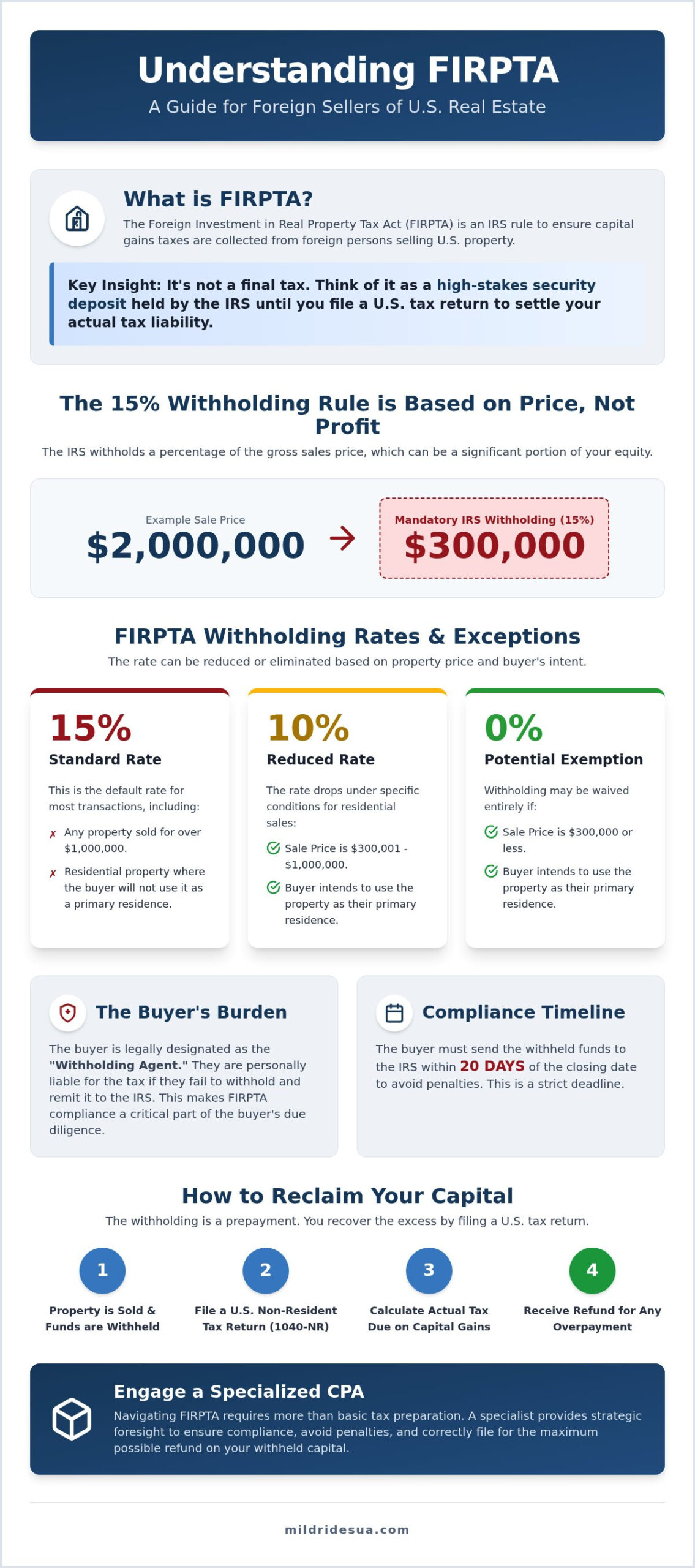
As of 2026, the standard withholding rate remains 15% of the “amount realized.” It’s critical to understand that this term refers to the gross sales price, not the profit you’ve made on the sale. If you sell a commercial building for $2 million, the IRS expects $300,000 upfront, regardless of your actual gain. Residential properties offer some relief through specific thresholds. If the property is sold for more than $300,000 but not more than $1,000,000, and the buyer intends to use it as a primary residence, the rate drops to 10%. For residential sales under $300,000 where the buyer will reside in the home, the withholding may be waived entirely. Mastering these thresholds is the first step toward protecting your investment capital during international real estate tax FIRPTA transactions.
The Buyer’s Burden: Understanding the Withholding Agent Role
Unlike standard domestic sales where the seller’s tax liability remains a personal matter, FIRPTA shifts the financial responsibility onto the purchaser. In the eyes of the IRS, the buyer is designated as the “Withholding Agent.” This means you are legally tasked with the collection and remittance of the required tax percentage. If the seller is a foreign entity and the tax isn’t withheld, the IRS doesn’t simply pursue the seller abroad. They hold the buyer personally liable for the unpaid tax, regardless of whether the funds were actually collected at closing. This creates a unique dynamic where the buyer must act as a protective steward of federal interests to safeguard their own financial position.
This structural shift makes international real estate tax FIRPTA compliance a critical due diligence item for every purchaser. A withholding agent is defined as any person or entity having the control, receipt, custody, or disposal of the funds. In practice, this responsibility is often managed through a closing agent, yet the legal burden remains firmly with the buyer. Protecting yourself requires a sophisticated understanding of the IRS FIRPTA Withholding Guidelines to ensure every document is executed with precision and foresight.
Buyer Liability and IRS Penalties
The consequences of a reactive approach can be severe. If Form 8288 isn’t filed within 20 days of the transfer, the IRS applies interest and penalties that accumulate quickly. Relying on a seller’s verbal assurance of their residency status is a high-risk strategy that often leads to financial exposure during an international real estate tax FIRPTA transaction. To mitigate this, a buyer must obtain a formal “Certification of Non-Foreign Status,” signed under penalty of perjury. This document provides the necessary legal shield, confirming the seller’s status as a U.S. person and exempting the buyer from the withholding mandate. Without this proof, the IRS assumes the seller is foreign, leaving the buyer to pay the price for non-compliance.
The Role of the Qualified Substitute
Title companies often step in as a “Qualified Substitute” to manage the sensitive tax identification numbers of the parties involved. While this provides a layer of data security, it doesn’t absolve the buyer of their ultimate liability. Title companies typically limit their involvement to the mechanics of the transaction, rather than offering strategic tax advice. This is where a proactive partnership with a specialized international tax advisor becomes indispensable. We provide the vigilant oversight needed to verify exemptions and ensure that the withholding amount is calculated accurately. By collaborating with title professionals, we create a secure environment where the buyer’s interests are protected from unforeseen IRS intervention, ensuring the long-term stability of the investment.
Common FIRPTA Exceptions and Reductions
The standard 15% withholding isn’t an immovable mandate. Instead, it’s a default position that you can challenge through strategic compliance and foresight. Under 26 U.S. Code § 1445, the law provides specific avenues to reduce or eliminate this financial burden based on the property’s value and intended use. Mastering these nuances is essential for any foreign investor navigating the complexities of international real estate tax FIRPTA, as it allows for the preservation of liquid capital during the transition of ownership.
One of the most frequent points of confusion involves the “Zero Tax Due” scenario. Many sellers assume that if they are selling at a loss or have no taxable gain, the withholding requirement simply vanishes. This is a high-risk misconception. The IRS requires the withholding regardless of your profit margin unless you have obtained a formal reduction or meet a specific exemption. Without a proactive approach, you could see 15% of your gross proceeds held by the IRS for months, even if you don’t owe a single dollar in capital gains tax. Effective tax planning for international clients requires anticipating these scenarios well before the closing table to avoid unnecessary capital being tied up in federal accounts.
The Personal Residence Exemption
The most accessible exception applies to residential properties sold for $300,000 or less. If the buyer intends to use the property as a primary residence, the withholding rate can be reduced to 0%. For properties priced between $300,001 and $1,000,000, this same residency intent can lower the rate to 10%. However, this isn’t a simple box to check. The buyer must occupy the property for at least 50% of the time it’s in use during each of the first two 12-month periods following the sale. Relying on this exemption requires a signed affidavit from the buyer, and if their plans change, the seller could still face scrutiny. We advise clients to verify the buyer’s residency status with rigorous care to ensure the exemption stands up to IRS review.
Withholding Certificates (Form 8288-B)
When the actual tax liability is significantly lower than the 15% default, filing Form 8288-B is the most effective strategic tool available. This application for a withholding certificate asks the IRS to reduce the withholding to the “maximum tax liability” actually owed. You must file this form before or on the date of closing to be effective. While the IRS reviews the application, which typically takes about 90 days, the withheld funds are usually held in a secure escrow account rather than being sent immediately to the IRS. This “escrow holdback” keeps your money within reach and ensures it’s released back to you as soon as the IRS issues the certificate, rather than waiting for a full tax season to pass.
The FIRPTA Compliance Checklist: Forms and Timelines
Success in an international transaction depends on a chronological, methodical approach to IRS reporting. Unlike domestic sales that conclude at the closing table, international real estate tax FIRPTA compliance requires a multi-stage execution that begins well before the deed is transferred. A reactive approach often leads to rejected forms and delayed refunds; proactive planning ensures that your capital remains protected throughout the process.
- Step 1: Status Verification. Confirm the seller’s foreign status and determine if the sales price triggers the 10% or 15% withholding rate based on current 2026 thresholds.
- Step 2: ITIN Acquisition. Secure an Individual Taxpayer Identification Number early. This is the foundation of your future refund claim.
- Step 3: Document Preparation. Draft Forms 8288 and 8288-A. These documents track the withholding and credit it to the correct seller’s account.
- Step 4: Remittance. The buyer must send the withheld funds and the completed forms to the IRS within the strict 20-day window following the closing.
- Step 5: Final Reconciliation. File a U.S. tax return in the following year to calculate actual tax and claim any overpayment.
ITIN Requirements for Foreign Sellers
You can’t secure a refund of excess withholding without a valid ITIN. The IRS uses this number to track your specific deposit and link it to your final tax return. Applying via Form W-7 requires certified identification documents, such as a passport, which must be handled with precision. Minor errors in the application often lead to rejections, extending the time your money stays with the government. Our team provides the specialized FIRPTA support needed to navigate the ITIN application process correctly the first time.
Filing Deadlines and IRS Reporting
The 20-day remittance rule is absolute. If the buyer or their agent fails to submit Form 8288 within 20 days of the property transfer, interest and late-filing penalties begin to accrue immediately. This timeline is even more critical if you’ve filed for a withholding certificate; the buyer must still report the transaction even if the funds are held in escrow. Once the funds are remitted, the IRS will eventually mail back a stamped copy of Form 8288-A. You must keep this document safe. It’s your primary proof of payment when you file your 1040-NR or 1120-F at year-end. This final return is the only way to reconcile your account and trigger the release of your refund. Foreign property owners who want to understand the full scope of their annual obligations can benefit from reviewing a comprehensive US tax services for foreigners guide that covers everything from the substantial presence test to the Foreign Earned Income Exclusion.
Strategic Planning with a FIRPTA Withholding Accountant
Generic tax preparation often fails to account for the specific, high-stakes nuances of international property dispositions. Unlike reactive tax preparers who simply record the withholding after it occurs, a specialized accountant acts as a strategic architect for your transaction. We provide the foresight necessary to manage international real estate tax FIRPTA obligations before they become permanent financial liabilities. By positioning ourselves as a proactive partner, we ensure that your investment capital is protected through vigilant stewardship rather than lost to administrative oversight.
Mildrid Esua, CPA, PLLC serves as a vigilant guide for foreign investors across Greensboro and High Point. Our approach moves beyond mere transactional filing; we provide a consultative relationship that addresses the intellectual and advisory depth required for complex tax resolution. Whether you are facing a potential IRS dispute or seeking to optimize your withholding amount, our firm stays continuously engaged to maintain the long-term stability of your U.S. interests.
Why Local Expertise Matters in North Carolina
In the North Carolina real estate market, local knowledge is a critical component of effective tax planning. Triad cities like Greensboro, High Point, and Winston-Salem have unique market dynamics that directly impact capital gains calculations. A local CPA understands these specific valuation trends, allowing for a more accurate assessment of your actual tax liability. We coordinate directly with local real estate attorneys and title agents to ensure that the remittance process is seamless. This professional synergy prevents the common communication gaps that often lead to IRS penalties or rejected forms, providing a steady hand in a complex regulatory environment.
Recovering Your Funds: The Final Step
The 15% withholding is a blunt instrument, not a final assessment of what you owe. In many cases, the actual capital gains tax is significantly lower than the amount held by the IRS. Recovering these excess funds requires a sophisticated understanding of the timing for tax return filings. We work to accelerate your refund by preparing 1040-NR or 1120-F returns with precision, ensuring that the IRS has no reason to delay the release of your capital. This final stage of the international real estate tax FIRPTA process is where our commitment as a growth partner becomes most evident, as we turn a complex withholding into a recovered asset.
To ensure your next transaction is managed with professional authority and strategic depth, Schedule a FIRPTA consultation with Mildrid Esua today.
Securing Your Investment Trajectory for 2026 and Beyond
Successfully navigating the sale of U.S. property as a foreign investor requires more than just following a basic checklist. It demands a sophisticated understanding of how international real estate tax FIRPTA mandates can impact your liquid capital. We’ve explored how the standard 15% withholding acts as a temporary deposit, the critical legal risks faced by the buyer as the withholding agent, and the strategic avenues available for reducing these amounts through the proper certification process.
As a Certified Public Accountant (CPA) with specialized international tax expertise, Mildrid Esua, CPA, PLLC provides the vigilant stewardship needed to transition from complexity to clarity. We offer dedicated IRS representation and tax resolution services tailored to the Greensboro and High Point markets, ensuring your compliance is absolute and your refund is accelerated. Don’t let your equity remain tied up in federal accounts due to a reactive approach. With the right strategic architect by your side, you can confidently manage your international holdings and focus on your next phase of growth.
Protect your investment: Contact our FIRPTA withholding experts today
Frequently Asked Questions
Do I have to pay FIRPTA if I am selling my property at a loss?
Yes, the IRS mandates withholding based on the gross sales price rather than your net profit. Managing international real estate tax FIRPTA obligations means understanding that the 15% is a default requirement regardless of your gain. To avoid this, you must proactively apply for a withholding certificate by proving your maximum tax liability is zero. Without that certificate, the buyer must remit the funds to the IRS at the closing table.
How long does it take to get a FIRPTA refund from the IRS?
Expect a timeline of 6 to 12 months after you file your annual U.S. tax return. While the IRS typically processes withholding certificate applications within 90 days, the actual cash refund only triggers after your final 1040-NR or 1120-F is processed. Strategic timing of your filing is essential to accelerate this recovery. Our team acts as a vigilant guide to ensure your documentation is flawless, preventing administrative delays.
Can a US citizen be a withholding agent for a foreign seller?
Yes, any buyer is legally designated as the withholding agent when purchasing property from a foreign person. This role carries significant responsibility regardless of the buyer’s own citizenship. The buyer must ensure the tax is collected and remitted within the 20-day window. This legal burden exists to ensure the IRS captures potential capital gains before the proceeds leave U.S. jurisdiction, making buyer due diligence a top priority.
What happens if the buyer fails to withhold the 15% tax?
The buyer becomes personally liable for the full tax amount plus interest and penalties. For instance, the IRS underpayment interest rate reached 7% during several quarters in 2026. Because the buyer is the designated steward of the funds, the IRS pursues them directly if the remittance is missed. This makes it vital for purchasers to coordinate with a specialized CPA to verify the seller’s status and ensure full compliance.
Is an ITIN mandatory for every foreign seller under FIRPTA?
Yes, an Individual Taxpayer Identification Number is mandatory to claim any refund of excess withholding. While you might technically close a sale without one, the IRS cannot credit the payment to your specific account or process a refund request without this identifier. Securing an ITIN early in the transaction process is a foundational step in our proactive strategy to protect your investment capital and ensure a smooth reconciliation.
Does FIRPTA apply to inherited property sold by a foreign person?
Yes, FIRPTA applies to any disposition of U.S. real property by a foreign person, including inherited assets. The method of acquisition doesn’t change the withholding requirement at the time of sale. Foreign heirs must still comply with the 15% withholding rule or apply for a reduction based on the property’s stepped-up basis. We assist heirs in navigating these complexities to ensure they don’t overpay the IRS during the liquidation process.
Can I avoid FIRPTA by using a 1031 exchange?
You can defer the tax, but you don’t automatically bypass the withholding requirement. A foreign seller must follow specific IRS notification procedures to prove the transaction is a non-recognition exchange. Often, this requires obtaining a withholding certificate to prevent the 15% from being diverted from the exchange. Without professional oversight, the mandatory withholding can leave you with insufficient funds to complete the purchase of your replacement property.
What is the difference between Form 8288 and Form 8288-B?
Form 8288 is the document used to remit the actual withheld funds to the IRS within 20 days of closing. In contrast, Form 8288-B is the application used to request a reduction or elimination of that withholding before the sale is finalized. One is a payment voucher, while the other is a strategic tool for managing international real estate tax FIRPTA burdens. Using both correctly is essential for maintaining your investment’s liquidity. Foreign investors who also operate U.S. business entities should be aware that tax compliance for foreign owned US business carries its own set of strict IRS reporting requirements, including Form 5472 obligations that run parallel to FIRPTA considerations.