


Bookkeeping is worth handing off when it starts competing with the work that keeps your business moving. Small business bookkeeping experts can help as responsibilities grow, finances become more complex, or you need clearer information to guide decisions.
It makes sense to want accurate records without adding another task to an already full schedule. A bookkeeper can organize transactions and financial reports, giving you a clearer view of cash flow, profitability, and tax preparation.
This guide explains when to hire a bookkeeper, what to consider when assessing support, and how consistent bookkeeping can strengthen financial decisions. You’ll also learn how to distinguish routine recordkeeping from the broader accounting and tax support that may help your Greensboro business plan ahead.
Key Takeaways
- Assess a bookkeeping provider’s credentials, accounting tools, service flexibility, and communication approach to find a fit for your business.
- Consider hiring help when financial tasks take attention away from core responsibilities or your business’s transactions and needs are growing.
- Consistent records and timely reports can clarify cash flow, profitability, and the financial trade-offs behind business decisions.
- Organized bookkeeping can support tax preparation and help reduce errors caused by incomplete or inconsistent records.
- Connect bookkeeping with small-business accounting and tax planning when you need financial records to inform decisions beyond routine recordkeeping.
1. Choosing a provider based on credentials and tools
A sound bookkeeping arrangement starts with methods suited to your transactions and reporting needs. Single-entry bookkeeping records each transaction once, while double-entry bookkeeping records each transaction twice. For example, a sale is recorded as income and also affects another account, such as inventory. A bookkeeper can consider transaction volume, the kinds of activity being recorded, and the financial reports you need when determining an appropriate approach.
Accounting methods matter, too. Cash accounting records income and expenses when money changes hands; accrual accounting records them when they are earned or incurred. The right fit depends on how your business operates and uses financial information. A bookkeeper can explain how each method affects the timing and presentation of revenue, expenses, and cash flow, then apply the selected method consistently.
Credentials offer one useful point of comparison. The American Institute of Professional Bookkeepers offers the Certified Bookkeeper (CB) designation. A credential can indicate relevant training, but it is only one part of the picture. Ask how the professional handles work relevant to your needs, such as reconciling bank activity, processing invoices, or preparing records for tax preparation. Clear explanations of the bookkeeping process also help you understand what the records show.
Software should support accurate, accessible records, not dictate the bookkeeping method. QuickBooks Online, Xero, and FreshBooks are examples of cloud accounting software used by bookkeeping providers. Cloud platforms can provide access to current financial data, automated bank feeds, invoicing, payroll and tax calculations, and centralized storage that the business and bookkeeper can access. The appropriate platform depends on your workflows, reporting needs, and accounting tasks.
Choosing software is only the starting point. A bookkeeper should establish how transactions enter the system, how records are reconciled, and how reports are shared. For example, automated bank feeds can import activity, while reconciliation helps match recorded transactions with bank statements. Regular review can reveal missing information and support dependable reports. Ask how access is managed, supporting records are organized, and questions requiring your attention are communicated.
Use these criteria to assess the working relationship:
- Credentials: Look for relevant training, such as the CB designation, and practical experience with your bookkeeping needs.
- Tools: Confirm the software supports your transactions, reporting, and collaboration requirements.
- Service flexibility: Clarify which bookkeeping tasks are handled and how the process can adapt as business activity changes.
- Communication: Establish how reports, questions, and missing records are addressed.
Small business bookkeeping experts should connect credentials and accounting software to a consistent process, rather than relying on software alone. A provider who explains the methods, reporting, and communication workflow gives you a clearer basis for assessing how bookkeeping can support business decisions.
2. When should you hire a bookkeeper?
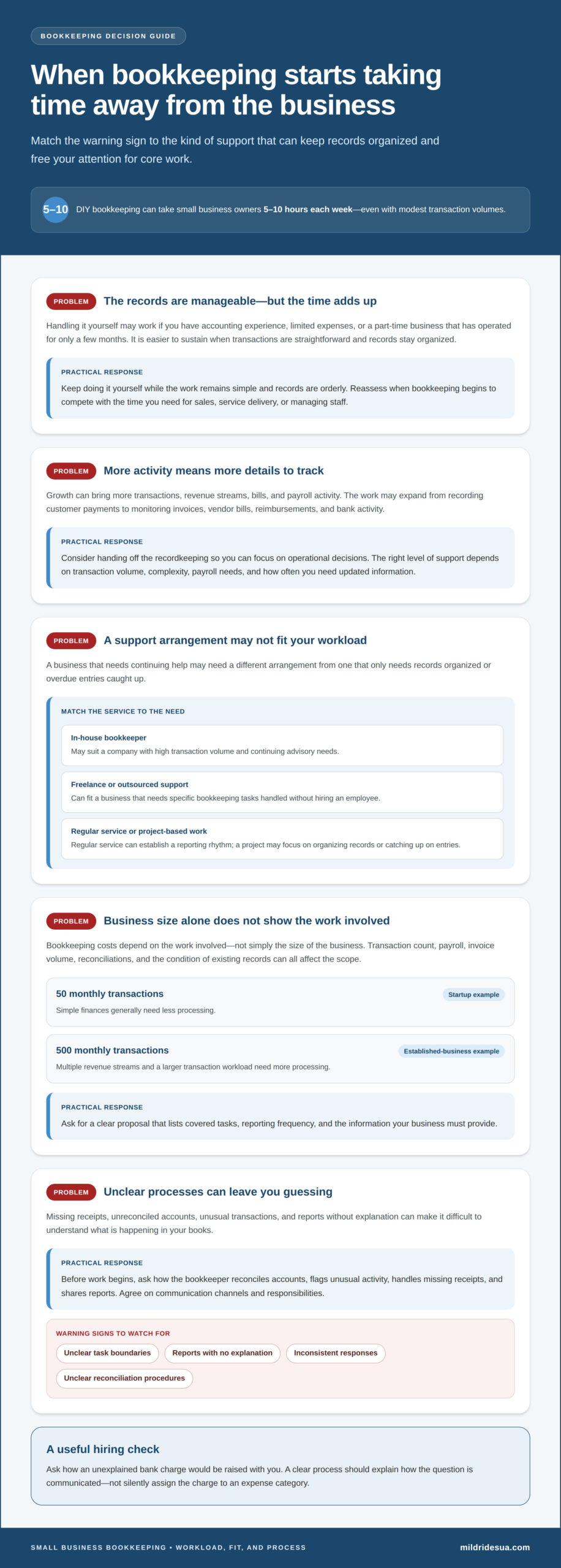
Start with the demands on your time and the complexity of your records. A business owner with accounting experience, a freelancer with limited expenses, or a part-time business operating for only a few months may manage bookkeeping independently. That can work when transactions are straightforward and records remain organized. But DIY bookkeeping can take small business owners 5-10 hours each week, even with modest transaction volumes.
Hiring becomes valuable when bookkeeping starts competing with sales, service delivery, or managing staff. A growing business may have more transactions, revenue streams, bills, and payroll activity to track. For example, an owner who once recorded a few customer payments may now need to monitor invoices, vendor bills, reimbursements, and bank activity. A bookkeeper can maintain those records while the owner focuses on operational decisions.
Consider whether your business needs occasional assistance or ongoing support. An in-house bookkeeper may suit a company with high transaction volume and continuing advisory needs. Freelance or outsourced support can fit businesses that need specific bookkeeping tasks handled without hiring an employee. Regular service can establish a reporting rhythm, while a project-based engagement may focus on organizing records or catching up on entries. The right arrangement depends on transaction volume, complexity, payroll needs, and how often you need updated information.
Bookkeeping costs depend on the work involved, not simply the business’s size. A startup with simple finances and 50 monthly transactions needs less processing than an established company with multiple revenue streams and 500 transactions. Payroll, invoice volume, account reconciliations, and the condition of existing records can also affect the scope. A clear proposal should identify covered tasks, reporting frequency, and what information the business must provide.
When hiring, focus on the work process as well as experience. Ask how the bookkeeper handles missing receipts, reconciles accounts, flags unusual transactions, and shares regular reports. For example, a provider should explain how an unexplained bank charge is raised with the owner, rather than silently assigned to an expense category. Agree on communication channels and responsibilities before work begins.
Warning signs include unclear task boundaries, reports with no explanation, inconsistent responses, or reluctance to describe reconciliation procedures. A provider who promises results without understanding your transaction patterns may not have assessed the work carefully. Look for organized handoffs, clear explanations, and a process that adjusts as business activity changes. If regular bookkeeping support would free time for core responsibilities, explore bookkeeping for small businesses as a practical next step.
3. Why small businesses need bookkeeping services
Small businesses need reliable records to understand where revenue goes and which obligations are approaching. Bookkeeping can include recording bank transactions, reconciling accounts, managing accounts payable and receivable, processing invoices and bills, and reviewing cash flow. For example, matching customer payments with invoices clarifies which revenue has been received and which remains outstanding.
Bookkeeping can also include payroll processing, expense tracking, customized financial reports, tax-preparation support, and budgeting or cash-flow advice. The right combination depends on the business’s transactions and reporting needs. A business with several products or services may need revenue and expenses organized by activity, while a smaller operation may prioritize reconciliations and invoices.
In-house, freelance, and virtual arrangements each suit different operating needs. An in-house bookkeeper may fit a business with high transaction volume and ongoing advisory needs; freelance or virtual support can suit businesses seeking specific tasks or remote collaboration. Virtual bookkeepers can use cloud platforms for reconciliations, payroll processing, and expense tracking, giving owners access to organized financial information without in-person record handling.
Outsourcing can free business owners to focus on customers and operations while supporting timely financial reporting. Current records help owners identify cash-flow pressure, review costs, and make decisions based on recent activity rather than incomplete figures. Consistent bookkeeping can also help reduce errors and penalties by keeping supporting information organized for reporting and tax preparation.
Flexibility matters as business activity changes. A seasonal business may need more support during busy periods, while a growing company may add payroll, revenue streams, or more frequent reporting. Define which accounts, transactions, and reports are covered so the bookkeeping arrangement reflects those needs. Clear task boundaries help prevent gaps when responsibilities shift.
Pricing depends on the case and is given after a quote request. The scope can reflect transaction volume, the complexity of accounts, payroll activity, reporting requirements, and the condition of existing records. For instance, organizing incomplete records may require different work from maintaining consistently updated accounts. A useful estimate describes the tasks included and the information the business must supply.
Before choosing an arrangement, connect the bookkeeping work to the decisions you need to make. If late invoices obscure incoming revenue, prioritize accounts receivable tracking. If payroll and operating expenses make cash flow harder to interpret, include those records in regular reporting. This keeps bookkeeping focused on useful information, not recordkeeping for its own sake.
4. Tracking profitability and financial ratios
Profitability becomes clearer when bookkeeping records are organized into reports. An income statement shows revenue and expenses over a period, helping owners assess whether sales cover operating costs. A balance sheet summarizes assets, liabilities, and equity at a point in time. A cash flow statement tracks cash moving into and out of the business. Together, these reports help distinguish reported profit from available cash.
Financial ratios turn report figures into measures that are easier to compare across periods. For example, gross profit margin compares gross profit with revenue, while the current ratio compares current assets with current liabilities. Consistent bookkeeping categories make it easier to tell whether changes reflect business activity or different recording choices. Owners can then investigate what changed, such as higher material costs or slower customer payments.
- Gross profit margin: Compare revenue after direct costs with total revenue to assess the profitability of sales.
- Operating margin: Compare operating income with revenue to understand how core business expenses affect earnings.
- Current ratio: Compare current assets with current liabilities to review short-term financial position.
- Cash flow: Review cash received and paid to identify timing pressures that profit figures alone may not show.
These measures are useful only when the underlying records are dependable. Bank reconciliations can identify differences between recorded transactions and bank activity. Consistently categorizing payroll, supplier bills, customer payments, and operating expenses helps preserve meaningful comparisons. If payroll costs rise, for instance, regular reporting can show whether revenue changed at the same time.
Supporting financial records give each report a traceable basis. Common records include invoices, receipts, payroll records, bills, bank and credit card statements, tax forms, and tax returns. Investment statements may also belong among a business’s records. Organized documents help explain how transactions entered the books and support report preparation and tax work.
Reporting quality also depends on a clear review process. A bookkeeper can reconcile accounts, investigate missing or duplicated entries, and prepare a balance sheet, income statement, and cash flow statement from recorded activity. These reports help owners assess performance and make informed financial decisions. They can also support tax preparation by keeping transaction details and relevant forms together.
For useful trend analysis, compare the same categories across reporting periods and investigate significant changes. A sudden change in receivables, payroll, or operating expenses may point to a timing issue or a shift in business activity. Current bookkeeping records help owners ask focused questions and act on a clearer view of profitability.
5. Benefits of bookkeeping for small businesses
Reliable bookkeeping gives owners a clearer basis for decisions about hiring, purchasing, and growth. An income statement can show whether revenue covers payroll and operating expenses; cash flow records reveal when customers pay and bills come due. These views answer different questions. Reviewing them together helps owners plan commitments around both profitability and available cash.
Saving time is another practical benefit. When a professional maintains transaction records, owners spend less time sorting receipts, following up on missing invoices, or correcting entries. That time can go back to customer service, operations, or sales. For a growing business, focusing on core work can matter as much as having organized financial information.
Regular reporting also supports earlier, more considered decisions. If a report shows rising supply expenses while sales remain steady, an owner can examine purchasing patterns before those costs shape future plans. If customer invoices remain unpaid, accounts receivable reporting can help prioritize follow-up. Bookkeeping turns individual transactions into patterns that leadership can evaluate.
Consistent records can make tax preparation more orderly. Categorized expenses, payroll records, invoices, and bank statements give the preparer a clearer view of business activity. Instead of gathering documents under deadline pressure, owners can work from organized transaction records. This supports accurate reporting and can help reduce errors caused by incomplete or misplaced information.
Bookkeeping also helps owners notice potential problems before they become harder to manage. Reconciled accounts can expose duplicate entries or transactions that need clarification. Timely cash flow reporting may show a gap between paying suppliers and receiving customer payments. With that visibility, owners can assess timing, expenses, and collection processes before committing to additional spending.
Hiring support can be a business decision, not simply an administrative expense. Owners can weigh the time spent maintaining records against the value of current reports and greater attention to operations. A business with several revenue streams, payroll, or frequent customer invoices may need a different level of support than a small operation with simple activity. The scope should fit the records and decisions involved.
To make bookkeeping more useful, connect each report to a management question. Use expense categories to review spending, receivables to monitor outstanding invoices, and cash flow reporting to plan upcoming payments. Then discuss unusual changes with the person responsible for the records. This creates a practical cycle: organized information, focused review, and decisions grounded in the business’s actual activity.
If you’re ready to make consistent recordkeeping part of your financial planning, get small business bookkeeping support.
Mildrid Esua, CPA, PLLC
Mildrid Esua, CPA, PLLC provides bookkeeping and small-business accounting support for owners seeking clearer financial records and better-informed decisions. Its bookkeeping work helps organize business activity, while tax planning and preparation connect those records with tax-related needs.
Consider this support when managing transactions takes time away from operations, reports need greater consistency, or financial information must inform upcoming business decisions. Bookkeeping can also work alongside payroll and tax planning, bringing related financial tasks into a more coordinated process. For concerns involving unfiled returns, back taxes, or tax liens, Mildrid Esua, CPA, PLLC also provides tax resolution and IRS representation.
Contact Mildrid Esua, CPA, PLLC to discuss bookkeeping support for your business.
Make financial clarity part of your next decision
The value of bookkeeping grows when you use financial information before making a major business move. Before hiring, expanding an offering, or committing to a new expense, consider what your records reveal about available resources and which questions remain unanswered. That habit makes bookkeeping a practical part of planning, not just a record of past activity.
Working with small business bookkeeping experts can help establish a steady process for turning financial activity into useful information. The right support should fit how your business operates and help you approach decisions with greater clarity. As your needs evolve, your bookkeeping process can evolve with them.
Mildrid Esua, CPA, PLLC offers bookkeeping alongside small-business accounting and tax advisory services. If you’re ready to discuss how professional support could fit your business, contact Mildrid Esua, CPA, PLLC. A clear next step can help you build a more confident foundation for what comes next.
Frequently Asked Questions
When should you hire a bookkeeper?
Hire a bookkeeper when recordkeeping begins delaying customer work, management decisions, or other essential responsibilities. A practical signal is having to postpone decisions because you can’t tell which invoices remain unpaid or which expenses have changed. Support can also help when a business adds payroll, new services, or more complex sales activity. If your records are straightforward and you have the time and experience to maintain them consistently, handling bookkeeping yourself may still suit your needs.
What is small business bookkeeping?
Small business bookkeeping is the organized recording and classification of a company’s financial transactions. It creates a consistent account of money received, money spent, and amounts owed or due. For example, recording a customer payment against the correct invoice preserves a useful transaction history. That organized record supports financial reports and gives an owner and their accounting professional a clearer basis for reviewing business activity.
What is the cost of hiring a bookkeeper?
The cost depends on the case and is given after a quote request. Factors include transaction volume, the complexity of accounts, payroll activity, reporting needs, and the condition of existing records. For example, maintaining current books differs from sorting out uncategorized transactions across several accounts. Ask for a defined scope that explains which tasks are included, how often reports are prepared, and what records you’ll need to provide.
Do certifications matter?
Certifications can demonstrate bookkeeping training, but they don’t replace relevant experience or a reliable work process. The American Institute of Professional Bookkeepers offers the Certified Bookkeeper designation. Consider whether a bookkeeper can explain how they handle reconciliations, transaction questions, and reporting for a business like yours. A credential is most useful alongside clear communication and practical knowledge of your accounting needs.
How much do small business bookkeeping services cost in the United States?
Across the United States, bookkeeping work varies with transaction volume, payroll, account complexity, reporting frequency, and record condition. A business with one revenue stream and orderly records has different needs from one with multiple activities and backlogged entries. Compare service scopes rather than looking only at a headline figure. Check whether the arrangement covers reconciliations, transaction categorization, payroll processing, and the reports your business needs.
How do I find and choose a qualified small business bookkeeper?
Choose a bookkeeper by matching their experience and workflow to your business’s records and operating needs. For a Greensboro business, assess how the professional communicates about unclear transactions and explains reports. Ask for a description of the month-end process, not confidential client records. Small business bookkeeping experts should define responsibilities, explain how questions are handled, and clarify how support can adapt as business activity changes.
What credentials should a small business bookkeeper have, such as QuickBooks ProAdvisor or NACPB certification?
There isn’t one credential that alone shows whether a bookkeeper is the right fit. The Certified Bookkeeper designation is offered by the American Institute of Professional Bookkeepers. If a professional lists QuickBooks ProAdvisor or NACPB credentials, ask how that training relates to your software and bookkeeping needs. Then consider practical experience, communication, and the ability to explain processes clearly. Assess qualifications alongside evidence of a careful, consistent approach.
What financial records and documents should I provide to a bookkeeper?
Provide records that support your business transactions, such as sales and purchase invoices, receipts, payroll details, bills, bank and credit card statements, and relevant tax forms or returns. Investment statements may also apply to your financial records. Group files by account or period and identify documents that need explanation. A note about a personal purchase mistakenly paid through a business account, for example, helps the bookkeeper classify it appropriately.




1 Comment
Leave your reply.