


Bookkeeping should do more than record transactions. It should show you where your business stands. For small business bookkeeping in High Point, NC, consistent recordkeeping, account reconciliation, and timely reports can help you make informed decisions and spend less time sorting through financial details.
Dependable books should not pull your attention away from customers and daily operations. The support you need depends on factors such as transaction volume, account complexity, and reporting needs. Pricing depends on the work involved, with a quote provided after a request.
This article explains how bookkeeping support works, what affects its cost, and how an organized process can save time. You’ll also see how regular reporting can give your business clearer financial information as it grows.
Key Takeaways
- Match bookkeeping support to your transaction volume, account complexity, and reporting needs so the work fits how your business operates.
- Reconcile accounts regularly and keep records organized to spot discrepancies and understand your financial position more clearly.
- Use up-to-date reports to monitor cash flow, plan business decisions, and identify questions that need attention.
- Compare the effort of handling books in-house with the time and oversight required; complexity and service scope are key cost factors.
- When bookkeeping needs connect with payroll, tax planning, or tax resolution, consider support that can address those related financial tasks.
Small business accountants serving High Point, North Carolina
For small business bookkeeping in High Point, NC, choose support that reflects your transaction volume, payroll needs, and the decisions your records need to inform. Accounting support can also connect organized books with tax planning and business reporting.
Bookkeeping and Accounting Services
Small-business bookkeeping typically includes recording income and expenses, categorizing transactions, reconciling accounts, and preparing reports. Accounting may also include financial analysis and tax planning. Identify which tasks need regular attention and which call for periodic review.
Credentials matter when selecting support. Accountants are described as financial professionals with an accounting degree from a four-year college or university. CPAs must pass the Uniform CPA Examination and receive the proper license to use the CPA designation. For S-Corp planning, businesses earning over $60,000 in net profit may save on self-employment taxes by electing S-Corp status. Owners should evaluate the election alongside reasonable compensation, payroll, and the work they perform, rather than treating profit alone as the decision.
Local and Online Bookkeeping Options
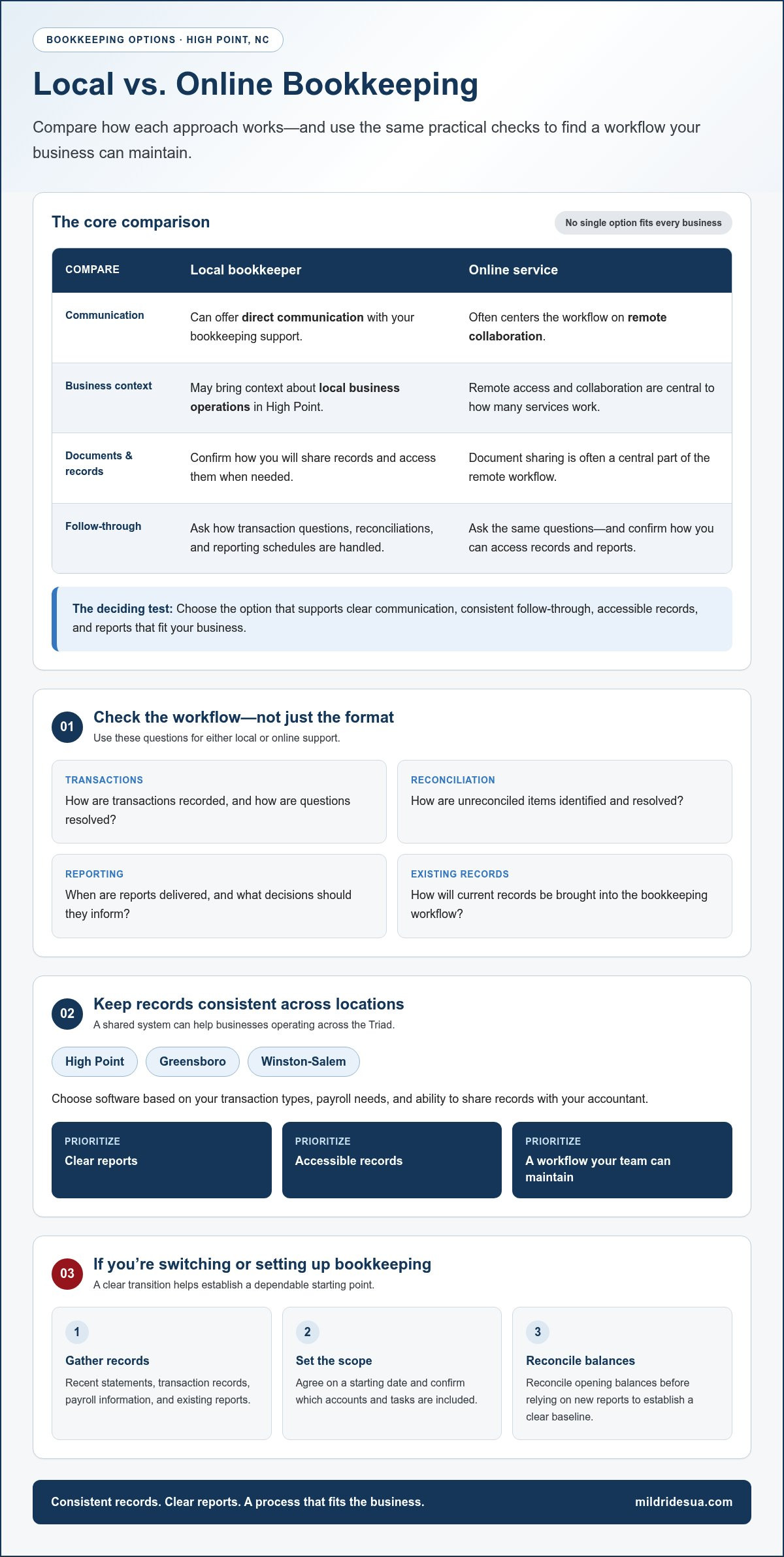
High Point bookkeepers can offer direct communication and context about local business operations, while online services often make document sharing and remote collaboration central to the workflow. Compare how each option handles transaction questions, reconciliation, reporting schedules, and access to records. The best fit is the one that supports consistent follow-through.
For businesses operating across the Triad, including High Point, Greensboro, and Winston-Salem, use a consistent system to capture activity across locations and sales channels. Choose software based on your transaction types, payroll needs, and ability to share records with your accountant. No single option suits every small business, so prioritize clear reports, accessible records, and a workflow your team can maintain.
Choosing a Qualified Bookkeeper
Choose a bookkeeper whose experience and process match your needs. Ask how transactions are recorded, unreconciled items are resolved, reports are delivered, and existing records are brought into the workflow. When reviewing feedback, look for specific comments about accuracy, communication, and dependable reporting rather than relying on a rating alone.
To set up bookkeeping or switch providers, gather recent statements, transaction records, payroll information, and existing reports. Agree on a starting date and confirm which accounts and tasks are included. Reconcile opening balances before relying on new reports to establish a clear baseline and avoid gaps during the transition.
Owners who are starting or formalizing a business can seek guidance beyond their bookkeeping provider. North Carolina’s Start a Business in North Carolina service provides a Small Business Advisor by phone at 800-228-8443, according to the North Carolina Department of Commerce. For registration questions, the North Carolina Secretary of State’s business registration customer service number is 919-814-5400. These resources can help owners identify administrative questions to raise as they organize records and plan their accounting workflow.
Tax obligations can also shape what owners ask their accountant to review. The North Carolina Department of Revenue says the state’s corporate income tax rate is scheduled to reach 0% by 2030. The North Carolina Department of Revenue states that economic nexus thresholds apply to out-of-state sellers with $100,000+ in sales or 200+ transactions in the state. Sellers can discuss whether those thresholds apply to their activity with a qualified tax professional.
Financial records, reconciliation, and reporting
Reliable books start with source documents, consistent transaction entries, and reconciled account balances. A regular preparation routine turns scattered receipts and statements into reports you can use.
Financial Record Maintenance
A bookkeeper is an operational choice, while maintaining organized records supports sound financial preparation. Owners can handle entries themselves or assign them to a bookkeeper, depending on transaction volume, available time, and record complexity.
Keep bank and credit card statements, sales records, receipts, invoices, loan documents, and payroll reports together by accounting period. For example, match a supplier invoice to its payment and bank transaction, then record the expense in the appropriate category. This creates a clear trail from source document to report.
Sales Tax and Payroll Tracking
For sales activity, track taxable and nontaxable sales, tax collected, refunds, and payments separately. A High Point cash-flow example lists sales tax due on the 20th; treating that date as a planning marker helps owners set aside funds and monitor the related balance.
For payroll, retain payroll registers, wage and deduction details, payment records, and related account entries. Compare payroll totals with withdrawals from the business account, then investigate differences before preparing reports. Keep sales tax and payroll activity separate to make both easier to review.
Use a repeatable monthly close instead of waiting until tax preparation. Gather statements and source documents for each account, enter missing transactions, and categorize them. Then reconcile each statement balance against the bookkeeping records, documenting timing differences and corrections.
- Match deposits to sales records, including card receipts and customer payments.
- Match withdrawals to receipts, invoices, payroll records, or loan activity.
- Separate owner contributions and withdrawals from business income and expenses.
- Review uncategorized items and investigate duplicate entries before closing the period.
After reconciliation, review the income statement and balance sheet for unusual changes. If supply costs rise sharply, compare vendor invoices and purchase timing before drawing conclusions. A cash-flow report can show expected customer receipts alongside upcoming payroll, supplier, and tax payments.
Keep corrections visible. If a bank charge was entered twice, document the correction rather than deleting the history without explanation. An audit trail helps you and your accountant understand changes to reported balances and supports accurate preparation.
Close each period with a short checklist: confirm all accounts are reconciled, save statements and supporting documents, review open invoices, and note questions for follow-up. This turns bookkeeping from transaction entry into a dependable record of business activity.
Bookkeeping benefits for small businesses
For a High Point business owner, current books turn daily activity into useful management information. Review income, expenses, open invoices, and upcoming obligations together instead of waiting for a cash shortage. This helps distinguish a profitable month from one affected by delayed customer payments.
Consistent categorization helps you understand which activities drive results. A contractor, for example, can separate materials, subcontractor costs, and travel expenses. Comparing these categories across reporting periods can reveal changing project costs and where estimates may need refinement.
Cash-flow visibility supports practical decisions. Before hiring, expanding inventory, or committing to equipment, compare expected payments with upcoming bills. If customer invoices remain unpaid, follow up before making a commitment that depends on those funds.
Organized books make tax preparation more structured. When receipts, invoices, and account entries are grouped consistently, you can trace a reported expense to its supporting record and identify missing documents earlier, rather than rebuilding transaction details during tax preparation.
- Review receivables: identify overdue invoices and assign follow-up.
- Compare expenses: investigate a category that changes between reporting periods.
- Plan commitments: line up expected receipts with payroll and supplier payments.
- Prepare documentation: connect each recorded transaction with its supporting record.
Bookkeeping can show whether growth is strengthening the business or adding strain. A retailer, for instance, may see higher sales alongside rising inventory purchases. Reviewing both helps assess whether stock levels and cash needs remain aligned, rather than relying on sales totals alone.
Reliable reports can improve communication with lenders, business partners, and tax professionals. A clear income statement and balance sheet provide a consistent starting point. You can explain changes by referring to recorded activity, such as a new supplier or a shift in customer payment timing.
Timely bookkeeping keeps questions close to the transactions that prompted them. If a deposit differs from the sales record, prompt review can clarify whether it reflects a processing delay, a refund, or an entry that needs correction. Addressing the discrepancy while details are accessible makes follow-up easier.
Bookkeeping creates the most value when you use the reports, not just produce them. Set a recurring review, choose a decision to examine, and record the next action. For example, review unpaid invoices before approving a discretionary purchase. This turns bookkeeping into an ongoing management tool.
Bookkeeping cost and time savings
Bookkeeping support is an operating expense, so compare its scope with the work it removes from your schedule. Pricing depends on the work involved, with a quote provided after a request. Factors include transaction volume, account complexity, payroll activity, cleanup needs, and reporting requirements.
Service structures vary. Accountants may charge package rates for ongoing weekly, monthly, or annual services, and the scope determines which tasks are included. A business with frequent sales, several payment accounts, and payroll may need a different workflow from a solo owner tracking fewer transactions.
Map your current process before comparing options. List the bookkeeping tasks you handle, how often they occur, and where delays arise. If payroll entries wait until month-end, for example, note the additional review needed to match payroll reports with bank withdrawals. This list clarifies what support should cover.
Save time by reducing repeated handling. A consistent routine for collecting invoices, recording transactions, and reconciling accounts can prevent last-minute searches through email during tax preparation. Saving a receipt with its transaction makes the supporting detail easier to find later.
Compare in-house bookkeeping with outside support by looking beyond transaction-entry time. Include your review time, corrections, report preparation, and follow-up on missing documents. A simple monthly time log can show whether bookkeeping interrupts customer service, scheduling, or sales work.
- Track the work: record time spent on entries, reconciliation, payroll, and corrections.
- Define the scope: identify which accounts, reports, and recurring tasks need attention.
- Review the handoff: note how documents reach the bookkeeper and how questions are resolved.
- Measure the outcome: compare time spent and report readiness across periods.
Consider a retailer who reconciles sales deposits manually. When card settlements arrive separately from daily sales records, matching them can require repeated investigation. A documented process that links sales summaries to deposits can reduce duplicate review and make discrepancies easier to spot.
Payroll adds a recurring workflow. Coordinate payroll reports, payment records, and bookkeeping entries, with clear responsibility for each step to help prevent missed information and duplicate entry. The right arrangement depends on how payroll is processed and records are shared.
Cost control also depends on preparation. Before service begins, organize statements, receipts, payroll reports, and prior records. A clean starting point can reduce catch-up work, while incomplete records may require additional sorting. Revisit the arrangement as transactions, staffing, or reporting needs change, so support remains aligned with the business.
Client experiences and reviews
Reviews are most useful when they describe a bookkeeping process, not just a general impression. Look for details about month-end close, payroll organization, tax preparation, communication, and support as a business changes. These specifics help you compare a provider’s working style with your needs.
One High Point bookkeeping client reports receiving closed books within a few days of month-end. This describes a specific workflow outcome: when the books were completed. When evaluating bookkeeping support, consider whether the timing helps you review expenses, plan payments, or prepare for a meeting.
Another client says bookkeeping support helped organize payroll and streamline tax preparation and budgeting. This feedback points to connected processes, not data entry alone. Consider how payroll records flow into bookkeeping and whether reports arrive in time to inform a budget review.
A growing-business client describes receiving CFO- and Controller-level support as the company expanded. The account illustrates how needs can change over time. A business may start by needing transaction organization, then require more structured financial review as staffing, sales activity, and reporting demands develop.
These accounts describe individual client experiences, not a guarantee of the same outcome for every business. Read them for the work described and its context. A useful review explains the task, communication, or result instead of relying only on broad praise.
- Look for a clear task: for example, month-end close, payroll organization, or budgeting.
- Notice the timing: a review may describe when reports or completed books became available.
- Check the business context: startup needs differ from those of a company expanding its team.
- Compare recurring themes: several comments about communication or accuracy can reveal what clients value.
Assess whether a review covers the kind of work you need. Feedback about payroll coordination may matter to an employer, while a report about growth-stage financial support may be more relevant to a business adding operations. Specific details help you interpret feedback rather than treating every review as equally applicable.
Use reviews alongside a written outline of your own priorities. Identify the reports, records, and recurring tasks that matter most, then compare those needs with the experiences described. If your current books need structured support, explore small-business bookkeeping support as a next step.
Mildrid Esua, CPA, PLLC: Tax Planning & Tax Preparation, Bookkeeping, IRS Representation, Small Business Accounting, Tax Resolution, Unfiled Tax, Tax Lien, Payroll Services
Mildrid Esua, CPA, PLLC helps small businesses connect organized bookkeeping with essential tax and accounting needs. Its services include bookkeeping, payroll, tax planning and preparation, and small business accounting. When records raise tax concerns, the firm also provides IRS representation and tax resolution for back taxes, tax liens, and unfiled returns.
This support can help when you need to establish a consistent bookkeeping process, prepare for tax work, or address unresolved tax issues. Bring your current records and identify the decisions or concerns you want to discuss to give the conversation a practical starting point.
To discuss your bookkeeping or tax needs, contact Mildrid Esua, CPA, PLLC.
Make Your Next Financial Decision With Clarity
Well-kept books are most valuable when they inform the next decision, not just document the last one. Start by identifying the financial question taking the most attention, then gather the records that could help answer it. You might be preparing for a staffing change, reviewing expenses, or organizing information for tax planning.
For small business bookkeeping in High Point, NC, consistent financial support can connect everyday records with broader accounting and tax needs. Mildrid Esua, CPA, PLLC provides bookkeeping and small business accounting, along with tax planning and preparation and tax resolution services. Owners dealing with unfiled returns, back taxes, or tax liens can also turn to the firm for IRS representation and tax relief.
Bring your current bookkeeping concerns and goals into the conversation to establish a useful starting point. Contact Mildrid Esua, CPA, PLLC to discuss support for your business. A clear next step can help you move forward with greater financial confidence.
Frequently Asked Questions
How can a bookkeeper help your business?
A bookkeeper can keep transaction records organized and help you understand how business activity is changing. A service business, for example, can separate income by project to see which work generated revenue and which expenses belong to it. Consistent records also help you bring focused questions about business performance or tax preparation to an accountant.
How much does a CPA cost for a small business in High Point?
A CPA’s fee depends on the work involved, such as tax preparation, ongoing accounting, or advice about a business decision. Record complexity, transaction volume, and the support required all affect the scope. Mildrid Esua, CPA, PLLC provides accounting and tax advisory services for small businesses. Pricing depends on the case, with a quote provided after a request.
What bookkeeping services do small businesses in High Point, NC need?
Bookkeeping works best when it reflects how your business operates. A retailer may need sales and inventory activity organized, while a consultant may prioritize client invoices and project expenses. For small business bookkeeping in High Point, NC, consider which records support your decisions, how payroll fits into the workflow, and what information your tax preparer needs at year-end.
How much do bookkeeping services cost in High Point, NC?
Bookkeeping pricing depends on the volume and complexity of the work, the reports requested, and whether records need catch-up organization. A straightforward transaction flow differs from a business with several accounts, payroll activity, and older records to sort. Pricing depends on the case, with a quote provided after a request.
What are the top-rated small business bookkeepers in High Point, NC?
High Point Bookkeeping is one option; assess providers by client feedback about accuracy, communication, and dependable reporting.




Leave a Reply
Your email is safe with us.