


For an existing calendar-year business, Form 2553 is generally due by March 15 for an S corporation election to take effect that year, according to the Internal Revenue Service. That deadline is a key planning point for North Carolina owners looking for an S corp election accountant in NC, especially when the business is approaching a new tax year.
Getting the date right is only part of the decision. You’ll also need to understand how the election affects payroll, owner compensation, and how business income reaches your personal return. This article explains when a newly formed business must file, what late-election relief may involve, how to assess a reasonable owner salary, and how distributions affect self-employment taxes. With those details in mind, you can assess whether an S corporation election fits your business and plan your next steps.
Key Takeaways
- For an existing calendar-year business, Form 2553 is generally due by March 15 for an election to take effect that year, according to the Internal Revenue Service.
- New businesses have a separate filing window: the Internal Revenue Service sets the deadline at two months and 15 days from the date the business began.
- An S corporation owner who works in the business needs to account for reasonable compensation and payroll before determining how distributions fit into the tax picture.
- Distributions may affect self-employment taxes differently from salary, but the owner’s pay and the business’s financial details matter.
- Review eligibility, filing timing, payroll, and North Carolina considerations together before deciding whether an S corporation election suits your business.
When is the S corp election due?
For an existing calendar-year business, Form 2553 is generally due by March 15 for an S corporation election to take effect that year, according to the Internal Revenue Service. Filing on time lets owners plan the election alongside compensation, payroll, and the coming tax year. The deadline is a starting point, not proof that the business qualifies.
To compare an LLC’s current tax treatment with an S corporation election, watch this overview:
Eligibility comes before the tax comparison. The Internal Revenue Service lists a limit of 100 shareholders for an S corporation. The business must also meet the other eligibility requirements, including having one class of stock. Ownership structure matters: adding a member or changing ownership terms can affect whether the corporation remains eligible.
The election itself requires a filing and agreement among owners. According to the Internal Revenue Service, an S corporation election is made by filing Form 2553 with all shareholders’ consent. Before submitting it, identify every shareholder, confirm the intended effective date, and coordinate signatures. A missing consent can disrupt the filing, even when owners agree informally.
New entities have a distinct deadline: according to the Internal Revenue Service, Form 2553 is due within two months and 15 days of the date the business began. A newly formed business should track its start date and decide its tax classification early. Existing LLCs may elect S corporation tax treatment through the appropriate IRS filing, without treating that tax choice as a change to every aspect of the LLC’s state-law structure.
Late-election relief may be available if a small business missed the filing deadline or its election was not approved, but relief is not automatic. Gather the business’s filing history, intended effective date, ownership details, and an explanation of the missed or unsuccessful filing. These records help clarify what happened and what corrective action may be needed.
Finally, evaluate the potential tax benefit against added operating work. An S corporation generally requires payroll for working owners and a separate annual business tax return, Form 1120-S. Compare the expected difference in owner-level taxes with payroll administration, bookkeeping, and return preparation. The result depends on business income, reasonable compensation, and how consistently the company earns profit.
- Estimate recurring profit after expenses, then model owner compensation and distributions.
- Include payroll and separate tax-return work in the comparison, not just potential tax savings.
- Revisit the election if ownership, income, or business structure changes.
A North Carolina business consistently netting $60,000-$80,000 or more per year after expenses may want to assess the election’s fit. That range is a planning prompt, not an automatic break-even point. A careful comparison weighs income stability, shareholder eligibility, payroll obligations, filing effort, and the owners’ consent before committing to the election.
What is a reasonable salary for an S corp owner?
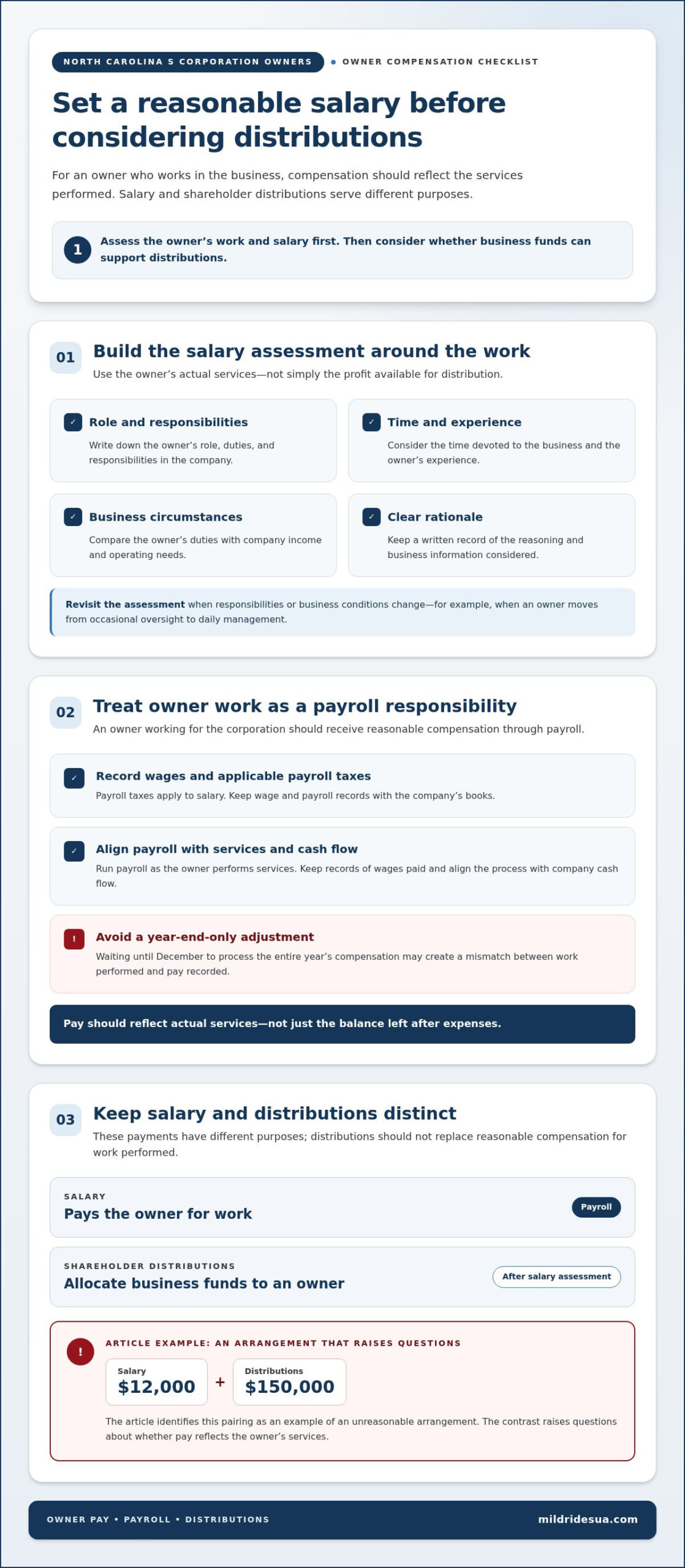
For North Carolina S corporation owners who work in the business, compensation should reflect the services they perform, and payroll taxes apply to salary. The analysis considers the owner’s role, duties, time devoted to the business, and the company’s income before setting pay.
Reasonable Compensation Analysis
Base the analysis on the work the owner actually performs, not simply the amount of profit available for distribution. Document the owner’s role, responsibilities, experience, and time devoted to the business. Compare those duties with the company’s income and operating needs. Salary should have a clear business rationale and reflect the services provided.
Revisit the analysis when responsibilities or business conditions change. An owner shifting from occasional oversight to daily management may need a different compensation assessment. Keep a written record of the role, the reasoning behind the salary, and the business information considered. This is more deliberate than choosing a wage solely to reduce payroll taxes.
Owner Payroll Requirements
An S corporation owner who works for the corporation should receive reasonable compensation through payroll, with payroll taxes applying to that salary. Treat the owner’s position as an employment role: record wages, withhold applicable payroll taxes, and keep payroll records with the company’s books. North Carolina owners should account for payroll throughout the year, rather than treating compensation as a year-end adjustment.
Run payroll as the owner performs services. Waiting until December to process the entire year’s compensation may create a mismatch between the work performed and the pay recorded. Align payroll with the company’s cash flow and keep records of wages paid. The schedule and amount should reflect actual services, not simply the balance left after expenses.
Salary and Shareholder Distributions
Salary pays the owner for work; shareholder distributions allocate business funds to an owner. These payments serve different purposes, so distributions should not replace reasonable compensation for services performed. Assess salary first, then consider whether available business funds support distributions after operating costs and payroll obligations.
A $12,000 salary paired with $150,000 in distributions is an example of an unreasonable arrangement. The contrast between pay and distributions raises questions about whether compensation reflects the owner’s actual work. Instead of relying on a preferred tax outcome, compare the salary with the owner’s duties, time, and position, then document the reasoning.
Salary and Self-Employment Tax
For a sole proprietor or single-member LLC, self-employment tax generally applies to nearly all net profit, in addition to income tax. An S corporation owner-employee’s self-employment tax is limited to the salary paid to that owner. Payroll taxes apply to wages, while distributions are not subject to self-employment tax.
That distinction can make the salary decision consequential, but it does not justify setting wages below a reasonable level. Consider the owner’s services alongside company income, then compare payroll costs with the potential tax effect of distributions. Account for compensation and administrative work, not just the tax treatment of one payment.
Keep a practical file for each compensation decision: describe the owner’s duties, record salary and payroll activity, and note changes in the role or business income. Review the records when responsibilities shift or the company’s financial picture changes. This gives owners a consistent basis for compensation decisions and keeps wages and distributions distinct in the books.
Form 2553 filing deadlines and late-election relief
For a new entity, Form 2553 is due within two months and 15 days of the date the business began, according to the Internal Revenue Service; an existing calendar-year business generally files by March 15 for that year’s election. Eligibility includes a 100-shareholder limit and one class of stock.
Form 2553 Filing Timing
Use the business’s start date or tax-year calendar to identify the correct filing window. The Internal Revenue Service sets the new-entity deadline at two months and 15 days after the business began. For an existing calendar-year business, the general deadline is March 15 for an election to take effect that year. Record the intended effective date before preparing the filing.
Build a submission checklist before filing: confirm the entity’s information, identify its shareholders, and obtain each shareholder’s consent. Keep a copy of the completed Form 2553 with the business’s tax records. These steps help owners coordinate the election with operating decisions, payroll setup, and the tax return for the intended year.
Late-Election Relief and Eligibility
A business that missed the filing deadline, or whose election was not approved, may qualify for late-election relief, but relief is not automatic. Assemble the original filing details, intended effective date, shareholder consents, and a clear account of why the election was late or unsuccessful. These facts help establish the circumstances behind the request.
Review eligibility at the same time. An S corporation must be domestic, have no more than 100 shareholders, and maintain one class of stock. Eligible shareholders include U.S. citizens or residents, estates, certain trusts, and certain exempt organizations. Check ownership records and governing documents for changes that could affect these conditions.
Keep the federal election separate from North Carolina return filing. North Carolina may grant an S corporation a seven-month extension to file when the extension application is received timely. That state filing extension belongs on the company’s compliance calendar alongside, not in place of, the Form 2553 election deadline. Track each filing by its purpose and effective period.
If the election was missed, reconstruct the timeline before taking corrective action. Note when the business began operating, which tax treatment it used, and when owners expected S corporation status to start. Compare those records with the Form 2553 deadline and collect shareholder approvals. A complete timeline helps explain the filing history clearly.
Eligibility and timing work together. For example, a new corporation could track its start date, confirm its shareholder structure, obtain consent, and then prepare Form 2553 within the applicable window. If an existing business seeks a later effective date, owners should document that choice consistently across company records and tax planning.
S-Corp election guidance for North Carolina business owners
An LLC or corporation elects federal S corporation tax status by filing Form 2553 with shareholder consent; North Carolina doesn’t require a separate state S corporation election. An S corp election accountant in NC can help coordinate the federal election with state compliance, payroll planning, and tax-return preparation.
Choose the tax structure with federal and North Carolina obligations in view. An LLC can elect S corporation tax treatment while remaining an LLC under state law, so the election doesn’t itself convert the entity into a corporation. A business consistently netting $60,000-$80,000 or more annually after expenses may want to assess the election’s fit, including compensation, payroll administration, and filing work.
North Carolina S corporations generally owe corporate franchise tax, while LLCs taxed as partnerships or disregarded entities don’t. For 2025, the franchise tax rate is $1.50 per $1,000 of the corporation’s tax base, and the minimum tax cannot be less than $200. The franchise tax has no maximum, subject to the exception in the instructions. Include this state obligation in an entity-structure comparison.
Annual compliance also varies by entity and tax year. North Carolina LLCs must file an annual report by April 15 and pay a $200 fee. A calendar-year corporation’s report is due April 15. An S corporation files Form 1120-S each year, and its North Carolina return is due by the 15th day of the fourth month after its taxable year closes. Track each filing separately.
Sales activity creates another compliance consideration for out-of-state businesses selling into North Carolina. The state’s economic nexus thresholds include $100,000+ in sales and 200+ transactions. Review sales records against both thresholds; an S corporation election doesn’t resolve sales-tax obligations.
Virtual CPA support can help North Carolina businesses coordinate election planning, bookkeeping, payroll, and tax preparation remotely. An S corp election accountant in NC can connect the election’s effective date with the business’s tax year, owner compensation, and annual returns. Organized financial records make these decisions easier to review as operations change.
Before electing, assemble the entity’s formation and ownership records, income and expense information, and payroll details. Compare projected net income with payroll and separate-return responsibilities, account for state franchise tax and annual-report obligations, and map filing dates to the operating calendar. An S corp election accountant in NC can help bring these considerations together for an informed decision.
Self-employment tax savings from distributions
An S corporation separates owner compensation from shareholder distributions, which have different self-employment tax treatment. Salary is subject to payroll taxes; distributions are not subject to self-employment tax. This distinction can affect a federal tax comparison, but distributions are not a substitute for reasonable pay.
For a sole proprietor or single-member LLC, self-employment tax of about 15.3% generally applies to nearly all net profit, in addition to income tax. An S corporation owner-employee’s self-employment tax is limited to the salary paid to that owner. The potential difference depends on the salary that reasonably reflects the owner’s work, not simply the business’s total profit.
Consider the illustration of a business earning $180,000 in profit and paying its owner a $90,000 salary. It shows why owners compare wages with distributions when evaluating tax treatment. It doesn’t establish a recommended salary or a set amount of tax savings. The company’s operating facts and the owner’s services shape that comparison.
A roughly 15% figure can illustrate the self-employment-tax difference associated with distributions. Treat it as an illustration, not a calculation of the owner’s total tax savings. Income tax still matters, as do payroll costs and the business’s separate filing responsibilities. A useful comparison looks at the combined effect rather than one tax alone.
Before projecting savings, separate the figures in the company’s records. Identify business profit, owner wages, payroll taxes, and distributions. Compare the S corporation outcome with the business’s current tax treatment, including income tax and employment-tax effects. This step-by-step review helps show whether a potential reduction outweighs additional payroll and return work.
Shareholder basis also matters. Distributions above a shareholder’s basis are taxable, so their treatment is not determined only by whether they avoid self-employment tax. Maintain records tracking each shareholder’s basis and distributions. Review them before authorizing payments, especially when profits change or the company has multiple shareholders.
For each tax year, reconcile payroll records, company books, and shareholder distribution records. Confirm that wages reflect services performed, then review the amount and timing of distributions against available business funds and basis. This creates a clear record of how the company divided compensation and shareholder payments, supporting more informed federal tax planning.
- Compare salary and distributions separately, rather than treating all business profit alike.
- Include income tax, payroll taxes, and additional filing work in the savings analysis.
- Review shareholder basis before distributions, since amounts above basis are taxable.
For support assessing S corporation distributions and self-employment tax implications, explore S corporation tax planning.
Mildrid Esua, CPA, PLLC: Tax Planning & Tax Preparation,Bookkeeping IRS Representation small business accounting Tax resolution unfiled tax, tax lien , payroll servies
Mildrid Esua, CPA, PLLC provides comprehensive tax planning and preparation, bookkeeping, small business accounting, and payroll services for business owners considering an S corp election accountant NC. Turn to the firm to connect election decisions with owner compensation, payroll records, and business tax filings.
A coordinated review can help organize the information behind the decision, including business income, expenses, payroll, and ownership details. The firm also provides tax resolution services and IRS representation for businesses facing tax issues, including unfiled returns or tax liens. These services address distinct needs, from planning ahead to resolving existing tax matters.
If you are considering an election or need help organizing your business tax records, contact Mildrid Esua, CPA, PLLC to discuss your needs.
Build a Tax Strategy That Can Adapt
An S corporation election is more than a filing decision. It shapes how you organize owner pay, business records, and tax planning as your company changes. Treat the election as part of an ongoing financial framework, and review it when your operations, ownership, or goals shift.
An S corp election accountant in NC can connect these decisions to your business’s broader tax picture. Mildrid Esua, CPA, PLLC provides tax planning and preparation, bookkeeping, and small business accounting, as well as tax resolution services for existing tax matters. A focused conversation can help identify the records and priorities to guide your next move.
For guidance tailored to your business, contact Mildrid Esua, CPA, PLLC. A considered plan can give you a clearer path forward as your business grows.
Frequently Asked Questions
Should my LLC be taxed as an S corp?
An S corporation tax election may suit an LLC with steady profits and an owner who works in the business, but the added payroll and filing work must make financial sense. Compare projected income, reasonable owner compensation, payroll administration, and state obligations with the LLC’s current tax treatment. For example, an LLC with irregular income may value its existing simplicity more than a potential tax difference.
Is An S-Corporation Right For Me?
An S corporation may suit your business if it earns consistent profit, you can manage payroll, and its ownership meets eligibility rules. It may be less suitable if income fluctuates sharply or added recordkeeping outweighs the potential tax benefit. Consider plans for hiring, reinvesting earnings, and adding owners. These decisions help determine whether this structure supports the business beyond the current tax year.
What Is the Difference Between an S-Corp and a C-Corp?
An S corporation generally passes income and losses through to shareholders’ personal tax returns, while a C corporation follows the double-taxation model described in federal tax comparisons. This affects how business income reaches owners, but both structures involve corporate compliance. Consider how you expect to distribute earnings, retain profits, and structure ownership before choosing. The right comparison includes operational needs, not just tax treatment.
Does North Carolina require a separate S corporation election or state tax filing?
North Carolina doesn’t require a separate S corporation election for state income tax, but an S corporation still has state filing obligations. Its return is generally due by the 15th day of the fourth month after the taxable year closes. The business also needs to account for North Carolina franchise tax and corporate annual-report requirements, which are separate from the federal S corporation election.
How do I find a CPA or tax accountant experienced with S corporations in North Carolina?
Look for an accountant who can connect election planning with owner payroll, bookkeeping, business returns, and North Carolina compliance. Ask how those pieces will be coordinated across the tax year, rather than treating Form 2553 as a stand-alone task. Mildrid Esua, CPA, PLLC provides small-business accounting and tax advisory services for owners in Greensboro and surrounding North Carolina communities.
What are the benefits and drawbacks of electing S corp status in North Carolina?
Potential benefits include pass-through treatment and different self-employment tax treatment for salary and distributions. Trade-offs include payroll administration, a separate annual federal business return, and North Carolina franchise tax and annual-report duties. Weigh these responsibilities against recurring business profit and owner workload. The election is more compelling when the expected tax effect justifies the additional compliance over time.
What happens if an S corp election is late or rejected, and how can relief be requested?
A late or unapproved election does not always rule out S corporation treatment. Some businesses may qualify for late-election relief, but approval is not automatic. Assemble the filing history, intended effective date, ownership details, shareholder consents, and a clear explanation of the delay or rejection. These records help establish the circumstances and support a complete relief request.
What ongoing North Carolina annual reports, tax returns, and fees apply to an S corporation?
A North Carolina S corporation generally files Form 1120-S federally each year and a state return after its tax year closes. For calendar-year corporations, the report is due April 15; the filing fee is $25 online or $30 by paper. North Carolina’s franchise tax cannot be less than $200 for 2025, according to the North Carolina Department of Revenue. Keep these obligations distinct in your compliance calendar.




Leave a Reply
Your email is safe with us.