


Filing a late return doesn’t automatically mean you must pay the full balance immediately. The IRS generally requires delinquent returns to be filed before it will consider other tax-resolution arrangements. Depending on your circumstances, options may include a payment plan or, if you meet the criteria, an offer in compromise. A CPA near me for tax resolution can help assess your records and ability to pay.
It’s understandable to worry that a late return will lead to an unmanageable bill or immediate collection action. Filing is an important first step, but it doesn’t erase the balance or settle what happens next.
This guide explains when you may owe the full amount, which relief options could apply, how long IRS collection can last, and what affects case timelines. It also explains how a CPA can represent you before the IRS, so you can assess your next steps with a clearer view of your options.
Key Takeaways
- Filing late returns is an essential step, but it doesn’t automatically determine how you’ll resolve any balance due.
- Penalty relief may depend on your prior compliance history and whether circumstances outside your control caused the delay.
- Compare payment arrangements with an offer in compromise by considering your ability to pay and the details of your tax liability.
- Collection and resolution timelines depend on the case; organized records and prompt responses can help keep the process moving.
- Understand what IRS representation involves and how a qualified tax professional can help you assess the next steps.
Penalty abatement
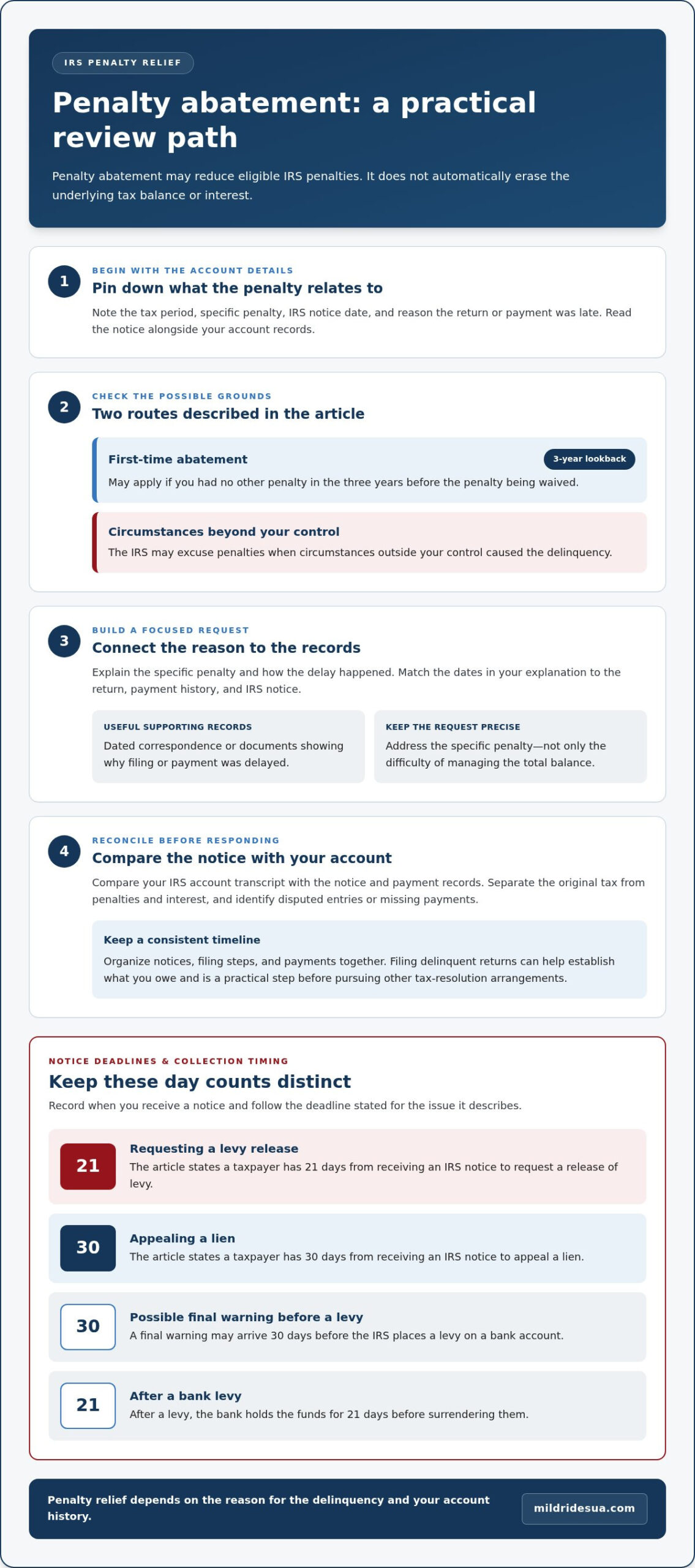
Penalty abatement may reduce eligible IRS penalties, but it doesn’t automatically erase the underlying tax balance or interest. Start by identifying the tax period, penalty, notice date, and reason the return or payment was late.
To compare payment arrangements and compromise offers, watch this overview:
IRS Notices, Penalties, and Interest
Read each IRS notice against your account records, then note the tax year, balance, penalty, and response deadline. A final warning may arrive 30 days before the IRS places a levy on a bank account. After a levy, the bank holds the funds for 21 days before surrendering them. These notice details help clarify the situation and which tax problems need attention first.
Tax Penalty Reduction
Tax penalty relief may be available through first-time abatement if you had no other penalty in the three years before the penalty being waived. The IRS may also excuse penalties when circumstances beyond your control caused the delinquency. Prepare a clear explanation supported by records, such as dated correspondence or documents showing why filing or payment was delayed.
Build your request around the specific penalty, not a general claim that the total is difficult to manage. Match dates in your explanation to the return, payment history, and IRS notice. For example, if a documented event disrupted your ability to file, explain when it happened and how it caused the delay. Organized evidence gives the IRS a clearer basis for reviewing your request.
Filing delinquent returns is a practical step before pursuing other tax-resolution arrangements. Gather missing tax records, prepare accurate returns, and address each outstanding period. A complete filing history can clarify the balance and associated penalties. Keep copies of submitted returns and IRS correspondence together so later discussions rely on consistent records.
Deadlines matter when a notice describes collection action. A taxpayer has 21 days from receiving an IRS notice to request a release of levy. A taxpayer also has 30 days from receiving an IRS notice to appeal a lien. Record the receipt date, preserve the notice, and act on the stated issue rather than setting the letter aside.
If penalties remain after review, compare your IRS account transcript with the notice and payment records. Separate the original tax from penalties and interest, then identify disputed entries or missing payments. This helps you explain your request precisely and prepare supporting documents. A tax professional who represents taxpayers before the IRS can help organize the file and present the relevant facts.
Relief depends on the reason for the delinquency and your account history, not simply the balance. Keep a timeline of notices, filing steps, and payments, and use it to explain your request consistently. A focused record helps the IRS assess the penalty issue without confusing it with other parts of your tax account.
For how long can the IRS pursue me for unfiled returns or unpaid taxes and penalties?
The IRS can require delinquent returns for any number of past years. There’s no statute of limitations on that filing requirement. Unpaid balances also need attention, but filing missing returns helps establish what you owe and which payment options may fit. Gather income records and prior notices, then list every tax year with an outstanding return or balance.
According to the Internal Revenue Service, payment options include full payment, a short-term payment plan paying in 180 days or less, or a long-term payment plan, also called an installment agreement, paying monthly. These choices address different repayment situations. Compare the amount due with the payment you can sustain, then review the plan terms and application steps for the option you’re considering.
An installment agreement spreads payments over time instead of requiring the full balance at once. Before applying, organize your tax returns, notices, income details, and essential expenses. A clear financial picture helps you assess whether the proposed payment is realistic. If it would leave necessary bills unpaid, revise your budget before agreeing to a schedule that may be difficult to maintain.
For example, a taxpayer with irregular self-employment income may need to review cash flow across stronger and slower months. A fixed payment that fits one unusually good month could strain the next. Map expected income against routine expenses and tax obligations before selecting a payment amount. This helps make the agreement more sustainable and highlights where records or missing returns need attention.
Filing remains a separate priority. The IRS may require missing returns before considering other tax-resolution arrangements, so identify each unfiled year and prepare accurate returns first. Keep copies of filings and correspondence together. Once the IRS account reflects the filed returns, you can evaluate the balance and payment options with a more complete picture, rather than relying on estimates or scattered notices.
If you already have an agreement, track every scheduled payment and keep confirmation records. A missed payment or changed financial situation can affect the arrangement, so read IRS correspondence promptly and respond to the issue it describes. If the proposed payment no longer fits, review your current income, expenses, and account information before seeking a change. Don’t ignore notices while evaluating your options.
Small businesses may need to consider operating cash flow alongside personal obligations. Separate business and household records, then identify which resources are available for payments without disrupting essential operations. If unfiled returns, notices, or an unaffordable schedule make the next step unclear, IRS representation for tax matters can help you organize the issues and communicate with the agency.
Offers in compromise
An offer in compromise is a request to settle eligible federal tax debt for less than the full amount owed. Taxpayers generally consider this route when the liability was assessed incorrectly or they cannot afford to pay it. The Internal Revenue Service describes its collection statute as 10 years when explaining eligibility for an offer in compromise. That period makes the account’s age and collection status relevant to evaluating this option.
Start by confirming the balance and filing status in your IRS records. Filing overdue returns can be an important step before pursuing other tax-resolution arrangements. Gather filed returns, income records, bank statements, details about assets, and records of regular expenses. These materials help present an accurate financial picture instead of relying on estimates. If an assessment appears wrong, organize documents supporting the figures you reported or the correction you’re requesting.
The amount proposed in an offer should reflect the financial facts behind your request. Review income, necessary expenses, available assets, and existing obligations together. For example, a taxpayer with modest earnings but valuable assets has a different financial profile from someone with similar earnings and few assets. A clear comparison helps explain why the proposed compromise fits your circumstances and how much you can reasonably direct toward the liability.
Compare this option with a payment plan before deciding. An installment agreement spreads repayment over time, while an offer in compromise seeks to settle the liability for less than its full amount. A payment schedule may be more appropriate if you can pay the balance over time. A compromise request may be more relevant if the assessed amount is incorrect or your financial records show you cannot pay the full liability. Compare both options using the same income, expense, and asset information.
Accuracy matters throughout the process. Reconcile account balances with IRS notices, confirm that each return and payment appears in your records, and explain any differences with supporting documents. Missing information or inconsistent figures can make your financial picture harder to assess. Keep a copy of every submission and note when the IRS requests additional materials. Organized records help keep the review focused on the amount owed and the basis for the proposed compromise.
An offer in compromise usually takes six to nine months for a decision. During that time, maintain current filing and payment responsibilities and keep new IRS correspondence with your application records. If the IRS rejects the proposal, review its reasons carefully and compare them with the financial information you submitted. A tax professional who represents taxpayers before the IRS can help organize evidence, assess whether an offer or payment plan better fits your situation, and prepare a focused response.
How long does it take for tax resolution, or to resolve my case?
Bring recent IRS notices, filed and unfiled tax returns, account transcripts, payment records, and income and expense documents. Include audit letters and supporting records if the IRS is examining a return. These materials help an accountant understand the balance, deadlines, and decisions already made.
There isn’t one timeline for every tax resolution case. The pace depends on the issue, the records available, the IRS review, and how quickly you provide requested information. A missing return, an audit dispute, and an installment agreement each involve different steps. Organizing documents early gives the discussion a clear starting point.
IRS accounts with tax liabilities under $50,000 can be resolved very quickly. That does not mean every account below that amount follows the same path. Missing filings, disputed assessments, incomplete records, and the relief requested can affect the work involved. Identify each tax year and the specific IRS action before estimating what remains.
IRS representation can include reviewing notices, organizing records, communicating with the agency, and preparing responses. During an audit, a representative compares the return with evidence such as receipts, bank records, and business documents. A clear, consistent explanation helps address the IRS’s specific questions. Keep copies of submissions and note which records support each reported item.
CPAs, attorneys, and enrolled agents are allowed to represent clients before the IRS. Their qualifications can suit different situations. A CPA may be suitable if you have a business or side job, rental properties, many assets, or IRS tax-related correspondence. Discuss the audit issue, deadlines, prior filings, and desired outcome before deciding what the representation should address.
An attorney may be relevant when your tax matter includes legal questions alongside IRS correspondence. Representation should match the task: an audit response requires focused records, while an installment agreement centers on a sustainable payment arrangement. Tax resolution services can include assessing the account, preparing submissions, and representing you. Clarify which specific steps are included in the engagement.
Case progress also depends on timely cooperation. If the IRS requests a missing receipt or corrected record, collect it promptly and connect it to the relevant tax year and issue. For example, label business expense records by category and explain how each relates to the return. Organized evidence reduces avoidable back-and-forth and keeps the response centered on the audit findings.
Before an IRS discussion, write down the notice date, tax period, amount in dispute, and questions you need answered. Ask the accountant or attorney to explain the next action and which records support it. This preparation helps you assess progress based on completed steps, rather than assuming every tax resolution follows the same schedule.
Tax resolution services and credentials
Tax resolution involves more than submitting forms: credentials, authority to represent you, and a documented plan matter. Focus on who can represent you before the IRS and what work your case requires.
Finding a CPA for IRS Tax Resolution
To find a CPA who handles IRS tax resolution, search the IRS database for tax preparer credentials and background information. Then discuss your specific concerns, such as unfiled returns, an audit notice, or wage garnishment, and ask how the professional would organize the response.
CPAs, attorneys, and enrolled agents may legally represent clients before the IRS. A person preparing federal tax returns needs an IRS Preparer Tax Identification Number. Review your paperwork before submission, and never sign a blank return. These steps help you assess both the preparer’s credentials and the process used for your case.
Representation should match the issue. For example, an audit involving business income may require organized invoices, bank records, and expense documentation. Ask how the tax professional will communicate with the IRS, which records you must provide, and which decisions remain yours. Clear responsibilities help prevent missed requests and keep each response tied to the relevant tax year.
Tax Resolution Options
A CPA can help assess an installment agreement or an offer in compromise using your income, necessary expenses, assets, and IRS account information. An installment agreement structures payments over time; an offer in compromise seeks to settle eligible tax debt for less than the full amount. Your financial records and the circumstances behind the liability help determine which option to examine.
Ask the professional to explain why a recommended option fits your situation and what steps it requires. For instance, if your current income supports regular payments, compare an installment arrangement with the cost of maintaining it. If the amount assessed appears incorrect, gather records supporting the disputed figures before deciding whether a compromise request addresses the problem.
Tax resolution work can also include reviewing notices, preparing submissions, and representing you in IRS communications. Clarify the scope in writing: which tax years are included, which documents you must provide, and how the professional will handle new IRS requests. A defined process makes it easier to track progress and distinguish preparation from representation.
Assessing Promises and Risks
Be cautious of firms that promise to settle tax debt for less before reviewing your returns, income, expenses, and assets. A promised outcome without a case-specific assessment can mislead taxpayers about available options. Ask for the reasoning behind the recommendation and how the professional will evaluate your actual IRS account.
Watch for pressure to submit incomplete information or sign forms you haven’t reviewed. For example, compare any proposed resolution with the balance and tax years shown in IRS notices. Keep copies of every document and ask what happens if the IRS rejects a request or seeks more records. Careful review helps you make informed decisions.
For support assessing your records and IRS options, explore tax resolution services as a next step.
Mildrid Esua, CPA, PLLC: Tax Planning & Tax Preparation, Bookkeeping, IRS Representation, Small Business Accounting, Tax Resolution, Unfiled Tax, Tax Lien, Payroll Services
Mildrid Esua, CPA, PLLC provides tax resolution and IRS representation for individuals and small businesses dealing with unfiled returns, back taxes, or tax liens. If you’re weighing an installment agreement, penalty relief, or another way to address an IRS balance, the firm can help assess the records and decisions involved.
The firm’s tax planning and preparation, bookkeeping, and small business accounting can also support a clearer understanding of tax obligations and financial records. For business owners, an accountant and tax advisor can connect current tax concerns with ongoing planning. Bring IRS notices, relevant returns, and payment records to make your concerns and priorities clear.
For help finding a dependable CPA near me for tax resolution or IRS representation, contact Mildrid Esua, CPA, PLLC or visit mildridesua.com.
Build a Clear Path Forward
Tax problems can feel all-consuming when every notice demands attention at once. Move from reacting to individual letters toward a deliberate plan for your financial future. Set out what you need to resolve first, which records you can assemble, and which questions remain unanswered. That preparation can make your next conversation more focused and useful.
If you’re searching for a CPA near me for tax resolution, choose an approach that considers both the immediate IRS issue and the financial decisions that follow. The right strategy depends on your records, obligations, and ability to meet proposed terms, so keep your priorities clear as you assess your options.
When you’re ready to discuss your tax situation, contact Mildrid Esua, CPA, PLLC. A considered first step can help you move toward greater clarity and a more stable financial outlook.
Frequently Asked Questions
Do I have to pay the full amount I owe the IRS when I file a late return?
No, filing a late return doesn’t automatically require you to pay the entire balance immediately. Filing establishes the return and helps clarify what you owe; payment is a separate step. The Internal Revenue Service lists full payment, a short-term plan paying in 180 days or less, and a long-term installment agreement with monthly payments as options. The right next action depends on your filed returns, account balance, and available cash flow.
How much do accountants charge for tax help?
Accountant fees depend on the work involved, not one standard amount for every taxpayer. A straightforward return requires different preparation from returns involving a business, rental income, investments, several tax years, or IRS correspondence. Ask for a quote that identifies the work covered, such as return preparation, bookkeeping review, or representation. Before proceeding, clarify whether additional notices or follow-up work fall within the quoted scope.
What does “tax relief” mean?
Tax relief describes options or assistance that address a tax balance, penalties, collection activity, or difficulty meeting tax obligations. It isn’t a single program or automatic reduction. For example, a taxpayer might seek penalty relief, arrange payments, or request an offer in compromise based on an incorrect assessment or inability to pay. Relief can also involve professional help organizing records and communicating with the IRS about the specific problem.
What happens if I ignore IRS notices?
Ignoring an IRS notice can lead to additional penalties and interest, and collection action may include wage garnishment. The notice identifies the issue and gives information about the next step, so keep it and note its response deadline. For example, a letter about a balance differs from one warning of collection action. Read the notice carefully, compare it with your records, and respond to the issue it raises.
What credentials and experience should a tax resolution CPA have?
CPAs, attorneys, and enrolled agents are permitted to represent clients before the IRS. You can search the IRS database for a tax preparer’s credentials and background; anyone preparing federal returns needs a Preparer Tax Identification Number. If you’re searching for a CPA near me for tax resolution in Greensboro, High Point, Burlington, or Winston-Salem, also discuss experience with your specific issue, such as an audit or unfiled returns.
How much does a CPA charge for tax resolution services near me?
Tax resolution fees depend on the case and are provided after a quote request. Factors include the number of tax years involved, missing returns, account complexity, notices or liens, and whether IRS representation is needed. A quote request should clarify the work included, such as reviewing account records, preparing submissions, or communicating with the IRS. That scope helps you understand what the proposed fee covers before authorizing the work.
How do CPA fees compare with enrolled agent and tax attorney fees for IRS tax problems?
There’s no reliable fee ranking that applies to every CPA, enrolled agent, or tax attorney. Each can represent clients before the IRS, while fees depend on the services required and the account’s complexity. Compare written scopes rather than credentials alone: one proposal might cover document review, while another includes representation and correspondence. Ask which tax years, IRS issues, and follow-up tasks the engagement addresses.
What are the IRS eligibility rules for an offer in compromise?
The IRS may allow taxpayers to settle for less than the full liability if the assessment is incorrect or they can’t afford to pay it. The financial review considers the taxpayer’s ability to pay and relevant assets. Delinquent returns must be filed before the IRS negotiates other resolution arrangements. The Internal Revenue Service describes the collection statute as 10 years when explaining offer-in-compromise eligibility, so account timing also matters.




Leave a Reply
Your email is safe with us.