

Selecting your business structure is not a simple administrative task; it’s the most significant architectural decision you’ll ever make for your financial future. Many entrepreneurs in the Greensboro and Winston-Salem area start with a bold vision for growth, yet they often find themselves paralyzed by the maze of NC-specific registration requirements or the persistent fear of an IRS audit. It’s common to feel that the complexities of the tax code are designed to work against you, especially when you’re trying to manage self-employment tax burdens while maintaining legal compliance.
Discovering the right local CPA for business formation allows you to transition from uncertainty to a state of informed confidence. By establishing a partnership rooted in vigilant stewardship, you can ensure your new enterprise is built on a tax-efficient foundation from its very first day. This article explores how to architect a legally protected entity and implement a proactive tax reduction strategy that secures your long-term stability. You’ll gain clarity on navigating North Carolina’s specific filing landscape while positioning your business for sustainable, strategic growth under the guidance of a dedicated advisor who stays continuously engaged with your success.
Key Takeaways
- Learn why partnering with a local CPA for business formation serves as a strategic architectural step that prevents costly tax leaks before your enterprise even launches.
- Understand the nuanced differences between LLC and S Corp structures in North Carolina to ensure your entity offers both legal protection and maximum fiscal flexibility.
- Identify specific methods to mitigate the 15.3% self-employment tax through proactive salary and distribution strategies designed for business owners in Greensboro and Winston-Salem.
- Follow a clear, local roadmap for NC Secretary of State registration and federal compliance that avoids the common pitfalls of administrative dissolution.
- Discover the value of continuous engagement, moving beyond simple filing services to establish a long-term partnership that supports your growth through professional bookkeeping and advisory.
The Strategic Importance of Choosing the Right Local CPA for Business Formation
Many founders view business formation as a simple checklist of administrative forms. They visit a generic website, pay a filing fee, and receive a digital folder of documents. This reactive approach treats your enterprise like a mere transaction rather than a growing legacy. Unlike automated services that prioritize volume over value, a Certified Public Accountant approaches your startup as a strategic architect. They don’t just record your history; they help you design your future. In the vibrant economic corridors of Greensboro and Winston-Salem, starting with a flawed foundation creates immediate tax leaks that drain your capital before you’ve even had the chance to scale.
A local CPA for business formation acts as a vigilant guide who understands the specific nuances of the North Carolina business environment. They ensure that every decision, from your initial registration to your internal accounting setup, aligns with a long-term vision of stability. This high level of professional involvement transforms a standard filing into a customized blueprint for success. Finding the right local CPA for business formation is about more than just compliance; it’s about securing a competitive advantage from the start.
Formation vs. Filing: Why the Distinction Matters
Filing is a clerical act, but formation is a strategic one. While an online service can submit Articles of Organization to the North Carolina Secretary of State, it won’t have the foresight to determine if that structure fits your specific revenue model. A proactive advisor looks ahead at the complex tax implications of your choices. They ensure you don’t just have a legal entity on paper, but an optimized vehicle for wealth preservation from day one. Choosing a reactive path often leads to poor formation choices that force you to play defense against the IRS later. By prioritizing strategic depth over administrative speed, you establish a protective barrier around your interests.
The Risks of Incorrect Entity Selection
Selecting the wrong business structure frequently leads to excessive exposure to the federal 15.3% self-employment tax. For entrepreneurs in High Point or Burlington, this oversight can result in thousands of dollars in avoidable expenses every year. Beyond these immediate financial hits, an incorrect setup complicates future transitions, such as adding new partners or raising capital. The hidden costs of attempting to fix a structure later include high legal fees, potential restructuring taxes, and significant administrative delays. Investing in expert guidance early prevents these complexities, allowing you to focus on growth rather than damage control.
Evaluating Business Entities: LLC, S Corp, and C Corp in North Carolina
Selecting your legal structure is a pivotal moment in the life of your enterprise. Unlike a generic online template, a local CPA for business formation analyzes your projected revenue and liability risks to recommend a structure that fits like a custom-tailored suit. In North Carolina, whether you choose an LLC or a Corporation, the initial filing fee is $125, but the long-term tax implications vary significantly between the two. Your choice dictates your relationship with the IRS for years to come, making it the most critical architectural decision you’ll face.
The North Carolina LLC Advantage
The Limited Liability Company (LLC) remains a favorite for new Greensboro entrepreneurs due to its operational simplicity and inherent flexibility. It offers a protective shell that separates your personal assets from business liabilities without the rigid formalities required by a traditional corporation. Transitioning from a sole proprietorship to an LLC is a vital step in professionalizing your brand and protecting your family’s financial security. The NC Secretary of State views LLCs as versatile entities, requiring an annual report fee of $200 due by April 15th each year. This structure allows for pass-through taxation, where business income is taxed at North Carolina’s flat 3.99% individual rate in 2026.
S Corp Election: The Strategic Architect’s Tool
For many growing businesses in Winston-Salem, the S Corp election represents the “Gold Standard” for Maximizing Self-Employment Tax Savings. By electing S Corp status, you can divide your income into two distinct categories: a reasonable salary and shareholder distributions. While the salary is subject to the federal 15.3% self-employment tax, distributions are generally exempt. This distinction can save thousands of dollars annually, providing you with more capital to reinvest in your growth. We act as your vigilant guide to ensure your salary meets IRS “reasonable” standards, preventing audits while optimizing your take-home pay. If you’re ready to move beyond basic filings, exploring an S Corp election for self employment tax can significantly alter your financial trajectory.
C Corporations and Liability Protection
C Corporations are often overlooked by small businesses, yet they offer unique benefits for those looking to reinvest heavily or raise capital. While they face the potential for “double taxation” at the federal level, North Carolina’s corporate income tax rate is just 2.00% in 2026 and is scheduled for a complete phase-out by 2030. This makes NC an increasingly attractive home for enterprises that plan to retain earnings for future expansion. Regardless of the entity you choose, liability protection is only effective if you maintain strict financial boundaries. A proactive advisor helps you avoid “piercing the corporate veil” by implementing rigorous bookkeeping and compliance standards that stand up to any level of scrutiny.
Maximizing Self-Employment Tax Savings through Proactive Planning
Without the guidance of a strategic architect, many new businesses suffer from a silent financial leak that drains capital long before the first annual report is due. This leak is the federal self-employment tax, which sits at 15.3% for 2026. For a business owner in High Point or Greensboro, failing to structure your entity correctly means every dollar of profit is subject to this tax in addition to North Carolina’s flat 3.99% individual income tax. Unlike reactive filing services that simply submit paperwork, a local CPA for business formation identifies these vulnerabilities early, ensuring your enterprise is built to retain as much revenue as possible.
At Mildrid Esua, CPA, PLLC, we specialize in identifying “lost” tax dollars within existing entities and preventing those losses in new ones. We analyze your projected earnings to determine the optimal ratio between a reasonable salary and shareholder distributions. This proactive methodology transforms your tax return from a source of stress into a reflection of a well-executed financial strategy. Formation timing also plays a critical role; electing the right status at the start of a fiscal quarter can prevent thousands of dollars in “catch-up” taxes and administrative headaches later in the year.
The S Corp Tax Reduction Framework
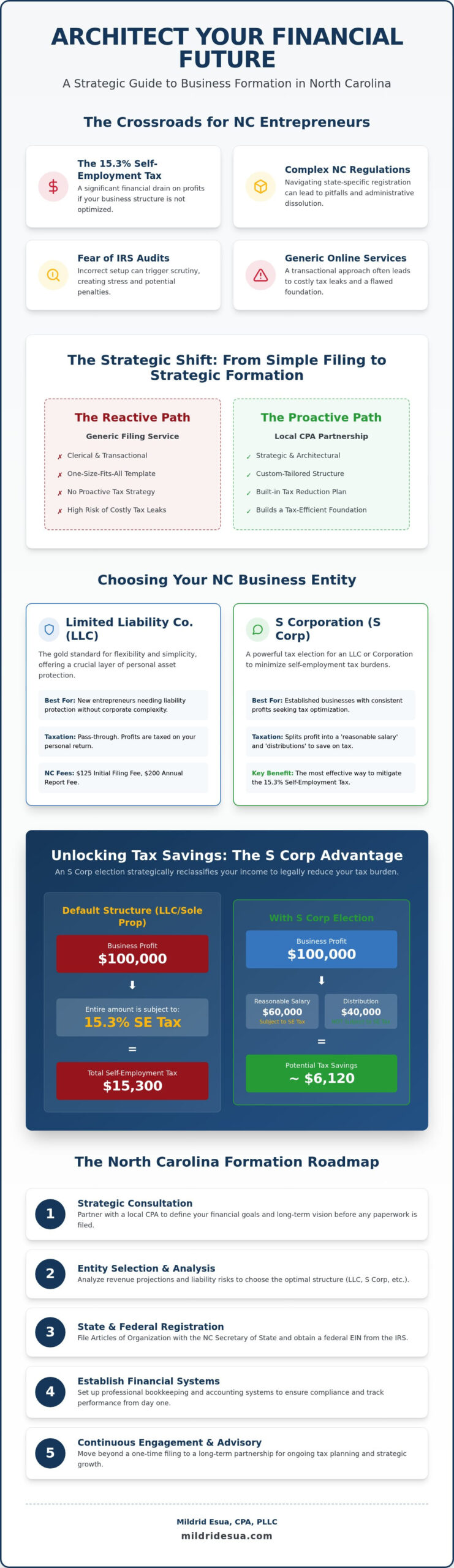
The transition to S Corp status is often the most effective way to mitigate the 15.3% self-employment tax. Consider a Greensboro consultant earning $150,000 in net profit. As a standard LLC, the entire $150,000 is subject to self-employment tax. By utilizing an S Corp election for self employment tax purposes, that same consultant might draw a reasonable salary of $70,000, leaving $80,000 as a distribution. Because distributions aren’t subject to the 15.3% tax, the savings are immediate and substantial. This framework is even more vital under 2026 rules, where maximizing every deduction is essential for long-term stability.
Avoiding Common IRS Red Flags During Formation
While the tax savings of an S Corp are significant, they require vigilant stewardship to maintain. The IRS closely monitors these entities for “reasonable salary” compliance and proper documentation. We manage the critical details that DIY services overlook, such as:
- Form 2553 Execution: Ensuring your S Corp election is filed accurately and within the strict 75-day window of formation.
- Corporate Formalities: Establishing the habit of recording meeting minutes and maintaining a clear separation of personal and business finances.
- Payroll Integration: Setting up a steady cadence for salary payments to satisfy federal requirements from day one.
By treating these administrative requirements as part of your business’s protective armor, you reduce the risk of future audit triggers. A local CPA for business formation doesn’t just help you start; they provide the steady hand needed to navigate the complexities of federal and state compliance as you grow.
The North Carolina Formation Roadmap: From Greensboro to Winston-Salem
Establishing a business in the Triad requires more than a visionary idea; it demands a methodical execution of state and local regulations. Unlike generic filing platforms that leave you to guess which county permits apply to your specific industry, a local CPA for business formation ensures every administrative detail is handled with precision. From securing your business name with the North Carolina Secretary of State for a $30 reservation fee to filing your Articles of Organization, we provide the vigilant stewardship necessary to avoid the risk of administrative dissolution. Selecting a local CPA for business formation means you aren’t just filing forms; you’re building a legacy.
In Guilford and Forsyth Counties, local compliance often involves more than just a federal Employer Identification Number (EIN). You may need specific privilege licenses or zoning permits depending on whether you’re operating in downtown Greensboro or the Innovation Quarter in Winston-Salem. Our role is to act as your strategic architect, building a compliant foundation that integrates federal, state, and local requirements into one cohesive system. This proactive approach prevents the common “fix-it” costs that plague many new entrepreneurs who try to go it alone.
Navigating NC State Requirements
While the Articles of Organization are the public documents that officially create your LLC for a $125 fee, your Operating Agreement is the private blueprint that governs how your business actually functions. We help you draft these critical documents to ensure clear ownership boundaries and operational clarity. Additionally, we manage your registration with the North Carolina Department of Revenue (NCDOR) to handle sales tax and withholding requirements correctly from the start. Maintaining your “Good Standing” status requires filing an annual report by April 15th each year along with a $200 fee. Missing this deadline doesn’t just result in paperwork; it threatens your liability protection.
Financial Infrastructure for New Businesses
A robust financial infrastructure is the lifeblood of any new enterprise. We guide you through the process of opening dedicated business bank accounts in the Triad area, ensuring a clean separation of funds that protects your corporate veil. By integrating QuickBooks for real-time financial visibility, we allow you to monitor cash flow and expenses with professional clarity. For those hiring their first employees in High Point or Burlington, we establish local payroll systems that manage North Carolina’s 1.0% new employer unemployment insurance rate and federal withholding with absolute accuracy. If you’re ready to build your enterprise on a foundation of professional excellence, contact us for expert business formation services.
Beyond the Filing: Continuous Engagement for Long-Term Stability
Many entrepreneurs treat the receipt of their Articles of Organization as the finish line. In reality, it’s merely the starting block. Generic online filing services often disappear the moment your documents are stamped, leaving you to navigate the complexities of payroll setup, estimated tax payments, and local compliance alone. This “one-and-done” methodology creates a dangerous vacuum where minor administrative oversights can quickly evolve into significant financial liabilities. Partnering with a local CPA for business formation ensures that the architectural integrity of your entity is maintained long after the initial filing fee is paid.
At Mildrid Esua, CPA, PLLC, we transition seamlessly from your formation advisor to your ongoing growth partner. By integrating monthly bookkeeping and proactive advisory services, we keep a constant watch over your financial health. This continuous engagement allows us to identify trends, optimize cash flow, and ensure your business remains in good standing with both the NC Department of Revenue and the IRS. Your success isn’t a seasonal event; it requires a year-round commitment to strategic stewardship and vigilant oversight.
The Value of an Ongoing Advisory Relationship
A proactive advisory relationship replaces year-end panic with calm, calculated decision-making. We provide quarterly tax projections that account for North Carolina’s flat 3.99% individual rate and the evolving corporate tax landscape. As your revenue scales in Winston-Salem or High Point, your initial structure might require adjustments to maintain its tax-efficient foundation. Waiting until tax season to address these shifts is a reactive strategy that often costs more in lost opportunities than the investment in professional oversight. Vigilant stewardship means looking ahead at the next three years, not just the last twelve months.
Next Steps for Your North Carolina Startup
Architecting a stable enterprise begins with a single, focused conversation with a local CPA for business formation who understands the Triad’s specific economic landscape. When you prepare for your first consultation, bring your vision for the next five years, any existing financial records, and your questions regarding S Corp elections or local Guilford County requirements. We provide a personalized entity analysis that moves beyond basic paperwork to create a comprehensive roadmap for your future. Don’t leave your enterprise’s stability to chance or an automated algorithm. Secure your business foundation today with Mildrid Esua, CPA, PLLC and ensure your North Carolina startup is built for the long term.
Architecting a Resilient Future for Your North Carolina Enterprise
Launching a business in the Triad is a bold step toward personal and professional independence. The difference between a simple filing and a strategic formation lies in the foresight applied to your tax structure and legal protections. By prioritizing tailored S Corp election strategies and a clear roadmap through NC-specific regulations, you transform your startup into a robust vehicle for long-term wealth preservation. Unlike transactional services that leave you to navigate the complexities of compliance alone, a local CPA for business formation provides the vigilant stewardship needed to shield your growth from avoidable tax leaks and IRS scrutiny.
Our localized Greensboro and Winston-Salem expertise, combined with a commitment to expert IRS representation, ensures that your interests are protected from day one. This proactive partnership allows you to focus on your vision while we manage the intricate details of your financial architecture. Ready to launch with confidence? Schedule a Business Formation Strategy Session with Mildrid Esua, CPA, PLLC today. Your entrepreneurial journey deserves a steady hand and a strategic mind to guide the way.
Frequently Asked Questions
Do I really need a CPA to form an LLC in North Carolina?
While you can technically file Articles of Organization independently, a local CPA for business formation ensures your entity choice aligns with your long-term financial goals. Unlike automated filing services, we analyze your revenue projections to prevent costly tax leaks from day one. Choosing a professional advisor provides a protective layer of vigilant stewardship, ensuring your operating agreement and tax elections are structured to safeguard your personal assets and optimize your future liability.
What is the difference between an LLC and an S Corp for tax purposes?
An LLC is a legal structure that offers liability protection, whereas an S Corp is a specific tax election made with the IRS. In North Carolina, a standard LLC is a pass-through entity where all profits are subject to the 15.3% self-employment tax. By electing S Corp status, you can split your income into a reasonable salary and shareholder distributions. This strategic division allows the distribution portion to remain exempt from self-employment taxes.
How much can I save on self-employment tax with an S Corp election?
Savings depend on the gap between your total net profit and your IRS-mandated reasonable salary. For example, if your Greensboro business nets $120,000 and you draw a $60,000 salary, you avoid the 15.3% self-employment tax on the remaining $60,000 distribution. This results in approximately $9,180 in annual federal tax savings. We act as your vigilant guide to ensure your salary levels meet federal standards while maximizing the capital you retain for reinvestment.
What are the ongoing compliance requirements for a new NC business?
North Carolina requires LLCs to file an annual report by April 15th each year with a $200 fee to the Secretary of State. Corporations must also file annual reports, though the fee is lower at $20 for online ACH payments. Beyond state filings, you must manage quarterly estimated tax payments and maintain a clear separation of business and personal finances. Failing to meet these deadlines can lead to administrative dissolution and the loss of protection.
Should I form my business in Delaware or North Carolina?
For most entrepreneurs operating in the Triad, forming in North Carolina is the more efficient choice. While Delaware offers specialized business courts, registering there requires you to also register as a foreign entity in NC, doubling your filing fees and administrative burdens. North Carolina’s business environment is increasingly attractive, featuring a flat 3.99% individual income tax rate in 2026 and a corporate tax rate of 2.00% that is scheduled for complete elimination by 2030.
How long does the business formation process take in 2026?
Standard processing times vary, but the North Carolina Secretary of State offers expedited options for those needing immediate results. You can choose 24-hour processing for a $100 fee or same-day processing for $200. Without expedited service, the timeline depends on the current backlog at the Secretary of State’s office. A local CPA for business formation can manage these filings on your behalf, ensuring your documents are accurate and submitted through the most efficient digital channels.
Can a local CPA help me if I already started as a Sole Proprietor?
Yes, transitioning from a sole proprietorship to a formal entity is a critical step in professionalizing your brand. We analyze your existing financial data to determine the most tax-efficient structure for your current revenue level. This process often involves cleaning up your bookkeeping and establishing a compliant payroll system. By formalizing your business now, you gain essential liability protection and unlock advanced tax strategies, such as the S Corp election, that were previously unavailable.
What local Greensboro taxes should a new business owner be aware of?
New business owners in Greensboro must account for Guilford County personal property taxes on business equipment and furniture. Depending on your specific industry, you might also be required to obtain a local privilege license or pay specific occupancy taxes. We help you navigate these localized requirements, ensuring you remain in good standing with both the city and county tax offices. This proactive management prevents unexpected assessments and ensures your financial foundation remains stable as you scale.