

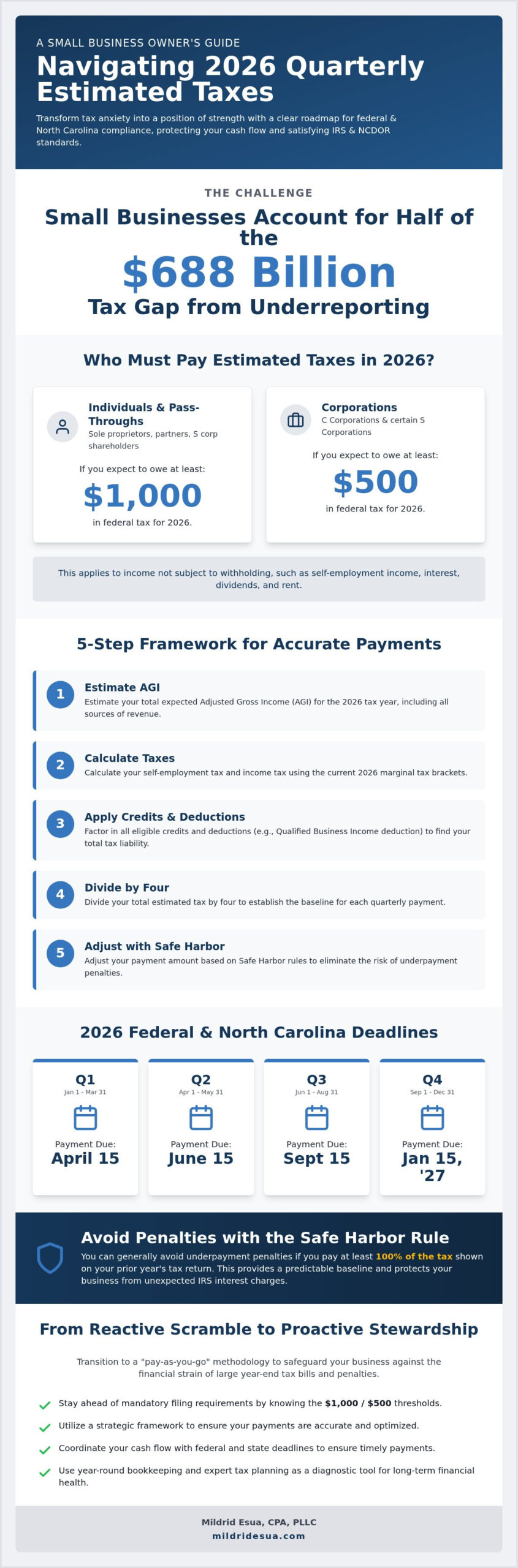
Did you know that small businesses account for half of the $688 billion tax gap attributed to underreporting? This staggering figure has prompted the IRS to intensify its focus on compliance, leaving many entrepreneurs in Greensboro and High Point feeling like they’re operating under a microscope. It’s understandable to feel overwhelmed by the shifting landscape of tax regulations and the constant pressure on your liquid capital. Managing quarterly estimated tax payments for small business often feels more like a reactive scramble than a strategic process, especially when you’re balancing federal obligations against North Carolina’s specific requirements.
We’re here to transform that anxiety into a position of strength and clarity. This guide will provide you with the exact 2026 deadlines and calculation methods you need to protect your cash flow and satisfy the vigilant standards of the IRS and the NCDOR. We’ll examine the specific interest rates for underpayment, clarify the $1,000 threshold for mandatory filings, and establish a methodical approach to year round compliance. By the end of this guide, you’ll have a reliable roadmap to navigate 2026 with the peace of mind that comes from professional stewardship and informed decision making.
Key Takeaways
- Determine if your 2026 tax liability meets the $1,000 threshold for individuals or $500 for corporations to stay ahead of mandatory filing requirements.
- Utilize a strategic framework to calculate expected adjusted gross income and self-employment taxes, ensuring your payments are accurate and optimized.
- Coordinate your cash flow with the 2026 federal and North Carolina deadlines to ensure timely quarterly estimated tax payments for small business interests.
- Transition to a proactive “pay-as-you-go” methodology to safeguard your business against the financial strain of large year-end tax bills and IRS penalties.
- Recognize the role of year-round bookkeeping and expert tax planning as a diagnostic tool for maintaining long-term financial health and compliance.
Understanding Who Must Make Quarterly Estimated Tax Payments
Traditional employees see their tax obligations settled with every paycheck through automatic withholding. Small business owners, however, operate under a different mandate. Estimated tax is the method used to pay tax on income not subject to withholding, creating a pay-as-you-go responsibility that demands foresight. For the 2026 tax year, the IRS requires individuals to make quarterly estimated tax payments for small business income if they expect to owe at least $1,000. Corporations face an even stricter standard; the requirement triggers at a $500 threshold.
This obligation extends beyond simple profit. It covers self-employment income, interest, dividends, and rents. If you operate a pass-through entity like an LLC or a Partnership, the business itself doesn’t pay income tax. Instead, the tax burden shifts to the owners. This transition from corporate to personal liability requires a high level of professional depth to manage correctly. Without vigilant stewardship, these obligations can easily lead to cash flow disruptions or unexpected penalties at year-end.
The Self-Employed and the 1099 Landscape
Freelancers and contractors are the primary targets for these rules because their income lacks the steady rhythm of a W-2 salary. You must manage the dual nature of self-employment tax, which encompasses both the employer and employee shares of Social Security and Medicare. This often surprises new entrepreneurs in Greensboro and High Point who are used to having these costs split with an employer. Strategic planning can mitigate this pressure. For instance, an S Corp election for self employment tax can alter this obligation by reclassifying a portion of your income, potentially lowering your overall tax exposure while maintaining full compliance.
Corporate Obligations in North Carolina
The North Carolina Department of Revenue maintains a serious focus on corporate compliance. C Corporations and S Corporation shareholders must align their state payments with federal deadlines to avoid interest charges. In North Carolina, you must make these payments if you expect your state tax liability to exceed $1,000. Managing quarterly estimated tax payments for small business interests at the state level requires the same precision as your federal filings. We approach this not as a mere transactional chore, but as a strategic diagnostic tool. Unlike a reactive filer who only looks backward, a growth partner uses these quarterly checkpoints to ensure your bookkeeping is accurate and your financial trajectory is stable. This methodical approach transforms a regulatory burden into a clear vision for your company’s future.
How to Calculate Your Estimated Payments: A Strategic Framework
Calculating quarterly estimated tax payments for small business requires more than a simple spreadsheet. It demands an integrated view of your 2026 financial goals. Unlike a reactive approach that only looks at past data, a proactive framework uses your current momentum to project future liabilities. To begin, follow this structured methodology to find your baseline:
- Step 1: Estimate your total expected adjusted gross income (AGI) for the 2026 tax year, including all sources of revenue.
- Step 2: Calculate your self-employment tax and income tax using the current 2026 marginal tax brackets.
- Step 3: Factor in all eligible credits and deductions, such as the Qualified Business Income (QBI) deduction, to find your total tax liability.
- Step 4: Divide this total by four to establish your quarterly baseline for federal and state obligations.
- Step 5: Adjust your payment amount based on Safe Harbor rules to eliminate the risk of underpayment penalties.
Referencing the IRS Estimated Tax for Small Businesses documentation is a vital first step in ensuring your baseline numbers align with federal expectations. However, a static document cannot replace the strategic depth of a customized tax plan.
The Safe Harbor Rule: Protecting Your Assets
The IRS provides a protective mechanism known as the Safe Harbor rule. Generally, you can avoid underpayment penalties if you pay at least 100% of the tax shown on your prior year’s return. For high earners with an AGI over $150,000, this requirement increases to 110%. This is the most secure way to shield your business from the 7% interest rate the IRS currently charges for underpayments in 2026. Within our strategic tax planning for businesses, we utilize these safe harbors to protect cash flow during high-growth years when your current income might significantly outpace your previous records.
Adjusting for Seasonality and Fluctuating Income
For many Greensboro and High Point businesses, income doesn’t arrive in a steady stream. If your revenue is seasonal, a “set it and forget it” approach to tax payments can lead to severe cash flow crises or missed opportunities. You may instead use the annualized income installment method. This allows you to pay smaller amounts during slow quarters and larger amounts when revenue peaks. Maintaining precision here requires more than an annual check-in. The role of monthly bookkeeping for small businesses is critical for these real-time adjustments. By keeping your records current, you can pivot your strategy as your income fluctuates throughout 2026. If you’re feeling uncertain about these calculations, partnering with a dedicated tax advisor can provide the clarity needed to maintain vigilant compliance.
Managing Cash Flow and Avoiding IRS Underpayment Penalties
Many entrepreneurs view taxes as a distant, annual hurdle. This reactive mindset often leads to a significant cash flow crisis when the final bill arrives. Transitioning to a pay-as-you-go strategy isn’t just about compliance; it’s a diagnostic tool for your business health. The IRS calculates penalties on a per-quarter basis. If you miss a payment in April, you start accruing interest immediately, even if you overpay in September. This granular approach to enforcement means that quarterly estimated tax payments for small business must be handled with consistent, vigilant stewardship to protect your bottom line.
Adhering to the official IRS guidelines on estimated taxes ensures you remain within the safe harbor zones discussed previously. Beyond avoiding penalties, this methodical approach removes the psychological weight of the “April 15th Surprise.” When you treat tax obligations as a regular monthly or quarterly expense, you maintain a clearer picture of your actual take-home profit. Tax resolution experts view these regular payments as preventative medicine, keeping your business out of the crosshairs of federal collections and ensuring long-term stability.
The High Cost of Procrastination
Delaying your payments is more than a minor oversight; it’s an expensive form of borrowing. For the 2026 tax year, the IRS interest rate for underpayment is 7% for the first, third, and fourth quarters, and 6% for the second quarter. North Carolina mirrors this seriousness, with a 7% annual interest rate for the first half of 2026. These costs can snowball quickly. If a calculation error or a missed deadline leads to a significant debt, you may require expert tax resolution North Carolina services to navigate the path back to compliance. The IRS typically shows more leniency to taxpayers who demonstrate a good faith effort through consistent, even if slightly imperfect, quarterly payments.
Strategic Cash Reserves for Taxes
A reliable method for managing these obligations involves the “30% Rule.” By setting aside 30% of every incoming payment into a dedicated tax savings account, you ensure the funds are available when the deadlines arrive. Unlike a general operating account, this reserve should be treated as unencumbered capital that belongs to the state and federal government. You can even utilize high-yield business savings accounts to earn interest on these reserves before they’re due. This practice embodies the role of a Strategic Architect, where you manage your business capital with foresight rather than reacting to deadlines as they appear. It’s a steady hand in a complex financial environment that ensures your growth isn’t hampered by avoidable debt.
2026 Deadlines and North Carolina State Specifics
The 2026 calendar year demands precise timing to maintain a compliant posture. For both federal and North Carolina obligations, the deadlines are synchronized, providing a streamlined rhythm for business owners. You should mark these specific dates on your operational calendar to ensure you don’t fall behind:
- Q1 Deadline: April 15, 2026
- Q2 Deadline: June 15, 2026
- Q3 Deadline: September 15, 2026
- Q4 Deadline: January 15, 2027
If the 15th falls on a weekend, the deadline moves to the next business day. Missing these dates triggers immediate interest charges, making quarterly estimated tax payments for small business a non-negotiable priority for your financial calendar. This schedule provides the structure needed to manage your business capital with foresight rather than reacting to deadlines as they appear.
North Carolina Department of Revenue (NCDOR) Requirements
North Carolina mandates estimated payments if you expect your total state tax liability after withholding to be $1,000 or more. For business owners in Greensboro and High Point, utilizing the NCDOR e-Business center is the most efficient way to submit these funds. Unlike national platforms that often overlook state-specific nuances, a localized strategy ensures your state and federal cadences match perfectly. This alignment is vital. It prevents the common mistake of settling federal debt while allowing state interest to accumulate at the 7% annual rate set for the first half of 2026. Proactive management ensures your state obligations are met with the same intellectual depth as your federal filings.
Local Filing Considerations in the Triad
Operating in Burlington, Kernersville, or Winston-Salem brings unique economic opportunities and specific reporting needs. A steady hand is required to manage these local variables throughout the year. National software chains often treat your business as a mere data point, but a local partner acts as a Strategic Architect. Continuous engagement is the only way to prepare for small business tax preparation Winston-Salem without the stress of last-minute adjustments. This localized expertise provides the protective oversight necessary to navigate the 2026 tax environment. It ensures that your business doesn’t just survive tax season but uses it as a springboard for growth.
If you’re ready to move beyond reactive filing, partner with a tax advisor who understands the Triad market to secure your 2026 tax strategy.
Beyond Compliance: Strategic Tax Stewardship with Mildrid Esua, CPA
Compliance is often viewed as the final destination of tax management. For the Strategic Architect, however, compliance is merely the baseline. True financial health requires a transition from reactive stress to a philosophy of proactive stewardship. Mildrid Esua, CPA, PLLC serves as a vigilant guide for Greensboro and Winston-Salem entrepreneurs, ensuring that every financial decision aligns with long-term stability. By reframing quarterly estimated tax payments for small business as a strategic diagnostic tool, we help you maintain a steady hand on your company’s trajectory throughout 2026. This methodical approach ensures your capital is protected and your growth remains uninterrupted by regulatory surprises.
A growth partner does more than just fill out forms. We provide the intellectual depth needed to navigate complex financial challenges before they become crises. This involves a consultative register that prioritizes your company’s future rather than just its past. Unlike a distant clerk who only looks backward, we stay continuously engaged with your data to provide forward-looking insights. Whether you are operating in Kernersville or Summerfield, our focus remains on optimizing your tax position and safeguarding your cash flow through every business cycle.
The Value of Continuous Engagement
Traditional accounting services often operate on a seasonal rhythm. Unlike this reactive model, our methodology emphasizes the importance of a year-round advisory relationship. We monitor your profitability on a quarterly basis, allowing us to make real-time adjustments to your payment schedules. If your revenue fluctuates in 2026, your tax strategy should pivot accordingly. To understand how we’ve applied these principles for regional success, you can review our Charlotte small business accountant strategic growth study. This same level of high-level expertise is applied to our clients in Jamestown and Oak Ridge, ensuring your local business benefits from sophisticated, tailored care that mirrors your actual performance.
Resolving Past Issues to Secure the Future
It’s difficult to focus on future growth when past obligations remain unresolved. If your business is currently struggling with back taxes, unfiled returns, or IRS liens, we provide the expert representation necessary to secure a clean slate. We specialize in tax resolution services that transition you from a state of crisis to a state of controlled compliance. Once your past issues are resolved, we implement the proactive frameworks discussed in this guide. This clean slate is the essential first step toward mastering your quarterly estimated tax payments for small business requirements. Secure your business’s future with a strategic consultation today.
Securing Your Financial Trajectory in 2026
Mastery over quarterly estimated tax payments for small business requires more than just meeting deadlines; it demands a strategic alignment of your cash flow with federal and North Carolina regulations. By implementing a pay-as-you-go methodology and utilizing safe harbor protections, you eliminate the risk of the 7% underpayment interest rate while maintaining liquid capital for growth. Unlike reactive filing, this proactive approach ensures your business remains resilient against seasonal fluctuations and regulatory shifts. It’s about maintaining a steady hand on your financial controls through every quarter of the year.
At Mildrid Esua, CPA, PLLC, we provide expert IRS representation for Greensboro businesses alongside customized S corp and tax optimization strategies. Our commitment to proactive year-round bookkeeping and advisory transitions you from the stress of tax season to a state of constant financial clarity. We don’t just look at your past performance; we architect your future stability through vigilant stewardship and professional depth. Your growth is our priority, and we look forward to navigating the complexities of 2026 by your side.
Partner with a Strategic Tax Architect-Schedule Your Consultation
Frequently Asked Questions
What happens if I miss a quarterly tax payment deadline in 2026?
Missing a deadline triggers an underpayment penalty that the IRS calculates for each specific period. In 2026, the interest rate for individuals is 7% for the first, third, and fourth quarters. This interest accumulates daily from the due date until the payment is settled. For entrepreneurs in Greensboro, these costs can erode your profit margins quickly. We recommend immediate catch-up payments to halt interest accrual and protect your business’s financial health.
Can I pay my quarterly estimated taxes online?
You can submit your federal payments through IRS Direct Pay or the Electronic Federal Tax Payment System. For your North Carolina obligations, the NCDOR e-Business Center provides a secure portal for Greensboro and High Point residents. Digital payments are the most reliable way to ensure quarterly estimated tax payments for small business interests are documented. They provide an immediate confirmation receipt. This is essential for maintaining accurate bookkeeping records throughout the year.
How much should a small business owner set aside for quarterly taxes?
Most small business owners should reserve approximately 30% of their gross income for tax obligations. This percentage typically covers both federal income tax and the 15.3% self-employment tax. If you operate in Winston-Salem or Burlington, you must also account for North Carolina’s flat tax rate. Maintaining a dedicated high-yield savings account for these reserves ensures you have the capital ready. Proactive bookkeeping helps you refine this percentage based on your actual deductions.
Do I need to pay quarterly taxes if this is my first year in business?
You are required to pay if you expect to owe at least $1,000 in tax for 2026. Even in your first year, the IRS expects you to estimate your earnings. If you had a tax liability in 2025, you can use the Safe Harbor rule to pay 100% of that amount to avoid penalties. New business owners in Kernersville should seek professional advisory early to establish a methodical payment rhythm from the start.
Is there a penalty if I overpay my quarterly estimated taxes?
No penalty exists for overpaying your estimated taxes. If your total payments exceed your actual liability, you can claim a refund or apply the overpayment to your 2027 estimated tax installments. While overpaying avoids IRS interest, it does tie up your business’s liquid capital. We help our High Point clients find a balance that ensures compliance without sacrificing the cash flow needed for daily operations and strategic growth.
How do S Corp distributions affect my quarterly estimated payments?
Distributions from an S Corp are not subject to self-employment tax, but they do increase your total taxable income. You must include these distributions when estimating your adjusted gross income for 2026. This distinction is a key part of our tax optimization strategies for Greensboro entrepreneurs. Correctly projecting these figures ensures your quarterly estimated tax payments for small business reflect your true liability while maximizing the benefits of your S Corp election.
What forms do I need for North Carolina state estimated taxes?
North Carolina uses Form NC-40 for individual estimated income tax payments. While paper vouchers are available, the North Carolina Department of Revenue strongly encourages using their online filing system. This is especially relevant for business owners in Burlington and Jamestown who want to avoid mailing delays. Ensuring your state forms align with your federal 1040-ES filings is a critical step in our vigilant stewardship of your tax compliance.
Can I change my estimated payment amount mid-year if my income drops?
You can and should adjust your payments if your revenue changes significantly mid-year. If your income drops, you can recalculate your remaining installments to preserve your cash flow. Conversely, if your Burlington business sees a sudden surge in profit, increasing your payments prevents a large bill in April. Using the annualized income installment method allows for these real-time adjustments. It ensures your tax strategy remains as dynamic as your business operations.