
An NC Department of Revenue payment plan may be available after you receive an official notice about taxes owed, if your required tax returns are up to date and the tax period remains collectible. The Department also considers whether a tax collection warrant or bank garnishment is already in place for the same periods. Individuals and businesses can apply, but business debts, including sales tax, follow different repayment terms from individual plans.
A tax balance can put pressure on personal finances or business cash flow, so understanding the repayment process matters. This article explains who may qualify, how installment payments work, what businesses with tax debt should know, and what to consider when standard requirements are difficult to meet.
You’ll also learn how to keep an agreement in good standing and why filing and paying new taxes matters while you repay an existing balance. Knowing these requirements can help you prepare for the next step in the state’s process.
Key Takeaways
- Eligibility depends on more than having an unpaid balance; understand which account and filing details can affect your application.
- Repayment timelines differ for individuals and businesses, so identify which rules apply to your tax debt.
- If standard payment requirements are difficult to meet, an exception request may involve sharing detailed financial information.
- Learn how payment methods, missed installments, and new tax obligations can affect an agreement.
- Tax preparation and resolution support can help individuals and businesses organize next steps when state tax debt becomes difficult to manage.
Am I eligible for an Installment Payment Agreement?
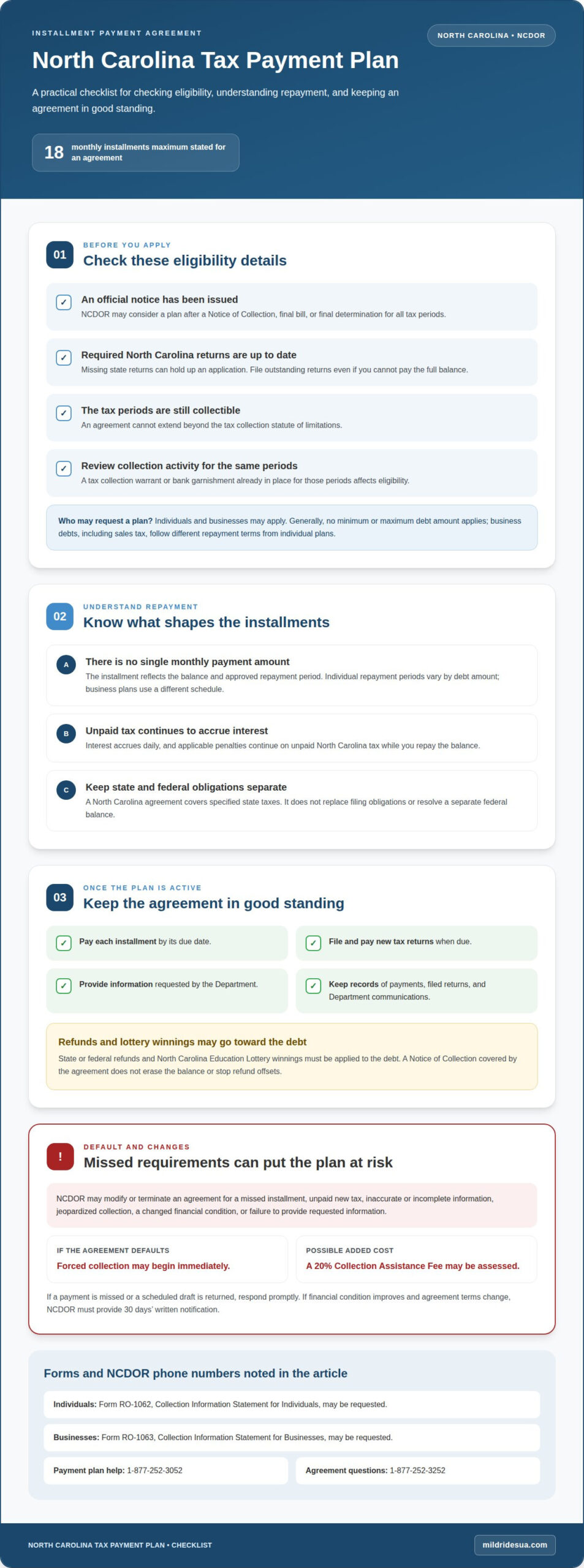
NCDOR may consider an installment payment agreement after you receive a Notice of Collection, final bill, or final determination for all tax periods. Your tax returns must be current, and the periods must remain collectible. The NC Department of Revenue calls this arrangement a payment plan.
Interest and applicable penalties continue on unpaid North Carolina tax, and interest accrues daily. NCDOR may assess a 20% Collection Assistance Fee if an installment agreement defaults. A default can therefore increase the balance, beyond the scheduled installments.
Eligibility also depends on the status of collection activity. The same tax periods cannot have a tax collection warrant or bank garnishment in place, under G.S. 105-242(a) or (b). An agreement cannot extend beyond the tax collection statute of limitations, under G.S. 105-241.24.
To request help with a payment plan, call 1-877-252-3052. For questions about an installment payment agreement, call 1-877-252-3252. Individuals may be asked for Form RO-1062, Collection Information Statement for Individuals. Businesses may be asked for Form RO-1063, Collection Information Statement for Businesses.
Once an agreement takes effect, keep these obligations in view:
- Pay each installment by its due date.
- File and pay all new tax returns when due.
- Provide information the Department requests.
- Account for state or federal refunds and North Carolina Education Lottery winnings, which must be applied to the debt.
A Notice of Collection for past-due taxes covered by the agreement may be disregarded. That does not erase the balance or stop refund offsets. If the agreement defaults, NCDOR may begin forced collection actions immediately. Respond promptly if you miss a payment or a scheduled draft is returned.
NCDOR may modify or terminate an agreement for several reasons. Under G.S. 105-237(b)(4), that includes missing an installment or failing to pay another tax when due. Other grounds include inaccurate or incomplete supporting information under G.S. 105-237(b)(1), jeopardized collection under G.S. 105-237(b)(2), or a changed financial condition under G.S. 105-237(b)(3). Failure to provide information requested by the Secretary is another ground under G.S. 105-237(b)(5).
If your financial condition improves and the agreement’s terms change, NCDOR must provide 30 days’ written notification. Keep records of payments, filed returns, and Department communications. Those practical steps help you track obligations and address issues before they lead to default.
Can You Make Payments on North Carolina State Taxes?
Yes. Individuals and businesses may request a North Carolina tax installment agreement after receiving an official notice about taxes owed. Eligibility depends on filed returns, collectible tax periods, and the status of any collection action.
North Carolina Plan Eligibility
For an NC Department of Revenue payment plan, bring every required North Carolina tax return up to date. The Department can consider an agreement only after it issues an official notice about the balance. Individuals and businesses may qualify, and generally no minimum or maximum debt amount applies.
Missing North Carolina returns can prevent an application from moving forward until they’re filed. File any outstanding state returns, even if you can’t pay the full balance. Federal filing obligations are separate: a federal return isn’t identified as a condition of a North Carolina agreement, but missing federal returns can affect federal tax matters.
Minimum Monthly Payment
There is no single monthly payment that applies to every taxpayer. The installment amount reflects the balance and the approved repayment period. Individuals’ repayment periods vary by debt amount, while business plans follow a different schedule. The North Carolina Department of Revenue says an installment payment agreement may be established for no more than 18 monthly installments.
To understand the proposed monthly payment, consider the covered balance and the time allowed for repayment. A larger balance spread across a longer approved term may produce a different installment from a smaller balance with less time. Interest on unpaid North Carolina tax accrues daily, so the amount owed can change during repayment.
File and pay future North Carolina returns on time, even while resolving older tax debt. An agreement covers specified state taxes; it doesn’t replace filing obligations or resolve a separate federal balance. Keep federal and state accounts distinct when organizing returns, notices, and payments.
South Carolina has separate eligibility rules, so North Carolina approval standards don’t carry over. In South Carolina, taxpayers with an active Department of Revenue levy or garnishment can’t request a payment plan. Participants must file and pay returns in full during the agreement, including estimated income taxes. South Carolina individual income tax and GEAR plan terms range from 12 to 48 months; GEAR plans require a 10% down payment.
Penalty relief depends on which tax authority imposed the charge. Federal and North Carolina penalty relief follow separate policies, so don’t assume federal First Time Abatement rules apply to North Carolina penalties. An IRS hardship determination likewise doesn’t automatically establish hardship status with the North Carolina Department of Revenue. Treat each agency’s balance and relief request separately.
Exception requests for taxpayers unable to meet requirements
Yes. Taxpayers can request an installment payment agreement electronically using Form RO-1033. If standard requirements are difficult to meet, an exception request involves separate financial information and does not replace the need to address eligibility.
Approval and Required Documentation
For an exception request, complete Form RO-1062, Collection Information Statement for Individuals. The North Carolina Department of Revenue may also require the last three months of bank statements for all accounts. These records help document the financial circumstances behind the request and show the funds available across accounts at a financial institution.
Submit requested documents with accurate, complete information. NCDOR may modify or terminate an agreement if information supporting it is inaccurate or incomplete under G.S. 105-237(b)(1). An exception request and its documentation allow the Department to assess the request; they do not, by themselves, establish an approved installment amount.
Eligibility Requirements
Review the tax periods and collection status involved before requesting an exception. A North Carolina tax period must be collectible under G.S. 105-241.22, and a tax collection warrant or bank garnishment cannot be in place for those same periods under G.S. 105-242(a) or (b). Required tax returns must also be up to date.
Explain which requirement creates the obstacle and provide records that relate to it. For example, if available funds affect the proposed installment payment, the bank statements may help present that financial picture. The Department may request additional information, so keep the figures consistent across Form RO-1062 and supporting records.
Online Application
Form RO-1033 provides an electronic way to request an installment agreement. The online request is distinct from an exception request: individuals seeking an exception must complete Form RO-1062. A business applicant may be asked for Form RO-1063, Collection Information Statement for Businesses.
Organize the tax notice, account details, and required forms before submitting information. A complete request helps connect the tax periods, proposed payment, and financial records. If NCDOR asks for additional information, provide it promptly; failure to provide requested information may support a change or termination under G.S. 105-237(b)(5).
Approval does not remove the ongoing obligations attached to an agreement. Pay each installment when due, file and pay new North Carolina tax returns on time, and respond to Department requests. A missed payment or a returned bank draft can put the agreement in default, while an unpaid new tax can also affect its status under G.S. 105-237(b)(4).
Keep copies of Form RO-1033, Form RO-1062, bank statements, notices, and payment records together. If the Department changes terms because your financial condition improves, it must provide 30 days’ written notification. Organized records make it easier to track the current installment amount and respond to an NCDOR notice without confusing separate tax periods.
Installment repayment periods for individuals
North Carolina sets repayment periods for individuals according to the amount of state tax owed. Businesses have a different repayment schedule, and payment timing matters once an agreement begins.
For individuals, the repayment periods are:
- Less than $1,000 in state taxes: 15 months.
- $1,000 to $6,999: 30 months.
- $7,000 to $49,999: 40 months.
- $50,000 or more: 50 months.
These periods help determine scheduled installments, but they don’t make an agreement automatic. The tax period must remain collectible, and the agreement cannot extend beyond the applicable collection statute of limitations. Interest on unpaid tax accrues daily, so the balance can change during repayment.
Maximum Monthly Installments
For individuals, the repayment period depends on the balance tier, with 50 months applying to debts of $50,000 or more. According to the North Carolina Department of Revenue, an installment payment agreement may be established for no more than 18 monthly installments. This stated agreement limit and the individual repayment periods are distinct details; businesses also have their own repayment period.
North Carolina businesses granted an agreement have a 12-month repayment period, regardless of the amount owed. The 18-monthly-installment limit is the maximum number of installments an agreement may be established for, not a promise that every taxpayer receives that term. A business agreement also cannot extend beyond the statute of limitations for assessing responsible persons under G.S. 105-242.2.
Yes, you can make extra payments toward an agreement and pay the debt off sooner. Additional payments reduce the outstanding balance, but keep making each scheduled installment until the Department confirms the agreement is satisfied.
Making an Installment Payment
Installment payments are generally drafted automatically from a bank account. The Department requires bank drafts unless you don’t have a bank account or drafts aren’t available for the tax schedule, as referenced in G.S. 105-241(a). Allow processing time by making payments at least 15 days before the due date.
Online payment is the fastest way to pay an installment, and you should have the notice number available. You can also pay by Visa or MasterCard credit or debit card, or mail payment payable to the NC Department of Revenue at PO Box 25000, Raleigh, NC 27640-0002.
Protect the agreement by tracking its due dates and confirming funds are available in the bank account. A missed or returned payment can put the agreement in default. If a payment is returned, the required payment is the scheduled installment plus a returned check penalty of 10% of that installment amount. Federal tax refunds and North Carolina refunds may also be offset against the debt while the agreement remains in effect, so don’t treat an expected refund as a substitute for scheduled payments.
Sales tax debt and business payment plans
Sales tax debt can affect business cash flow differently from an individual income tax balance. Before requesting an installment agreement, identify each tax type, period, and notice.
North Carolina businesses granted an installment agreement have a 12-month repayment period, regardless of the amount owed. Separately, according to the North Carolina Department of Revenue, an installment payment agreement may be established for no more than 18 monthly installments. Plan terms must also fit within the applicable collection limits for the tax debt.
For a business taxpayer, the practical starting point is a complete account picture. Match each sales tax or income tax balance to its notice and tax period. Confirm that required returns are filed, since an agreement does not replace filing obligations. Businesses may be asked to provide Form RO-1063, Collection Information Statement for Businesses, to describe financial circumstances.
Electronic submission is available. Taxpayers can request an installment payment agreement using Form RO-1033. Before submitting, organize the notice number, business account information, and requested financial details. This helps distinguish sales tax liabilities from other North Carolina balances and supports a clear request.
Payment logistics matter as much as the proposed amount. Installments are generally drafted from a bank account unless the taxpayer has no bank account or a draft is unavailable for the tax schedule, as referenced in G.S. 105-241(a). Maintain enough funds for each scheduled debit. A returned payment requires the installment plus a returned check penalty equal to 10% of the scheduled payment amount.
Missing an installment or failing to pay a new tax when due can put an agreement at risk. North Carolina may modify or terminate an agreement if you miss a payment or another tax obligation. If an agreement defaults, the Department may begin forced collection actions immediately. A tax collection warrant or wage garnishment may add pressure to business finances.
Keep current sales tax filings separate from older balances covered by an agreement. File and pay new North Carolina taxes as they come due, and respond to Department requests for information. Track each notice, return, bank draft, and payment confirmation so a new income tax liability isn’t confused with sales tax debt.
When sales tax arrears overlap with bookkeeping or return issues, get help organizing business tax records before those issues compound. A clear record of filings, notices, and payments can support a more informed approach to resolving the balance.
Mildrid Esua, CPA, PLLC: Tax Planning & Tax Preparation,Bookkeeping IRS Representation small business accounting Tax resolution unfiled tax, tax lien , payroll servies
Mildrid Esua, CPA, PLLC helps individuals and small businesses address tax obligations through tax planning, tax preparation, and tax resolution services. When unpaid state taxes, unfiled returns, or tax liens complicate your next step, organized records and a clear view of the account can support informed repayment decisions.
For businesses, bookkeeping and small business accounting can help organize tax records and current obligations. Individuals facing back taxes can get tax resolution support as they consider available options. The right next step depends on the tax issue, relevant returns, and records involved.
For support addressing tax debt or organizing your tax matters, contact Mildrid Esua, CPA, PLLC.
Make Your Next Tax Decision With Greater Clarity
Resolving state tax debt means more than responding to a balance. You also need to consider how a repayment commitment fits alongside personal finances or business cash flow. A deliberate approach can help you weigh the immediate obligation against longer-term stability.
Treat an NC Department of Revenue payment plan as one part of the bigger picture. Before committing to a course of action, consider how tax responsibilities interact with your other financial obligations and upcoming business needs. Clear records and informed planning can make a stressful issue easier to manage.
When back taxes, unfiled returns, or business tax questions make the path forward difficult to assess, professional tax guidance can help you evaluate your next steps. Contact Mildrid Esua, CPA, PLLC to discuss your tax situation and available support.
Frequently Asked Questions
How do I pay?
Pay online using the notice number to identify the correct tax account and installment. North Carolina also accepts Visa or MasterCard credit and debit cards, online bank drafts, and mailed payments payable to the NC Department of Revenue at PO Box 25000, Raleigh, NC 27640-0002. For an automatic draft, keep enough funds available in the designated account. Save the payment confirmation with the notice and your records.
What if I can’t make a payment?
If a scheduled payment is missed or returned, pay online within 10 days to avoid default. If you already know the scheduled amount won’t clear, review your account and contact the Department promptly rather than assuming the agreement will pause. A returned installment requires the scheduled payment plus a returned check penalty equal to 10% of that installment. A default can lead to forced collection action.
Where can I get more information?
For assistance requesting a payment plan, call the North Carolina Department of Revenue at 1-877-252-3052. For questions about an installment payment agreement, call 1-877-252-3252. Have your notice number and the tax periods involved available so you can explain which balance or payment you’re asking about. Keep notes on the information provided and any follow-up the Department requests.
How do I set up a payment plan with the North Carolina Department of Revenue?
Request an agreement electronically with Form RO-1033 after receiving an official notice about the taxes owed. The NC Department of Revenue payment plan request should identify the relevant account and tax periods. Before submitting, assemble your notice and filing records, then review the proposed payment method and due dates. Individuals or businesses may also be asked for a financial information statement.
Who qualifies for a North Carolina tax payment plan?
Individuals and businesses may qualify if their required North Carolina returns are current and the tax periods remain collectible. A tax collection warrant or bank garnishment for the same periods can affect eligibility. The Department must first issue an official notice about the balance. For example, a taxpayer with an unfiled state return should address that filing before relying on an installment agreement.
What information and documents are needed to request a North Carolina tax payment plan?
Start with the official tax notice, which helps identify the account and covered periods. An individual may be asked to submit Form RO-1062, Collection Information Statement for Individuals; a business may be asked for Form RO-1063, Collection Information Statement for Businesses. An exception request may also require the last three months of bank statements for all accounts. Provide complete, consistent financial details.
How long can a North Carolina tax payment plan last?
For individuals, repayment periods depend on the state tax balance: 15 months below $1,000, 30 months for $1,000 to $6,999, 40 months for $7,000 to $49,999, and 50 months for $50,000 or more. Businesses granted agreements have a 12-month repayment period. Separately, the North Carolina Department of Revenue says agreements may be established for no more than 18 monthly installments.
What happens if I miss a payment or default on a North Carolina tax installment agreement?
A missed installment or returned payment can put the agreement in default, and the Department may begin forced collection actions immediately. NCDOR may also modify or terminate an agreement if you fail to pay another tax when due, provide inaccurate information, or fail to provide requested information. Responding promptly matters: a taxpayer who can pay online within 10 days may avoid default after a missed or returned payment.




Leave a Reply
Your email is safe with us.