

A payment plan works only if the payments fit your situation and you keep the agreement on track. For help with an IRS payment plan in Greensboro, start by identifying the option that matches your balance: according to the Internal Revenue Service, an individual can apply online for a short-term plan when the combined tax, penalties, and interest owed are below $100,000, with payment due within 180 days or less.
It’s understandable to focus first on getting approved, but what happens after approval matters just as much. Interest and penalties can continue to increase your balance, and missed payments can put your agreement at risk.
This guide explains how to apply, what IRS Simple Payment Plan eligibility rules mean for individuals and businesses, and how interest and penalties affect what you owe. You’ll also learn practical ways to manage payments, respond to changes in your circumstances, and reduce the risk of default, so you can plan your next step with greater clarity.
Key Takeaways
- Compare short-term and longer-term payment options, then choose an application route that fits your tax balance and ability to pay.
- Review the Simple Payment Plan balance rules and filing requirements before applying.
- Factor ongoing interest and penalties into your repayment strategy, since a longer payoff period can increase what you owe.
- Protect your agreement by planning for payments and acting promptly if your finances change or you miss an installment.
- Learn when tax resolution support can help you assess your options and manage IRS communication.
Applying for a payment plan
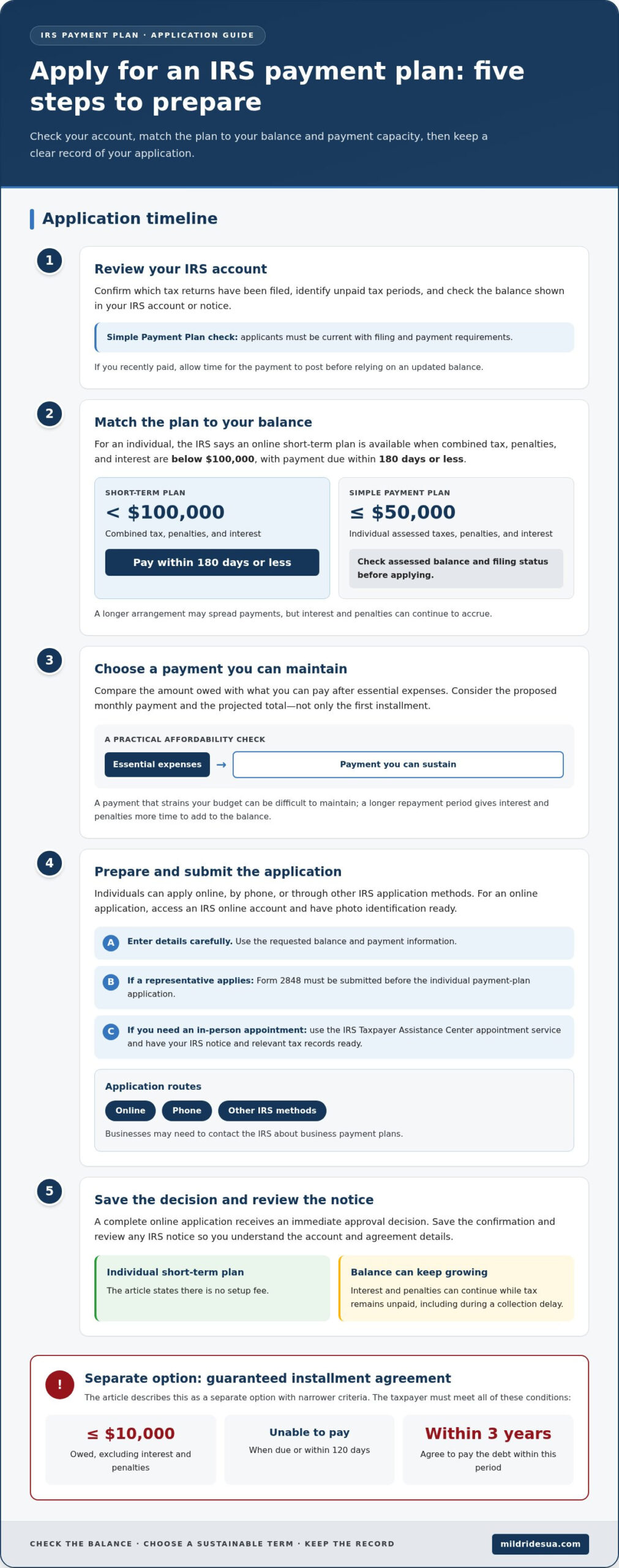
Greensboro residents can apply directly to the IRS online, by phone, or through other application methods. According to the Internal Revenue Service, individual taxpayers can apply online for an IRS short-term payment plan if they owe less than $100,000 in combined tax, penalties, and interest. The Internal Revenue Service says this plan lets an individual pay the amount owed within 180 days or less.
For free IRS tax help, begin with the IRS’s online payment plan application or its Taxpayer Assistance Center appointment service. An individual short-term plan has no setup fee, and the IRS can help taxpayers understand their account and notices.
To visit an IRS Taxpayer Assistance Center near Greensboro, use the IRS appointment service to arrange an in-person visit. Have your IRS notice and relevant tax records ready when you make the appointment.
Before applying, gather the information you need to propose a realistic payment. Check the balance and tax periods in your IRS account or notice, then compare the total with what you can pay without missing essential expenses. If you recently made a payment, allow time for it to post before relying on an updated balance.
- Review your account. Confirm the tax returns have been filed and identify any unpaid periods. Applicants must be current with filing and payment requirements for a Simple Payment Plan.
- Choose a term you can maintain. A short-term plan suits a balance you can clear within 180 days. A longer arrangement may spread payments, but interest and penalties can continue accruing.
- Apply through the appropriate route. Individuals can submit an online request, while businesses may need to contact the IRS about business payment plans.
A guaranteed installment agreement is a separate option with narrower criteria. According to the Internal Revenue Service, a taxpayer must owe $10,000 or less, excluding interest and penalties. The taxpayer must also be unable to pay when due or within 120 days, and agree to pay the debt within three years.
For an online application, create or access an IRS online account and have photo identification available. Enter the requested balance and payment details carefully, then save the confirmation and review any IRS notice. If a representative applies for an individual, Form 2848 must be submitted before the payment-plan application. A complete online application receives an immediate approval decision, helping you know whether to proceed or consider another approach.
Interest and late-payment penalties
An IRS payment agreement gives you time to pay, but it doesn’t freeze your balance. Interest, penalties, and fees can increase what you owe while a federal tax bill remains unpaid. A longer repayment term gives those charges more time to accrue, so compare the proposed monthly payment with the projected total, not just the first installment.
Start with your latest IRS notice or account balance. Separate the original tax from interest and penalties if the account shows them separately. Then compare the amount left after essential expenses with the payment you can sustain. A payment that strains your budget can be difficult to maintain, while a payment that is too low may extend repayment and increase the balance.
A collection delay is not the same as penalty relief. The IRS may temporarily delay collection if it determines that you can’t pay, but interest and penalties continue until the balance is paid in full. A delay can provide breathing room, but it doesn’t stop the debt from growing. Factor in those continuing charges when considering timing and affordability.
- Review the balance. Compare the current account total with your last notice, and account for payments that haven’t posted.
- Test affordability. Build a budget around a monthly payment you can maintain without missing essential bills.
- Consider the term. A longer agreement may reduce immediate pressure, but can leave more time for interest and penalties to accumulate.
- Keep records. Save notices, payment confirmations, and documents explaining financial hardship or unusual circumstances.
Penalty relief may be available when circumstances beyond your control prevented you from complying despite your efforts. If you believe this applies, identify the events that affected your filing or payment, explain the steps you took, and organize supporting records. Hardship alone doesn’t erase the tax balance, and interest may continue while the IRS reviews relief or collection options.
If a notice lists unfamiliar charges, compare the tax periods and amounts with your returns and payment records. Correcting a posting error or understanding an assessed penalty can clarify the balance before you change an agreement. Don’t assume that a payment automatically removes earlier penalties. Check how the IRS applied it and what remains due.
For complex balances or several unpaid periods, organize the notices and account history before choosing a response. A structured review of IRS tax records can help you assess the balance, payment capacity, and possible penalty-relief grounds before making a plan change.
Simple Payment Plan eligibility
Eligibility depends on the taxpayer type, assessed balance, and current filing status. According to the Internal Revenue Service, an individual taxpayer must have $50,000 or less in assessed taxes, penalties, and interest to meet the IRS Simple Payment Plan balance limit. This threshold includes assessed penalties and interest, so compare it with the assessed balance, not only the original tax.
For a business without trust fund taxes, the Internal Revenue Service sets the Simple Payment Plan balance limit at $50,000 or less in assessed taxes, penalties, and interest. Businesses with trust fund taxes generally face a lower limit of $25,000 or less. An out-of-business sole proprietorship with trust fund taxes may qualify with $50,000 or less in assessed taxes, penalties, and interest.
Before applying, confirm which category fits your tax debt. Trust fund taxes are business taxes collected or withheld from others, such as employment taxes. This distinction matters because a business balance may involve different tax types and eligibility limits. Review your IRS account records and notices to identify the assessed amount and relevant tax periods.
Applicants must be current with filing and payment requirements. This means filing any required missing returns and addressing current tax obligations before relying on a payment agreement. A balance within the limit alone does not meet every application condition. Check the filing history for each relevant period, then confirm that the current balance reflects posted payments and assessments.
A Simple Payment Plan differs from a streamlined installment agreement. According to the Internal Revenue Service, a streamlined IRS installment agreement is for taxpayers who owe $50,000 or less, excluding interest and penalties. The balance test is therefore not identical: the Simple Payment Plan limit includes assessed interest and penalties, while the streamlined agreement threshold excludes them. Most taxpayers have up to 10 years to pay through a Simple Payment Plan.
The application process avoids some additional financial disclosures. Simple Payment Plans do not require a collection information statement, lien determination, or trust fund recovery penalty determination. The process may be more direct, but applicants still need accurate balance and filing information. Gather your notices, tax account details, and payment records before applying.
- Individuals: Compare assessed taxes, penalties, and interest with the $50,000 limit.
- Businesses: Identify whether trust fund taxes are involved before applying.
- All applicants: Bring filing and payment requirements current, then verify the assessed balance.
If your balance exceeds the applicable limit or filing obligations remain unresolved, address those issues before choosing an installment option. Reviewing tax periods, business tax types, and payment records helps you choose an appropriate next step instead of applying under the wrong eligibility category.
Avoiding payment-plan default
An agreement is easier to maintain when each installment fits your cash flow and you respond quickly to changes. Set a calendar reminder several days before each due date, and keep enough funds in the chosen account. For example, if a customer pays late and your business revenue drops, review the upcoming payment before its due date rather than waiting for a withdrawal to fail.
Build a simple cash-flow check around income, essential expenses, and your IRS installment. Review it when work hours, customer receipts, or household costs change. If the scheduled amount no longer fits, don’t silently reduce or skip it. Contact the IRS promptly to discuss the agreement and possible changes. Continue filing required returns and meeting current tax obligations, as unresolved obligations can complicate account management.
If you miss a payment, act immediately. Review your IRS account and recent notices to see whether the payment posted, whether the agreement changed, and what balance remains. Keep the payment confirmation, bank record, and notice together. If a payment was returned, confirm the account details before arranging another payment. Clear records help explain what happened and support a focused discussion with the IRS.
Taxpayers who can’t make the minimum required payment on a revised installment plan may be directed to complete Form 9465 and Form 433-F, or consolidated Form 433-H. These forms help the IRS review a proposed agreement alongside financial information. Gather current income records, household expenses, bank information, and the tax notices tied to the balance before completing requested paperwork. Accurate figures matter, so reconcile records before submitting them.
Qualifying low-income taxpayers may receive reimbursement if they meet certain conditions. Keep the IRS acceptance notice and records of any applicable fee, then review the updated agreement for the payment amount and due date. A revised installment is useful only if you can sustain it.
- Track the due date: Use a calendar reminder and check available funds before the scheduled payment.
- Review changes promptly: Match IRS notices with account activity and payment records.
- Prepare financial details: Organize income and expense records if the IRS requests forms for a revised plan.
- Confirm the terms: Save the revised agreement and follow its stated payment instructions.
Preventing default takes ongoing attention, not just a completed application. Regularly review your income, payment dates, and IRS notices to spot financial pressure early. If the approved amount has become unrealistic, address the issue before another missed installment makes the account harder to manage.
Can I change or cancel an IRS payment plan?
You can request a change if your income, expenses, or ability to pay has shifted. Compare your current budget with the installment amount, then decide whether you need a lower payment, a different due date, or cancellation because you can pay the remaining balance. Review your IRS account and latest notice first, so your request reflects the amount and terms currently recorded.
Eligible low-income taxpayers may receive reimbursement if they meet certain conditions. Review the fee terms before changing an existing payment agreement.
Consider both the fee and your recordkeeping when choosing how to proceed. Before requesting a revision, gather your agreement details, current balance, recent payment history, and income and expense information. If you use automatic withdrawals, check whether the change affects your bank account or payment schedule. Keep the submission confirmation and any IRS notice showing the revised terms.
Cancellation and revision are different. A revision asks the IRS to adjust an agreement, while cancellation ends it. If you can pay the full remaining balance, review your account and follow IRS payment instructions. If you can’t, consider requesting a change instead of simply stopping payments. Interest and penalties can continue to accrue on an unpaid balance, even when collection is temporarily delayed.
The timing of a rejected request or terminated agreement can also matter. The IRS generally suspends the collection-period clock for 30 days when an installment-agreement request is rejected or an existing agreement is terminated. Treat a rejection notice as a prompt to review the reason, the balance, and the payment terms, then decide on a documented next step. Don’t assume that a pending change pauses your existing obligations.
- Recalculate affordability: Compare the proposed payment with reliable income and essential expenses.
- Pick a revision route: Consider online, phone, mail, or in-person options alongside the applicable IRS fee.
- Keep evidence: Save payment records, the request confirmation, and every IRS response.
- Respond to notices: Read the stated reason and follow the response instructions rather than ignoring the account.
When several tax periods or business obligations complicate your balance, organized tax-resolution support can help you assess the account and prepare to revise a plan. Mildrid Esua, CPA, PLLC provides IRS representation and tax resolution services for taxpayers managing back taxes, liens, and related tax issues.
Mildrid Esua, CPA, PLLC: Tax Planning & Tax Preparation, Bookkeeping, IRS Representation, Small Business Accounting, Tax Resolution, Unfiled Tax, Tax Lien, Payroll Services
Mildrid Esua, CPA, PLLC provides IRS representation and tax resolution services for individuals and small businesses facing unpaid tax balances, unfiled returns, or tax liens. Turn to the firm for help understanding your IRS account, organizing outstanding tax matters, or assessing a payment-plan issue alongside broader back-tax concerns.
For small businesses, accounting and tax advisory support can bring business records and tax obligations into clearer view. Tax preparation and bookkeeping address related recordkeeping needs, while IRS representation focuses on communication and resolution. The right support depends on the issue, including whether missing returns need to be addressed before managing an existing balance.
Consider how a payment agreement fits into your complete tax position, rather than treating it as a separate task. Contact Mildrid Esua, CPA, PLLC to discuss your IRS payment-plan concerns.
Build a steadier path forward
An IRS payment arrangement is part of your wider financial picture, not a decision to set aside once the first payment clears. Keep records and a calendar to track how tax obligations fit alongside household or business commitments. Revisit your plan when income or expenses change, and make deliberate adjustments before financial pressure disrupts your longer-term priorities.
For help with an IRS payment plan in Greensboro, prepare a brief summary of your concern, the notices or records involved, and the outcome you’re working toward. This gives the next conversation a clear starting point, whether you’re reviewing an existing arrangement or addressing unresolved tax matters. A considered next step can replace uncertainty with a more structured plan.
Contact Mildrid Esua, CPA, PLLC to discuss your tax situation. Move forward with a clearer view of your options and a plan for staying engaged with your financial responsibilities.
Frequently Asked Questions
How do I manage my plan to avoid default?
Track each scheduled payment and confirm it appears in your IRS account. If you use automatic withdrawals, keep the linked account active and watch for returned-payment notices. Save confirmations for card or other payments. If an installment doesn’t post as expected, review your account and respond promptly to any IRS notice. Don’t assume a payment went through until you can see a record.
What are the different types of installment payment plans?
The IRS offers short-term plans for balances that can be paid quickly, as well as long-term installment agreements. Other categories include Simple Payment Plans, streamlined agreements, and guaranteed installment agreements, each with its own eligibility rules. First identify whether you’re applying as an individual or a business, then compare your balance and filing status with the requirements for each option.
What is a payment plan?
An IRS payment plan lets a taxpayer pay an outstanding federal tax balance over time. It sets a schedule for addressing the debt but doesn’t remove the underlying obligation. If the balance spans several tax periods, review your account to understand which periods are included and how payments are applied. Keep the plan details with your tax records.
What is a tax debt installment agreement?
A tax debt installment agreement is a formal arrangement with the IRS to pay eligible tax debt in scheduled installments. Its terms set out the payment arrangement. Before accepting, consider whether the proposed amount fits your budget alongside essential expenses and current tax obligations. Keep the IRS acceptance notice so you can refer to the approved terms if questions arise.
How do I set up an IRS payment plan online?
Sign in to your IRS online account or create one using photo identification. Review the balance and tax periods shown, then complete the online application with the requested information. Have your latest notice and payment details ready to help prevent entry errors. After submitting, save the confirmation and review the approval decision, payment method, and schedule in your account.
What IRS installment agreement options are available?
Options include short-term arrangements, long-term payment plans, and agreements using automatic bank withdrawals or other payment methods. Individuals can apply online for eligible plans, while other circumstances may require a different application route. Simple Payment Plan installments can be made by automatic withdrawal, IRS Direct Pay, debit or credit card, digital wallet, or cash through an approved third-party processor.
What are the IRS payment plan fees and interest rates?
Setup fees vary by plan and application method. Interest continues to accrue on unpaid balances, and the rate can change. Use your current IRS account balance to assess repayment.
Who qualifies for an IRS short-term payment plan or installment agreement?
According to the Internal Revenue Service, individuals may apply online for a short-term plan if combined tax, penalties, and interest are below $100,000, with payment due within 180 days or less. Other installment options have separate balance and filing criteria. Greensboro residents looking for help with an IRS payment plan can start by identifying their applicant type, assessed balance, and any outstanding filing obligations.




Leave a Reply
Your email is safe with us.