

IRS “forgiveness” is not a gift; it’s a strategic architectural outcome of proving your financial reality to the government. You likely feel the heavy weight of unfiled returns or the looming threat of wage garnishments, and you’re rightly skeptical of “pennies on the dollar” marketing that sounds too good to be true. It’s exhausting to manage these pressures while trying to maintain your professional focus. However, legitimate IRS back tax forgiveness programs do exist for those who approach the 2026 tax landscape with precision and high-level expertise.
This guide provides a clear pathway to resolving your debt and stopping collection actions before they escalate. You’ll discover how to qualify for the Fresh Start initiatives, the reality behind the 21% Offer in Compromise acceptance rate, and how the new Automatic Exemption from Penalty program launching in summer 2026 could benefit you. Unlike reactive services that only address the symptoms of tax debt, we focus on a proactive partnership that ensures long-term financial stability. By the end of this article, you’ll have a sophisticated plan to reduce your liability and move from complexity to informed decision-making with expert CPA guidance.
Key Takeaways
- Recognize that legitimate tax relief isn’t a gift but a strategic outcome achieved through specific legal provisions.
- Explore the qualifying criteria for 2026 IRS back tax forgiveness programs and how to determine if an Offer in Compromise is your best path forward.
- Understand why resolving unfiled tax returns is the mandatory gatekeeper to any formal debt settlement or relief application.
- Discover how the IRS calculates your Reasonable Collection Potential and what it means for your home equity or retirement accounts.
- Learn why having a vigilant guide for professional representation is vital for North Carolina taxpayers seeking to stop collection actions.
Understanding the Reality of IRS Back Tax Forgiveness Programs
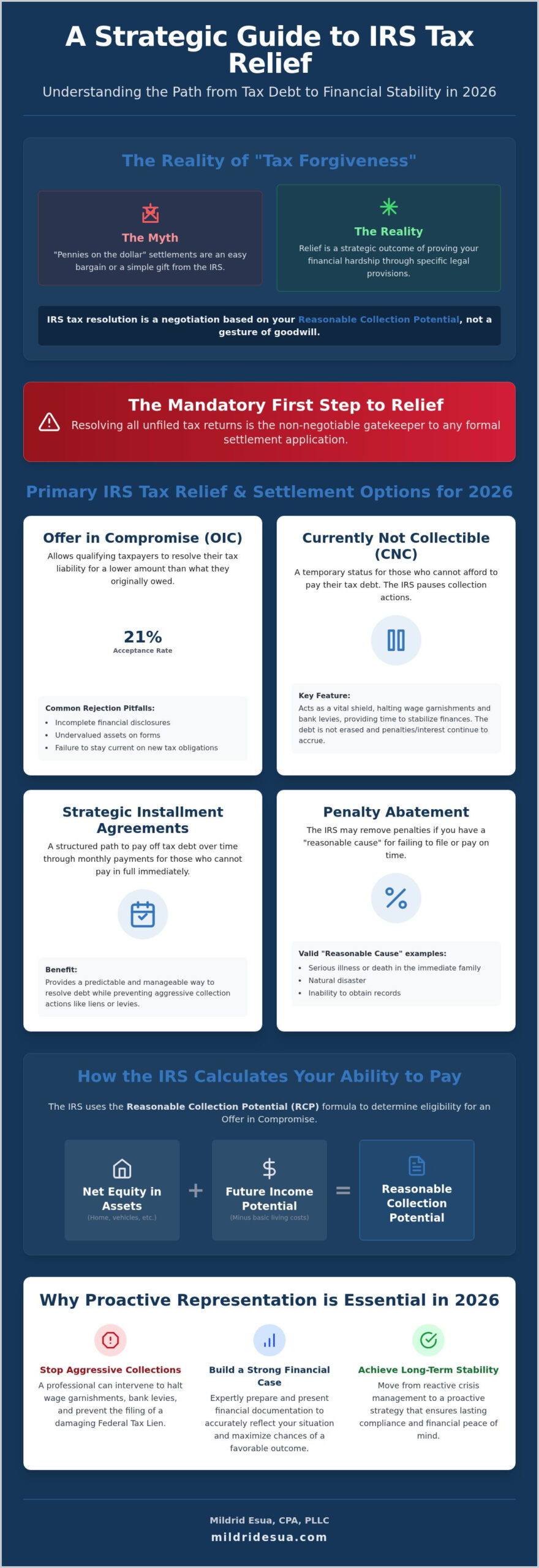
The term “forgiveness” often carries a weight of hope that doesn’t quite match the rigid legal reality of the Internal Revenue Code. In a professional context, IRS back tax forgiveness programs represent the legal reduction or elimination of tax debt through specific, documented provisions. While the IRS rarely “forgives” debt as a gesture of goodwill, it provides structured pathways like the Offer in Compromise (OIC) or penalty abatement for those who meet strict eligibility criteria. These options fall under the “Fresh Start Initiative,” a comprehensive umbrella framework designed to help taxpayers balance their obligations with their actual ability to pay. Unlike a simple tax amnesty, which might offer a temporary window for compliance, these programs require a rigorous demonstration of your financial position. IRS tax resolution is a strategic negotiation based on documented financial hardship, where the goal is to reach a settlement that reflects your true economic capacity.
The Myth vs. Reality of “Pennies on the Dollar”
Aggressive marketing campaigns often promise to settle debts for “pennies on the dollar” with minimal effort. This narrative is a dangerous oversimplification. The IRS only accepts a settlement when its internal calculations suggest the full amount is genuinely uncollectible within the remaining statutory period. It’s not a bargain; it’s a cold assessment of your Reasonable Collection Potential. A proactive, CPA-led approach focuses on building a forensic financial case rather than relying on reactive panic. We act as your vigilant guide, ensuring every asset and expense is categorized to reflect your reality, not the IRS’s assumptions.
Why 2026 is a Critical Year for Tax Resolution
The landscape of 2026 presents new challenges for those with outstanding debt. The IRS has significantly enhanced its digital tracking capabilities, using sophisticated automated systems to identify back tax liabilities faster than ever before. These tools allow the agency to move from identification to enforcement actions, such as wage garnishments or bank levies, with alarming speed. Waiting for the IRS to initiate contact is a high-risk strategy. It’s vital to secure professional representation and resolve these issues before a Notice of Federal Tax Lien is filed, as a public lien can cripple your long-term financial stability and credit access. Engaging with IRS back tax forgiveness programs now allows for a controlled, strategic resolution rather than a forced response to aggressive collection.
Primary IRS Tax Relief and Settlement Options for 2026
Navigating the maze of Official IRS tax debt options requires a shift from reactive fear to strategic planning. While many taxpayers search for IRS back tax forgiveness programs, the reality is a menu of specific legal statuses tailored to your financial health. These aren’t generic favors; they’re calculated provisions designed to resolve debt when full collection is unlikely or impossible. Beyond the well-known settlement options, there’s Currently Not Collectible (CNC) status. This serves as a vital shield for those in immediate financial crisis. It doesn’t erase the debt, but it halts all collection actions, including levies and garnishments, while you stabilize your finances. Penalty Abatement is another underutilized tool. If you have a “reasonable cause” for late filing, such as a serious illness or natural disaster, the IRS may remove the associated penalties, significantly reducing your total balance.
The Offer in Compromise (OIC) Deep Dive
The OIC remains the flagship of debt settlement, though it’s statistically rigorous. The IRS uses the Reasonable Collection Potential (RCP) formula to decide your fate. This formula scrutinizes your net equity in assets, future income, and allowable living expenses. Most rejections happen because taxpayers fail to distinguish between “Doubt as to Collectibility” and “Doubt as to Liability.” The former means you simply can’t pay the full amount, while the latter suggests the tax assessment itself is incorrect. Common pitfalls that lead to rejection include undervalued assets, incomplete financial disclosures on Form 433-A, or failing to remain current on estimated payments during the application process.
Strategic Installment Agreements
For those who don’t qualify for a total settlement, Strategic Installment Agreements offer a structured path forward. Standard agreements are traditional, but Streamlined Installment Agreements allow individuals and small businesses to avoid the invasive financial verification process if they meet specific debt thresholds. The Partial Payment Installment Agreement (PPIA) is a powerful middle-ground solution. Unlike a full payment plan, a PPIA allows you to pay a reduced monthly amount based on your actual budget. This is strategically significant because it allows the 10-year Statute of Limitations on collections to continue running. If the time expires before the debt is paid, the remaining balance is effectively eliminated. If you’re seeking Expert Tax Resolution North Carolina, understanding these nuances is essential for long-term stability. Managing these complexities is where a proactive partner adds the most value, ensuring your tax resolution strategy is built for endurance rather than a temporary fix.
How the IRS Evaluates Eligibility for Tax Forgiveness
The IRS doesn’t determine eligibility based on your intent or personal stress; it judges every application through the cold lens of Reasonable Collection Potential (RCP). This mathematical cornerstone of most IRS back tax forgiveness programs is a forensic calculation of your total equity in assets combined with your future income potential. If the resulting figure is less than the total debt, the agency may consider a settlement. However, the 21% acceptance rate for these applications underscores why a precise, data-driven approach is necessary. You aren’t just filling out forms; you’re building a legal case that your financial reality makes full payment an impossibility. Documentation is the most critical phase of this process, as any missing record allows the IRS to default to its own, often more aggressive, estimates of your wealth.
Your assets, including home equity and retirement accounts, are viewed as immediate sources of liquidity. The agency also scrutinizes your monthly “allowable living expenses,” which are governed by strict national and local standards. If your actual costs for housing or transportation exceed these standards, the IRS will count that “excess” as disposable income available to pay your debt. This is where many unrepresented taxpayers fail, as they don’t know how to strategically argue for deviations from these standard allowances based on documented necessity.
Asset Valuation and Equity Considerations
When valuing your property or business equipment, the IRS typically applies a “Quick Sale Value” (QSV), which is generally 80% of the Fair Market Value. This 20% reduction reflects what the asset might fetch in a forced liquidation. Understanding this distinction is vital when navigating the Offer in Compromise program. A vigilant guide also works to protect essential business assets. If liquidating a specific piece of equipment would end your ability to generate income, we argue for its exclusion from the RCP, ensuring your long-term earning potential remains intact while you resolve your past liabilities.
The 10-Year Statute of Limitations
Every tax assessment has a Collection Statute Expiration Date (CSED), typically 10 years from the date it was recorded. A strategic architect always examines these dates before recommending a specific program. It’s important to understand that certain “tolling events,” such as filing for an OIC or an appeal, actually pause this 10-year clock. This gives the IRS more time to collect than they originally had. If your CSED is approaching rapidly, applying for IRS back tax forgiveness programs might be counterproductive. We analyze the remaining time on your statute to determine if a settlement or a different protective path is the most effective way to secure your financial future.
The Gatekeeper to Relief: Resolving Unfiled Tax Returns
The IRS operates on a strict “Compliance First” mandate. Before the agency even considers an application for IRS back tax forgiveness programs, they require every missing return from the last six years to be filed. This isn’t just a procedural suggestion; it’s a hard barrier to any form of relief. If you’re seeking Unfiled Tax Returns Help in Greensboro, you likely understand the paralyzing weight of missing paperwork. This delay often leads to the IRS filing a Substitute for Return (SFR) on your behalf. An SFR is a strategic disaster for the taxpayer. The agency calculates your debt using the highest possible tax rate with zero deductions, credits, or exemptions, often resulting in a liability that is double or triple what you actually owe.
Reconstructing Records for Small Businesses
Reconstructing financial history for multi-year non-filers is a forensic task that requires precision. We don’t rely on guesswork; instead, we utilize bank statements, credit card records, and IRS wage and income transcripts to build a defensible set of books. Professional Monthly Bookkeeping for Small Businesses provides the structural integrity needed to survive an audit of these back filings. By meticulously identifying every deductible business expense, we often reduce the initial “estimated” debt before the settlement negotiation even begins. This proactive reconstruction turns a chaotic situation into a documented financial reality that the IRS can’t easily ignore.
Preventing Future Back Tax Issues
Resolving the past is only half the battle for long-term stability. A vigilant guide ensures you don’t fall back into the debt cycle through proactive tax planning and structural adjustments. For many small business owners, an S Corp Election for Self-Employment Tax is a powerful tool to manage ongoing liabilities more effectively. This strategy allows you to pay yourself a reasonable salary while taking remaining profits as distributions, which aren’t subject to the 15.3% self-employment tax. This foresight prevents the accumulation of future debt and maintains the continuous compliance required for your relief programs to remain in good standing. If you’re ready to break the cycle of unfiled returns and secure your financial future, schedule a consultation with our tax resolution experts to build your path forward.
Why Professional IRS Representation is Essential for NC Taxpayers
Facing the IRS alone is often an exercise in high-stakes vulnerability. The psychological toll of receiving constant collection notices is significant, but the strategic risk of misrepresenting your financial position is even greater. When you engage with IRS back tax forgiveness programs, you aren’t just filing paperwork; you’re entering a complex negotiation with an agency that possesses vast enforcement powers. A CPA serves as a vigilant guide, positioning themselves as a protective barrier between you and the IRS. This stewardship ensures every communication is filtered through a lens of professional authority. This shield allows you to maintain your professional focus while a seasoned expert manages the intricate, often aggressive demands of tax resolution.
One of the most common reasons for settlement failure is the incorrect completion of Form 433-A or 433-B. These financial statements are the foundational evidence for your case. A single error in asset valuation or an overlooked “allowable” expense can lead to a summary rejection or a significantly higher settlement amount than necessary. Professional representation ensures these documents are forensically accurate and strategically optimized to reflect your true economic reality. We prioritize long-term financial stability over the one-time “quick fix” often promised by high-pressure marketing schemes. Our goal is to ensure the resolution we build today remains durable and compliant for years to come.
Navigating Local IRS Offices in North Carolina
Local expertise provides an invaluable advantage for business owners in Greensboro, Winston-Salem, and the surrounding areas. Regional IRS offices often have specific procedural rhythms and administrative preferences that a distant, national firm might overlook. Working with a firm deeply familiar with the North Carolina tax landscape provides a steady hand during audit or collection meetings. For local entrepreneurs, this means having a representative who understands regional enforcement trends and can advocate for your interests with the specific authority that only a local CPA can command.
Taking the First Step Toward a Fresh Start
The transition from reactive fear to proactive strategic intent begins with a comprehensive consultation. We analyze your unique financial architecture to identify the specific relief program that offers the most robust protection for your assets and income. This methodical approach replaces the chaos of tax debt with a clear, actionable plan. It is time to stop reacting to IRS pressure and start directing your own financial trajectory. Contact Mildrid Esua, CPA, PLLC for a strategic tax resolution consultation and take the first step toward reclaiming your peace of mind and financial sovereignty.
Reclaiming Your Financial Sovereignty in 2026
The path to resolving tax debt is built on precise documentation and strategic foresight. You’ve learned that navigating IRS back tax forgiveness programs requires more than just filling out forms; it demands a forensic understanding of your Reasonable Collection Potential and a commitment to full compliance through filing all unfiled returns. Unlike reactive approaches that leave your assets vulnerable, a proactive plan focuses on long-term stability and stopping aggressive collection actions before they escalate.
By partnering with a vigilant guide, you gain the advantage of CPA-led strategic tax resolution tailored to the specific regulatory landscape of 2026. Our firm provides the local expertise in Greensboro and High Point necessary to manage regional IRS procedures with calm confidence. We maintain a constant stewardship of your interests, ensuring that every negotiation is handled with intellectual rigor and professional authority.
It’s time to move from the stress of uncertainty to the clarity of an expert-designed resolution. Secure Your Financial Future with Strategic IRS Representation and begin your transition toward a stable, compliant financial future. You don’t have to face this complexity alone; we’re here to be your growth partner every step of the way.
Frequently Asked Questions
Can I really settle my IRS debt for less than I owe in 2026?
Yes, it is possible to settle for less than the full balance through the Offer in Compromise program. The IRS accepts roughly 21% of these applications based on the taxpayer’s Reasonable Collection Potential. This process requires a forensic demonstration that your assets and future income can’t cover the total debt. For business owners in High Point or Greensboro, this means proving that full payment would create an actual financial hardship.
What is the IRS Fresh Start Program and how do I apply?
The Fresh Start Program is an umbrella term for several initiatives designed to help taxpayers resolve debt, generally targeting those who owe less than $50,000. You don’t apply for “Fresh Start” directly; instead, you apply for specific options like an Offer in Compromise or a streamlined installment agreement. Applications involve submitting detailed financial disclosures on IRS forms. A CPA acts as your vigilant guide to ensure your application meets all regulatory requirements.
How long does it take for the IRS to approve an Offer in Compromise?
Most taxpayers should expect the Offer in Compromise process to take between six and twelve months for a final determination. The IRS has two years to make a decision before an offer is automatically accepted by law. During this period, the agency conducts a thorough investigation of your financial records. For North Carolina residents, having professional representation ensures that requests for additional information are handled promptly, preventing unnecessary delays in your resolution.
Will the IRS forgive my back taxes if I am unemployed?
Unemployment doesn’t lead to automatic forgiveness, but it often qualifies you for “Currently Not Collectible” status. This status halts collection actions like bank levies while you’re without income. While the debt remains and interest continues to accrue, the IRS stops active pursuit of the balance. This serves as a vital shield for Greensboro families facing immediate crisis, providing the breathing room needed to find new employment and stabilize their long-term financial trajectory.
What happens if I have unfiled tax returns and owe back taxes?
The IRS won’t consider any IRS back tax forgiveness programs until all required returns are filed. If you remain non-compliant, the agency may file a Substitute for Return on your behalf. These government-filed returns often result in a much higher liability because they don’t include your legitimate deductions or credits. Filing your original returns is the mandatory first step to regaining control and qualifying for any legal debt reduction or settlement strategies.
Can a CPA stop an IRS bank levy or wage garnishment?
Yes, a CPA can often stop a levy or garnishment by filing an immediate request for a Collection Due Process hearing or proposing a formal resolution. Once we establish a proactive plan, such as an installment agreement or CNC status, the IRS typically releases the seizure. For Winston-Salem business owners, this intervention is critical to maintaining operations. We act as a protective barrier, ensuring the IRS respects your taxpayer rights during enforcement.
What is the difference between tax forgiveness and a payment plan?
Tax forgiveness involves a legal reduction of the total principal or penalties you owe, whereas a payment plan is an agreement to pay the full balance over time. An Offer in Compromise is the primary method for actual debt reduction. Conversely, an installment agreement allows you to satisfy the debt in monthly portions. Strategic architects often look for “Partial Payment” plans that allow some debt to expire under the 10-year statute of limitations.
How much does the IRS charge in interest and penalties on back taxes?
For the fourth quarter of 2026, the IRS interest rate for underpayment is 7% per year, compounded daily. Additionally, the failure-to-file penalty is 5% of the unpaid tax for each month it’s late, capped at 25%. The failure-to-pay penalty adds another 0.5% per month. These costs accumulate rapidly, making it essential for Burlington taxpayers to seek professional intervention before the total balance becomes unmanageable through the aggressive compounding of interest and penalties.