


An IRS notice arrives with a balance you don’t recognize and a deadline you’re unsure how to meet. Before reacting, check what the notice says, which tax year it concerns, and when it asks you to respond. IRS tax resolution services Greensboro taxpayers seek can help clarify the issue and assess possible next steps. The right approach depends on the facts of your account and your financial circumstances.
It’s understandable to feel pressure when the IRS contacts you, especially if you’re behind on filings or concerned about a tax lien. Ignoring a notice can narrow your options, while choosing a resolution based on assumptions may create new problems. Start by gathering the notice, recent tax returns, income and expense records, and any correspondence with the IRS.
This article explains how IRS resolution generally works, what information to prepare, and how options such as payment arrangements or an Offer in Compromise may fit different situations. You’ll also learn what to ask when evaluating a representative, including who will handle your case and how they assess possible outcomes. Mildrid Esua, CPA, PLLC provides IRS representation and tax resolution in Greensboro, offering CPA-led, case-specific guidance without promising a particular result.
Key Takeaways
- Unresolved balances, collection notices, and missing returns can be reasons to explore support. First identify the tax years and issues involved.
- Payment agreements, Offers in Compromise, penalty relief, and Currently Not Collectible status serve different purposes. Eligibility depends on individual circumstances.
- When comparing IRS tax resolution services Greensboro taxpayers should verify the representative’s credentials, authority, communication approach, and written terms.
- Gather notices, prior returns, available account transcripts, and relevant financial records to make a professional review more focused.
- Mildrid Esua, CPA, PLLC provides IRS representation and tax resolution for individuals and small businesses, with tax preparation and compliance support that may complement resolution work.
When IRS Tax Resolution Services in Greensboro May Be Worth Exploring
An IRS notice can feel unsettling, especially when it refers to an unpaid balance, collection activity, or tax returns you haven’t filed. You don’t need to determine the full solution before asking for guidance. Unresolved balances, repeated collection notices, and several missing filings are common reasons individuals and small businesses explore IRS tax resolution services Greensboro professionals may provide.
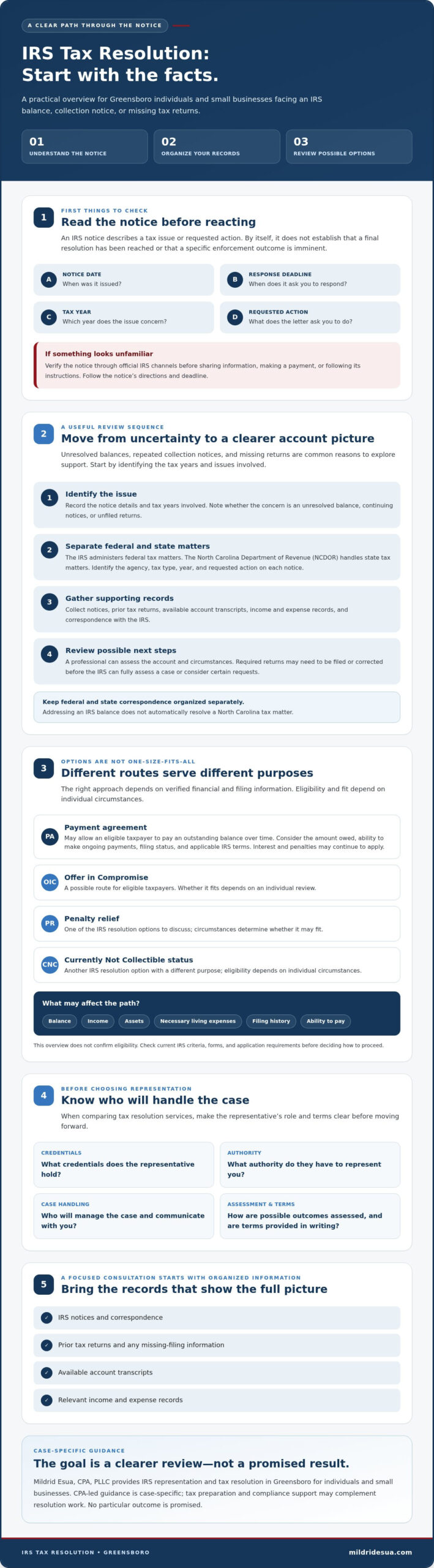
An IRS notice describes a tax issue or requested action. By itself, it doesn’t establish that a final resolution has been reached or that a specific enforcement outcome is imminent. Read the letter carefully, confirm what it concerns, and follow its instructions and deadline.
For a general introduction to local tax-debt concerns, watch this video:
Which IRS notices or circumstances deserve prompt attention?
Start by noting four details: the notice date, response deadline, tax year, and action requested. These help distinguish a request for information from a balance notice or another matter that calls for a response. Letters differ, so don’t assume every IRS mailing means collection is about to occur. If something looks unfamiliar, verify the notice through official IRS channels before sharing information, making a payment, or following its instructions.
Professional review may also help when balances remain unresolved, notices continue to arrive, or unfiled returns span multiple years. Missing filings can complicate the account picture, so identify the tax years involved rather than guessing at the total issue. A clear record of what you’ve received and filed gives a tax professional a more useful starting point.
When is a tax issue federal, and when is it state-level?
The IRS administers federal tax matters. The North Carolina Department of Revenue (NCDOR) handles state tax matters. A taxpayer can have separate concerns with both agencies, even when they relate to similar tax years or financial circumstances. Review each notice on its own terms, identifying the issuing agency, tax type, year, and requested action.
Don’t assume that addressing an IRS balance also resolves a North Carolina matter. Keep federal and state correspondence organized separately, and confirm current procedures with the relevant agency or a qualified professional. For federal tax debt, the Offer in Compromise (OIC) program is one possible route for eligible taxpayers, but whether it fits depends on an individual review.
Which IRS Resolution Options Could Fit a Greensboro Taxpayer’s Situation?
There isn’t one resolution that suits every tax account. The appropriate path can depend on the balance, income, assets, necessary living expenses, filing history, and ability to pay. IRS resolution options depend on verified financial and filing information. Required returns may need to be filed or corrected before the IRS can fully assess a case or consider certain requests.
The IRS outlines several options to manage tax debt. Use the overview below to understand their general purposes, not as confirmation that you qualify. Check current IRS criteria, forms, and application requirements before deciding how to proceed.
| Option | General purpose | Factors and limits to consider |
|---|---|---|
| Payment agreement | May allow an eligible taxpayer to pay an outstanding balance over time. | Consider the amount owed, ability to make ongoing payments, filing status, and applicable IRS terms. Interest and penalties may continue to apply. |
| Offer in Compromise | May allow a qualifying taxpayer to settle for less than the full amount owed. | The IRS reviews financial and other eligibility factors. It isn’t a guaranteed settlement, and an application requires supporting information. |
| Penalty relief | May reduce or remove certain penalties when applicable grounds are met. | The reason for the penalty, relevant records, and IRS review matter. Relief from a penalty doesn’t necessarily remove the underlying tax or interest. |
| Currently Not Collectible | May temporarily pause collection when a taxpayer qualifies based on financial circumstances. | A pause doesn’t erase the debt or automatically end related obligations. The IRS may review the taxpayer’s situation again. |
How do payment agreements and settlement offers differ?
An installment agreement focuses on paying an eligible balance over time, so a realistic payment amount is central to the assessment. An Offer in Compromise seeks to settle the debt for less than the full amount, but acceptance depends on IRS criteria and a review of the taxpayer’s circumstances. Don’t assume either option fits before the facts and current requirements are checked.
What do penalty relief and Currently Not Collectible status mean?
Penalty relief depends on the applicable grounds, supporting records, and IRS review. Currently Not Collectible status may pause collection for qualifying taxpayers who can’t pay while meeting necessary expenses. It doesn’t automatically erase tax debt or all related obligations. A case-specific review can help compare these paths with payment options. For guidance on IRS representation and tax resolution, consider professional support for your tax matter.
How to Evaluate IRS Tax Resolution Services in Greensboro Before Hiring
Choosing representation is a decision about both expertise and the working relationship. Before engaging IRS tax resolution services Greensboro taxpayers should understand who will handle the matter, what that person is authorized to do, and what the engagement covers. A careful review can help distinguish case-specific guidance from broad assurances.
No responsible provider can promise a particular IRS outcome before reviewing your records and circumstances. A professional can explain possible paths, identify uncertainties, and outline the work involved. The IRS decides whether to accept a request or grant relief.
What qualifications and representation authority should you verify?
Ask who will work directly on your case and what credentials that individual holds. Verify credentials with the relevant licensing or credentialing body, and ask about the person’s current authority to represent taxpayers before the IRS. A firm’s credentials don’t automatically establish the authority or scope of every staff member who may handle your matter.
Form 2848, Power of Attorney and Declaration of Representative, may be used to authorize an eligible representative to act before the IRS for specified tax matters and periods. Ask whether it’s appropriate for your case, who would be named, and which matters the authorization covers. Read the form before signing it.
Which promises and engagement terms should raise questions?
Claims of guaranteed debt elimination, guaranteed acceptance of an Offer in Compromise, or a fixed result deserve serious scrutiny. Outcomes depend on verified facts and IRS review. Ask how the professional will assess your records before recommending a strategy. Be cautious if the explanation is vague or relies on pressure instead of a reasoned review.
Use this checklist before agreeing to representation:
- Confirm the professional. Get the name and credentials of the person who will handle your case, not only the firm’s general qualifications.
- Define the scope. Ask which tax years and issues are included, what IRS communications or matters the representative will handle, and what work is excluded.
- Clarify fees and responsibilities. Request written fee terms and a clear explanation of records, approvals, or actions you’ll need to provide.
- Set communication expectations. Ask who your contact will be, how updates are handled, and how you’ll receive copies of filings and correspondence.
- Separate preparation from representation. Confirm who will prepare or amend returns and who will communicate with the IRS. These tasks may have different scopes.
A written agreement should make the working relationship clear before it begins. If a point remains unclear, request an explanation in writing. This lets you compare providers on responsibilities and process, not just confident-sounding promises.
What to Prepare Before an IRS Tax Resolution Consultation in Greensboro
You don’t need to solve the tax issue or assemble a perfect file before speaking with a professional. A few organized records can make the first discussion more focused and help identify what’s still missing. For IRS tax resolution services Greensboro taxpayers may seek, preparation means giving a professional a reliable starting point, not proving your case on your own.
Which records help a professional understand the tax issue?
Begin with the IRS notice or letter that prompted you to seek help. Keep related correspondence together, ordered by date and marked with the tax year and any requested response. Then gather what you have from this checklist:
- IRS records: Notices, letters, payment confirmations, and account transcripts, if available.
- Filing history: Filed federal returns for the relevant years, plus any records showing which returns may be missing or need correction.
- Income and payment documents: Wage or income statements, records of estimated tax payments, and receipts for payments already made.
- Financial information: Relevant household income, expenses, assets, and liabilities, as appropriate to the matter.
- Business records: If the issue involves a business, gather relevant income, expense, payroll, and bookkeeping records for the tax years in question.
Make a short timeline of IRS contacts, noting dates, the person or department involved if known, and what was discussed. Write down deadlines and questions, such as which returns or records are still needed and what the next review step may be. If you can’t find a document, note that rather than delaying the conversation.
Protect your information. Before sending tax returns, account transcripts, or financial documents, confirm the professional’s secure intake process through a trusted contact method. Don’t send sensitive records through an unverified email address or link.
What happens during a careful case review?
A professional may compare your filing history, account information, notices, payments, and financial circumstances to understand what the IRS records show and where details may be incomplete. The review can identify missing returns or supporting documents, clarify which tax years are involved, and help outline possible next steps. It’s a fact-finding process, not a guarantee of a particular resolution.
For more background, you can also review a guide to expert tax resolution in North Carolina as you prepare questions for your own case. If you’re ready to discuss the records you’ve gathered, contact Mildrid Esua, CPA, PLLC about IRS tax resolution.
How Mildrid Esua, CPA, PLLC Supports IRS Tax Resolution in Greensboro
Mildrid Esua, CPA, PLLC provides IRS representation and tax resolution for individuals and small businesses in Greensboro and nearby North Carolina communities, including High Point, Burlington, Kernersville, Jamestown, Oak Ridge, Summerfield, and Winston-Salem. The firm assists with back taxes, tax liens, and unfiled returns. For taxpayers considering IRS tax resolution services Greensboro support, a CPA-led review can help clarify the records, tax years, and practical questions that shape a case-specific plan.
Resolution work can connect with tax preparation and ongoing compliance. For example, a review may identify a missing return or a return that needs attention before the next step can be assessed. Accurate filings and organized records can help establish a clearer picture of the account and support future compliance planning. The work required depends on the taxpayer’s circumstances, so don’t assume a particular IRS decision or outcome in advance.
What can CPA-led IRS representation involve?
Depending on the engagement and the representative’s authorization, IRS representation may involve reviewing notices and available tax information, discussing possible resolution approaches, and communicating with the IRS within the agreed scope. The sequence matters. One case may require attention to filing history first, while another may call for an initial review of balances, correspondence, and financial information.
Before proceeding, ask which professional will handle your matter, what authority that person currently has to represent you before the IRS, and which tax years and issues the representation covers. Confirm the firm’s current authorization, the matters it accepts, and service availability directly. These details help ensure expectations match the actual engagement.
How can Greensboro taxpayers take the next step?
Prepare a concise summary before contacting the firm. Include the notice or issue that prompted you to seek help, the tax years involved, which returns you believe are filed or outstanding, and any response deadlines. Note prior IRS contacts and bring the correspondence and records you have available. You don’t need to resolve every uncertainty first. Identifying what you know and what you’re unsure about can make an initial discussion more productive.
If unfiled returns are part of the concern, ask whether tax preparation may be relevant to the resolution work and what records are needed to assess your filing history. A focused conversation can clarify possible next steps without assuming a particular result. To discuss your situation, contact Mildrid Esua, CPA, PLLC with your notices, tax years, deadlines, and available documents.
Take the Next Step Toward a Clearer Tax Plan
A tax notice is a reason to understand your situation, not to assume a particular outcome. Note the tax years, deadlines, and actions requested, then gather the records you have. Resolution options vary, and a careful review of filing history and financial circumstances can help identify a realistic path forward.
Choosing support matters, too. Confirm who will handle your case, what the representation covers, and how the engagement works. Mildrid Esua, CPA, PLLC is owned and operated by Mildrid Esua, a CPA, and provides IRS representation and tax resolution. For individuals and small businesses considering IRS tax resolution services Greensboro, this CPA-led support offers an opportunity to discuss the facts without relying on promises of a guaranteed result.
Discuss your IRS tax concerns with Mildrid Esua, CPA, PLLC, including the notices you received, relevant tax years, deadlines, and records you’ve gathered. A clear first conversation can help turn uncertainty into informed next steps.
Frequently Asked Questions
How do I find IRS tax resolution services in Greensboro?
Look for a provider who identifies the professional handling your case, explains their credentials and IRS representation authority, and provides written terms for the work. Ask how they review notices, filing history, and financial records before discussing possible options. Mildrid Esua, CPA, PLLC provides IRS representation and tax resolution in Greensboro and nearby communities, including High Point, Burlington, Kernersville, Jamestown, Oak Ridge, Summerfield, and Winston-Salem. Verify that the firm accepts your specific matter.
Can a CPA represent me before the IRS?
Yes, a CPA may represent taxpayers before the IRS when authorized and acting within the scope permitted for their credentials. Ask which professional will handle your case and verify that person’s current authority for the tax matters and years involved. Form 2848 may be used to authorize an eligible representative for specified matters. Mildrid Esua, CPA, PLLC provides IRS representation, but confirm current authorization and the scope of services for your situation directly with the firm.
What should I bring to an IRS tax resolution consultation?
Bring the IRS notice that prompted your concern, related correspondence, filed tax returns for the years involved, and account transcripts if available. Income documents, payment records, and relevant household or business financial records can also help clarify the circumstances. Note response deadlines, previous IRS contacts, and questions you want answered. You don’t need a complete file to begin. Identify what’s missing and ask how to share sensitive documents securely.
Is an Offer in Compromise available to everyone who owes the IRS?
No. An Offer in Compromise isn’t available to everyone, and submitting an application doesn’t guarantee acceptance. The IRS evaluates eligibility and financial information under its current criteria. A professional can review your filing status, income, expenses, assets, and other relevant facts to assess whether this option may be appropriate. If it doesn’t fit, other resolution paths may be worth reviewing. Check current IRS requirements before applying or relying on an advertised settlement promise.
Can IRS tax resolution services help with wage garnishment or a tax lien?
A tax professional may help review the IRS issue and explain possible next steps, but the work depends on the matter, the professional’s authority, and the agreed scope. Mildrid Esua, CPA, PLLC lists IRS representation and assistance with tax liens among its services. If you’re facing wage garnishment or a lien, share the notice and relevant dates, then confirm directly whether the firm handles that specific issue. Don’t assume every provider addresses every collection matter.
What is the difference between an IRS tax problem and a North Carolina tax problem?
An IRS tax problem concerns federal taxes administered by the Internal Revenue Service. A North Carolina tax issue is handled separately by the North Carolina Department of Revenue. One taxpayer may have matters with both agencies, and resolving one doesn’t automatically resolve the other. Check which agency sent each notice, the tax year, and the requested response. Keep the records distinct and verify current procedures with the agency or a qualified professional.
How long does IRS tax resolution take?
There’s no single timeline for IRS tax resolution. The process may depend on the issue, the tax years involved, whether returns or records are missing, how quickly information is provided, and the IRS’s review. Ask the professional handling your matter what steps are anticipated, what could affect timing, and how updates will be shared. Treat any promised fixed resolution date cautiously, since case-specific reviews and agency decisions can vary.




Leave a Reply
Your email is safe with us.