


An urgent tax notice calls for a clear plan, not a rushed promise of instant relief. If you’re searching for emergency tax relief Greensboro, start by identifying who sent the notice and when a response is due. This helps you determine whether you’re dealing with the IRS, the North Carolina Department of Revenue, or both.
It’s understandable to worry about collection action, missed deadlines, or choosing the wrong kind of help. Federal and state tax matters follow separate processes, so a solution that sounds simple may not fit your circumstances. Emergency relief also doesn’t automatically erase a balance.
This article explains how to assess the issue, gather notices and financial records, and identify resolution paths to discuss with a qualified Greensboro CPA. You’ll learn how to prepare for a case review with Mildrid Esua, CPA, PLLC, including what to consider if federal and North Carolina issues both need attention. The goal is a practical next step based on your notices, deadlines, and financial picture.
Key Takeaways
- For emergency tax relief Greensboro, identify the agency, tax type, period, and response date on each notice.
- Relief options depend on your circumstances. A payment arrangement, Offer in Compromise, or currently-not-collectible status may be worth reviewing.
- Tax relief doesn’t automatically erase a balance. Distinguish between managing a debt, disputing it, and qualifying for a specific relief option.
- Gather notices, filed returns, income details, payment records, and prior correspondence for a focused case review.
- A CPA conversation can help clarify which agencies are involved, which deadlines need attention, and what resolution paths may fit your situation.
Emergency Tax Relief in Greensboro: Identify the Urgent Issue First
A tax notice or unpaid balance deserves prompt attention, but it doesn’t call for panic or guesswork. Before deciding what to do, identify the agency, tax type, tax period, and any response date shown on each notice. A request for information may call for a different response than a balance notice or collection communication, so read the full document and check exactly what it asks you to do.
The notice, deadline, and tax period determine the first response. Emergency tax relief Greensboro starts with accurate triage, not assumptions about what a letter means or which relief option may apply.
This video discusses IRS back-tax help in Greensboro and offers a local perspective on seeking assistance:
Which tax agency sent the notice?
Check the letterhead and agency identification to see whether the notice came from the IRS or the North Carolina Department of Revenue (NCDOR). Note whether it concerns federal income tax, payroll tax, or a North Carolina tax obligation. If both agencies have contacted you, treat them as separate matters. They may involve different tax periods, records, deadlines, and responses. Verify phone numbers and website addresses through official agency sources instead of relying on information from an unsolicited caller.
Keep the type of notice in mind as you consider next steps. A request for information isn’t automatically a demand to pay, and a balance notice doesn’t explain which resolution options may fit. If you’re considering an Offer in Compromise, this Offer in Compromise (OIC) program overview provides background. Eligibility and suitability require a case-specific review.
What should you do when a tax deadline is near?
Keep the complete notice, including the envelope, attachments, and delivery date. Record the response date and any action the letter says is pending. If it mentions a deadline or collection action, seek prompt professional review to clarify what needs attention. A CPA can help distinguish IRS correspondence from an NCDOR issue and identify records needed to assess each matter.
Don’t ignore the letter, send unsupported statements, or assume a phone call pauses a deadline. Confirm instructions directly with the issuing agency using verified contact information. If a date is close, organize your documents and ask what response is appropriate before acting.
Greensboro Tax Relief Options: Understand What May Apply
Tax relief isn’t one universal program. The right path depends on what you owe, which agency is involved, your financial circumstances, and the records available to support your case. A useful review compares potential options without assuming one is available or suitable before checking eligibility and current requirements.
A tax-resolution option must fit your circumstances and the rules of the agency handling the balance. This matters in emergency tax relief Greensboro, especially when both federal and North Carolina liabilities are involved.
How do IRS resolution pathways differ?
For an IRS balance, possible routes may include a payment arrangement, an Offer in Compromise, or currently-not-collectible status. Each serves a different purpose and depends on IRS requirements and an individual review:
- Payment arrangements may let a taxpayer address a balance over time, subject to applicable IRS requirements. Compare proposed terms with your income, expenses, and ongoing tax obligations.
- An Offer in Compromise may let eligible taxpayers settle for less than the full amount owed. It isn’t automatic debt forgiveness. Eligibility and supporting financial information need careful assessment.
- Currently-not-collectible status may be considered when paying would create financial hardship. It doesn’t necessarily erase the debt, and interest and penalties may continue to accrue.
Standards, documentation, and application procedures can change, so check current IRS guidance before relying on an option. Also distinguish debt-resolution programs from disaster-related deadline relief. The IRS explains its emergency relief for individuals and businesses, which may apply in federally declared disaster situations. That is separate from resolving a tax balance.
When could a North Carolina tax issue need separate attention?
Federal and state tax liabilities are administered separately. An IRS arrangement doesn’t automatically resolve an NCDOR balance, and a state matter may involve different correspondence, tax periods, and procedures. Gather NCDOR notices alongside federal records, then check current state guidance before deciding how to respond.
If you’re unsure which agency or pathway applies, a case-specific CPA review can help clarify the issues without promising a particular outcome. Mildrid Esua, CPA, PLLC provides tax resolution and IRS representation. You can review Greensboro tax resolution support as you consider next steps.
Does Emergency Tax Relief Erase Tax Debt? Compare Claims and Realistic Outcomes
Seeking tax relief doesn’t automatically remove a balance. Depending on the facts, a review may identify a way to manage payments, challenge an amount that appears incorrect, or assess whether you qualify for a specific relief option. These routes serve different purposes. None should be presented as guaranteed before the records and applicable rules are reviewed.
An evaluation can identify possible relief, but it can’t promise that a tax debt will be canceled. For emergency tax relief Greensboro, this distinction helps you assess claims carefully and focus on what can be verified.
How can you evaluate a tax-relief claim?
Ask what service is being provided, which agency or agencies are involved, and who would represent you. Request a clear explanation of the proposed steps, the records needed, possible limitations, and decisions that remain with the tax agency. Be cautious if someone guarantees an outcome, pressures you to act before reviewing notices, or can’t explain what representation involves.
Don’t sign incomplete forms or share sensitive financial details with an unverified caller. Confirm identities and contact information independently. Make sure you understand what you’re authorizing before sending records or agreeing to a proposed approach.
What can change the outcome of a tax-resolution case?
The right review may depend on whether the issue involves income tax, payroll tax, or another liability, as well as the tax periods involved and the age of the balance. Filing status, income, assets, payment history, and prior correspondence can help establish the financial picture. Filing compliance may also matter for some options, but requirements vary by pathway and agency. Check current standards before relying on assumptions.
A case review can compare possible next steps, such as checking whether an amount is accurate, considering payment options, or assessing eligibility-dependent relief. It can also clarify which records support the analysis. A CPA can assess the facts and discuss representation needs, but the IRS or another tax agency makes its own decisions.
Keep local property taxes separate from federal tax debt. Guilford County’s Guilford County property tax relief programs address local property-tax circumstances, not an IRS balance. Identifying the agency and type of tax helps you pursue a relevant review instead of relying on a broad claim that one form of relief resolves every obligation.
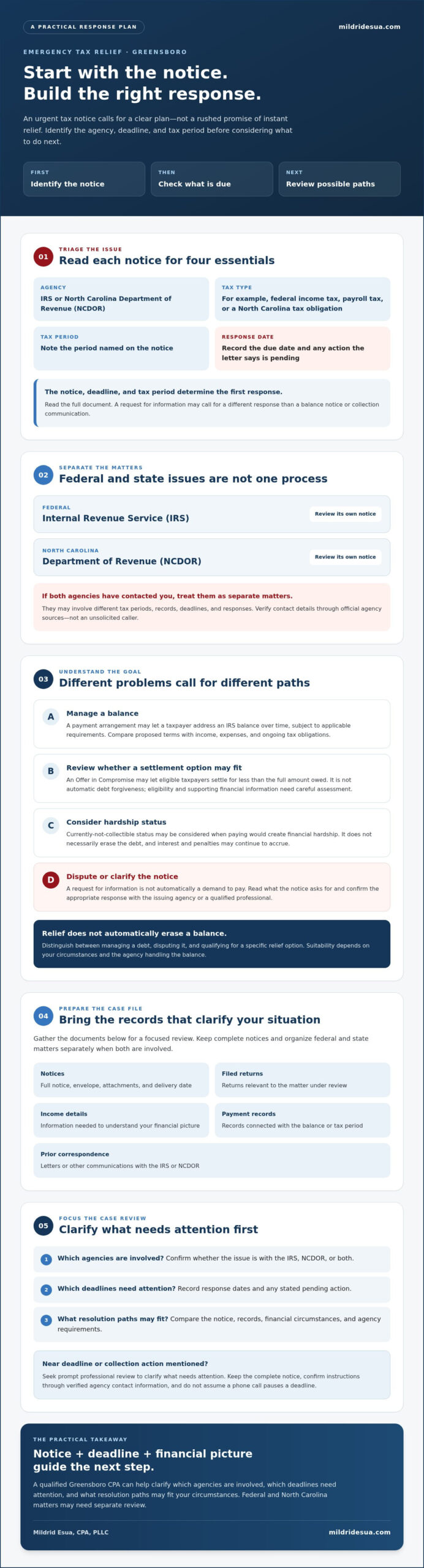
How to Prepare for Emergency Tax Relief in Greensboro
Organized records help turn an urgent tax concern into a focused case review. Start with the notices, then match them to the relevant returns and payment history. Before reaching out, note the agency, tax years, response dates, and steps you’ve already taken. This preparation helps clarify which issues need attention first without requiring you to solve the case on your own.
Which documents should you gather?
Collect what you have, even if the file isn’t complete. Group documents by agency and tax period so federal and North Carolina matters don’t get mixed together.
- IRS and North Carolina Department of Revenue notices, including envelopes, attachments, and copies of responses you sent.
- Filed tax returns for the periods involved, along with income records that help explain your financial circumstances.
- Payment confirmations, account records, and correspondence with a prior tax representative, if applicable.
- For a business matter, relevant payroll-tax records and entity information, such as business formation or filing documents.
Then write down the timeline: when each notice arrived, which deadlines it lists, whether you contacted an agency, and what response or payment followed. If a return, receipt, or letter is missing, say so. Don’t fill gaps by guessing or creating a record from memory. Note what’s unavailable so it can be considered accurately during the review.
What should you ask a Greensboro tax-resolution CPA?
Use the first conversation to define the scope. Ask which agency, tax periods, and liabilities the review will cover, what representation includes, and which records are still needed. Clarify what remains your responsibility, including any follow-up or information you may need to provide. A focused discussion should explain potential next steps and limitations, not promise a specific agency decision.
You can also ask about strategic tax planning for businesses as a related service. A CPA can assess available records and explain case-specific representation needs, but missing information or separate state and federal issues may require further review. If you’re preparing for emergency tax relief Greensboro, bring your organized notices and questions to a case review with Mildrid Esua, CPA, PLLC to discuss tax-resolution support and IRS representation that may fit your situation.
Get Case-Specific Emergency Tax Relief Support in Greensboro
When tax notices, unpaid balances, or missing returns are difficult to assess alone, a structured review can help bring the facts into focus. Mildrid Esua, CPA, PLLC provides tax resolution and IRS representation, including assistance with back taxes, tax liens, unfiled returns, and IRS correspondence. An initial conversation is meant to clarify the issue and representation needs, not promise immediate relief or a particular outcome.
What to expect from a tax-resolution case review
A review may begin with the notices and related records, then clarify which agency is involved, the tax periods at issue, filing status, and the concerns you want addressed. If federal and North Carolina matters are both present, each may require its own analysis. The available documents, the type of liability, and the facts you share will guide what can be assessed and what information may still be needed.
Next steps depend on your case. A review can identify questions to resolve, records to locate, and potential options to discuss, but it can’t guarantee how an agency will respond or how quickly a matter will progress. For business owners, strategic tax planning for businesses may also support forward-looking planning once the urgent issue is understood.
How to take the next step without delay or pressure
Before contacting the firm, have the notice and response date available, along with the agency name and tax years involved. Bring filed returns, payment records, prior correspondence, and details of actions you’ve already taken. If records are missing, explain what you don’t have rather than filling gaps with estimates. This gives the CPA a clearer starting point for determining what the review should cover.
Keep track of active response dates while arranging professional guidance. Don’t assume that contacting a firm changes a deadline or pauses agency action. Follow the notice instructions and verify questions with the issuing agency through official contact information. A focused discussion can help clarify the immediate concern, which records matter, and what representation may involve.
If you’re seeking emergency tax relief Greensboro, Mildrid Esua, CPA, PLLC can discuss your circumstances and tax-resolution needs without promising a specific result. Request a tax-resolution consultation to begin a case-specific conversation.
Take the Next Step With a Clear Tax-Relief Plan
Urgent tax problems are easier to assess when you identify the agency, tax period, and response date, then gather the notices and records that explain your situation. Relief options depend on your circumstances and the agency’s rules, so be cautious of promises to erase debt or guarantee an outcome before anyone reviews your case.
If you’re considering emergency tax relief Greensboro, a focused conversation with a qualified CPA can help clarify what needs attention, which records are relevant, and which resolution paths may warrant further review. Mildrid Esua, CPA, PLLC is owned and operated by Mildrid Esua, CPA, and provides IRS representation and assistance with back taxes, tax liens, and unfiled returns.
The firm serves Greensboro and nearby communities, including High Point, Burlington, Kernersville, Jamestown, Oak Ridge, Summerfield, and Winston-Salem. Bring the notice and deadline information you have to discuss your situation with the firm. Request a case-specific tax-resolution consultation.
Frequently Asked Questions
What should I do first if I receive an urgent IRS tax notice in Greensboro?
Read the full notice and identify the tax period, requested action, and response date. Keep the envelope and attachments, then gather the related return and payment records. Don’t assume that calling the IRS changes a deadline. If the notice mentions collection action or you’re unsure how to respond, seek case-specific tax-resolution guidance promptly and continue tracking the stated date while arranging a review.
Can a CPA help with emergency tax relief in Greensboro?
A CPA can review notices, assess your records, explain possible resolution paths, and provide IRS representation when authorized and appropriate. Mildrid Esua, CPA, PLLC is owned and operated by Mildrid Esua, CPA, and serves Greensboro and nearby North Carolina communities. Ask whether your location is within the firm’s service area, which agencies and tax periods are included, what documents are needed, and what remains your responsibility. No specific agency decision can be guaranteed.
Does IRS tax relief erase back taxes?
No, not automatically. Depending on the circumstances, a taxpayer may explore a payment arrangement, dispute a balance, or seek another option if eligible. Some approaches manage how a balance is addressed without eliminating the underlying debt. Eligibility, documentation, and consequences vary by pathway and current agency rules. Before choosing a course of action, ask for a clear explanation of potential benefits, limitations, and financial information you may need to provide.
Can the IRS and North Carolina Department of Revenue collect taxes separately?
Yes. The IRS and North Carolina Department of Revenue administer separate tax liabilities, so resolving one doesn’t necessarily resolve the other. Review each notice to identify its issuing agency, tax type, and relevant period. Separate filings, responses, or resolution discussions may be needed, depending on the facts. If both agencies are involved in your Greensboro tax matter, ask a professional to clarify the scope of each review and verify current state procedures.
What documents should I bring to a tax-relief consultation?
Bring relevant IRS and North Carolina notices, filed returns, income records, payment confirmations, and prior correspondence. Make a brief timeline with tax periods, response dates, calls, and steps you’ve already taken. Business owners may also need payroll-tax records and entity information. If a document is missing, explain what you don’t have rather than estimating or recreating it from memory. A reviewer can help identify what additional information may be needed.
Is emergency tax relief guaranteed if I hire a tax professional?
No. A qualified professional can help organize information, assess your case, and discuss possible options, but can’t guarantee an agency decision, a particular reduction, or a deadline extension. Be wary of promises made before your records have been reviewed or pressure to sign without understanding the proposed work. Ask who will represent you, what the engagement includes, what limitations apply, and which actions remain your responsibility.
How quickly can a tax-relief case be resolved?
There’s no single timeline for every tax-resolution case. Timing can depend on the agency, the type and age of the liability, missing returns, the completeness of your records, and the response required. A case review can help clarify priorities and possible next steps, but don’t assume a fixed timeline. Continue monitoring notices and meeting response dates while your situation is assessed with local support in Greensboro, High Point, Burlington, Kernersville, Jamestown, Oak Ridge, Summerfield, or Winston-Salem.




Leave a Reply
Your email is safe with us.