

An IRS wage levy can start without a court order. If you’re deciding how to stop IRS wage garnishment in Greensboro, act on the notice and address the tax debt: the IRS generally must send a Final Notice of Intent to Levy and Notice of Your Right to a Hearing at least 30 days before issuing a levy, according to the Internal Revenue Service. A hearing request, payment arrangement, or hardship-based request may provide a path to challenge or resolve collection.
It’s understandable to worry about how much of each paycheck will remain for bills and essentials. How to stop IRS wage garnishment in Greensboro depends on where the collection process stands, whether a notice deadline is still open, and what your finances can support.
This article explains how wage levies and bank levies work, then compares appeals, installment agreements, and Currently Not Collectible status. You’ll see what each option can address and how back taxes affect your choices, so you can plan your next step.
Key Takeaways
- Identify whether the IRS has issued a levy or is still at the notice stage, since the available response options depend on where collection stands.
- According to the Internal Revenue Service, a Final Notice of Intent to Levy typically gives you 30 days to request a Collection Due Process hearing.
- Compare an appeal, an installment agreement, and Currently Not Collectible status based on your circumstances and ability to pay.
- According to the Internal Revenue Service, the collection period for tax debt, including wage garnishment, is generally 10 years.
- Address back taxes alongside the garnishment so the response considers both immediate paycheck pressure and the underlying balance.
Currently Not Collectible status
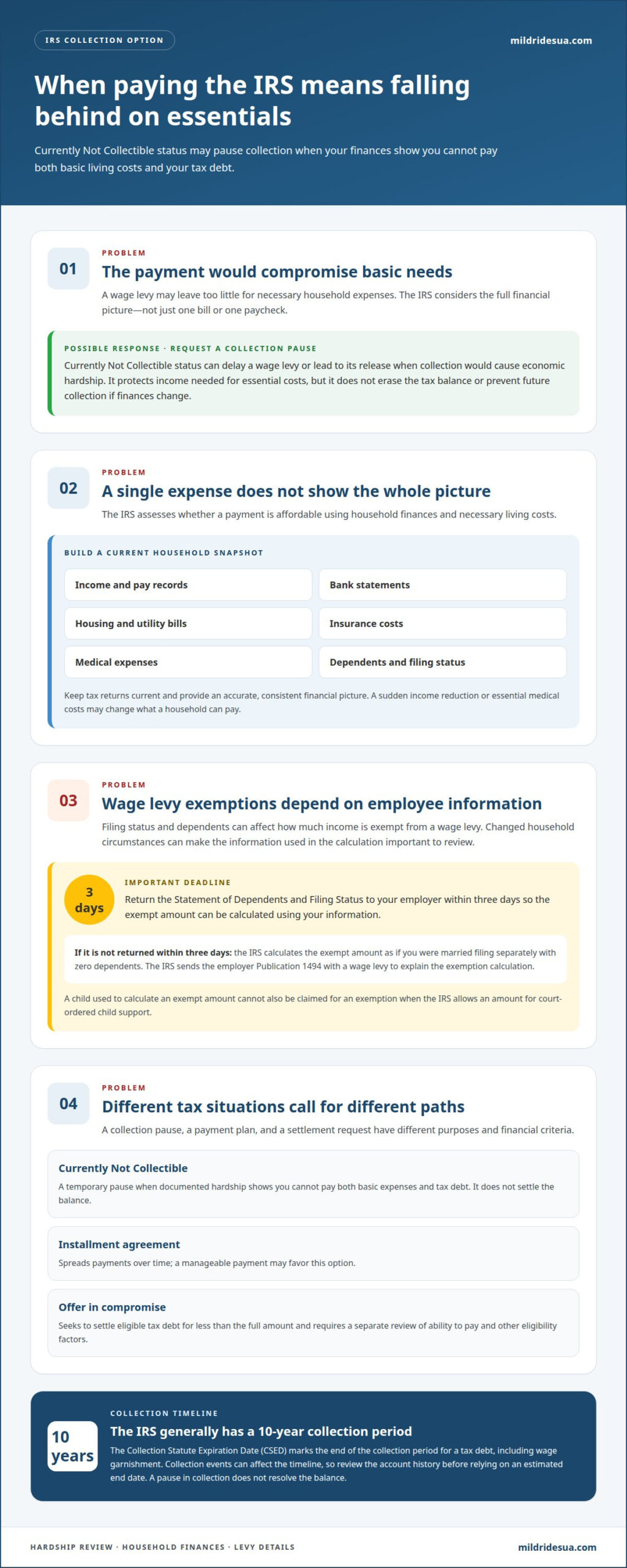
Currently Not Collectible status can pause collection when paying would prevent you from meeting basic living expenses. It may lead to release of a wage levy, but it doesn’t erase the tax balance.
Non-Collection Status and Economic Hardship
Currently Not Collectible status is a temporary collection pause for taxpayers whose finances show they can’t pay both basic expenses and their tax debt. The IRS may delay a wage levy or release one if collection causes economic hardship. This status can protect income needed for essential costs, but it doesn’t settle the debt or prevent future collection if finances change.
The decision depends on the full household budget, not one bill or paycheck. Income, necessary expenses, available assets, dependents, and filing status help show whether a payment is affordable. Keep tax returns current and provide an accurate financial picture. A sudden income reduction or essential medical costs may change what a household can pay.
Compare this pause with an installment agreement, which spreads payments over time, or an offer in compromise, which seeks to settle eligible tax debt for less than the full amount. Each option has different financial criteria. A manageable payment may favor an installment agreement, while documented hardship can support a request for non-collection status. An offer in compromise requires a separate review of ability to pay and other eligibility factors.
Documents Showing Inability to Pay
Financial records help show whether required living costs leave money available for IRS collection. Build a current picture using pay statements or income records, bank statements, housing and utility bills, insurance costs, medical expenses, and records of dependents. The IRS uses financial information to assess ability to pay, so consistent figures matter more than a single unexplained expense.
For exempt wages, the employee must return the Statement of Dependents and Filing Status to the employer within three days to have the exempt amount calculated using the employee’s information. If it isn’t returned within three days, the IRS calculates the exempt amount as if the employee were married filing separately with zero dependents. The IRS sends the employer Publication 1494 with a wage levy to explain the exemption calculation.
Filing status and dependents can affect how much income is exempt from a wage levy. Review the information used in the calculation, especially if household circumstances have changed. A child used to calculate an exempt amount can’t also be claimed for an exemption when the IRS allows an amount for court-ordered child support.
The Collection Statute Expiration Date, or CSED, marks the end of the IRS collection period for a tax debt. The Internal Revenue Service generally has a 10-year collection period, including wage garnishment. Because collection events can affect the timeline, review the account history before relying on an estimated end date. A pause in collection doesn’t itself resolve the tax balance.
What Are Wage Garnishments and Bank Levies?
An IRS wage levy directs an employer to send part of your pay toward federal tax debt. A bank levy instead reaches money in a financial account, while North Carolina can also use tax collection levies.
Tax Levies and Wage Garnishments
A tax levy is a collection action that takes income or property to satisfy unpaid taxes. An IRS wage levy is often called a wage garnishment, but tax levies follow different limits from ordinary consumer debt garnishments. The distinction matters because general federal limits for ordinary garnishments don’t apply to federal or state tax debts.
For federal tax debt, the IRS sends a levy to your employer, who must withhold and forward wages. The IRS can also levy money in financial accounts. In North Carolina, the Department of Revenue can garnish wages, levy bank accounts, and file state tax liens for unpaid state taxes. Identify which agency issued the notice before assessing your options.
A revenue officer may handle a case directly, including communications about collection and a levy. That differs from routine notices processed through the IRS collection system, but the underlying issue remains unpaid tax debt. Check the notice for the agency, tax periods, amount, and contact details. A federal IRS levy and a North Carolina Department of Revenue action involve separate tax accounts.
Effects on Paychecks
After your employer receives an IRS wage levy, it must send the required portion of each paycheck to the government. The IRS calculates exempt wages using filing status and dependents, so the amount withheld depends on the information applied to the levy. A bonus, commission, or fee can also count as wages for levy purposes.
Child support can affect the exempt amount. The IRS may release money needed for court-ordered support when the order predates the employer’s receipt of the levy. A child used to calculate exempt wages can’t also be counted for the IRS allowance tied to that support order. Provide your employer with the required dependent and filing-status statement within three days.
Attorney and enrolled-agent fees vary with tax periods, missing filings, records, and the scope of representation. The price depends on the case and is provided after a quote request. A fee estimate should distinguish a levy response from broader work on back taxes or returns.
For information about an IRS levy on your account, use the telephone number on the IRS notice or levy correspondence. The IRS can address its collection action, but it doesn’t provide private representation as a tax attorney or enrolled agent.
Watch for promises that a levy will certainly stop or pressure to pay through unusual methods. Don’t rely on an unsolicited caller’s claims. Use the contact information on the IRS correspondence to discuss the account. Keep copies of notices and payment records, and don’t share financial details until you’ve established who is contacting you.
Appealing or challenging a garnishment
An appeal can challenge a collection action, while a release request asks the IRS to stop a levy. The right route depends on the notice received, the deadline, and the reason for disputing collection.
Appeal Options and Processes
A Collection Due Process hearing gives taxpayers a formal way to raise issues about a proposed levy. According to the Internal Revenue Service, a taxpayer who receives a Final Notice of Intent to Levy typically has 30 days to request one. Use Form 12153 to request the hearing and explain the dispute or collection alternative.
For a levy already underway, the Collection Appeals Program may provide another appeal route. Its availability depends on the collection action and timing. A timely appeal matters because a Collection Due Process hearing can pause the collection statute, with an additional 90 days when a Tax Court petition is filed.
If the IRS rejects an appeal, a taxpayer must file a challenge within 30 days of the appeal decision. Missing a deadline can narrow the available review options, so keep the notice, the decision, and proof of when each was received. An appeal should identify the specific issue, such as an incorrect balance or a proposed payment arrangement the agency has not considered.
How do you appeal an IRS wage levy or request a Collection Due Process hearing? Submit Form 12153 for a CDP hearing within the deadline stated on the notice, and clearly explain the issue. For other collection disputes, the Collection Appeals Program may apply.
Responding to a Wage Levy Notice
After receiving an IRS wage levy notice, review the tax periods, balance, and response instructions, then contact the IRS using the telephone number on the correspondence. Explain your financial situation and identify the employer or office processing the levy. Having its fax number can help the IRS send a release promptly.
How do you contact the IRS to request a wage garnishment release? Call the number on the levy or IRS letter and state why release is needed, such as economic hardship or an agreed resolution. IRS phone service is available from 7 a.m. to 7 p.m. local time, Monday through Friday.
Ask what information the IRS needs to evaluate your request, and keep copies of submitted records. A request for release is separate from an appeal, so explain whether you are disputing the action, seeking relief, or both. Your employer generally continues withholding until it receives instructions to stop.
Does federal garnishment always mean IRS tax collection? No. Federal agencies may garnish up to 15% of disposable earnings for defaulted debts owed to the United States, while an IRS wage levy collects unpaid taxes. Distinguishing the agency and debt type helps direct an appeal to the right program. A levy is a collection action, not a change to a credit agreement.
Installment agreements
An IRS installment agreement lets a taxpayer pay tax debt over time instead of making one full payment. For a Greensboro household facing a wage levy, a payment plan can provide a structured alternative, but the proposal must reflect the actual financial situation. The IRS considers the balance, income, expenses, and amount available for payments. A payment that leaves too little for essential costs may not be sustainable.
How can an installment agreement stop or release an IRS wage garnishment? The IRS may release a wage levy after you and the agency agree on an underlying resolution, such as a payment plan. Your employer continues withholding until it receives release instructions, so submitting a request alone doesn’t stop payroll deductions.
Timing matters. Simple IRS payment plans in North Carolina can be set up in 30 to 60 days. If a wage levy is already active, the IRS wage levy release timeline through the Automated Collection System is typically 2 to 6 weeks after the underlying resolution is agreed. These are separate stages: agreeing on a plan and processing a levy release. Keep the levy notice available and confirm which IRS office is handling collection.
Before proposing an installment amount, assemble current income and expense information. Pay records show take-home income, while bank statements and bills help explain essential expenses. The IRS needs a realistic view of what remains after necessary costs. For example, if you have irregular self-employment revenue, account for fluctuations rather than basing the payment on an unusually strong month.
Review the balance and filing history as part of the same assessment. Missing returns or incorrect account details can complicate a payment proposal, while an accurate tax account gives the IRS a clearer basis for discussing terms. If the notice includes multiple tax periods, identify each period and its balance before deciding what a monthly payment can reasonably cover.
A Direct Debit Installment Agreement is a specific payment arrangement. The IRS may withdraw a federal tax lien when a taxpayer enters this agreement and meets certain criteria. Lien withdrawal and wage levy release are different actions, so resolving one doesn’t establish that the other has occurred. Confirm the status of each collection action with the IRS.
Keep records of the agreement, payments, and IRS correspondence. If the IRS accepts a plan, follow its terms and respond promptly to later notices. A missed payment or change in income can affect the arrangement. Careful tracking helps you spot a problem early and address it before collection activity resumes.
Back taxes and wage garnishment
Back taxes can turn an unpaid balance into continuing pressure on income, especially once the IRS serves a wage levy. The Internal Revenue Service generally has a 10-year collection period for tax debt, including wage garnishment. That period makes account history important: taxpayers need to understand which tax years remain unresolved and what collection action applies to each.
A wage levy doesn’t eliminate tax debt. It directs part of your earnings toward the balance. The IRS may release a levy if the amount owed is paid, the collection period ended before the levy was issued, or another resolution supports release. A release addresses the levy, not necessarily every unpaid tax year or filing issue.
Unfiled returns can complicate resolution because the IRS may not have a complete account of your liabilities. Organize notices and tax records by year, then identify missing filings and assessed balances. For small business owners, payroll records and bookkeeping can help clarify income and tax obligations across affected periods. An accurate picture helps distinguish a disputed balance from a payment or hardship issue.
Hardship can also shape the collection response. If paying the IRS would prevent necessary living expenses, present current income and essential costs to support a request for non-collection status. This status can temporarily pause collection, but it doesn’t erase the debt. Changes in income or expenses can affect whether the IRS continues the pause.
Distinguish federal back taxes from North Carolina tax debt. The IRS handles federal liabilities, while the North Carolina Department of Revenue collects state taxes. A state balance may involve separate notices or collection actions, so resolving an IRS account alone doesn’t address state tax obligations.
For each tax year, create a concise account record of notices received, returns filed, payments made, and current collection activity. Match each IRS notice to its tax period before discussing a resolution. If the balance appears incorrect, gather records supporting a correction. If your income can’t support payments, organize household expenses and income evidence. These steps address the underlying issue, not just paycheck withholding.
When back taxes and garnishment overlap, weigh the levy, filing history, income, and hardship together. A payment arrangement may suit a taxpayer with room in the budget, while non-collection status may be relevant when essential expenses consume available income. An offer in compromise is another option, but it requires a separate assessment of eligibility and ability to pay.
For help evaluating back taxes and collection options, get support with tax resolution before choosing a path.
Mildrid Esua, CPA, PLLC
Mildrid Esua, CPA, PLLC helps individuals and small businesses assess IRS collection issues and consider a clear resolution path. If a wage levy overlaps with back taxes, unfiled returns, or a tax lien, IRS Representation and Tax Resolution services can bring those concerns into one coordinated review.
The review can account for notices received, tax periods involved, filing status, income, necessary expenses, and available collection options. That context helps determine whether an appeal, installment agreement, hardship request, or another resolution route fits your circumstances. Addressing the underlying tax account matters alongside the immediate effect on each paycheck.
For help assessing your IRS collection situation, contact Mildrid Esua, CPA, PLLC.
Make your next move with a clear plan
If you’re considering how to stop IRS wage garnishment in Greensboro, turn the available information into a deliberate decision. Set out what needs attention first, which records support your position, and what outcome your household or business can sustain. A defined sequence helps keep a time-sensitive notice from getting lost among competing financial demands.
Keep a current record of correspondence, decisions, and changes in income or essential expenses. This working file can help you explain your situation consistently as the IRS reviews your account. If circumstances shift, update the financial picture before relying on an earlier proposal. A clear record of what changed makes it easier to decide whether the current approach still fits.
If you’d like help applying these considerations to your tax situation, contact Mildrid Esua, CPA, PLLC. A thoughtful, well-documented next step can bring greater clarity to a difficult process.
Frequently Asked Questions
Does the IRS have to notify me before garnishing wages?
Generally, the IRS sends a Final Notice of Intent to Levy and Notice of Your Right to a Hearing before levying wages. The notice usually provides a response window, so review the date and instructions promptly. According to the Internal Revenue Service, taxpayers typically have 30 days after receiving the notice to request a Collection Due Process hearing. Keep the notice and envelope together to track the deadline.
How much can the IRS take from my paycheck?
There isn’t one flat percentage for every IRS wage levy. The IRS calculates exempt wages using factors that include filing status and dependents, so the amount left for you depends on the information used in the calculation. Compensation can include bonuses, commissions, and fees, not just regular salary. Review the levy calculation alongside your pay statement to understand how withholding affects take-home pay.
How does a wage garnishment affect your taxes?
Wages taken through an IRS levy remain taxable earnings and are reported on Form W-2. The levy changes how part of your pay is sent, not how the employer reports your compensation. Compare your year-end W-2 with your pay records, including levy deductions, when preparing your return. Keep the IRS notices and payroll statements together so you can track income reporting and collection activity.
How long does it take to release an IRS wage levy?
After an underlying resolution is agreed, an IRS wage levy release through the Automated Collection System typically takes 2 to 6 weeks. The resolution and release are separate steps, so an accepted payment arrangement doesn’t mean payroll withholding has already stopped. Keep tracking each paycheck until the employer receives release instructions. If withholding continues, contact the IRS using the number on its levy correspondence.
What does garnishment look like on your pay stub?
Your pay statement may show a deduction that reduces take-home pay, but employers can use different labels for withholding. Look for an item identified as an IRS levy, tax levy, or garnishment, and compare it with gross and net pay for that pay period. If the description is unclear, ask payroll what the deduction represents and keep the statement with the IRS notice.
How can I stop an IRS wage garnishment in Greensboro, NC?
To stop an IRS wage garnishment in Greensboro, NC, identify the notice and tax periods, then contact the IRS using the number on its correspondence. Explain whether you’re disputing the levy, seeking a payment arrangement, or facing hardship. A hearing request may be available if the notice deadline is still open. The IRS must send release instructions to your employer before payroll withholding stops.
What are the IRS rules for releasing a wage levy due to financial hardship?
The IRS may release a levy when collection causes economic hardship, such as leaving insufficient income for necessary living costs. Present a current household budget that accounts for income and essential expenses, then explain how continued withholding affects those needs. A hardship-based release addresses the levy, not the underlying tax balance. The IRS may review your financial circumstances again if income or expenses change.
Can an IRS offer in compromise stop a wage garnishment, and how long does it take?
An offer in compromise may resolve eligible tax debt, but submitting an offer alone doesn’t show that a wage levy has been released. Confirm the status of the offer and the levy separately, and watch for release instructions to your employer. In North Carolina, tax resolution cases involving multiple years of unfiled returns or larger balances typically take three to six months.




Leave a Reply
Your email is safe with us.