

The simplest business structure isn’t always the most tax-efficient choice. Choosing how to structure a new business for tax purposes means weighing how income is taxed alongside ownership, personal liability, state rules, and ongoing filing obligations. No single structure fits every business.
Taxes matter when you choose how to set up a business, but the decision goes beyond the tax return. Structure can affect how profits flow to owners, what liability protections apply, and which filings the business must make.
This comparison explains how sole proprietorships, partnerships, LLCs, C corporations, and S corporations differ in taxation, eligibility, liability, state-level considerations, and filing obligations. You’ll see which factors tend to favor each option, where an S corporation election may fit, and how to make a decision that supports your current needs and growth plans.
Key Takeaways
- Compare tax treatment alongside liability, ownership needs, and filing obligations; the lowest-tax option on paper may not fit your business goals.
- Understand how sole proprietorships and partnerships pass business income through to owners, and what that means for personal tax responsibilities.
- Assess whether an LLC’s liability structure and tax treatment align with your plans, including the state-level rules that can affect its costs.
- Weigh an S corporation election against its eligibility requirements and added payroll and filing responsibilities.
- Use professional tax planning to connect your structure choice with bookkeeping, payroll, and your longer-term business plans.
S corporation pass-through taxation and eligibility limits
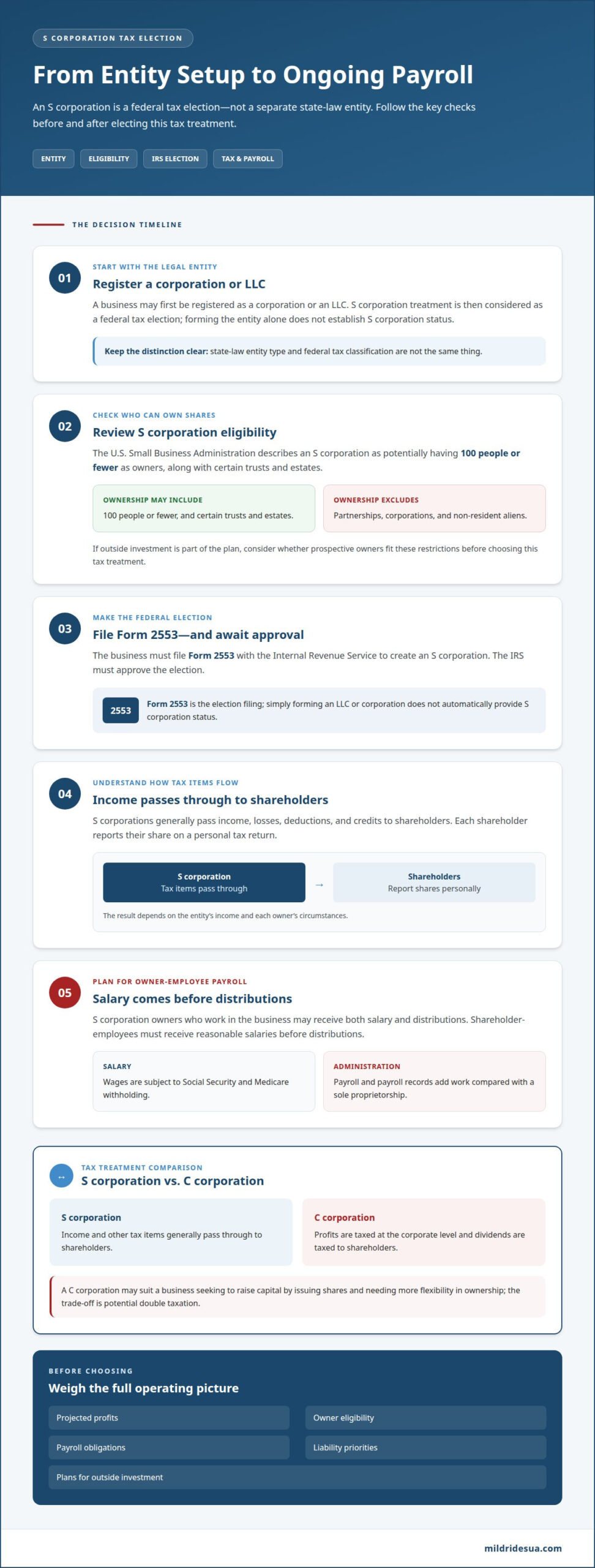
An S corporation is a federal tax election, not a separate state-law entity type. A business may first be registered as a corporation or an LLC, then elect S corporation tax treatment if eligible. The Internal Revenue Service requires a business to file Form 2553 to create an S corporation. The IRS must approve the election, so forming an entity alone doesn’t establish S corporation status.
Pass-through taxation generally means an S corporation passes income, losses, deductions, and credits to its shareholders. Each shareholder reports their share on a personal tax return. The entity’s profits therefore aren’t taxed in the same way as C corporation profits, which are taxed at the corporate level and again when distributed as dividends. The result depends on the entity’s income and each owner’s circumstances.
Ownership limits matter before an election. The U.S. Small Business Administration describes an S corporation as potentially having 100 people or fewer as owners, along with certain trusts and estates. It excludes partnerships, corporations, and non-resident aliens from ownership. A business expecting outside investment should consider whether its prospective owners fit these restrictions before selecting this tax treatment.
S corporation owners who work in the business may receive both salary and distributions. Shareholder-employees must receive reasonable salaries before distributions, and their wages are subject to Social Security and Medicare withholding. This payroll requirement adds administration compared with a sole proprietorship. Evaluate an S corporation election against expected earnings, owner responsibilities, and the work involved in maintaining payroll records.
| Structure | Federal tax treatment | Eligibility or ownership | Capital and administration |
|---|---|---|---|
| Sole proprietorship | Owner reports business income | One owner | Simpler structure; no separate ownership interests |
| Partnership | Income passes through to partners | Two or more partners | Partners share ownership and responsibilities |
| LLC | Tax treatment depends on classification | One or multiple members | State-law entity with adaptable ownership |
| S corporation | Income and other tax items pass through | Ownership restrictions apply | Election and payroll administration |
| C corporation | Corporate tax, then shareholder tax on dividends | Corporate ownership structure | Can suit businesses seeking to raise capital through shares |
A C corporation, unlike an S corporation, may suit a company that plans to raise capital by issuing shares and needs more flexibility in ownership. The trade-off is potential double taxation: corporate profits are taxed when earned, then dividends are taxed to shareholders. A sole proprietorship or partnership may involve fewer corporate formalities, while an LLC offers a state-law liability structure and can use different federal tax classifications.
Before deciding how to structure a new business for tax purposes, compare projected profits, owner eligibility, payroll obligations, liability priorities, and plans for outside investment.
Sole proprietorship taxation and personal liability
A sole proprietorship keeps ownership simple, but business finances and personal tax reporting are closely connected. The owner reports business income or loss on a schedule attached to their personal return, rather than filing a separate business tax return. Business profits are subject to personal income tax and self-employment tax for Social Security and Medicare. The owner keeps the profits, but personal liability can extend to business obligations.
Business structure affects tax reporting and the separation between business and personal responsibility. A sole proprietor’s business income is generally taxed once, even if reinvested, and self-employed taxpayers commonly make estimated payments quarterly. An LLC creates a state-law business entity and can provide limited liability protection, while its tax treatment depends on its classification. Neither the entity label nor a tax election automatically changes every obligation.
A limited partnership divides roles between a general partner and limited partners. The general partner typically has unlimited liability, while the other partners have limited liability. Partnership income generally passes through to partners, who report their shares on personal returns. For example, a partner’s tax reporting may reflect partnership income even when their role differs from the general partner’s management responsibilities.
An LLC can have one owner or multiple members, and its federal tax treatment depends on its classification. A single-member LLC may be treated differently from a multi-member LLC, which most often files a partnership return. Depending on the business and an owner’s involvement, LLC income may also be subject to self-employment tax. Liability protection can help separate business obligations, but it doesn’t cover every personal obligation.
A tax professional can compare an LLC’s standard tax treatment with an LLC tax election, weighing ownership, income flow, liability priorities, and reporting duties. This helps show how the same business activity could be reported under different classifications, without treating a tax election as a substitute for the state-law entity.
Deductions and credits depend on eligible expenses, business activity, and how the entity reports tax items. According to the Internal Revenue Service, an operating business may deduct up to $5,000 of eligible startup costs in its first year. Pass-through structures can allocate deductions and credits to owners, while a corporation reports its own tax items.
Changing a structure or converting an LLC to a corporation can alter tax classification, reporting, and how income or assets are treated. A professional should assess the timing and consequences before the change, rather than assuming the new structure applies retroactively.
Consult a CPA or tax attorney before formation, an LLC tax election, a change in ownership, or a planned conversion. Early advice lets tax reporting, liability priorities, and continuity plans inform one coordinated decision.
Business entity costs and filing requirements
Formation costs depend on the business entity, its state, and its intended structure. A sole proprietor may have fewer formation filings than a corporation or LLC, but licenses and state tax registrations can still apply. The initial cost doesn’t include recurring reports, tax filings, or payroll administration.
State obligations can begin soon after registration. According to the U.S. Small Business Administration, state initial reports or tax board registration filings most often need to be filed within 30-90 days after state registration. The deadline depends on the state’s requirements, so a company operating across state lines may face separate registration calendars. Missing a filing can create compliance problems even when federal tax returns are current.
Federal filing duties also depend on how the business earns income and employs people. According to the Internal Revenue Service, a self-employed person in the United States must file a tax return if net business income is $400 or more. This threshold concerns filing a tax return, not whether the business has other reporting or payment responsibilities. An entity’s classification determines which income tax return form it must file.
Self-employment tax and payroll taxes are related, but they work differently. A sole proprietor generally pays self-employment tax on net business profits, while a corporation with shareholder-employees handles payroll withholding on wages. An S corporation owner who works in the business must receive a reasonable salary before distributions. Structure affects how owner compensation is recorded, reported, and taxed.
Registration costs are only one part of the comparison. A corporation or LLC may involve state formation filings and ongoing reports, while a sole proprietorship may still need local permits or tax registrations. The state, business activity, number of owners, and presence of employees shape the filing workload. A business with employees also needs payroll records and employment tax filings.
- Formation: Match the state filing to the intended business entity and ownership structure.
- State follow-up: Track initial reports and tax board registration deadlines, including the 30-90 day window identified by the SBA.
- Federal setup: Identify the income tax return form and any employment-related filings tied to the structure.
- Ongoing records: Keep books that distinguish owner draws, wages, business expenses, and tax payments.
Formation paperwork is only the start of tax administration. For example, hiring an employee can introduce payroll withholding and employment tax duties that a solo operation doesn’t have. Changing from a sole proprietorship to an LLC or corporation can also alter the entity’s tax return and state reporting obligations. Build filing dates and recordkeeping into the structure decision instead of treating them as tax-season tasks.
General partnership pass-through taxation
A general partnership is formed when two or more partners operate a business venture together. For federal income tax purposes, its pass-through treatment means tax items flow to the partners rather than being taxed only at the entity level. Each partner reports their share on personal tax returns. Unlike corporate shareholders, partners participate in the partnership itself, so ownership and responsibilities need careful definition.
Pass-through taxation doesn’t mean a partnership has no filing or administration. Its records need to show income, expenses, and each partner’s share clearly. For example, when partners contribute different resources or perform different roles, accurate bookkeeping connects business results to their respective tax reporting. The books should also distinguish business transactions from personal spending, making return figures traceable.
Partners should agree on how decisions, contributions, and profit-sharing work before operations begin. A written agreement can clarify these arrangements and provide a reference when the business earns income, incurs expenses, or changes ownership. The agreement and bookkeeping should tell a consistent story. If one partner manages daily operations while another contributes capital, documenting their roles helps explain the business’s financial activity.
Pass-through taxation also means business profits and cash distributions are not necessarily the same. A partnership may retain funds for operating needs, while partners still need to understand how allocated tax items affect their personal returns. Planning cash flow alongside tax reporting helps prevent a mismatch between funds available to partners and amounts they may owe. Review both records before deciding on withdrawals.
Partnership administration becomes more complex as owners are added, responsibilities change, or the business operates in additional states. A partner’s departure, a new contribution, or a shift in profit-sharing can affect records and reporting. Consistent bookkeeping provides a reliable basis for tracking these changes and assessing whether the original arrangement still matches how the business operates.
Compared with a C corporation, a general partnership avoids corporate-level taxation followed by shareholder tax on dividends. But it doesn’t provide the same ownership structure as a corporation, where shareholders hold shares. Partners should weigh pass-through reporting against shared control, personal liability, and future financing plans. If outside investors expect shares or a different governance structure, a partnership may not suit that direction.
Before choosing this structure, partners can evaluate a few practical points together:
- How will the partners document ownership, roles, and profit-sharing?
- Who will maintain records that support each partner’s tax reporting?
- Could changing owners or seeking investment require a different business structure?
These decisions connect the partnership’s federal tax treatment with day-to-day management. A clear agreement and dependable records help each partner understand how business results flow into individual returns.
LLC pass-through taxation and state entity-level taxes
An LLC is formed under state law, while its federal tax treatment depends on its classification. In a common pass-through arrangement, business income and expenses flow to owners’ personal tax returns, and owners pay tax on their share of profits. The LLC’s legal form and federal tax reporting are related, but they are separate decisions.
Ownership affects the filing path. An LLC with one owner is a single-member LLC; one with multiple owners is a multi-member LLC. Multi-member LLCs most often file a partnership income tax return, with tax items flowing to members. The operating agreement can describe ownership shares, responsibilities, and profit allocation, supporting consistent records and reporting.
Pass-through treatment doesn’t mean every state handles an LLC the same way. State tax rules and registration requirements can add obligations beyond federal income tax reporting. The business’s location affects which taxes and regulations apply. Significant revenue from a state or employees working there may also create additional state tax considerations.
Some states may impose taxes or filing requirements at the entity level, even when federal income passes through to owners. The LLC’s state, business activity, and tax classification shape the analysis. Account for both the entity’s state obligations and the owners’ personal returns, rather than assuming federal pass-through treatment settles every state tax question.
Bookkeeping is central to keeping those filings aligned. The LLC’s records should distinguish revenue, deductible expenses, member contributions, and distributions. For example, if members receive distributions that differ from their allocated profit shares, the records and operating agreement should clarify how the amounts relate. Accurate records help tax reporting reflect the LLC’s finances.
Before deciding on an LLC’s tax treatment, owners can consider:
- How many members will own the business, and how will the agreement allocate profit?
- Where will the LLC earn revenue or have employees?
- Which federal return classification and state filings apply to its activity?
- Would a different tax election support the owners’ compensation and growth plans?
These questions connect federal returns, state obligations, and member arrangements. A tax professional can compare expected income, ownership, and operating locations, then map the reporting consequences before formation or a change in classification. This review is especially useful when the business operates across state lines or adds members.
If an LLC already has unpaid tax obligations, explore back-tax relief options as part of addressing its tax position.
Mildrid Esua, CPA, PLLC
Mildrid Esua, CPA, PLLC helps small businesses assess how entity choice, tax treatment, bookkeeping, and payroll fit together. Turn to the firm when forming a business, considering a tax election, or reviewing whether your current structure still supports your plans. A coordinated review can clarify how income flows to owners, which filings apply, and what records support ongoing tax preparation.
Tax planning is also useful when growth, new ownership, or changing operations may affect the original decision. Through small business accounting and tax preparation, Mildrid Esua, CPA, PLLC helps connect day-to-day financial records with tax obligations, making your structure part of a deliberate plan rather than a one-time filing choice.
For guidance on your business structure, contact Mildrid Esua, CPA, PLLC.
Set a structure that can grow with your business
Choosing how to structure a new business for tax purposes is a starting point, not a decision isolated from future operations. As ownership, payroll, income, and recordkeeping needs change, revisit whether the original structure still supports the business’s direction. A thoughtful review connects today’s tax choices with the practical demands of running and growing the company.
Mildrid Esua, CPA, PLLC provides tax planning and preparation, bookkeeping, small business accounting, and IRS representation. Its tax resolution services can help address unfiled returns, back taxes, and tax liens. This coordinated perspective helps owners make decisions with current reporting and longer-term stability in view.
For guidance on your next business tax decision, contact Mildrid Esua, CPA, PLLC. A clear plan can give you a steadier foundation for the next stage of growth.
Frequently Asked Questions
What business structures can a new business choose in the United States?
Common choices include sole proprietorships, partnerships, corporations, and limited liability companies. An S corporation is a tax election available to an eligible business, not a separate state-law entity type. New owners can compare these options by considering ownership, personal liability, expected financing, and tax reporting. For example, a business with co-owners needs an arrangement that addresses shared control as well as each owner’s tax responsibilities.
How are sole proprietorships, partnerships, LLCs, S corporations, and C corporations taxed?
Tax treatment depends on both the entity and its federal tax classification. Sole proprietors generally report business income on personal returns, while partnership income passes through to partners. LLCs may receive pass-through treatment, and multi-member LLCs most often file partnership returns. S corporations pass tax items through to shareholders. C corporations pay tax on corporate profits, and shareholders may pay tax again on dividends.
How can a tax professional help choose a tax structure based on business income, ownership, and liability?
A tax professional can model how expected income and owner compensation may be reported under different structures, then weigh the results against ownership and liability priorities. For example, a business planning to add owners may need different governance and tax reporting from a solo operation. A coordinated review also considers the business’s state, payroll needs, and growth plans, helping owners compare trade-offs before choosing a structure.
What are the IRS requirements and deadlines for electing S corporation status?
The Internal Revenue Service requires a business to file Form 2553 for S corporation status, and the IRS must approve the election. Eligibility also matters: the U.S. Small Business Administration describes a limit of 100 people or fewer as owners, with certain trusts and estates allowed, while partnerships, corporations, and non-resident aliens are excluded. The filing plan should account for the intended effective tax year and the business’s eligibility.
What startup and ongoing costs are involved in forming and maintaining each business structure?
Costs vary with state filing rules, entity type, and ongoing reporting needs. Initial state filing fees depend on where the business registers. That figure concerns registration, not professional tax or accounting services. Ongoing expenses can include state reports, tax preparation, bookkeeping, and payroll administration, depending on the business’s activities and whether it employs people.
How do state taxes, franchise taxes, and annual filing requirements vary by state?
State obligations depend on where the business operates, its entity type, and its activities. A state may require reports or tax-board registration after formation, and some states impose entity-level taxes. Revenue from a state or employees working there may also affect whether the business is considered active there. For a Greensboro business operating elsewhere in North Carolina, Mildrid Esua, CPA, PLLC can map relevant state filings alongside federal reporting.
How can a professional help register a business, obtain an EIN, and set up tax accounts?
A professional can align the chosen structure with formation paperwork, identify whether the business needs an Employer Identification Number, and organize tax-account setup around its activities. An EIN is needed for businesses with employees and for corporations or partnerships. For a North Carolina business, coordinated formation and tax planning from Mildrid Esua, CPA, PLLC can connect registration records with bookkeeping, payroll, and the returns required by the selected structure.
What tax deductions and credits are available to new businesses under each structure?
An operating business may deduct up to $5,000 of eligible startup costs in its first year. Available deductions and credits depend on eligible expenses, business activity, and how the entity reports tax items; pass-through structures can allocate them to owners, while a corporation reports its own tax items.




Leave a Reply
Your email is safe with us.