


Five years of unfiled taxes is a records problem before it is a payment problem. If you haven’t filed taxes in five years, what you should do first is review all five missing federal tax years and the current filing year. Gather the records you can access, then reconstruct business income and expenses before preparing the returns.
It’s understandable to worry that filing will reveal an unmanageable balance. But you should still file past-due returns even if you can’t pay the full amount. The next steps depend on what each accurate return shows, including any balance, penalties, interest, collection activity, or potential refund.
This guide explains which records can help rebuild incomplete business books, how to approach the returns in sequence, and what to consider when addressing amounts owed or refunds. For small-business owners and self-employed taxpayers, careful reconstruction can replace years of uncertainty with a clearer filing plan and better-informed decisions about what comes next.
Key Takeaways
- Rebuild business income and expenses from source documents, not transcripts alone, which may omit expenses and tax-basis details.
- Organize returns in filing order so each year’s figures and carryover details can be considered in context.
- Separate the steps for filing from the steps for resolving a balance; filing past-due returns remains important even if full payment isn’t possible.
- Review refund deadlines alongside any balances, penalties, interest, or IRS notices before deciding what to address next.
- A tax professional can prepare unfiled returns, reconstruct small-business records, and help assess tax-resolution options.
Consequences of not filing multiple years of tax returns
Unfiled returns can lead to substitute assessments, delayed refunds, and collection activity. Review IRS notices and account records first, then identify which tax years need attention.
-
Review IRS Notices and Substitute Returns
Gather every IRS notice and review your IRS account status before deciding what to file. Look for substitute returns, proposed tax assessments, and deficiency notices. A substitute return may omit deductions, exemptions, or credits you could claim on your own return. If you receive Notice CP3219N, the Internal Revenue Service says you have 90 days to file the past-due return or petition in Tax Court.
-
Understand Delinquent-Return Enforcement
Keep the IRS’s six-year delinquent-return policy in mind when organizing older tax years. The IRS generally requires six years of back tax returns for a taxpayer to be in good standing, and IRS management must approve deviations. Five missing years therefore don’t automatically mean only five returns matter. Include the current filing year in your review, and don’t assume an informal estimate establishes your filing requirement.
- Identify every missing federal tax year, including the current filing year, and match each year with any IRS notices or substitute assessments. If you’re missing five years, generally review those five years and the current year. Federal filing also doesn’t resolve state filing or account obligations. Keep state records and notices separate so federal filing doesn’t create the impression that every tax issue is settled.
- Check refund eligibility as you identify unfiled returns. The Internal Revenue Service says taxpayers generally must file within 3 years of a return’s due date to claim a refund of withholding or estimated taxes. Older returns can still matter even if a refund deadline has passed. An unavailable refund doesn’t remove the need to file, and the IRS may hold refunds while its records show past-due returns.
- Determine whether each IRS assessment is based on your own return or a substitute return. A substitute assessment may not account for deductions or credits, and the IRS may assess tax on unreported income without them. An unpaid balance can lead to collection actions, including wage or bank-account levies or a federal tax lien notice. Compare each notice with the corresponding tax year before responding.
- Monitor IRS account information and keep copies of notices, filed returns, and delivery records together by tax year. You can check account status through an IRS online account or call the IRS at 1-800-829-1040. Record the date of any notice and its response deadline. That timeline helps distinguish a proposed assessment from an amount already assessed and keeps urgent correspondence from being overlooked.
Documentation for income, payments, basis, and expenses
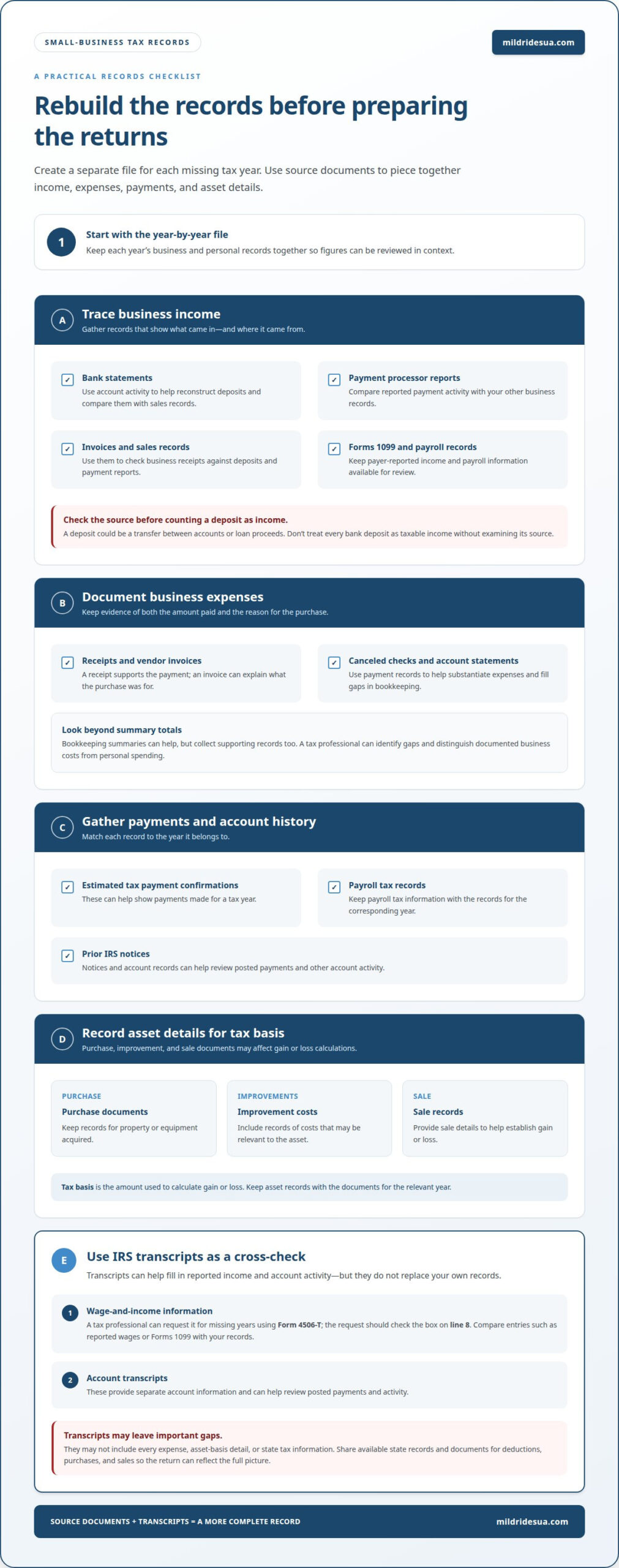
Create a separate records file for each missing tax year. A tax professional can use source documents alongside IRS transcripts to reconstruct income and expenses.
-
Have a Tax Professional Gather Income and Expense Records
Provide the tax professional with business and personal records for each unfiled year. Useful examples include bank statements, payment processor reports, invoices, receipts, payroll records, and Forms 1099. The professional organizes income and expenses by year, then compares deposits with sales records. Don’t treat every bank deposit as taxable income without examining its source, such as transfers between accounts or loan proceeds.
- Collect records that support business expenses, not just totals from a bookkeeping summary. Receipts, vendor invoices, canceled checks, and account statements can help document what the business paid and why. A transaction description, for example, may identify a supplier, while an invoice explains the purchase. Before using amounts on a return, a tax professional can identify gaps and distinguish documented business costs from personal spending.
- Include payment records and asset details for each year. Estimated tax payment confirmations, payroll tax records, and prior notices can help show payments credited to an account. For property or equipment, provide purchase documents, improvement costs, and sale records. These details can establish tax basis, the amount used to calculate gain or loss. IRS transcripts don’t contain every expense, state detail, or tax-basis fact needed for a complete return.
-
Have a Tax Professional Get IRS Wage-and-Income Transcripts
Ask the tax professional to obtain wage-and-income information for the missing years using Form 4506-T. The request should check the box on line 8. The professional can compare transcript entries, such as reported wages or Forms 1099, with your business records and identify missing income sources. IRS account transcripts provide separate account information, so they can help review posted payments and activity.
- Use transcripts as a cross-check, not a replacement for your own records. An IRS wage-and-income transcript may help identify payer-reported income, but it won’t provide every expense or asset-basis detail. A transcript also may not capture state tax information. Give the tax professional available state records and documents for deductions, purchases, and sales so each return reflects the full picture.
- Pay close attention to self-employment income as you reconstruct the records. Self-employed people who don’t file federal income tax returns won’t have that self-employment income reported to the Social Security Administration for retirement or disability benefit credits. Accurate income records therefore matter beyond calculating federal tax. Once the books and transcripts are aligned, a tax professional can prepare returns using documented income, payments, basis, and expenses.
Tax balances, penalties, interest, and resolution options
Separate filing from resolving the balance: first establish what each return shows, then address payment and penalties. State tax agencies handle unfiled returns, penalties, and payment plans separately from the IRS, under their own procedures.
-
Review Filing and Payment Penalties
Review each year’s balance and separate failure-to-file penalties from failure-to-pay penalties. Both can accumulate over time, and together can reach 47.5% of the tax bill. Interest can also add to the amount due. Don’t assume an IRS substitute assessment reflects the deductions or credits available on a complete return. Keep notices and calculations organized by tax year.
- Distinguish an inability to pay from willful failure to file. In the United States, willfully failing to file taxes can result in up to five years in prison. Tax evasion can also result in a fine of up to $100,000, according to the Office of the Law Revision Counsel, U.S. House of Representatives. These are serious potential consequences, not a reason to delay filing accurate past-due returns.
- File past-due returns even if you can’t pay the full balance. Submitting a return doesn’t make an unpaid amount disappear, but it establishes the reported tax and lets you address the account using actual return information. Compare the assessed amount with the completed return for each year. Keep proof of filing and payment records with the matching tax documents.
- Ask about an IRS payment arrangement if the balance exceeds what you can pay at once. The Internal Revenue Service says that if you can’t pay in full immediately, you may qualify for additional time, up to 180 days, to pay in full. Taxpayers who cannot pay their full balance at once may also attempt to arrange a payment plan with the IRS. Review the amount due and available payment capacity before choosing an agreement.
-
Explore Penalty Abatement
Review each penalty separately and determine whether penalty abatement may apply. Taxpayers can request penalty abatement when applicable, but the request should address the penalties assessed and the circumstances relevant to them. Keep notices, filed returns, and supporting records together by year. Don’t treat a possible reduction as a substitute for filing, paying what you can, or addressing interest on the balance.
- Address state balances separately. A federal payment plan doesn’t settle state tax obligations, and a federal return doesn’t resolve state filing requirements. Identify the state agency, missing state returns, assessed penalties, and any available payment-plan process for each state involved. Keep state and federal balances distinct so payments and correspondence go to the correct tax account.
Filing sequence and refund deadlines
Prepare the returns in a deliberate sequence, reviewing each year’s figures before finalizing later years. Filing old returns remains necessary even when a refund deadline has passed.
- Start by listing every unfiled federal tax year and the current filing year. Then organize records and notices by tax year, so income, payments, and assessments match the correct return. If you’re asking, “I haven’t filed taxes in 5 years, what should I do?” begin by establishing which years are missing. Don’t combine several years of information into one estimate; each return needs its own figures and supporting records.
- Have a tax professional prepare the returns in chronological order, starting with the oldest year in scope. Earlier returns can affect figures used in later years, including carryover items. Review each year’s income, deductions, payments, and resulting balance before moving forward. This sequence can help reveal inconsistencies, such as a payment or business asset appearing in one year’s records but not the next.
- Submit each completed return through an appropriate filing method and keep a copy of every return and proof of submission. Sending a return doesn’t mean the IRS has processed it. Track filing status and correspondence by tax year, and distinguish a received return from a processed return. The IRS says accurately completed past-due returns take approximately 6 weeks to process, so allow time before treating an account as updated.
- Review refund eligibility separately from the duty to file. The Internal Revenue Service says taxpayers generally must file within 3 years of a return’s due date to claim refunds of withholding or estimated taxes. The general federal refund claim deadline is the later of three years from filing the original return or two years from paying the tax, subject to a separate lookback limit and statutory exceptions. Apply the relevant deadline to each year.
- Don’t assume an older return cannot be filed because a refund may no longer be available. There’s no time limit associated with filing old tax returns in the United States, but the IRS does not pay refunds for old returns. If you’re still wondering, “I haven’t filed taxes in 5 years, what should I do?”, remember that filing can establish reported income and address a missing return, even when a refund deadline has passed.
- After submission, compare IRS account activity with your copies of the filed returns. If a refund is due, track whether the return is processed and whether the refund claim falls within the applicable deadline. If the IRS account still shows a missing return, keep the submission record and follow up on that tax year. Maintain separate federal and state filing records because federal filing alone doesn’t resolve state obligations.
How can a tax professional file back taxes for the past five years in the U.S.?
A tax professional can turn five missing tax years into a coordinated filing project. Start by defining the years involved, documenting each return, and tracking what happens after submission.
- Provide the professional with the tax years involved, prior returns, and IRS correspondence. Include personal and business details that changed during those years, such as a new business, a sale, or a change in filing status. Those changes can affect how each return is prepared. A clear year-by-year timeline helps identify missing information before drafting begins.
- Agree on a records-gathering plan for each year. The professional can organize income documents, business books, payment records, and expense support into separate files. If bookkeeping for a year is incomplete, identify the gaps rather than treating estimates as verified amounts. For example, sales reports and bank deposits can be reconciled before reporting business income on the return.
- Have the professional determine which federal and state returns are in scope. A federal return doesn’t resolve state filing obligations, so each state connection needs separate attention. Business activity, income sources, and prior notices can help define the work involved. The professional can also distinguish tax-return preparation from a separate response to an IRS notice.
- Review each draft one tax year at a time before filing. Compare the return with source documents, reported income, claimed expenses, payments, and relevant asset transactions. Ask the professional to explain material differences between the draft and available records. This review can catch a misplaced payment or omitted business expense before it affects the filed return.
- Coordinate the filing order with the professional, especially if an earlier year affects later-year figures. Keep final signed or approved copies, submission records, and related correspondence together by year. A submitted return and a processed return are different stages, so track the status of each filing. That record helps organize follow-up and identify which years still need attention.
- Once the returns establish the balances, review the next steps with the professional. A balance may require payment planning, while a notice may need a separate response. Keep those decisions tied to the specific tax year and IRS communication. For coordinated help preparing past-due returns, request professional back-tax filing support.
Mildrid Esua, CPA, PLLC: Back Taxes & IRS Tax Relief
Mildrid Esua, CPA, PLLC helps individuals and small businesses address unfiled returns through Back Taxes & IRS Tax Relief. Turn to the firm when several years of records need reconstruction, an IRS notice requires a response, or filed returns leave balances to resolve.
Support can include tax preparation, bookkeeping, IRS representation, and tax resolution for unfiled returns or tax liens. For business owners, coordinated accounting and tax-advisory support can connect older filings with ongoing financial records. The next step is to discuss which years are unfiled, what notices you’ve received, and whether your priority is completing returns or addressing an assessed balance.
Contact Mildrid Esua, CPA, PLLC to discuss your unfiled tax returns and next steps.
Turn the next step into a steady plan
Unfiled returns can feel like a problem defined by the past, but your next decision can shape what comes after. Rather than letting uncertainty set the pace, make a clear plan to move from unresolved filings toward better-informed tax decisions. Treat this as a transition, not just a stack of overdue paperwork.
If you’re wondering what to do because you haven’t filed taxes in five years, start with a practical step: bring the years, records, and notices to a professional conversation. A focused review can clarify which steps belong together and whether a separate resolution decision is needed. You don’t have to map every consequence before taking that first step.
With a clear path, you can address outstanding tax matters while giving future filing and recordkeeping more deliberate attention. The goal is not just to look backward, but to build a steadier foundation for decisions ahead.
Discuss your next tax steps with Mildrid Esua, CPA, PLLC, and move forward with greater clarity.
Frequently Asked Questions
Which unfiled federal tax returns should I file, and how far back does the IRS require?
Review all missing federal returns, not just the oldest or newest year. The IRS generally expects six years of back returns for a taxpayer to be in good standing, though deviations require IRS management approval. If five years are missing, include those years and the current filing year in your review. A tax professional can assess the filing scope against your account notices and circumstances.
How can a tax professional get wage and income transcripts and records for missing tax years from the IRS?
A tax professional can request wage-and-income information with Form 4506-T, checking the box on line 8. These transcripts can help identify income reported by employers and other payers. They don’t replace business records: invoices, receipts, asset purchase documents, and state details may still be needed. For example, a transcript may show a Form 1099 but not the expenses connected with that income.
What penalties and interest apply for failing to file and pay federal taxes?
Failure-to-file and failure-to-pay penalties can apply when a return is late or a balance remains unpaid, and interest may accrue on amounts due. The total depends on the account and the period involved. Ask a tax professional to review the IRS account by tax year and distinguish assessed tax from penalties and interest. That breakdown clarifies what the balance represents before you consider payment options.
Can I get a tax refund for returns filed more than three years late?
Possibly, depending on when the original return was filed and when the tax was paid. The general federal refund claim deadline is the later of three years from filing the original return or two years from paying the tax, subject to a separate lookback limit and statutory exceptions. Withholding and estimated-tax refunds generally require filing within three years of the return’s due date. Review each year separately.
What should I do if I owe back taxes but cannot afford to pay the IRS?
File the past-due returns even if you can’t pay the full balance, then review payment arrangements with the IRS. If you can’t pay in full immediately, you may qualify for additional time, up to 180 days, according to the Internal Revenue Service. A payment plan may be another option. First establish the balance from filed returns, then consider what payment amount your finances can support.
Can the IRS file a substitute return if I have not filed, and how can a tax professional replace it with my own return?
Yes. The IRS may prepare a substitute return using information available to it, which may leave out deductions, credits, or exemptions you could claim. A tax professional can prepare your own return using income documents and supporting records, then address the substitute assessment with the IRS. Keep the notice and tax-year details together so the professional can connect the filed return with the correct account activity.
Could I face criminal charges, liens, levies, or wage garnishment for not filing taxes?
Willful failure to file can carry criminal consequences, while unpaid assessed taxes may lead to collection actions. In the United States, willfully failing to file can result in up to five years in prison; tax evasion can result in a fine of up to $100,000, according to the Office of the Law Revision Counsel, U.S. House of Representatives. Collection actions may include wage or bank levies and a federal tax lien notice.
Should I hire a CPA, enrolled agent, or tax attorney to file multiple years of back taxes?
Consider hiring a tax professional when records span several years, business income needs reconstruction, or IRS notices require a coordinated response. Focus on whether the professional’s experience fits your needs, such as preparing multiple returns, addressing IRS account issues, or organizing small-business records. Mildrid Esua, CPA, PLLC serves individuals and small businesses in Greensboro and the surrounding local communities, with tax preparation and IRS representation.




Leave a Reply
Your email is safe with us.