

What if the best first step toward resolving back taxes isn’t choosing filing software, but finding out exactly which returns are missing? If you need to file back taxes online NC, that distinction matters: online filing may be available for some prior-year returns, but the options depend on the tax year and filing method. Submitting a return can also clarify whether you owe, so plan for what comes next rather than treating e-filing as a complete resolution plan.
It’s understandable to feel uncertain when records are incomplete or you’re worried that filing could reveal a balance or prompt a collection notice. Start by checking your filing history and gathering the records you do have. This guide explains how to check whether overdue federal and North Carolina returns can be filed online, what information to gather, and what to consider if you can’t pay a balance in full.
You’ll also learn how to identify unfiled years, coordinate federal and state returns, and recognize when professional support may help. If several years, notices, or missing records complicate the process, a tax professional can assist with preparation and help coordinate filing with a broader tax-resolution strategy.
Key Takeaways
- Before you file back taxes online NC, list the years that may be missing and confirm whether each federal and state return can be transmitted electronically.
- Gather income, withholding, and deduction records for each tax year, then verify the required filing method before submitting.
- Filing an overdue return clarifies reported income and any balance, but it doesn’t automatically resolve tax debt.
- If you owe, review appropriate next steps, such as discussing payment arrangements or other resolution options, without assuming you qualify.
- Several unfiled years, incomplete records, complex returns, or agency notices may make CPA support useful for coordinating preparation and resolution.
File Back Taxes Online in NC: Process Limits & Benefits
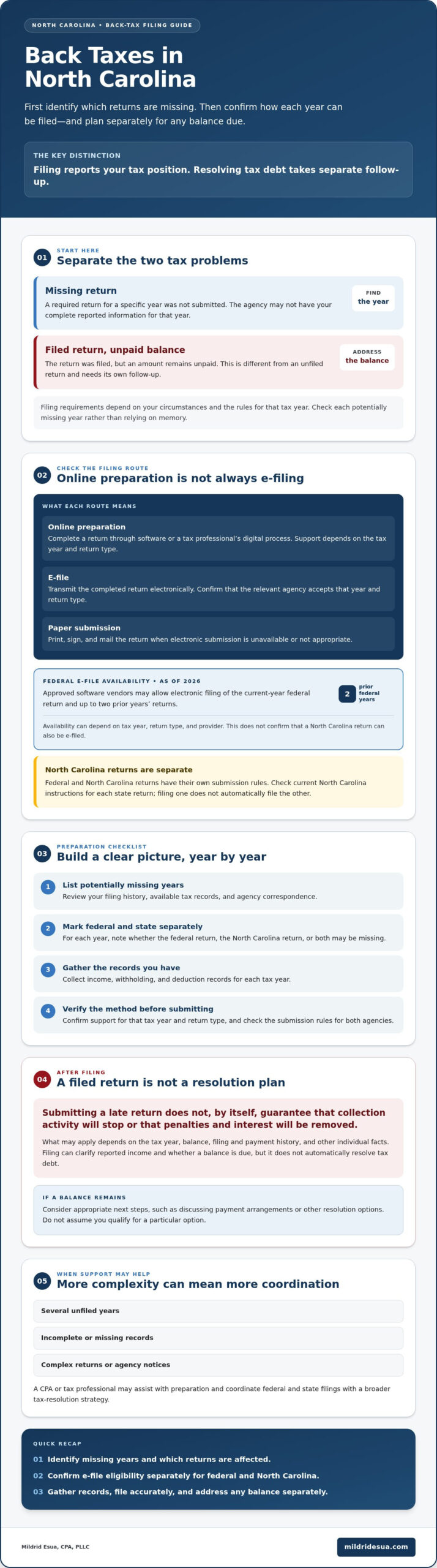
Back taxes are required returns for earlier years that haven’t been filed. If you’re trying to file back taxes online NC, first separate two issues: a missing return and an unpaid balance. A missed filing obligation means the tax agency hasn’t received a required return. An unpaid balance can exist even when a return has already been filed. Whether you were required to file depends on your circumstances and the rules for that specific year, so check each potentially missing year instead of relying on memory.
A tax return reports information used to determine tax owed or a refund due. For a high-level introduction to what a tax return is, see this overview. Federal and North Carolina returns are separate filings, each with its own requirements. Filing one doesn’t automatically complete the other, and reported information may need to be considered across both returns.
For a general overview of filing overdue returns, watch this video:
When does an unfiled return become a back-tax concern?
A return becomes a concern when you were required to file for that tax year and didn’t submit it. That differs from filing a return that calculates a balance you haven’t paid: in the first case, the agency may not have your complete reported information; in the second, the return is filed but an amount remains unpaid. Filing can establish the reported facts for a year, but it doesn’t erase the distinction or determine every consequence.
Filing requirements can change with your income, filing status, income sources, and year-specific rules. Make a list of years you may have missed, then compare it with available tax records and agency correspondence. Note separately whether you think the federal return, the North Carolina return, or both are missing. This is a more reliable starting point than guessing from memory.
Does filing late online stop penalties or collection?
No. Submitting a late return doesn’t, by itself, guarantee that collection activity will stop or that penalties and interest will be removed. What may apply depends on the tax year, the balance, your filing and payment history, and other individual facts. Filing accurately can clarify your reported tax position, but it isn’t a substitute for addressing an amount due or responding to agency notices.
Filing reports your tax position; resolving tax debt requires separate follow-up. Once you know which returns are missing and whether they show a balance, you can assess what to do next. If multiple years, incomplete records, or notices make that difficult, CPA support with unfiled returns and tax resolution may help coordinate preparation with a broader plan.
Can You E-File Back Taxes Online in North Carolina?
Yes, sometimes, but “prepare online” and “e-file” aren’t the same thing. Tax software may let you enter information for an older return even if it can’t transmit that tax year electronically. Federal and North Carolina returns also have separate submission rules, so online access for one doesn’t confirm that the other can be e-filed.
As of 2026, approved software vendors may allow electronic filing of the current-year federal return and up to two prior years’ returns. Availability can depend on the tax year, return type, and provider. Before choosing how to file back taxes online NC, review the IRS guidelines on filing past-due returns and check the North Carolina Department of Revenue’s current instructions for each state return.
| Filing route | What it means | What to verify |
|---|---|---|
| Online preparation | Complete a return using software or a tax professional’s digital process. | Whether the provider supports that tax year and return type. |
| Eligible e-file | Transmit the completed return electronically to the relevant tax agency. | That both the federal and North Carolina returns are accepted for that year. |
| Paper submission | Print, sign, and mail a return when electronic submission isn’t available or appropriate. | Correct year-specific forms, mailing address, and instructions. |
Which prior-year returns may be filed electronically?
There isn’t one answer for every overdue return. Confirm IRS acceptance for each federal tax year, then check North Carolina’s prior-year filing options and eligibility separately. Ask the software provider which years it supports for preparation and which it can actually transmit. Before entering information, confirm that the provider supports the specific return type and tax year you need; a general “prior-year” feature doesn’t guarantee e-filing is available.
When might paper filing or professional help be necessary?
Paper submission may be an option when a return can’t be e-filed. Use the instructions for that specific tax year, confirm the mailing address before sending documents, and keep a complete copy of what you submit along with proof of mailing or delivery.
Several missing years, agency notices, business income, or uncertainty about your filing history can make the right filing route harder to assess. A tax professional can help review the returns and available submission methods. Mildrid Esua, CPA, PLLC assists with tax preparation and unfiled returns. Readers considering back-tax preparation and resolution support can explore whether professional guidance fits their circumstances.
How to Prepare and File Federal and NC Back Taxes Step by Step
A year-by-year process helps you identify what’s missing, rebuild records, and submit each return through an accepted method. Keep federal and North Carolina documents distinct so you can track what each return needs and whether it has been filed.
- 1. List missing years. Compare your records with available IRS account information and notices you’ve received. For each year, record whether a federal return, a North Carolina return, or both may be missing. Verify the list before preparing anything.
- 2. Gather records by year. Collect W-2s, 1099s, prior returns, and business records, along with documentation for deductions that may apply. Keep income and withholding information organized by tax year, and set aside records relevant to the North Carolina return, such as state withholding information.
- 3. Reconstruct gaps and prepare each return. If a form is missing, ask the employer or payer for a copy, or check whether an official account record or transcript can help. IRS transcripts may provide useful information, but they may not replace source documents or include every detail needed for an accurate return. Review dependents, business activity, and other complex items carefully.
- 4. Verify the submission method. Check whether the specific federal return and its North Carolina counterpart are eligible for e-file through your chosen provider. If electronic submission isn’t available, confirm the correct paper forms and year-specific mailing instructions before sending the returns.
- 5. Submit and retain proof. Track federal and state submission status separately. Save a complete copy of each return, e-file acceptance or rejection notices, mailing receipts, and related correspondence.
Prepare each missing year under the tax rules that apply to that year, not by copying a current return. Forms, thresholds, and other provisions can differ by year, so verify the applicable instructions before finalizing calculations. If you file back taxes online NC, confirm that the state return was submitted and accepted separately from the federal one.
Gather documents for each missing tax year
Organize paperwork in clearly labeled folders for each year, whether digital or physical. Include income forms, withholding records, prior returns, business books, and documentation for deductions you may need. For missing forms, contact the employer or payer and review available official account records. If income sources, dependents, or business activity make the facts difficult to reconstruct, use a careful year-specific review rather than estimating.
Submit and keep evidence of federal and NC filing
Filing the federal return doesn’t complete the North Carolina filing. Keep separate submission confirmations and copies, then respond to follow-up correspondence from either agency. If a filed return shows an NC balance, review the NC Department of Revenue payment options for official information. For help understanding resolution steps, see the Expert Tax Resolution in North Carolina guide.
What If You Owe After Filing Back Taxes in NC?
An overdue return can bring your tax picture into focus, including a balance due. That can feel uncomfortable, but leaving required returns unfiled keeps reported income and any potential amount owed uncertain. Filing is a step toward clarity, not an automatic agreement to a payment plan or a guarantee that collection activity will stop.
After you file back taxes online NC, review each completed return and any IRS or North Carolina notice carefully. Check the tax year, income, withholding, calculations, and amount shown against your records. If an agency sends a notice, note its response date and follow its instructions. Don’t assume that filing alone pauses collection, removes penalties or interest, or resolves a disagreement.
What should you do if a return shows a balance?
Start by checking how the balance was calculated and whether the return matches your records. If something appears incorrect, gather supporting documents and determine how to respond before the notice deadline. If the amount is accurate but you can’t pay in full, review current agency rules and available options. The North Carolina Department of Revenue may offer installment agreements in some cases; availability and terms depend on individual circumstances. Confirm details directly with the agency.
Federal and state balances are separate matters. A payment or arrangement with one agency doesn’t automatically address an amount owed to the other. Keep records of payments, agency communications, and any arrangement you pursue.
When is CPA or tax-resolution support worth considering?
Professional guidance may be useful when you’re dealing with several unfiled years, incomplete records, IRS notices, a tax lien, or a disputed amount. These situations can require more than return preparation: they call for a careful review of the facts and coordination between filing and follow-up. Mildrid Esua, CPA, PLLC assists individuals and small businesses with back taxes, unfiled returns, tax-resolution services, and IRS representation.
If you owe North Carolina taxes, consult the NC Department of Revenue’s information on past-due taxes for current collection and payment resources. For a longer-term perspective after addressing overdue filings, explore strategic tax planning for NC entrepreneurs.
Several years, notices, or unresolved questions can make the next steps difficult to coordinate alone. Explore back-tax and tax-resolution support from Mildrid Esua, CPA, PLLC to discuss preparation and potential resolution steps for your circumstances.
Choose a Back-Tax Filing Path and Get Support in North Carolina
The right filing approach depends on more than whether a website lets you start a return. Consider how many years are missing, how complete your records are, how complex your income is, and whether an agency has contacted you. These details can help you decide whether software is a reasonable fit or whether professional preparation and tax-resolution guidance may be more appropriate.
A practical checklist for selecting your filing method
- One or a few straightforward returns, complete records: Self-preparation may work if you’ve confirmed that the software supports the specific tax year and both the federal and North Carolina return types you need.
- Several years or incomplete records: Consider professional preparation if you need to coordinate multiple returns or reconstruct missing information.
- Notices, balances, liens, or disputes: Tax-resolution guidance may help you assess the filing work alongside agency correspondence and possible next steps. Don’t assume that preparing or submitting a return resolves those issues by itself.
If you plan to file back taxes online NC, verify each return’s eligibility before entering information. Online preparation isn’t the same as electronic submission, and state and federal options may differ. For straightforward returns that meet a provider’s requirements, software can be practical. If business income, multiple years, unclear records, or agency notices complicate the picture, a CPA review can help you decide how to approach preparation and follow-up.
Prepare for a conversation with a North Carolina CPA
Bring a list of potentially missing years, copies of prior returns, tax notices, income records, and questions about what you filed or still need to submit. If some documents are missing, note what you have already requested and what remains unavailable. An organized list gives the discussion a useful starting point.
Ask how the federal and North Carolina returns will be handled, whether each tax year can be e-filed, and how you’ll confirm that both submissions were received. If a return shows a balance, ask what separate follow-up may be needed. Clear expectations can help you understand the work involved without assuming a particular filing or resolution outcome.
Mildrid Esua, CPA, PLLC assists with tax preparation, back taxes, and unfiled returns. The firm serves communities including Greensboro, High Point, Burlington, Kernersville, Jamestown, Oak Ridge, Summerfield, and Winston-Salem. If several years or agency correspondence make the next steps difficult to coordinate, you can discuss your back-tax filing and resolution options and bring the records and questions you’ve gathered.
Take the Next Step Toward Filing with Clarity
Before you file back taxes online NC, identify every potentially missing year and confirm whether both the federal and North Carolina returns can be submitted electronically. Online preparation doesn’t always mean e-filing is available. Organize records by year, verify each submission separately, and keep proof of filing.
If a return shows a balance, remember that filing clarifies your tax position but doesn’t automatically resolve the debt. Review agency notices and response dates, then consider what follow-up may apply to your circumstances. A clear filing record gives you a stronger foundation for making informed decisions about next steps.
Mildrid Esua, CPA, PLLC assists with back taxes and unfiled returns and provides IRS representation and tax-resolution services. The firm serves Greensboro, High Point, Burlington, Kernersville, Jamestown, Oak Ridge, Summerfield, and Winston-Salem. If several years, missing records, or agency notices make filing difficult to coordinate, discuss your back-tax filing and resolution options.
Frequently Asked Questions
Can I file back taxes online in North Carolina?
Often, you can prepare an overdue return online, but whether you can submit it electronically depends on the tax year, return type, and provider. Federal and North Carolina e-file options may differ, so verify each return before starting. If electronic filing isn’t available, paper filing may be necessary. Keep a complete copy and proof of submission for both returns, and track their acceptance separately.
Is it too late to file a prior-year tax return online?
Not necessarily, but online preparation and electronic filing are different. A provider may let you prepare an older return even if it can’t transmit that year electronically. Check current IRS and North Carolina Department of Revenue rules, then use the accepted submission method. If you have several missing years, organize records and returns by year so you can verify each one instead of assuming the same filing option applies to all.
How many years of back taxes should I file?
The number depends on your filing history, circumstances, and any IRS or North Carolina notices. Don’t assume filing only your most recent return resolves every outstanding requirement. First, identify all years that may be unfiled, then confirm what’s required with the relevant agency or a qualified tax professional. Keep prior returns and notices together; they can help clarify which years need review and support accurate preparation.
What happens if I file back taxes and cannot pay the balance?
Filing and paying are separate steps. A return can clarify the reported tax, but it doesn’t automatically establish a payment arrangement or stop collection activity. Review how the balance was calculated and read any agency notice for its response date and instructions. Then check current payment or resolution options with the relevant agency. A CPA or tax-resolution professional can help assess potential next steps, but eligibility and outcomes depend on your circumstances.
Do I need to file a separate North Carolina return for back taxes?
If you had a North Carolina filing requirement for a particular year, you may need to submit a state return separately from your federal return. Requirements and submission methods can vary by tax year and taxpayer facts. Confirm the state filing obligation and accepted method with the North Carolina Department of Revenue. Don’t assume that filing a federal return automatically submits a North Carolina return or confirms that state filing obligations are met.
Can a CPA help me file several years of back taxes?
Yes. A CPA can help review your filing history, organize available records, prepare overdue returns, and explain how filing differs from resolving a balance. Professional support may be useful if several years are missing, documents are incomplete, or agencies have sent notices. Mildrid Esua, CPA, PLLC assists with back taxes and unfiled returns for individuals and small businesses in Greensboro, High Point, Burlington, Kernersville, Jamestown, Oak Ridge, Summerfield, Winston-Salem, and nearby communities.
Should I file back taxes before responding to an IRS notice?
Read the notice first and note the tax year, requested information, and response date. Filing an overdue return may be part of addressing the issue, but it may not answer every question or resolve the matter. Don’t ignore a deadline or assume filing closes the case. If the notice concerns a proposed change, balance, or collection action, consider qualified professional guidance to understand the response needed and coordinate it with any unfiled return.




Leave a Reply
Your email is safe with us.