

Resolving back taxes starts with understanding what you owe and which options fit your finances, not simply asking the IRS for relief. If you’re worried about a lien, levy, or the effect of tax debt on your business, learning how to negotiate with the IRS on back taxes can help you take a more deliberate next step.
Forms, deadlines, and collection notices can feel overwhelming, especially when you’re also trying to protect your finances. The right next step depends on your complete tax picture: whether required returns are filed, what you can realistically pay, and which IRS options may apply. Relief isn’t automatic, and no single program works for everyone.
This guide explains how to review your position, compare options such as payment plans and an Offer in Compromise, and decide when professional representation may help. It also covers financial disclosures, collection actions, and ongoing tax planning. With a clearer view of the process, you can respond to notices with a plan rather than reacting to each one as it arrives.
Key Takeaways
- Before negotiating with the IRS on back taxes, review your filing status, finances, and potential resolution paths.
- Compare payment arrangements with an Offer in Compromise to understand which IRS option may fit your circumstances.
- A representative authorized through Form 2848 may communicate with the IRS on your behalf.
- Financial disclosures and the Collection Statute Expiration Date can affect your resolution strategy.
- Small business owners in the Piedmont Triad may need to address federal and North Carolina tax issues separately.
Understanding Your Standing: The Foundation of IRS Negotiation
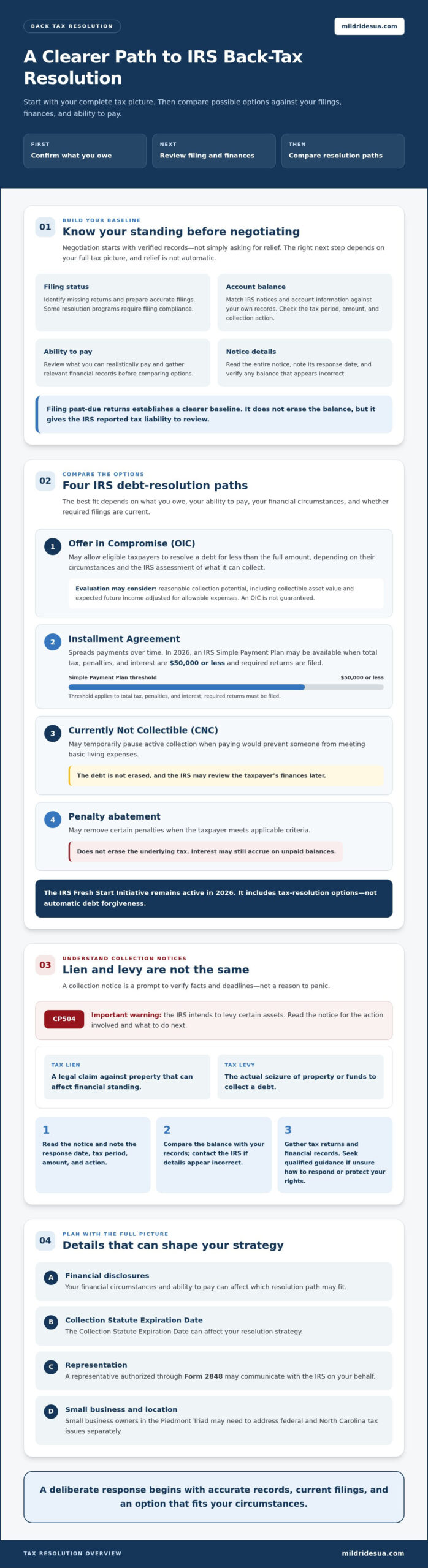
Negotiating with the IRS means reviewing what you owe, confirming your filing and financial status, and identifying a resolution option that fits your circumstances. It is not simply a request for leniency. Start by matching IRS notices and account information against your own records, then check which returns are missing and what you can afford to pay. This gives you a more reliable basis for deciding how to negotiate with the IRS on back taxes.
The IRS Fresh Start Initiative remains active in 2026 and includes several tax-resolution options, not automatic debt forgiveness. For example, a Simple Payment Plan may be available when total tax, penalties, and interest are $50,000 or less and required returns are filed. Other options, including the Offer in Compromise (OIC) program, have separate eligibility rules and require careful evaluation.
For a general overview of tax-debt negotiation, watch this video:
The Critical Role of Tax Compliance
Unfiled returns can limit access to resolution options because the IRS needs a complete picture of your reported tax liability before evaluating some arrangements. Filing past-due returns establishes that baseline. It does not erase a balance, but it replaces missing information with figures that can be reviewed and addressed. First identify missing returns and prepare accurate filings, then assess which resolution paths may be available. The IRS can discuss an account before every return is filed, but specific programs may require you to be current with filing requirements.
Identifying IRS Collection Notices
A CP504 is an important warning that the IRS intends to levy certain assets. The notice explains the action involved and what to do next. Distinguish a tax lien, a legal claim against property that can affect your financial standing, from a tax levy, the actual seizure of property or funds to collect a debt. Treat a notice as a prompt to verify the facts and deadlines, not a reason to panic.
- Read the entire notice and note the response date, tax period, amount, and stated collection action.
- Compare the balance with your records. If something appears incorrect, contact the IRS using the details on the notice.
- Gather tax returns and financial records. Seek qualified guidance if you’re unsure how to respond or protect your rights.
Addressing filing requirements and understanding the notice creates a firmer foundation for resolving the balance. Ignoring either can leave you responding to collection activity without a clear view of your options.
The Four Pillars of IRS Debt Negotiation Programs
There is no single route for resolving tax debt. The right option depends on what you owe, your ability to pay, your financial circumstances, and whether required filings are current. Learning how to negotiate with the IRS on back taxes means comparing the available options against your situation, not assuming the most widely discussed program is automatically the best fit.
- Offer in Compromise (OIC): May allow eligible taxpayers to resolve a debt for less than the full amount, depending on their circumstances and the IRS’s assessment of what it can collect.
- Installment Agreement: Spreads payments over time. In 2026, the IRS’s Simple Payment Plan may be available when total tax, penalties, and interest are $50,000 or less and required returns are filed.
- Currently Not Collectible (CNC): May temporarily pause active collection when paying would prevent someone from meeting basic living expenses. The debt is not erased, and the IRS may review the taxpayer’s finances later.
- Penalty abatement: May remove certain penalties when the taxpayer meets the applicable criteria. It does not erase the underlying tax, and interest may still accrue on unpaid balances.
Qualifying for an Offer in Compromise
An OIC is not a guaranteed “pennies on the dollar” outcome. The IRS generally evaluates reasonable collection potential (RCP), which considers the value of assets it could collect and expected future income, adjusted for allowable expenses. As the legal definition of an offer in compromise explains, an offer may involve doubt about liability, collectibility, or effective tax administration. Missing returns, incomplete or inconsistent financial disclosures, or an offer that does not reflect the IRS’s analysis can weaken an application.
Before applying, confirm that your filings are current and gather accurate records of income, assets, expenses, and liabilities. The goal is to support your proposal with a complete financial picture, not simply to offer the smallest possible amount.
Strategic Use of Installment Agreements
A Simple Payment Plan, previously called a streamlined installment agreement, may suit taxpayers who meet the IRS’s eligibility limits. A Partial Payment Installment Agreement may be considered when a taxpayer cannot pay the full balance before the collection period ends. The IRS reviews financial information to determine an appropriate amount. Approval and terms depend on the individual case.
To support a realistic monthly payment request, document necessary living expenses and separate them from discretionary spending. An approved agreement can establish a predictable payment structure and may prevent levy action while you meet its terms. Do not assume collection activity has stopped until the IRS confirms your status. If you’re unsure how to compare these options, IRS tax resolution guidance can help you evaluate the available paths.
CPA Representation vs. DIY Negotiation: A Strategic Comparison
You can contact the IRS and pursue a resolution yourself. The challenge is coordinating accurate returns, financial disclosures, deadlines, and program requirements while collection pressure is affecting your decisions. A CPA can organize the facts, explain tradeoffs, and help you communicate consistently. Representation does not guarantee a particular result, but it can add structure to a process that might otherwise feel reactive.
Review the IRS’s official IRS options for tax debt alongside your own circumstances. The right choice depends on the account and your ability to meet the requirements, not on a promise that one approach works for everyone.
How a CPA Can Help Build a Strategy
A CPA can review past filings and supporting records for missed or incorrectly reported deductions, credits, or business expenses that may lawfully affect a tax liability. The goal is accurate reporting, not manufacturing a lower balance. With Form 2848, you can authorize an eligible representative to receive confidential tax information and represent you before the IRS for the matters specified. The representative can communicate within the scope of that authorization, while you remain responsible for providing complete, truthful records.
Consider a hypothetical Greensboro business owner who receives notice of a potential tax lien. A representative might first reconcile filed returns and account transcripts, then review the notice, deadlines, and possible resolution paths before responding. This is an illustration, not a claim about a real client or a guaranteed outcome. When considering a professional fee, weigh the time involved, the complexity of the case, and the value of informed compliance. Do not assume representation will produce a specific amount of savings.
The Risks of DIY IRS Negotiation
Handling your own case can be reasonable when the facts are straightforward and you understand the process. Risk increases when records are incomplete, returns are unfiled, or multiple tax periods overlap with business finances. A casual estimate or inconsistent explanation can complicate review, while missing information may delay consideration or lead the IRS to reject a request. Accurate records matter more than persuasive wording.
Be cautious of tax-relief marketers who guarantee dramatic outcomes or pressure you to act before reviewing your records. A local CPA is not automatically the right choice just because they are nearby. Check relevant experience, understand the engagement terms, and ask who will handle IRS communications. For individuals and small businesses in Greensboro, High Point, Burlington, Kernersville, Jamestown, Oak Ridge, Summerfield, and Winston-Salem, a CPA familiar with tax resolution and IRS representation can provide a local point of contact. To learn about the firm’s services, visit IRS representation and tax resolution.
Ultimately, how to negotiate with the IRS on back taxes starts with a reliable account of what happened and a resolution strategy you can sustain. Choose between handling the case yourself and seeking representation based on its complexity, your confidence with the documentation, and the consequences of a missed step.
A Methodical Timeline for Negotiating Back Taxes
A strong resolution strategy follows a sequence. Submitting a proposal before checking filings, account records, and deadlines can create avoidable delays. Use this framework for how to negotiate with the IRS on back taxes to move from financial disclosure to a sustainable agreement with a clearer understanding of each decision.
- Build a complete financial disclosure. Individuals and self-employed taxpayers may use Form 433-A; businesses may use Form 433-B. Gather records that support income, expenses, assets, and debts.
- Review the Collection Statute Expiration Date (CSED). Check assessment dates and any events that may affect the collection period.
- Select a resolution path. Compare options against your financial capacity, eligibility, and long-term obligations.
- Submit the proposal and monitor the review. Keep copies, track IRS correspondence, and respond to requests by their deadlines. Review times vary, so do not assume silence means approval or that collection activity has stopped.
- Confirm the terms and stay compliant. Understand payment dates and other conditions, then keep required returns filed and current tax obligations on track.
Mastering the Financial Disclosure
Financial forms require documented figures, not rough estimates. Reconcile each source of income and support expenses with records such as statements, bills, and business bookkeeping. The IRS uses national and local expense standards when evaluating some living costs, while treatment can depend on the expense category and individual facts. An expense above a standard may require additional explanation and documentation. Identify assets accurately, too. Do not assume property is automatically protected from collection; exemptions and collection decisions depend on applicable rules and circumstances.
The Importance of the CSED
In general, the IRS has 10 years from the date a tax is assessed to collect it, but the CSED is specific to the account and can be affected by events that pause or extend the collection period. Certain resolution requests and other legal circumstances may suspend the clock. Review the IRS account history before choosing a strategy, and do not rely on a rough estimate of when a debt will expire.
If a balance is approaching its CSED, it may be worth evaluating whether a proposed action could affect the timeline. That does not mean ignoring notices or assuming the debt will disappear. Compare potential timing effects with current collection risks and your ability to pay before deciding. A qualified tax-resolution professional can help interpret the account history and sequence next steps.
After an agreement is approved, protect the result by following its terms and staying current with filing and payment responsibilities. For help organizing disclosures and evaluating your resolution timeline, explore professional IRS tax resolution support.
Local Tax Resolution in Greensboro and Winston-Salem
Federal tax debt and North Carolina tax debt involve different agencies, accounts, and resolution processes. An IRS payment arrangement does not automatically resolve a balance with the North Carolina Department of Revenue, and addressing state debt alone will not settle a federal liability. Identify which agency sent each notice, the tax periods involved, and the response deadlines. Keeping the obligations separate helps you avoid treating them as one problem.
For Piedmont Triad business owners, the records needed to understand a tax balance can vary by business. A manufacturer in High Point may need to organize payroll records and cash-flow information while addressing overdue payroll taxes. A small business in Greensboro may need to reconcile bookkeeping and tax filings before its owner can assess a federal or state balance. In either case, accurate records and a sequenced plan are essential.
Piedmont Triad Business Tax Nuances
Strong bookkeeping helps a business understand what was reported, identify missing information, and prepare for discussions with the relevant tax authority. Local representation can provide a point of contact for small businesses, but the resolution strategy still needs to reflect the facts of the account. For a broader overview of tax resolution in North Carolina, consider how the process fits your circumstances.
Mildrid Esua, CPA, PLLC works with individuals and small businesses in the Piedmont Triad on tax resolution and IRS representation, including matters involving back taxes, unfiled returns, and liens. As you determine how to negotiate with the IRS on back taxes, keep the federal plan distinct from any steps needed to address North Carolina obligations.
From Crisis to Continuous Engagement
Resolving an existing balance is one part of restoring financial stability. After addressing past-due filings and agreeing on a manageable path, ongoing tax planning, preparation, and bookkeeping can help business owners monitor obligations and reduce the risk of another back-tax issue. Consider what tax planning needs may be relevant to your business as you work to stay current.
If you’re in Greensboro, High Point, Burlington, Kernersville, Jamestown, Oak Ridge, Summerfield, or Winston-Salem, you can use the firm’s website to inquire about a CPA consultation and discuss your tax-resolution needs. Request a CPA consultation to begin a conversation about the records, notices, and next steps involved in your situation.
Build a More Stable Path Forward
Resolving back taxes starts with a clear picture of your filings, finances, and IRS notices. From there, compare options such as a payment plan, an Offer in Compromise, or other relief based on your circumstances. Accurate disclosures and a sensible sequence can turn a stressful problem into a structured resolution process.
Knowing how to negotiate with the IRS on back taxes also means looking beyond the immediate balance. Once a resolution is in place, staying current with filings and payments, supported by ongoing tax planning and bookkeeping, can help protect your financial stability.
Mildrid Esua, CPA, PLLC provides IRS representation and works with small businesses on tax disputes, serving Greensboro, High Point, and other Piedmont Triad communities. If you’re ready to discuss your situation, contact the firm about IRS tax resolution.
Frequently Asked Questions
Can the IRS really settle for less than what I owe?
Yes. The IRS may accept less than the full balance through an Offer in Compromise (OIC) if you qualify, but approval is not guaranteed. The IRS assesses your financial information, including income, expenses, and assets, to determine what it can reasonably collect. An OIC is not right for everyone, and incomplete filings or unsupported financial details can hinder an application. Compare eligibility and alternatives before deciding whether to apply.
What happens if I ignore the IRS notices about my back taxes?
Ignoring notices can leave you less time to review the balance, correct an error, or respond before the IRS escalates collection. Depending on your case and the notices sent, collection actions may include a federal tax lien or a levy on certain assets. Read each notice carefully, note its deadlines, and verify the tax periods and amounts. If you’re unsure how to respond, seek qualified guidance rather than leaving the notice unanswered.
How long does the tax negotiation process typically take?
There is no single timeline for tax resolution. Timing depends on the option pursued, whether required returns and financial disclosures are complete, the complexity of your account, and IRS review. A payment-plan request may follow a different path from an Offer in Compromise, which requires detailed financial evaluation. Respond promptly to requests and keep copies of submissions. Avoid relying on a promised turnaround time; ask what factors could affect your specific case.
Will negotiating with the IRS stop a pending tax lien or levy?
Not necessarily. Contacting the IRS or submitting a proposal does not automatically stop a lien or levy. The effect depends on the collection stage, the relief requested, and the IRS’s decision. Read the notice for deadlines and appeal rights. If the IRS proposes a levy or files a lien, act promptly to understand your options; some formal appeal requests have strict time limits. Do not assume collection is paused until you receive confirmation.
What is the difference between an Offer in Compromise and an Installment Agreement?
An Offer in Compromise may let an eligible taxpayer resolve a debt for less than the full amount, based on the IRS’s review of the person’s circumstances and ability to pay. An Installment Agreement allows payments over time, generally toward the balance owed. The right option depends on your finances, eligibility, and ability to meet the terms. Neither is an automatic reduction or a guaranteed way to stop every collection action.
Do I need a lawyer or a CPA to negotiate with the IRS?
You can deal with the IRS yourself, but a qualified representative may help organize records, assess available options, and communicate with the agency. Attorneys, CPAs, and enrolled agents may be authorized to represent taxpayers before the IRS, subject to applicable rules and the scope of authorization. For complex back taxes, liens, or unfiled returns, consider the representative’s experience and fit. Mildrid Esua, CPA, PLLC provides tax resolution and IRS representation for individuals and businesses in Greensboro, High Point, and the Piedmont Triad.
Can I negotiate my North Carolina state taxes at the same time as my federal taxes?
You can work on both tax debts at the same time, but they involve separate agencies and processes. An agreement with the IRS does not automatically resolve a balance with the North Carolina Department of Revenue, and a state arrangement does not settle federal debt. List each agency, tax period, notice, amount, and deadline, then plan the responses together. Small businesses in Greensboro, High Point, and nearby Piedmont Triad communities may need to coordinate records across both accounts.
What if I can’t afford to pay anything to the IRS right now?
If paying would prevent you from meeting basic living expenses, ask whether Currently Not Collectible status may fit your circumstances. The IRS reviews financial information before making that determination. CNC status is generally temporary, does not erase the debt, and does not mean you can ignore notices or filing obligations. Gather evidence of income, necessary expenses, assets, and debts, then review your options. A payment plan or another resolution path may be appropriate if your finances change.




Leave a Reply
Your email is safe with us.