

Payroll tax problems can turn a routine filing issue into a broader IRS concern. A Greensboro CPA for IRS problems can help identify what remains unresolved, organize tax records, and develop a response to unfiled returns, tax debt, audits, or payroll filings. The right next step depends on the notices, filings, and account history involved.
If you’re concerned that an IRS issue could affect your business or personal finances, that concern is understandable. Paid tax preparers should have a Preparer Tax Identification Number (PTIN) to enter on a federal tax return, according to the Internal Revenue Service. This article explains how tax preparation and planning, audit representation, tax debt resolution, and payroll support can address different parts of the problem.
You’ll also learn what information can clarify the issue, how payroll tax concerns fit into a broader resolution strategy, and when ongoing accounting support can help you make informed decisions. The goal is a clear, organized response and a steadier path forward.
Key Takeaways
- Organize tax records and review bookkeeping, estimated payments, payroll, and business structure to make tax preparation and planning more coordinated.
- For an IRS audit, understand what the notice requests and gather records that directly support the items under review.
- Address tax debt by clarifying what returns or balances remain unresolved, then assessing possible resolution paths, including a payment plan when an Offer in Compromise isn’t an option.
- Treat payroll tax issues as part of the wider tax picture: review filing and payment records to identify where the process broke down and what needs attention.
- Match the support you seek to the problem, whether it involves unfiled returns, tax liens, audit representation, back taxes, or ongoing small-business accounting.
Tax preparation, planning, and consulting
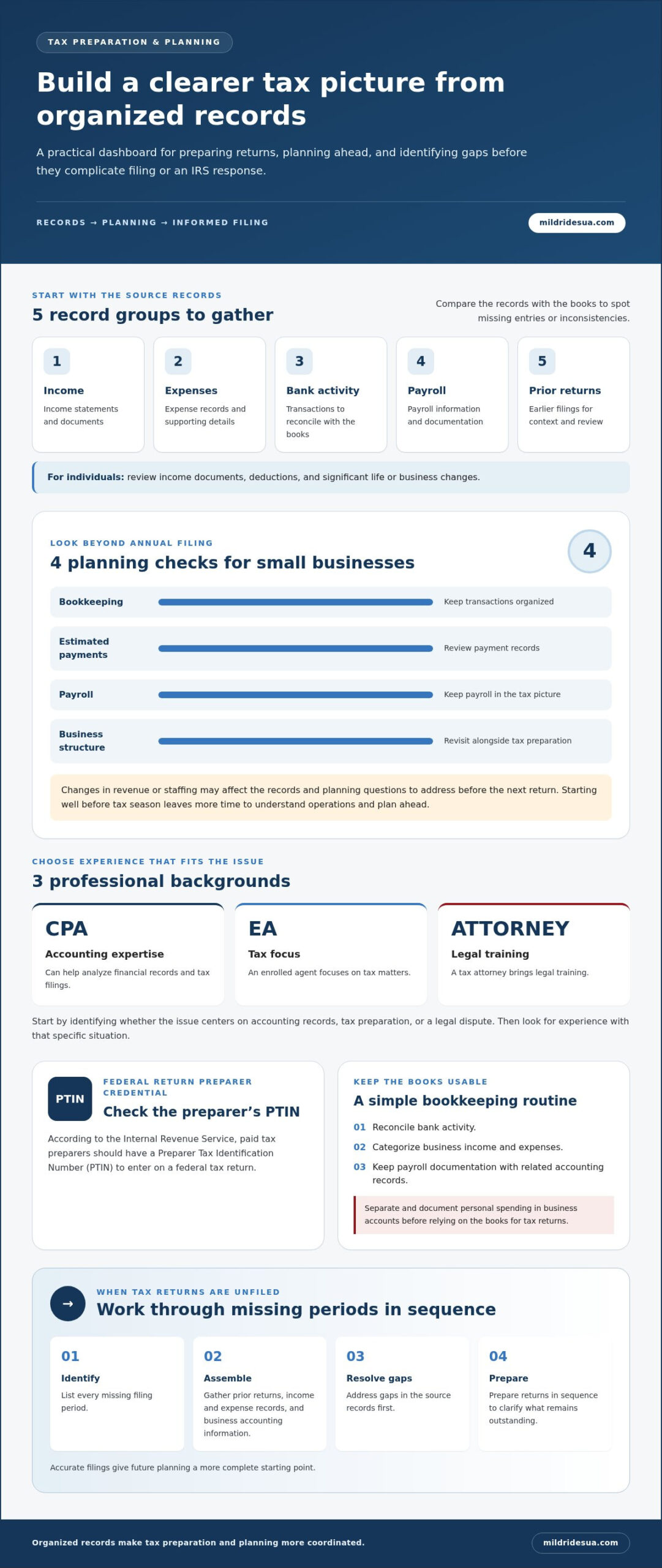
Tax preparation starts with complete records, not a last-minute search for receipts. Before preparing a return, Greensboro business owners can gather income statements, expense records, bank activity, payroll information, and prior returns. Comparing these records with the books can reveal missing entries or inconsistencies that need attention. Individuals may also need to review income documents, deductions, and significant life or business changes.
CPAs, enrolled agents, and tax attorneys bring different professional backgrounds to IRS disputes. A CPA’s accounting expertise can help analyze financial records and tax filings; an enrolled agent focuses on tax matters; a tax attorney brings legal training. To compare them, identify whether your issue centers on accounting records, tax preparation, or a legal dispute, then look for experience with that specific situation.
Planning adds a forward-looking layer to annual filing. Small-business owners can review bookkeeping, estimated tax payments, payroll, and business structure alongside tax preparation. Changes in revenue or staffing, for example, may affect the records and planning questions to address before the next return. Starting the conversation well before tax season leaves more time to understand business operations and plan ahead.
Bookkeeping supports this process by organizing transactions into usable records. Reconcile bank activity, categorize business income and expenses, and keep payroll documentation with the related accounting records. If a business account includes personal spending, separate and document those items before relying on the books for tax returns. A bookkeeping review can also reveal missing records that could complicate filing or an IRS response.
Preparing unfiled tax returns starts with identifying every missing filing period and assembling the records for each return. Gather prior returns, income documents, expense records, and business accounting information. Prepare the returns in sequence, resolving gaps in the source records first. Accurate filings help clarify what remains outstanding and give future planning a more complete starting point.
For federal returns, paid tax preparers should have a Preparer Tax Identification Number (PTIN) to enter on the return, according to the Internal Revenue Service. Include this credential in your initial screening, then ask about direct experience with your issue. For example, ask how the professional would approach a small-business return with unfiled periods and incomplete bookkeeping.
To find a Greensboro CPA for IRS problems with relevant experience, read reviews for recurring details about communication, follow-through, and the type of tax matter handled. Then ask specific questions about your situation, such as audit support, missing returns, or payroll records. Compare the answers with your needs, and clarify how preparation, bookkeeping, and consulting fit together before moving forward.
IRS audit representation
An IRS audit response should address the notice, the requested records, and the tax items under review. A clear process helps individuals and businesses organize evidence and keep decisions focused on the issue.
Audit Representation and Appeals
Representation can include reviewing the IRS notice, organizing relevant records, preparing responses, and communicating about the items under examination. If an audit questions a business expense, for example, match invoices and payment records to the accounting entry instead of sending unrelated paperwork. If the examination leads to a proposed adjustment, review the IRS explanation and supporting documents before deciding whether to accept the result or pursue an appeal.
Ask how the representative will track correspondence, explain possible outcomes, and keep you informed. Each IRS question should be connected to specific evidence, with any gaps identified. Appeals involve challenging an IRS determination, so assemble the relevant records and clearly explain the reasons for disagreement.
Credentials and Representation Authorization
To verify a CPA’s credentials, review the professional’s name and license status through the appropriate North Carolina licensing authority. Then ask about experience with the type of audit involved, such as individual income, business expenses, or payroll records. A practical discussion should clarify how the CPA would organize the requested documents and explain the issues in your case.
Representation also requires clarity about authorization. Ask what written authorization the IRS needs, what matters it covers, and whether it allows the representative to receive or discuss your tax information. Read it before signing and make sure its scope matches the audit or appeal you want help handling.
Notice and Audit Response Deadlines
Use the response date printed on the specific IRS notice as your working deadline. The timing and requested action can vary by notice, so identify both before gathering records. Missing a response date may limit your opportunity to provide relevant information or challenge a proposed adjustment through the process described in the notice.
Start by saving the notice, noting its date, and listing every requested document. If records are stored in different places, such as bookkeeping software, bank files, and email, gather them into one organized set. Keep copies of everything you submit and record when and how you sent it.
Before responding, compare each requested item with the records that support it. An IRS representation review can help organize your response, clarify which documents are relevant to the examination, and prepare for follow-up questions. Keep communications focused, retain copies of submissions, and address each notice instruction rather than sending an unstructured bundle of records.
IRS tax debt relief and resolution
Resolving IRS debt starts with understanding the balance, filing history, and correspondence behind it. A structured review helps distinguish missing returns from unpaid tax and identify practical next steps.
IRS Problem Resolution
IRS problem resolution can address unpaid balances, unfiled returns, tax liens, and questions about how an account reached its current status. Start by collecting IRS notices, filed returns, payment records, and supporting documents. Compare them with the stated balance and filing history. For example, a payment missing from the account record requires different follow-up from a return that was never filed.
Consider how different tax periods connect. A business owner may need to review personal filings alongside business records, especially when income or payroll information affects both. Bookkeeping support can help locate transaction records, but keep copies of documents and correspondence together. An organized file gives resolution discussions a specific starting point.
Tax Debt Relief Options
The available path depends on the balance, filing status, ability to pay, and supporting financial information. A resolution review can assess whether an Offer in Compromise is an option. Taxpayers who don’t qualify may consider a payment plan. Choose an approach after carefully reviewing the account, rather than assuming one resolution method fits every case.
Addressing IRS tax problems promptly can help taxpayers manage the resolution process. The IRS may take several years to catch up with a taxpayer who owes taxes, so an unresolved balance can remain a concern as records and notices accumulate. Keep current correspondence organized, and make sure any proposed approach accounts for both existing debt and ongoing tax responsibilities.
Local Tax Resolution Resources
Are free or low-cost tax resolution resources available in Greensboro? A no-cost first step is to review the IRS notice, gather your tax records, and compare the balance with filed returns and payment history. This preparation can clarify the issue before you decide whether professional assistance is needed.
If you explore community assistance, consider whether the program handles your type of issue, such as unfiled business returns or tax debt. Basic tax filing help may not address negotiations over an existing balance or a lien. For professional support, the work depends on the unresolved filings, available records, and resolution questions that need attention.
Steps After an IRS Notice
After receiving an IRS notice in North Carolina, read it fully and identify its response date, requested action, tax period, and balance. Keep the original and make a working copy. Gather related returns, payment records, and correspondence, then compare each item with the notice. Follow the notice’s response instructions and retain a copy of what you send.
If information appears incorrect, document the specific discrepancy and gather records that support your position. If the notice concerns a balance you can’t pay at once, review the account and potential resolution routes instead of ignoring the letter. Track follow-up correspondence in the same file so you can consider each new IRS communication alongside the earlier notice and your response.
Payroll tax problems
Payroll tax problems can start with a missed filing, an incorrect payroll entry, or a payment that doesn’t match business records. A proactive review compares payroll registers, filed returns, payment confirmations, and IRS notices. This helps pinpoint whether the issue involves reporting, payment, employee records, or several connected records.
Start with the affected tax periods and build a record set for each. Include payroll reports, bank statements, filed payroll returns, payment confirmations, and correspondence. Compare reported wages and tax amounts with the payroll system and accounting ledger. If a filed return reports different totals from the payroll register, for example, identify the entries causing the difference before preparing a response.
Separate a current processing problem from an older balance. A current discrepancy may require correcting payroll records and ensuring future filings use accurate information. An existing IRS balance needs its own review, including notices received, payments credited, and periods involved. Treating both as one issue can obscure what needs immediate attention and what calls for resolution planning.
A focused review can follow these steps:
- Match each IRS notice to its tax period and requested action.
- Reconcile payroll registers against filed returns and accounting records.
- Locate payment confirmations and compare them with the amounts recorded.
- List missing or inconsistent documents before preparing a response.
For a small business, payroll and bookkeeping records should support one another. If wages appear in the payroll system but not the ledger, the discrepancy can affect financial statements and tax reporting. If a bank payment lacks a clear payroll reference, identifying its purpose may take extra review. Consistent account categories and well-kept records make these comparisons more useful.
Once the source of the problem is clear, organize corrective work by tax period and issue. A business with a reporting mismatch and an unpaid balance, for example, should track each separately. Keep copies of amended or corrected filings, payment records, and IRS correspondence together. Use the notice’s instructions to identify the next response step, and retain evidence of anything submitted.
Payroll support is especially useful when an owner needs to connect payroll records with tax filings and accounting. A coordinated review can clarify which amounts were reported, which payments were recorded, and where the records diverge. The practical takeaway is simple: reconcile the documents first, then address each identified filing or payment issue with a focused response.
What IRS problems can a Greensboro CPA help resolve?
A Greensboro CPA can help organize tax records, prepare missing returns, respond to IRS questions, and assess tax debt. The work depends on the notice, filing history, and records involved. Start by listing each unresolved issue and its tax period, then separate filing needs from balance disputes and payroll concerns.
Unfiled tax returns: A CPA can help prepare returns using income records, expense documents, and prior filings. For a small business, bookkeeping records may need review before return figures can be assembled. Note which tax periods are missing, collect the relevant documents, and address each return systematically. This creates a clearer picture of outstanding filing work.
IRS audits and notices: Support can include reviewing the notice, matching its questions to records, and preparing a focused response. If an IRS question concerns a business expense, for example, gather the invoice, payment record, and accounting entry. Keep the notice and response materials together so you can understand later correspondence in context.
Tax debt and liens: Resolution work can address back taxes and tax liens by reviewing account records, filing status, and payment history. A balance review should distinguish amounts due from periods with missing returns or disputed entries. If an Offer in Compromise isn’t available, a payment plan may be considered. The right choice depends on the taxpayer’s circumstances and financial information.
Payroll tax problems: A CPA can help compare payroll records, filed returns, payment confirmations, and accounting entries. If wages in the payroll system don’t match figures on a return, identify the entries behind the difference. Organize documents by tax period and distinguish a reporting discrepancy from an unpaid balance. This helps direct attention to the underlying issue.
Planning to prevent recurring problems: Once immediate IRS matters are organized, small businesses can use bookkeeping and tax planning to improve future records. Regular reconciliation, for example, can bring payroll entries and bank activity into alignment before tax preparation. Reviewing estimated payments and business records also helps owners spot questions earlier, rather than discovering gaps while responding to an IRS notice.
Before seeking help, prepare a concise issue summary: list notices, affected filing periods, missing returns, known balances, and payroll discrepancies. This gives a professional a practical starting point and helps distinguish a single filing task from connected resolution needs. If your situation involves back taxes, unfiled returns, or a lien, discuss IRS tax resolution options with Mildrid Esua, CPA, PLLC.
Mildrid Esua, CPA, PLLC: Tax Planning & Tax Preparation,Bookkeeping IRS Representation small business accounting Tax resolution unfiled tax, tax lien , payroll servies
Mildrid Esua, CPA, PLLC helps individuals and small businesses address tax filings and IRS concerns with coordinated accounting support. If you’re dealing with unfiled returns, back taxes, a tax lien, an audit, or payroll tax problems, the firm’s IRS representation and tax resolution services can help organize the issue and guide next steps.
Support also includes tax planning and preparation, bookkeeping, and small-business accounting. These services can connect current IRS matters with the records and planning needed for future filings. Resolving a missing return, for example, may involve preparing it while reviewing related bookkeeping records. Small-business owners can also use ongoing accounting and tax advisory support to incorporate tax decisions into a broader business plan.
If you’re ready to discuss your tax situation, contact Mildrid Esua, CPA, PLLC.
Move from uncertainty to an informed next step
The most useful next step is to turn an IRS concern into a defined work plan. Identify what needs attention first, which records are available, and which decisions depend on resolving the issue. That focus helps you use professional guidance strategically instead of letting each new task dictate your priorities.
A Greensboro CPA for IRS problems can connect the immediate concern with the financial picture behind it. For a small business, that means considering how tax resolution relates to ongoing accounting, preparation, and planning. Mildrid Esua, CPA, PLLC provides tax resolution services and small-business accounting, alongside tax planning and preparation.
Before reaching out, prepare a brief outline of the issue and the outcome you’re seeking. Note the IRS communication involved, any unresolved filing or payment questions, and what you need help deciding. A clear starting point keeps the conversation focused on practical next steps.
Contact Mildrid Esua, CPA, PLLC to discuss your tax situation and begin shaping a considered path forward.
Frequently Asked Questions
IRS Tax Problems in Greensboro NC?
If you’re facing an IRS issue in Greensboro, identify what the notice or account concerns and what decision you need to make. A Greensboro CPA for IRS problems can help assess a disputed tax balance, missing filing, or payroll records that don’t align. Prepare the relevant correspondence and records, then focus the discussion on the unresolved issue and the outcome you’re seeking.
What is Tax Relief?
Tax relief is assistance in addressing tax debt or other unresolved tax issues. It can involve reviewing the account and considering resolution routes, such as a payment plan or an Offer in Compromise. These options work differently: a payment plan addresses repayment over time, while an Offer in Compromise is evaluated as a separate proposal. Relief means pursuing an appropriate resolution, not assuming a balance will be erased.
Which Greensboro CPAs specialize in IRS tax problems and tax resolution?
Mildrid Esua, CPA, PLLC provides IRS representation and tax resolution services for matters involving back taxes, tax liens, and unfiled returns. For Greensboro taxpayers, the key question is whether the support fits the issue: a missing return requires preparation, while a lien or disputed balance calls for resolution work. The firm also serves small businesses with accounting and tax advisory services.
Can a Greensboro CPA negotiate an IRS payment plan, offer in compromise, or penalty abatement?
A CPA providing IRS representation can help assess a payment plan or Offer in Compromise and prepare the related resolution request. A payment plan may be an option when a taxpayer doesn’t qualify for an Offer in Compromise. Penalty abatement is a separate request that requires review of the circumstances and supporting records. Gather notices, tax returns, payment history, and relevant documents for that assessment.




Leave a Reply
Your email is safe with us.