

An IRS tax levy is the legal seizure of wages, bank funds, Social Security benefits, or other property to satisfy a tax debt. Unlike a tax lien, which claims property as security, a levy takes assets. If you’re deciding how to deal with an IRS tax levy in NC, note that the Internal Revenue Service gives taxpayers 30 days from the date of a Notice of Intent to Levy and Notice of Your Right to a Hearing to request a Collection Due Process hearing or an Equivalent Hearing.
An IRS tax levy can disrupt your income and make everyday expenses harder to manage. To deal with one, identify what the IRS is taking, check the notices and deadlines, and respond promptly. Don’t assume that proposing a payment plan will automatically stop an active levy.
This article explains the difference between a lien and a levy, when wages or Social Security benefits may be affected, and how payment arrangements and levy-release requests work. You’ll also find practical steps for responding while addressing the tax debt and protecting your financial stability.
Key Takeaways
- Identify whether the IRS has filed a lien or issued a levy, since one claims property as security while the other seizes assets.
- Read every IRS notice promptly and note the response options and deadlines it gives.
- Don’t assume that proposing a payment plan will automatically stop an active wage levy; confirm the levy’s status with the IRS.
- Review whether hardship, payment, or another qualifying circumstance may support a levy-release request.
- Get help organizing tax records and evaluating resolution options when a levy threatens your income or business cash flow.
Can the IRS levy my wages without providing prior notice?
The IRS usually sends collection notices before levying wages, though rare exceptions exist. Read each notice promptly and note its deadlines.
-
Verify the Levy Notice and Tax Balance
Match the notice to your tax records, including the tax year, balance, and type of tax. To verify the amount, contact the IRS at 800-829-1040 or review your IRS account information. If the balance appears wrong, raise the specific discrepancy with the IRS rather than ignoring the notice.
A levy can reach wages and, in some cases, Social Security benefits or other property. Check which tax periods and assets the notice identifies, then keep your notices, account records, and payment confirmations together. These records can help you explain a discrepancy between the IRS balance and your own.
-
Review Notice Deadlines and Collection Timeline
Read the notice of intent and identify its date, response deadline, and hearing instructions. According to the Internal Revenue Service, a taxpayer has 30 days from the date of an IRS Notice of Intent to Levy and Notice of Your Right to a Hearing to request a Collection Due Process hearing or an Equivalent Hearing.
Most levies follow billing notices and a final opportunity to respond, though rare jeopardy levies can proceed without the usual notice process. The IRS generally keeps a levy in place until the debt is paid, the levy is released, or the collection period expires. That period usually runs 10 years from the tax assessment date, but collection events can affect its calculation.
If you’re learning how to deal with an IRS tax levy in NC, first distinguish a levy notice from a lien notice. A levy can take property; a lien asserts a claim against it.
-
Pursue a Collection Due Process Appeal
Submit Form 12153 or an equivalent written request within the applicable deadline, and explain the collection issue or resolution you seek. A timely Collection Due Process request generally pauses the levy while the hearing is pending. The hearing is informal and may take place by telephone; the IRS may ask for Form 433, a Collection Information Statement.
If you miss the deadline, you may still have up to one year to request an Equivalent Hearing, but the request does not require the IRS to stop collection. A tax attorney, CPA, or enrolled agent experienced with IRS collections can help assess your records, deadlines, and options. Start by matching your request to the notice and the issue you’re challenging.
You can contact the IRS Taxpayer Advocate Service for taxpayer advocate assistance. Low Income Taxpayer Clinics may offer free or low-cost help to eligible taxpayers. If you can’t meet basic living expenses, request Currently Not Collectible status and document your income, expenses, and assets. The debt remains, so keep filing required returns and addressing new tax bills.
Installment agreements and levy release
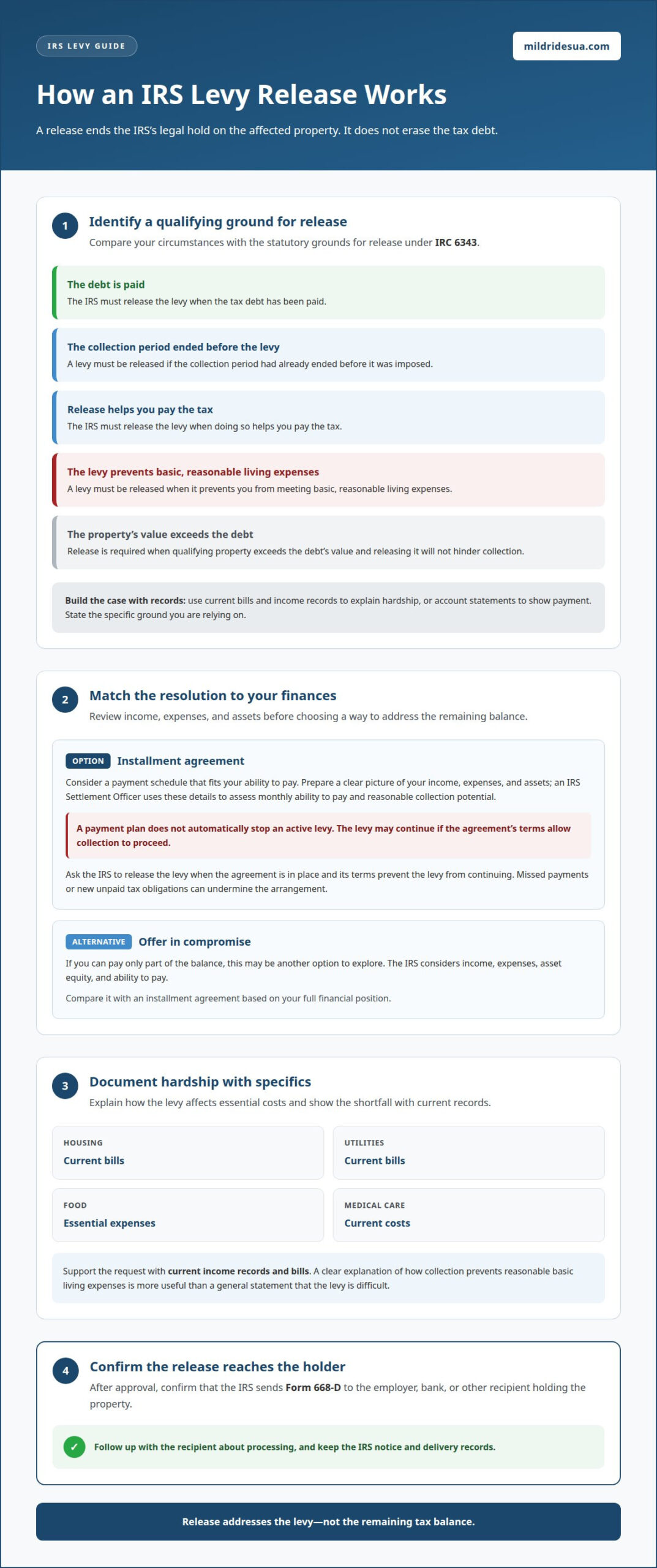
A levy release ends the IRS’s legal hold on the affected property, but it doesn’t erase the tax debt. Review the grounds for release, payment terms, and delivery process in that order.
-
Check the Conditions and Grounds for Release
Compare your situation with the statutory release grounds under IRC 6343. The IRS must release a levy when the tax debt is paid, the collection period ended before the levy, or releasing it helps you pay the tax. Release is also required when the levy prevents basic, reasonable living expenses or when qualifying property exceeds the debt’s value and release won’t hinder collection.
Identify the ground for your request and gather supporting records before contacting the IRS. For example, use current bills and income records to explain hardship, or account statements to show payment. A release addresses the levy, not the remaining balance, so also consider how you’ll resolve the debt.
-
Consider an Installment Agreement
Consider whether an installment agreement fits your ability to pay, and request terms that address the active levy. The agreement sets a payment schedule, but the levy may continue if the terms allow collection to proceed. Ask the IRS to release the levy when the agreement is in place and its terms prevent the levy from continuing.
Prepare a clear picture of your income, expenses, and assets. An IRS Settlement Officer uses these details to assess your monthly ability to pay and reasonable collection potential. Propose a sustainable amount: missed payments or new unpaid tax obligations can undermine the arrangement and leave collection issues unresolved.
If you can pay only part of the balance, an offer in compromise may be another option to explore. The IRS considers income, expenses, asset equity, and ability to pay. Compare it with an installment agreement based on your financial position, rather than choosing a payment amount before reviewing the full picture.
-
Address Economic Hardship
Document how the levy affects essential expenses such as housing, utilities, food, and medical care. Use current income records and bills to show the shortfall, then request a release on hardship grounds. A clear explanation of how collection prevents you from meeting reasonable basic living expenses is more useful than a general statement that the levy is difficult.
After approval, confirm that the IRS sends Form 668-D to the employer, bank, or other recipient holding the property. This form notifies the recipient that the levy has been released. Follow up with the recipient about processing, and keep the IRS notice and delivery records with your account documents.
A levy release doesn’t return funds already sent to the IRS or cancel the unpaid balance. If you don’t arrange a resolution, the IRS may issue another levy. If the IRS denies your release request, you may appeal the decision before or after the levy affects wages, a bank account, or other property.
If I enter a payment plan, will that stop an ongoing levy?
No. A payment proposal and an active levy are separate collection matters. While arranging a sustainable resolution, confirm the levy’s status directly with the IRS.
- Confirm the plan’s status. A proposed installment agreement alone doesn’t tell your employer to stop withholding wages. Ask the IRS whether it has approved the agreement and issued a levy release. Don’t assume deductions have ended until your employer receives instructions from the IRS.
Record the agreement terms, when you submitted your request, and any IRS response. If a bank levy is involved, ask the bank what funds it is holding and whether it has received release instructions. This helps you distinguish a pending request from an approved arrangement.
- Choose a payment option that fits your finances. The Internal Revenue Service says short-term payment plans may run for 180 days or less. For a longer resolution, an installment agreement can spread payments over time. Assess income, necessary expenses, and other obligations before proposing an amount you can maintain.
After the IRS approves a payment plan, ask for the levy to be released and confirm what notice must reach your employer or bank. Approval doesn’t mean the recipient has received release instructions. Keep copies of IRS correspondence and follow up with the recipient if withholding or a hold continues.
- Assess whether an offer in compromise fits. The IRS may settle tax debt for less than the full amount owed. When reviewing an offer, it considers income, expenses, asset equity, and ability to pay. This option may suit someone who can pay only part of the debt before the collection period ends.
Organize your financial records before pursuing an offer, and compare its requirements with those of a payment agreement. Submitting an offer doesn’t release a levy. Ask the IRS about the levy separately and continue responding to collection notices while it reviews your proposal.
- Document hardship and protect your next steps. If levy deductions leave you unable to meet basic, reasonable living expenses, prepare current records of income, housing costs, utilities, and other essential expenses. Request a release on hardship grounds and explain the specific shortfall. If you can’t pay while meeting necessary expenses, ask about Currently Not Collectible status.
A release doesn’t erase the tax debt or automatically return funds already sent to the IRS. Keep required returns current, monitor IRS notices, and account for possible tax refunds in your financial planning. If the IRS denies your request, review its reason and the available appeal options before deciding how to respond next.
Can the IRS levy my Social Security benefits?
Yes. The IRS can levy eligible Social Security benefits and other assets, but the rules vary by payment type. Identify the affected income or property, then act on the notice and any collection deadline.
A North Carolina tax balance or court judgment is separate from an IRS debt and may involve a different collection action. Check which authority issued each notice: an IRS levy concerns federal tax collection.
- Check which Social Security payment is affected. The Internal Revenue Service says its Federal Payment Levy Program generally levies eligible Social Security benefits at 15%. Supplemental Security Income is among the federal payments excluded from that program, so distinguish SSI from other Social Security benefits in your records.
Compare the benefit notice and bank statement with the federal payment description. If you believe the payment was misidentified or the levy creates hardship, contact the IRS promptly and explain the specific issue. A payment plan or levy-release request may address collection, but neither takes effect without IRS action.
- Ask your bank about a bank account levy. A bank receiving an IRS levy must hold affected funds for 21 days before sending them to the IRS if the issue remains unresolved. Use that period to contact the IRS, identify protected or wrongly levied funds, and provide supporting records.
Ask the bank when it received the levy and which funds it placed on hold. A bank levy targets funds held at that time; the IRS must refile to seize funds again. Keep account statements and correspondence, since the timing and source of deposits may matter if you dispute the seizure.
- Distinguish wage levies from ordinary garnishment. An IRS wage levy generally continues with each paycheck until the IRS tells the employer to stop. Contact the IRS about a release or resolution, and give your employer any IRS release notice. A proposed payment agreement alone doesn’t end withholding.
Federal law lists property exempt from IRS levy in 26 U.S.C. § 6334. Review whether the asset or payment fits an exemption, and raise the precise category with the IRS. A tax refund or other federal payment may face different treatment from wages, so identify the payment source before making a request.
- Act quickly if funds have already been transferred. A levy release doesn’t automatically return money already sent to the IRS. You may file a claim for the return of levied proceeds and appeal an IRS denial. Keep the levy notice, bank records, benefit statements, and proof of hardship together to support your request.
A federal tax lien and a levy have different effects: a lien claims property as security for unpaid taxes, while a levy seizes assets to satisfy the debt. Identify which notice you received before requesting relief. Resolving a lien and releasing seized funds are separate steps.
Difference between a tax lien and a levy
Distinguish the two before responding: a federal tax lien asserts a claim, while a levy takes property. Your notice helps identify which collection action needs attention.
- Identify whether the IRS is asserting a claim or taking assets. Under IRC §6321, a federal tax lien claims a taxpayer’s property as security for unpaid taxes. Under IRC §6331, a levy seizes property to satisfy the tax debt. A lien does not itself transfer money from your bank account or wages; a levy can reach those assets.
Read the IRS notice and identify the action it describes. A lien concerns the government’s claim against property; a levy concerns property being collected. A lien notice doesn’t mean your paycheck or bank account has already been seized.
- Match the collection action to the affected property. A lien can affect the government’s claim to property you own, while a levy may take funds from a bank account or payments from an employer. The IRS may also levy property you partly own with others, including business income, bank accounts, or rental income.
List the assets and income named in the notice, then compare them with your records. If a bank or employer received levy instructions, ask that institution which property or payments are affected. If you received only a lien notice, focus on resolving the federal tax debt and understanding the claim.
- Check the notice type before choosing a response. A notice of intent to levy signals a proposed collection action and may include hearing rights. A lien and a levy have different effects, so requesting the release of seized funds is not the same as addressing a lien. Keep each IRS notice with the tax period and account records it identifies.
For a levy, consider whether payment, an installment agreement, hardship, or an appeal supports a release request. For a lien, address the tax balance and ask the IRS about resolving its claim. Don’t assume that resolving one automatically removes the other.
- Choose your next step based on the problem. If the IRS has taken wages or bank funds, focus first on the levy’s impact and any time-sensitive notice. If the issue is a lien, determine how the claim affects property and pursue a plan for the tax debt. This distinction helps direct your records, request, and communication to the right collection issue.
For help evaluating a lien, levy, and potential resolution together, request IRS tax resolution assistance based on the notices and account details you have.
Mildrid Esua, CPA, PLLC: Tax Planning & Tax Preparation,Bookkeeping IRS Representation small business accounting Tax resolution unfiled tax, tax lien , payroll servies
Mildrid Esua, CPA, PLLC can help you assess IRS notices, outstanding returns, and tax debt when a levy affects your income or business finances. Its IRS Representation & Tax Resolution services address back taxes, unfiled returns, and tax liens, helping you evaluate a practical response and coordinate next steps with the IRS.
For small-business owners, Accounting, Bookkeeping, Payroll services can help organize financial records relevant to payment discussions and ongoing tax obligations. Consider getting support when you need help understanding collection options, preparing a response, or managing several tax issues at once.
Contact Mildrid Esua, CPA, PLLC to discuss your IRS tax concerns.
Take the Next Step Toward Financial Stability
If you’re deciding how to deal with an IRS tax levy in NC, turn the information you’ve gathered into a coordinated resolution plan. Consider how your response affects household cash flow, business obligations, and your ability to stay current with future taxes. A short-term reaction may ease immediate pressure, but a lasting plan should also address what led to the unpaid balance.
Set aside your notices, account records, and questions before discussing your situation. A clear summary of what the levy affects, what you can realistically pay, and what needs urgent attention can make the conversation more focused. If the tax issue involves a small business, consider how personal and business finances intersect so your decisions support stability beyond the immediate collection matter.
Mildrid Esua, CPA, PLLC can help you consider a path forward through IRS representation and tax resolution services. Contact Mildrid Esua, CPA, PLLC to discuss your tax situation and identify the next practical step. A measured response can help you move from uncertainty toward a more deliberate financial plan.
Frequently Asked Questions
What Is an IRS Tax Levy?
An IRS tax levy is a legal action that takes property to satisfy unpaid federal taxes. The IRS may collect from wages, bank funds, or eligible federal payments. If you receive a levy notice, identify the affected assets and the tax periods listed. Compare the stated balance with your records, then respond to the specific collection action rather than treating every IRS notice as a seizure.
What is the difference between an IRS levy and a tax lien?
An IRS levy takes property, while a tax lien asserts a claim against property as security for unpaid taxes. A lien may concern the government’s claim to property you own, while a levy can remove funds from a bank account. Check the notice’s wording and what action has already occurred. A lien notice and a levy-release request address different collection problems, even when they relate to the same tax debt.
Can the IRS seize my home?
The IRS may seize a primary residence, but it generally must obtain court approval first under IRC §6334(e). That makes a home seizure different from a bank levy or wage levy. If an IRS notice concerns your residence, preserve the notice and any related property records, then promptly address the collection action. A request involving a home should clearly identify the property and the tax debt involved.
Does an IRS levy affect my credit score or public record?
An IRS levy notice is a collection document, so don’t assume it tells you whether a credit report or public record has changed. First distinguish a levy from a tax lien, then review the specific record you’re concerned about. Keep IRS notices and any lien filing information. If you find an entry you believe is inaccurate, compare its details with your tax account and the documents you received.
How long does it take for the IRS to levy after sending the final notice?
There isn’t a fixed number of days between a final notice and an actual levy in every case. The Internal Revenue Service gives taxpayers 30 days from the date of its Notice of Intent to Levy and Notice of Your Right to a Hearing to request a Collection Due Process hearing or Equivalent Hearing. Review the notice date immediately; a rare jeopardy levy may follow a different process.
How much of my paycheck can the IRS garnish in a wage levy?
The amount depends on the portion of wages exempt from levy, which the IRS determines using rules in Publication 1494. Don’t apply an ordinary creditor garnishment limit to an IRS wage levy. Review the wage levy paperwork and your pay details, then use the IRS exemption rules to understand the amount left available for collection. An IRS wage levy can continue across paychecks until the IRS instructs your employer to stop.
What Other Types of IRS Tax Resolution Options Are There?
Options may include an installment agreement, an offer in compromise, Currently Not Collectible status, or a Collection Due Process appeal. An installment agreement spreads payments; an offer in compromise may settle eligible tax debt for less than the full balance. Currently Not Collectible status may fit when you can’t afford payments. Compare income, expenses, assets, filing status, and appeal deadlines before choosing a resolution.
What is an IRS tax levy and how is it different from an IRS tax lien?
A levy takes property, while a lien is the IRS’s claim securing unpaid federal tax debt. For example, a lien concerns the government’s claim against property, while a levy can seize funds in a bank account. Check whether your notice describes a claim, a proposed collection action, or property already taken. This distinction helps you decide whether to address the debt, challenge a levy, or seek a release.




Leave a Reply
Your email is safe with us.