


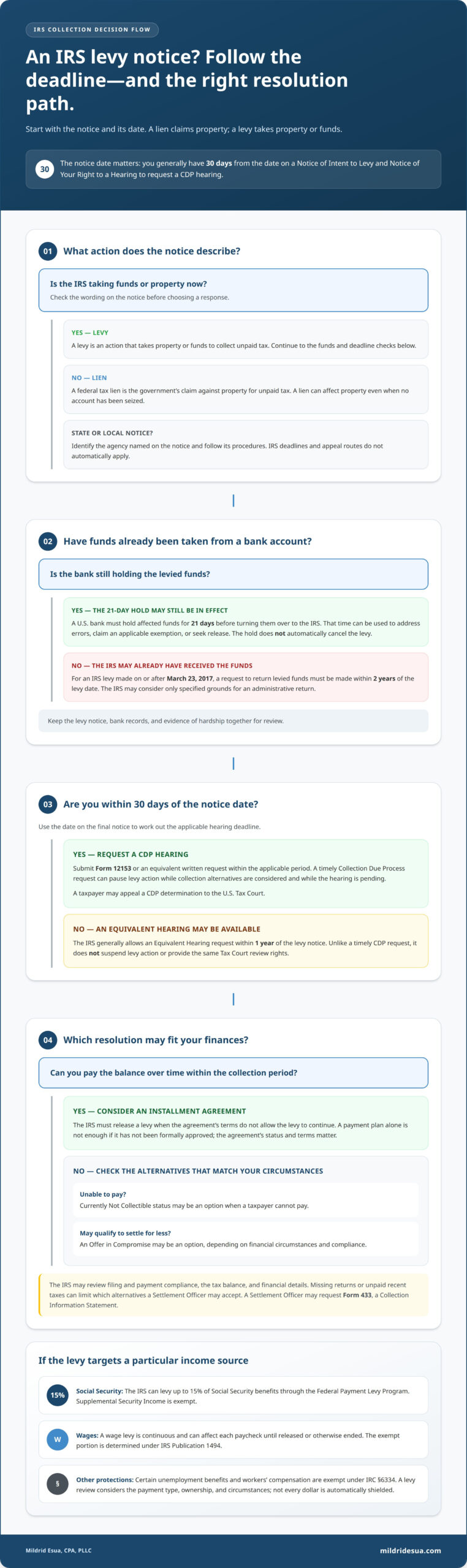
A tax lien and a tax levy are not the same threat. To stop a tax levy before it takes money from your wages or bank account, a timely request for a Collection Due Process hearing can pause levy action while you discuss alternatives with the IRS. According to the Internal Revenue Service, you have 30 days from the date on a Notice of Intent to Levy and Notice of Your Right to a Hearing to request that hearing.
It’s understandable to treat an IRS collection notice as an immediate demand to pay in full. But the right response depends on what the notice says, whether the IRS has already taken property, and which resolution options fit your finances. A lien is a claim against property for unpaid taxes; a levy is an action that takes property or funds.
This guide explains how to seek a levy release, when an installment agreement or Offer in Compromise may help, and how a tax levy differs from a lien. It also explains how a tax professional can review the notice, your filing and payment status, and your financial circumstances to develop a resolution strategy.
Key Takeaways
- Learn how a levy can affect Social Security benefits and what options may apply to funds already taken.
- Understand why the notice date matters when considering a hearing to challenge collection action.
- See how financial hardship may affect a request to have a levy released.
- Explore when payment arrangements or an Offer in Compromise may fit a tax resolution strategy.
- Distinguish a federal tax lien from a levy so you can identify the IRS action you’re facing.
Can the IRS levy my Social Security benefits?
Yes. According to the Internal Revenue Service, the IRS can levy up to 15% of Social Security benefits through the Federal Payment Levy Program (FPLP). The program applies to certain federal payments, so the type of benefit matters. Supplemental Security Income is among the payments exempt from IRS levy. A benefit’s name and source help distinguish protected income from payments the IRS may reach.
A levy on Social Security is different from a bank account levy. For a bank levy, a bank in the United States must hold affected funds for 21 days before turning them over to the IRS, according to the Internal Revenue Service. That hold period gives time to address errors, claim an applicable exemption, or seek release. It does not automatically cancel the levy.
Wage levies work differently again. An IRS wage levy is continuous under IRC §6331(e), meaning it can affect each paycheck until released or otherwise ended. Your employer receives the levy notice and withholds the amount required under the applicable rules. IRS Publication 1494 explains how the exempt portion of wages is determined. A taxpayer who is merely making payments without an approved formal arrangement may still face wage levies.
Some property and income receive protection. Supplemental Security Income is exempt, and certain unemployment benefits and workers’ compensation are exempt under IRC §6334. Wage exemptions depend on the rules in Publication 1494. These protections do not mean every dollar in a bank account or every federal payment is automatically shielded. A levy review examines the payment type, ownership, and circumstances supporting a release request.
If the IRS has already received levied funds, a return request may still be possible. According to the Internal Revenue Service, for an IRS levy made on or after March 23, 2017, a request to return levied funds must be made within 2 years of the levy date. The IRS may consider only specified grounds for an administrative return. Keep the levy notice, bank records, and evidence of hardship together for review.
A federal tax lien is not a levy. A lien establishes the government’s claim against property for unpaid tax debt; a levy takes property or funds to collect it. A lien can affect property even when no account has been seized. Identifying the notice you received helps determine whether the immediate issue is a recorded claim or active collection.
For a state or local tax levy, identify the agency named on the notice and follow its procedures. IRS deadlines and appeal routes do not automatically apply to state or local collections.
For no-cost assistance, a taxpayer can use the IRS collection hearing process directly, generally by submitting Form 12153 for a Collection Due Process hearing. A tax professional can also assess the notice and represent the taxpayer through IRS Representation.
Will the IRS levy your bank account?
Yes. The IRS may take funds from a bank account when collection notices go unanswered and the tax debt remains unresolved. The notice date matters because it determines which hearing rights and deadlines may apply.
Levy Notices and CDP Rights
A Notice of Intent to Levy and Notice of Your Right to a Hearing gives you a chance to challenge collection or propose an alternative. According to the Internal Revenue Service, a taxpayer has 30 days from the notice date to request a Collection Due Process (CDP) hearing or an Equivalent Hearing. A timely CDP request can pause levy action while collection alternatives are considered.
Before a hearing, the IRS may review filing and payment compliance, the tax balance, and relevant financial details. A Settlement Officer may request Form 433, a Collection Information Statement. Missing returns or unpaid recent taxes can limit which alternatives the officer may accept.
Collection Alternatives
An installment agreement may suit a taxpayer who can pay the balance over time within the collection period. The IRS must release a levy when the agreement’s terms do not allow the levy to continue. A payment plan alone is not enough if it has not been formally approved, so the agreement’s status and terms matter.
Other possibilities include Currently Not Collectible status when a taxpayer cannot pay, or an Offer in Compromise when the taxpayer may qualify to settle for less. These options depend on financial circumstances and compliance. An exempt amount of wages may remain protected from a wage levy, but an installment agreement is different: it sets terms for resolving the debt.
Appeals and Late CDP Requests
If the IRS denies a request to release a levy, the taxpayer may appeal through the Collection Appeals Program (CAP), using Form 9423 for a levy-release denial. CAP generally moves faster than CDP, but its decision doesn’t provide the same route to court review. A taxpayer may also appeal a CDP determination to the U.S. Tax Court.
For a late levy hearing request, the Internal Revenue Service generally allows an Equivalent Hearing request within one year of the levy notice. Unlike a timely CDP request, an Equivalent Hearing does not suspend levy action or provide the same Tax Court review rights.
CDP Hearing Deadlines
Use the date on the final notice to calculate the CDP deadline, then submit Form 12153 or an equivalent written request within the applicable period. A late request may still lead to an Equivalent Hearing, but the collection protections differ. The IRS generally has 10 years after a tax assessment to collect the tax debt by levy, according to the Internal Revenue Service.
A CDP request can pause levy action, while the hearing is pending, and toll the collection period until the hearing is completed. The IRS may still collect if no suitable alternative is accepted. If a levy proceeds, funds taken are applied to the tax debt; any remaining assessed balance remains due, including penalties already assessed. The notice and account record show the balance and additions; the facts here establish no separate fixed levy fee. For help assessing notices and collection options, IRS representation can bring the deadlines, account status, and proposed resolution into one coordinated review.
How Can a Tax Professional Get an IRS Levy Released?
A tax professional evaluates the levy’s legal basis, the taxpayer’s finances, and the IRS account before requesting a release. A strong request connects a specific release ground to clear supporting documents.
Economic Hardship and IRS Errors
Under Internal Revenue Code section 6343, the IRS must release a levy if it prevents someone from meeting basic, reasonable living expenses. A tax professional can organize income, housing costs, utilities, medical expenses, and necessary transportation to show the effect on household finances. The request should explain which essential expenses the levy leaves unpaid.
Hardship is not the only possible basis. A professional can compare the levy notice with the account transcript, filed returns, payment records, and assessment details. If the taxpayer has already paid, the IRS assessed the wrong amount, or the collection period ended before the levy, those records can support a release request.
The review also considers whether releasing property would help the taxpayer pay the tax, whether the levy exceeds the amount owed without helping collection, and whether an approved agreement bars continued levy action. The professional can present the relevant facts and request a written decision. A levy release stops that levy, but it does not erase the tax debt; the IRS may levy again if the balance remains unresolved.
Timing After Contacting the IRS
Contacting the IRS does not itself release a levy. The timing depends on the reason for the request, the records needed to support it, and how quickly the IRS reviews the case. A notice of intent and a levy already served on a bank or employer may require different follow-up.
A tax professional first identifies the active collection action and submits a focused request with supporting documents. For hardship, that may include a household budget and proof of necessary expenses. For an account error, it may include payment confirmations or filed-return records. A specific evidence package helps the IRS assess the request without confusion.
After approving a release, the IRS generally sends Form 668-D to notify a bank, employer, or other recipient that property or payments have been released. The recipient must then process the notice. A professional tracks the IRS decision and the release communication, follows up on missing information, and explains any remaining balance or collection arrangement needed to resolve the debt.
If the IRS denies a levy release, the denial is not necessarily the end of the review. A taxpayer may appeal through the Collection Appeals Program, including when the request concerns hardship or an IRS error. The professional can assess the reason given, organize relevant records, and present the appeal through the applicable process.
Payment plans and Offers in Compromise
A payment plan or Offer in Compromise can provide a structured path for resolving IRS tax debt. The appropriate option depends on whether you can pay in full over time or qualify to settle for less.
Payment Plan Options
An installment agreement may fit when your income and expenses support payments that can fully pay the tax debt within the collection period. The IRS considers whether you can meet the proposed terms and stay current with filing and payment obligations. A professional can review your financial information, identify a sustainable payment amount, and present the request clearly.
Making payments without an approved agreement does not necessarily prevent collection action. Once an installment agreement is approved, the IRS must release a levy if the agreement’s terms do not allow it to continue. The agreement’s status and wording matter, especially when a bank account or other assets are already subject to collection.
If you cannot afford payments, Currently Not Collectible status may be an alternative. The IRS can consider whether paying would prevent you from covering basic, reasonable living expenses. A financial review should account for income, essential costs, and assets, rather than treating a proposed payment as affordable simply because some funds remain after bills.
Levy Release Through an Offer
An Offer in Compromise may be appropriate if you can pay only part of the tax debt before the IRS collection period expires. The IRS evaluates your financial circumstances and ability to pay. A tax professional can organize relevant income, expense, and asset information to assess whether an offer is a realistic resolution, rather than relying on an amount chosen without financial analysis.
A timely Offer in Compromise generally prevents the IRS from issuing a levy while the offer is pending and for 30 days after rejection. That protection is different from an automatic release of property already levied. If the IRS has taken funds or served a levy, the request should address the active collection action and the basis for release separately.
Submitting an offer does not erase the balance by itself. The taxpayer must provide complete financial information and meet the offer’s terms if it is accepted. If the IRS rejects the offer, the next decision may involve an installment agreement, another collection alternative, or an appeal. The right course depends on the reason for rejection, available assets, and ability to make payments.
Before recommending an agreement or offer, a professional can compare the full-payment timeline with the taxpayer’s documented ability to pay. That analysis helps align the requested collection alternative with the household budget and IRS account, while accounting for any levy already affecting funds or assets.
Difference between a federal tax lien and a levy
A federal tax lien and an IRS levy are related collection tools, but they work differently. A lien establishes the government’s legal claim against property for unpaid tax debt; a levy takes property or funds to satisfy that debt.
IRC §6321 authorizes the IRS to claim a taxpayer’s property as security for unpaid taxes. The lien concerns the government’s interest in property, rather than an immediate transfer of money. For example, a lien can affect a taxpayer’s home or other assets even when no bank account has been seized. A levy is the direct collection action, such as taking funds held by a bank or withholding wages through an employer.
The notice you receive helps identify which action is active. A federal tax lien notice signals a claim tied to the debt. A Notice of Intent to Levy warns of possible seizure and includes information about hearing rights. If a bank levy is already underway, the account may be temporarily frozen while the bank holds affected funds. A lien notice alone does not mean funds have been taken.
The difference changes the response. For a levy, the immediate focus is whether the IRS can release the property, whether an appeal is available, and whether a collection alternative fits. For a lien, the review focuses on the underlying tax balance and steps that may resolve or alter the government’s claim. An installment agreement may address how the debt will be paid, but do not assume that entering one automatically removes a lien.
Full payment can change the lien’s status. The IRS generally releases a federal tax lien within 30 days after full payment. That is distinct from releasing a levy, which concerns property already targeted for collection. If a taxpayer has paid, the account record and payment evidence help establish whether the IRS has received and applied the funds.
For a Greensboro taxpayer, start by matching the notice title and stated action to the account records. Then determine whether the matter involves a federal lien, a pending levy, or both. A lien can remain relevant while the IRS considers collection; a levy can directly affect cash flow, wages, or bank accounts. Treating them as interchangeable may lead to a response that misses the immediate risk.
If you’re facing either action, get help reviewing your IRS lien or levy and identifying the resolution path that fits your tax account and ability to pay.
Mildrid Esua, CPA, PLLC
Mildrid Esua, CPA, PLLC helps individuals and small businesses assess IRS levy notices and pursue a resolution strategy grounded in their tax and financial circumstances. Its IRS Representation and Tax Resolution services support taxpayers dealing with back taxes, unfiled returns, or a tax lien alongside an active levy.
A tax professional can review the collection notice, account details, filing status, and available financial information to identify relevant options. Depending on the circumstances, that may include seeking a levy release, addressing an IRS account issue, or evaluating a payment arrangement or Offer in Compromise. The aim is a clear, coordinated response that addresses the immediate collection action and the underlying tax debt.
For help reviewing your IRS levy situation, contact Mildrid Esua, CPA, PLLC.
Build a More Stable Path Forward
Addressing an IRS levy is also an opportunity to take a more deliberate approach to future tax obligations. A resolution works best when it fits the taxpayer’s actual finances and supports consistent decisions after the immediate collection issue is addressed. Treat the next step as part of a broader plan, not an isolated response to a notice.
If you need to stop a tax levy, organize your current notices and relevant tax records so a professional can assess the situation and discuss a suitable course of action. A clear review can bring the immediate concern and longer-term tax planning into focus without relying on rushed decisions.
For guidance tailored to your circumstances, connect with Mildrid Esua, CPA, PLLC and take the next step toward greater clarity and financial stability.
Frequently Asked Questions
What Is an IRS Levy and How Does It Work?
An IRS levy is a collection action that takes property to satisfy unpaid federal taxes. The IRS may direct a third party, such as a bank or employer, to turn over funds or withhold wages. For example, a bank levy can affect money in an account, while a wage levy affects pay before it reaches you. The notice and property involved determine which collection rights or release options may apply.
What Is the Difference Between a Federal Tax Lien and a Tax Levy?
A lien establishes the federal government’s claim against property for unpaid taxes; a levy takes property or funds to collect the debt. For instance, a lien may affect a property sale or refinancing, while a levy can interrupt access to an account. Check the document’s title and stated action. Responding to a lien issue may require a different resolution strategy than addressing funds already targeted by a levy.
Can the IRS Levy Without Notice?
The IRS generally gives taxpayers notice and an opportunity to request a hearing before collecting through a bank account or wages. A rare exception applies in jeopardy cases under IRC §6330(f), when the IRS may levy without a pre-levy hearing. If a levy arrives without an earlier notice, identify the collection action and ask a tax professional to review the circumstances and available appeal options.
Can the IRS Seize My Home?
The IRS can seize a taxpayer’s primary residence only after obtaining court approval under IRC §6334(e). That requirement makes a home seizure different from a bank or wage levy. If a notice refers to a residence, distinguish a federal tax lien from an actual seizure action and review the document’s language carefully. A tax professional can assess the collection record and explain what response or appeal may fit the situation.
How Can a Tax Professional Help Stop an IRS Levy?
A tax professional can review IRS notices, account information, filed returns, payment records, and household finances to identify potential release grounds or collection alternatives. For example, proof of payment may help address an account discrepancy, while income and essential expenses can support a hardship request. The professional can prepare a focused request or appeal and represent the taxpayer in discussions with the IRS.
How Long Does an IRS Levy Last?
An IRS levy generally continues until the IRS releases it or the collection action otherwise ends. According to the Internal Revenue Service, the IRS generally has 10 years after a tax assessment to collect the tax debt by levy. The collection period can be affected by certain events, including a pending Collection Due Process hearing. For a wage levy, each paycheck may remain affected while the levy continues.
What Is a Tax Levy Wage Garnishment?
A tax levy wage garnishment is an IRS instruction to an employer to withhold part of an employee’s pay and send it toward tax debt. Unlike a one-time bank levy, a wage levy is continuous under IRC §6331(e), so it can affect successive paychecks until released or otherwise ended. IRS Publication 1494 explains how the exempt portion of wages is determined, based on the applicable wage-levy rules.
How Can a Tax Professional Help Stop an IRS Tax Levy Immediately?
A professional can promptly review the levy notice, determine whether property has already been taken, and identify a supportable request for release or appeal. The response may rely on hardship evidence, an IRS account error, or a suitable collection arrangement. A professional can also follow up with the IRS and the bank or employer. Timing depends on the case and the action needed; contacting a professional does not itself release a levy.




1 Comment
Leave your reply.