

Not every tax-return mistake calls for an amended return. If a North Carolina business return contains an error in the computation of income or franchise tax, file an amended return; the general North Carolina deadline is three years from the date the return was filed or was required by law to be filed, whichever is later. Knowing how to amend a business tax return in NC starts with identifying which return needs correction and what changed.
It’s understandable to assume that any error means you need to submit a new return. But the right next step depends on the return and the kind of error: the IRS corrects clerical errors on federal individual returns, so those errors don’t call for Form 1040-X.
This guide explains when to amend a business tax return in NC, how to prepare and submit the corrected return, and which records to gather, including supporting documents and updated forms or schedules. It also covers what to consider if the correction shows additional tax due, so you can plan the filing with clearer information.
Key Takeaways
- Gather the original return, records that support the correction, and any revised forms or schedules before preparing an amendment.
- Trace each change to its supporting record so the corrected figures and explanation tell a consistent story.
- If an amendment increases federal tax, plan the filing and payment together to help limit potential penalties and interest.
- Partnerships and S corporations use different North Carolina amended-return forms, so identify the entity type before preparing the correction.
- Consider tax preparation or small-business accounting support when the amendment affects several forms, periods, or business records.
When should you file an amended tax return?
Amend a North Carolina business return when an error changes the income or franchise tax reported. To learn how to amend a business tax return in NC, first identify the return and affected figures. The North Carolina Department of Revenue provides amended business return forms, instructions, and contact information.
- Compare the filed return with your business records and pinpoint the error. The general North Carolina deadline is three years from the date the return was filed or was required by law to be filed, whichever is later. Note the filing date and tax year, since both help identify the applicable deadline.
-
Amend a Corporate Return
Choose Form CD-405 or CD-401S for a North Carolina corporate amended return, matching the form to the original filing. Review the original return’s entity and tax-year details before transferring corrected figures. If a federal report changes federally reported or reportable taxable income, the corporation must file an amended return under oath within two years after receiving that report.
-
Amend a Partnership or S Corporation Return
Identify whether the original North Carolina filing was for a partnership or an S corporation. Corporate taxpayers use Form CD-405 or CD-401S to amend a return, so select the form that corresponds to the original filing. Compare revised figures with the records and federal changes that prompted the correction. Don’t assume a federal amendment alone corrects the state return.
- Prepare the amended return using a copy of the original return or an additional return from the back of the tax forms booklet. Mark the corrected return “AMENDED RETURN.” Include supporting documents and every new or changed form and schedule related to the adjustment. For example, if a revised figure changes a supporting schedule, include the updated schedule with the corrected return.
- Review the complete filing package before sending it to the Department. Reconcile each changed amount with its supporting record and include any additional tax, penalty, and interest due. If you changed a federal return, contact the state tax agency for information about correcting the state return. Knowing how to amend a business tax return in NC also means keeping a copy of the submitted return and supporting records together.
Additional tax owed after amending
For a North Carolina amendment, include any additional tax, penalty, and interest due. Keep records supporting each changed figure in case the Department reviews the filing.
If an amended return shows additional federal tax, file and pay promptly to help avoid penalties and interest. If the North Carolina amendment shows an overpayment, use the amended return to claim a refund.
- Recalculate the corrected tax before sending the amended return. Compare the original calculation with the revised figures, then determine whether the change creates a balance due or an overpayment. For example, a corrected income figure may change taxable income and the resulting tax. Keep your calculation with the records supporting the adjustment so the amount reported is traceable to the correction.
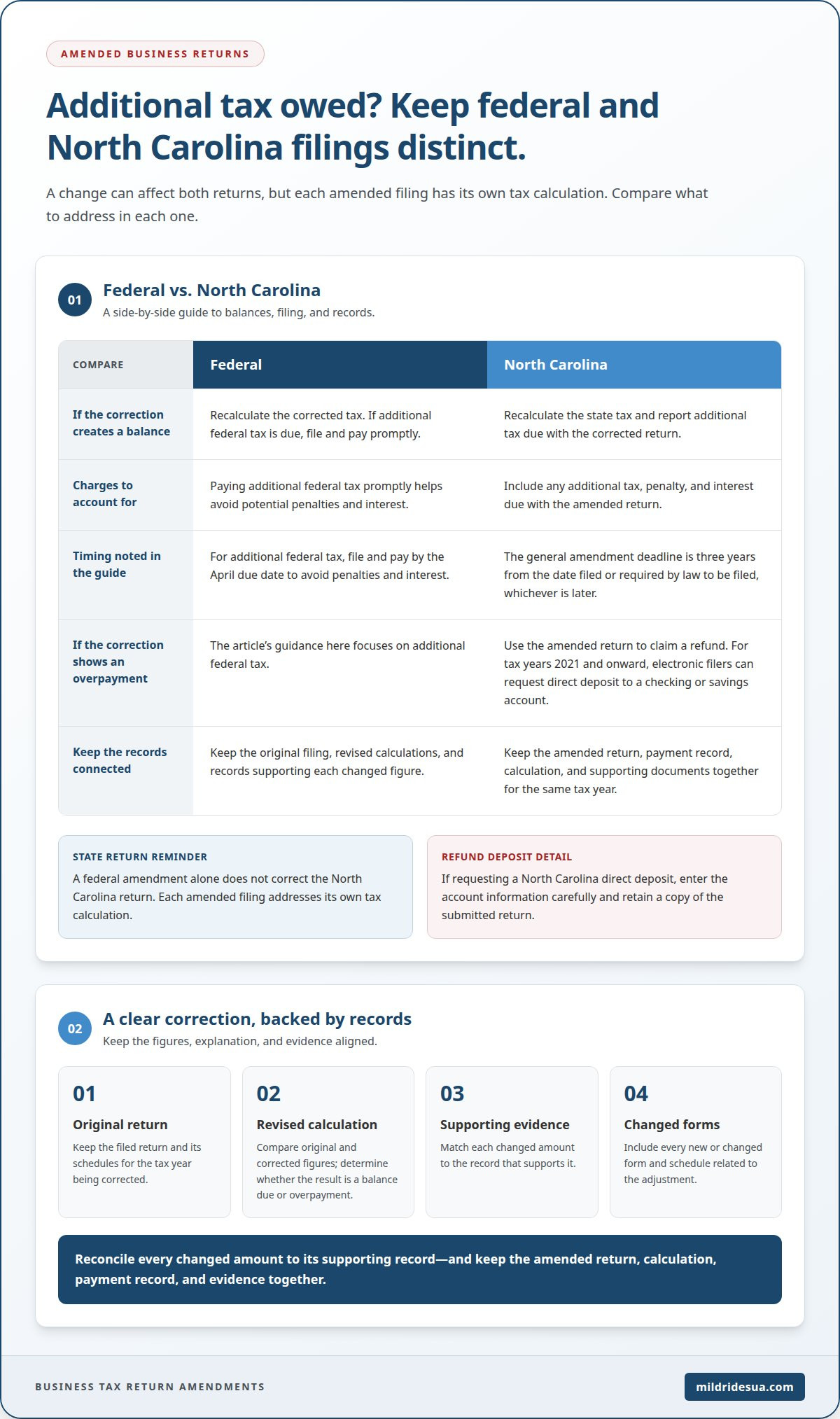
- Keep the North Carolina balance separate from any federal balance. A change to one return can affect the other, but each amended filing addresses its own tax calculation. For additional federal tax, file and pay by the April due date to avoid penalties and interest. For North Carolina, report any additional tax, penalty, and interest due with the corrected return.
- Review the payment calculation before submitting the North Carolina return. Trace each amount to the revised tax figures and account for any penalty or interest due. Don’t treat the tax increase as the only amount to settle if the corrected filing also shows additional charges. Keep the amended return, payment record, and calculation together for the same tax year.
- Use the amended return to claim a refund when the correction reduces the tax owed. For tax years 2021 and onward, electronic filers can request direct deposit of an amended-return refund into a checking or savings account. Enter the account information carefully, and retain a copy of the submitted return with the refund calculation.
- Organize evidence explaining why the return changed. Keep the original filing, revised calculations, records supporting each corrected figure, and copies of changed forms or schedules. If the North Carolina Department of Revenue asks about a discrepancy, these records connect the amended figures to the underlying business activity. A clear explanation also distinguishes a deliberate correction from an unexplained difference.
Documents to collect before amending
Gather the original North Carolina return, records supporting each correction, and all changed forms or schedules. Add a concise explanation of what changed and why the original figures were incorrect.
- Start with the filed return for the tax year you’re correcting. Keep its schedules and attachments in your working file so you can compare the original amounts with the revised figures. Add the filing confirmation or a copy of the submitted return, if available. This gives you a reference point and helps distinguish corrected entries from amounts that remain unchanged.
- Collect records directly tied to each changed amount. For a revenue correction, gather invoices, sales records, or deposit documentation supporting the revised total. For an expense adjustment, organize receipts, vendor invoices, and payment records. Match each document to a specific line or schedule rather than collecting unrelated files. This makes the calculation easier to reconstruct.
- Use bookkeeping reports to trace totals back to source records. A general ledger, income statement, or transaction listing can show how the original number was assembled and where the adjustment belongs. For example, if a transaction was posted to the wrong category, keep the ledger entry with the underlying invoice. Clearly mark the corrected treatment in your workpapers.
- Gather payroll and business account records if the correction involves compensation, withholding, or a payment recorded in the wrong period. Compare payroll summaries with payment records and bank statements. If the amended figure depends on a particular transaction, note its date, amount, and business purpose in your file. These details help explain the change without relying on memory.
- Include the revised forms and schedules affected by the correction. A changed figure on the main return may also alter a supporting schedule, so compare the original filing with the corrected calculation before assembling the package. If a federal change prompted the state adjustment, keep the federal amended return and relevant supporting schedules with your records. This helps show how the state correction relates to the federal change.
- Explain the correction briefly and in plain language. State the original treatment, the corrected treatment, and the record supporting the change. For example: “The original expense total omitted an invoice; the revised amount includes the invoice dated in the applicable tax year.” Keep this explanation consistent with the amended figures and supporting documents.
- Arrange the file by tax year and correction, then check every revised amount against its supporting record. Keep copies of the original return, amended forms, explanation, and relevant records together. A clearly labeled file makes it easier to prepare the submission, answer questions about an adjustment, and preserve the reasoning behind the corrected figures.
Errors that do not require an amended return
Separate an administrative mistake from a change to the tax calculation before preparing another filing. The IRS corrects clerical errors on federal individual returns, so taxpayers shouldn’t use Form 1040-X to report them. For a North Carolina business return, focus on whether the error changes the computation of income or franchise tax.
- Identify which return contains the mistake: a federal individual return, federal business return, or North Carolina business return. The IRS rule about clerical corrections applies to federal individual returns, not automatically to every business or state filing. For a North Carolina return, assess whether the error changes the reported income or franchise tax calculation. This distinction helps prevent applying an individual-return procedure to a business filing.
- Compare the reported information with the original source records before deciding what action is appropriate. For example, check a transposed figure against the ledger entry and supporting transaction record. Determine whether correcting it changes a tax calculation or merely changes how information appears. A typo in a business name and an incorrect income figure have different effects, so document what the records show.
- For a federal individual return, don’t file Form 1040-X solely to report a clerical error that the IRS corrects. Keep the original return and records that show the correct information together. If the IRS contacts you about a correction, compare its notice with the filed return and source documents. This step concerns individual federal filings, not a North Carolina business return.
- For a North Carolina business return, trace the error through the calculation. If the correction changes income or franchise tax, treat it as a substantive return issue rather than a simple formatting adjustment. For example, a bookkeeping entry that changes reported business income could affect the calculation. If the figure remains unchanged and only a non-calculation detail needs correction, don’t assume the federal individual-return rule determines the state process.
- Record your decision and preserve the supporting evidence. Note the return involved, the incorrect entry, the source record, and whether the correction changes the tax calculation. For example, save a ledger extract beside the transaction document it supports. If a North Carolina business return contains an income or franchise tax calculation error, prepare to correct that return rather than rely on the IRS clerical-error process for individuals.
How do I amend a North Carolina partnership or S corporation tax return?
- Start with the North Carolina return containing the error. Identify the entity type and tax year from the filed copy before selecting a correction form. If you discover an error in a return filed with the Department, amend it. The correction should address the filed return, not replace it with a newly prepared original filing.
- Match the correction form to the original return. North Carolina corporate taxpayers use Form CD-405 or CD-401S to amend a return. Review the form used for the original filing and choose the appropriate amended form. For a partnership or S corporation, verify the entity classification shown on the filed return before transferring corrected figures.
- Reconcile the changed entries with your business records and original filing. Identify which income, deduction, or other reported amount needs correction, then recalculate affected figures and schedules. For example, if a corrected ledger total changes an amount on a supporting schedule, carry that change through the amended return. Keep a clear record of how each revised figure was calculated.
- Prepare the amended return using a copy of the original return or an additional return from the back of the tax forms booklet. Mark the corrected filing “AMENDED RETURN” and send it to the Department. Include supporting documents and changed forms or schedules that explain the adjustment. Review the package for consistency, especially when one corrected amount affects other entries.
- Check the filing deadline before submitting. The North Carolina deadline is three years from the date the return was filed or was required by law to be filed, whichever is later. If the correction follows a federal return change, contact the state tax agency for information about correcting the state filing. Keep the federal change and its supporting records with your North Carolina workpapers.
- Include any additional North Carolina tax, penalty, and interest due with the corrected return. Keep a copy of the amended filing, attachments, and payment record together by tax year. If the return involves interconnected partnership or S corporation records, discuss the amended filing with a tax professional before submitting it.
Keep other North Carolina tax information in its proper context when assembling the entity’s records. Mecklenburg County, North Carolina, levied an additional 1% local sales and use tax. In North Carolina, ordering for 2027 motor fuel licenses and decals may begin September 1, 2026. North Carolina motor fuel licenses and decals are valid for one calendar year only. These details may be relevant to other business records, but do not substitute for checking the amended partnership or S corporation return and its supporting schedules.
Mildrid Esua, CPA, PLLC: Tax Planning and Tax Preparation
Mildrid Esua, CPA, PLLC helps small businesses align tax preparation with their accounting records when a return needs correction. If an amendment involves multiple schedules, bookkeeping discrepancies, or an unpaid balance, the firm can help organize the filing and clarify next steps. It also provides tax resolution services for businesses dealing with back taxes or tax liens. Contact Mildrid Esua, CPA, PLLC for a coordinated review of your amended business return.
Make the Next Filing a More Deliberate Step
A corrected return can reveal where your business records or tax processes need better alignment. Use that insight to refine how transactions are categorized, preserve support for key figures, and establish a consistent review before future filings. These habits can make later tax decisions clearer and help you respond with well-organized records when circumstances change.
Understanding how to amend a business tax return in NC is one part of maintaining sound tax records. The next step is to consider how the correction affects your broader tax position and what process will help keep future filings consistent. If you want professional guidance tailored to your business’s tax preparation or accounting needs, contact Mildrid Esua, CPA, PLLC to discuss the situation.
Move forward with a clear record of the correction and a practical plan for the next filing. A careful review today can support more confident decisions tomorrow.
Frequently Asked Questions
Can you make corrections on your tax return?
Yes. If an error changes income or franchise tax reported on a North Carolina business return, correct the filed return with an amendment. First identify the return and determine whether the mistake changes its tax calculation. The IRS corrects clerical errors on federal individual returns, so Form 1040-X isn’t used for those errors. That federal individual-return rule doesn’t automatically apply to a North Carolina business filing.
Which North Carolina business tax returns can be amended, and which form is required for each?
A North Carolina taxpayer who discovers an error on a return filed with the Department should amend it. Corporate taxpayers use Form CD-405 or CD-401S, matching the form to the original return and entity type. For a partnership return, use a copy of the original return or an additional return from the back of the tax forms booklet. Mark the correction “AMENDED RETURN” before sending it.
How do I amend a North Carolina corporate income and franchise tax return?
Use the North Carolina corporate form that matches the original filing, Form CD-405 or CD-401S. Prepare the corrected return, mark it “AMENDED RETURN,” and include supporting documents and changed schedules. If a federal report changes federally reported or reportable taxable income, a corporation must file an amended return under oath within two years after receiving that report. Include any additional tax, penalty, and interest due.
Can I amend a North Carolina business tax return online, or must I file by mail?
For a North Carolina business amendment, prepare a corrected return from a copy of the original or an additional return in the tax forms booklet, mark it “AMENDED RETURN,” and send it to the Department. The process described for these returns is to submit the corrected return; don’t assume federal online filing options also apply to the state return. Follow the Department’s instructions for the applicable form and submission details.
What is the deadline to file an amended North Carolina business tax return?
The general North Carolina deadline is three years from the date the return was filed or was required by law to be filed, whichever is later. A separate rule applies when a corporation’s federal report changes federally reported or reportable taxable income: the corporation must file under oath within two years after receiving the report. For example, a Greensboro business should identify which deadline applies to its specific correction.
Do I need to amend my North Carolina return after changing my federal business tax return?
A federal change can affect figures reported to North Carolina, so determine whether the state return also needs correction. If you change a federal return, contact the state tax agency for information about correcting the state filing. For a corporation, a change to federally reported or reportable taxable income triggers an amended return under oath within two years after receipt of the federal report. Keep records of the federal adjustment with your state filing documents.



Leave a Reply
Your email is safe with us.