


A spouse’s tax fraud can leave the other spouse facing an IRS debt tied to a return they didn’t knowingly prepare or benefit from. Innocent spouse relief may address an unjust tax situation involving fraud by a spouse or ex-spouse, and an innocent spouse relief CPA in Greensboro can help assess the circumstances and prepare a focused request. The IRS uses Form 8857 for claims involving innocent spouse relief, separation of liability, and equitable relief.
It’s understandable to worry that a debt tied to a joint return will remain your responsibility, especially after separation or divorce. The return, your knowledge of the tax issue, and the circumstances surrounding the debt all matter when the IRS considers a relief request. This article explains the relief options, how fraud and an ex-spouse may factor into a case, and how professional representation can clarify your next steps.
Key Takeaways
- Learn when tax debt tied to a spouse’s or ex-spouse’s actions may merit a request for relief.
- See how the circumstances behind a joint return can shape the relief options to consider.
- According to the Internal Revenue Service, Form 8857 covers innocent spouse relief, separation of liability, and equitable relief.
- Understand how relevant records and a clear account of the circumstances can support a relief request.
- Explore how professional IRS representation can help bring structure to a tax-resolution matter.
Innocent spouse relief
A joint return can leave one spouse facing tax problems tied to income or deductions handled by the other. For example, a spouse may discover an unpaid balance after learning that information on the return was inaccurate or incomplete.
Relief Options
Innocent spouse relief, separation of liability, and equitable relief are distinct options. The facts behind the return help determine which may fit. A review should consider who supplied the financial information, what each spouse knew, and how the tax issue affected the requesting spouse. A fraud allegation also requires a careful account of events and supporting records.
Look beyond the label. A request should connect the tax issue to the specific circumstances rather than treating every joint-return debt alike. A CPA can review the returns and financial records, then identify questions that may affect the request. This analysis can help you understand the relevant facts and plan how to address the tax problem.
How do CPA, tax attorney, and enrolled agent roles differ? A CPA generally brings accounting and tax-return analysis; a tax attorney focuses on legal advice, while an enrolled agent specializes in tax matters before the IRS. The accounting complexity and legal questions in your case help determine which expertise is most useful.
How much do CPAs charge? The price depends on the case and is given after a quote request. Cost factors include the number of returns, the volume of records, disputed issues, and the representation required.
How long does the IRS take to decide? The review period depends on the returns involved, the evidence submitted, and whether the IRS requests more information. Organized records and complete responses can help avoid preventable delays, but review times vary by case.
Application Risks and Spouse Notification
An application can bring a sensitive financial dispute to the other spouse’s attention. The IRS may contact the other spouse during its review, so consider communication and personal safety concerns before proceeding. A careful review of the facts can help identify sensitive details and prepare for questions about the return.
Conflicting records or unexplained facts can make a request harder to assess. An innocent spouse relief CPA in Greensboro can organize the financial timeline, identify gaps, and present the circumstances consistently. Before representation begins, a CPA firm should explain its role, review the return history, and discuss how it will handle IRS communications.
How do I find a CPA in Greensboro? Look for a CPA who handles IRS representation and tax resolution, and ask how the firm reviews joint returns, supporting records, and spouse-related issues. A focused discussion of your return history can help establish whether the professional understands the work involved.
Innocent spouse IRS relief
An IRS notice may combine tax, interest, and penalties, even when spouses disagree about the return. Before responding, separate the balance into its components and identify the tax year and return each notice concerns. For example, a notice about omitted income calls for a different factual review than one involving a disputed deduction. This distinction helps frame the relief request around the actual tax issue, not assumptions.
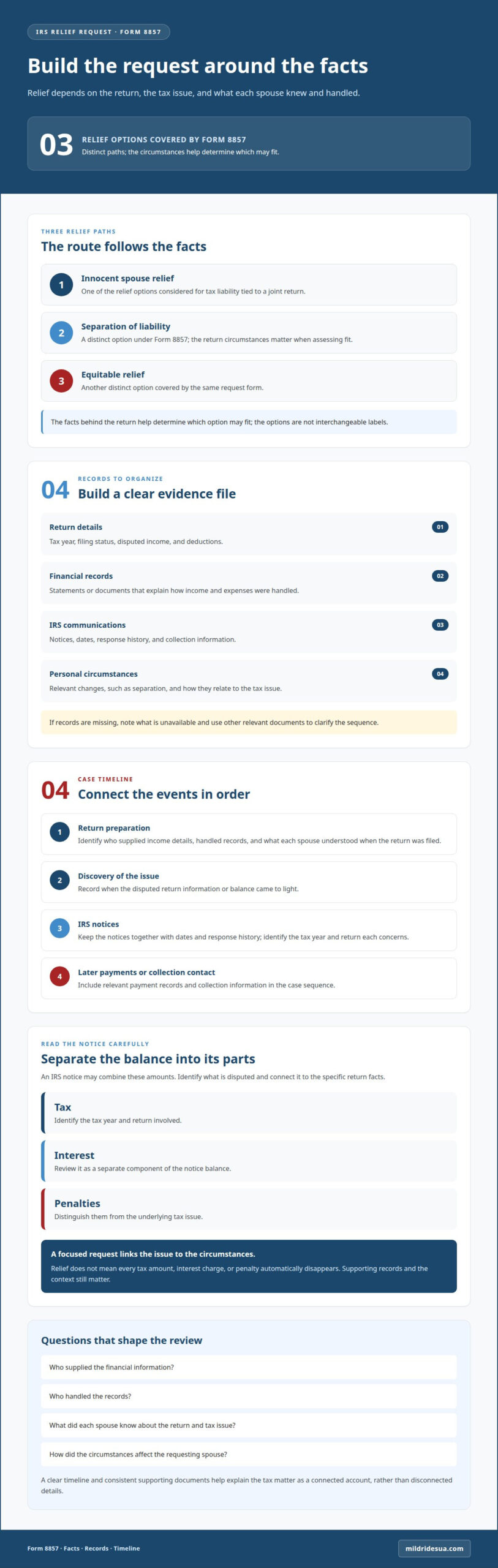
Form 8857 is the request associated with innocent spouse relief. A well-prepared submission connects the disputed return information to the requesting spouse’s circumstances. The review should establish who provided income details, who handled records, and what each spouse understood when the return was filed. A timeline can organize those facts: return preparation, discovery of the issue, IRS notices, and any later payments or collection contact.
What is the deadline for filing Form 8857? There isn’t one deadline that can safely be applied to every relief request. The applicable timing depends on the relief basis and the IRS case history, including notices and collection activity. A representative should determine the relevant filing window from those case details before preparing a submission.
Timing matters because waiting for a complete picture can create avoidable pressure. Gather the returns, IRS notices, payment records, and correspondence that show how the balance developed. If records are missing, note what is unavailable and use other relevant documents to clarify the sequence. A clear record helps the IRS assess the request and helps a representative respond consistently if questions arise.
- Return details: Identify the tax year, filing status, disputed income, and deductions.
- Financial records: Organize statements or documents that explain how income and expenses were handled.
- IRS communications: Keep notices together with dates, response history, and collection information.
- Personal circumstances: Record relevant changes, such as separation, and how they relate to the tax issue.
Relief doesn’t mean every tax amount, interest charge, or penalty automatically disappears. The request must explain which liability is disputed and why the facts support relief. For instance, evidence that one spouse controlled financial records may help explain the other spouse’s limited involvement, but the context and supporting documents still matter. A structured review can help you present a coherent account of the tax matter rather than disconnected explanations.
Professional IRS representation can organize records, assess the factual basis for a request, and manage case communications. This support can be useful when notices, incomplete records, or a spouse’s conflicting account make it difficult to plan a response.
Innocent spouse relief for tax debt caused by a spouse
A joint tax return can create a shared balance, even when one spouse supplied inaccurate information. For example, one spouse may have omitted freelance income while the other handled household bills. An IRS notice may include tax, penalties, and interest, so the total alone doesn’t explain how the debt arose. A careful review connects each disputed amount to the return information and the person who provided it.
The central issue is more than whose name appears on a return. The request needs a clear account of what each spouse knew, handled, and understood when filing. Consider a return prepared using business records controlled by one spouse. Records showing who managed the business, communicated with the preparer, or received income statements can help explain the other spouse’s role. Dates matter too: a later discovery may help establish when the requesting spouse learned of the problem.
Can the IRS collect a joint tax debt while a relief request is pending? Yes, collection can remain an issue while the request is pending. Filing a request alone does not mean collection has stopped; IRS notices and account activity still need prompt attention.
That makes each new notice important. A balance-due letter, proposed collection action, or request for records may require a different response. A representative can review the notice date, tax period, amount, and requested action, then coordinate the response with the relief request. Ignoring a notice because the application is under review may leave an important deadline or request unanswered.
Evidence should match the disputed tax issue. For omitted income, income statements and account records may help establish who received or managed the funds. For a questionable deduction, receipts, bookkeeping entries, and correspondence about the expense may clarify who claimed it and why. Separation records can also help establish when spouses maintained separate finances or stopped sharing household responsibilities.
- Identify the debt: Match each notice to its tax period and disputed item.
- Build the timeline: Record when the return was filed, when the issue surfaced, and when notices arrived.
- Connect documents to facts: Pair bank records, business records, or messages with the specific amount in dispute.
- Track IRS contact: Preserve notices and response records together for a consistent case history.
Organized records can make representation more efficient, but they don’t guarantee relief. A practical first step is a defined review of the returns, notices, and evidence, rather than treating every joint balance the same. With those details assembled, a tax professional can assess the request and plan responses to the IRS while tracking collection communications.
What are the three types of innocent spouse relief: innocent spouse, separation of liability, and equitable relief?
According to the Internal Revenue Service, Form 8857 covers innocent spouse relief, separation of liability, and equitable relief. These are distinct routes for addressing tax connected to a joint return. Choosing between them starts with identifying the disputed balance, the return details, and how each spouse relates to the issue.
Innocent spouse relief focuses on whether the requesting spouse should be held responsible for a tax problem tied to information on a joint return. For example, one spouse may have supplied incorrect income details while the other had limited involvement in preparing the return. The review considers the return, the source of the information, and each spouse’s role. A clear account should connect those facts rather than rely only on the spouses’ different recollections.
Separation of liability focuses on dividing responsibility for a joint tax balance between spouses. This option may be relevant when disputed items can be connected to one spouse’s income, deductions, or other return information. A useful first step is to map each disputed amount to its source. For instance, business income records may help distinguish one spouse’s activity from shared household income. The records and circumstances guide how the issue is presented.
Equitable relief addresses circumstances that call for a broader review of fairness. Rather than focusing only on who supplied a particular return item, the analysis can consider the surrounding financial and personal context. For example, a spouse’s access to financial accounts, knowledge of household finances, or later separation may help explain the situation. Those details need a clear connection to the tax debt, not just a general description of hardship.
Compare the options against the specific facts before choosing a request. A return showing omitted income may raise different questions from one involving a disputed deduction or an unpaid balance. Organize the tax years, notices, return entries, and supporting records so the connection is clear. A timeline can also show when the issue arose and what each spouse knew at each stage.
- Identify the issue: Separate disputed income, deductions, and unpaid balances.
- Trace responsibility: Connect each return item to the available financial records.
- Document context: Note relevant household, financial, or separation circumstances.
- Match facts to relief: Present the route that best addresses the documented issue.
The three options aren’t interchangeable labels. A focused review helps avoid framing a request around the wrong concern. Matching the return facts and personal circumstances to the relief type can give the IRS a coherent explanation of what happened and why the requesting spouse seeks relief.
What IRS forms and evidence are needed to request innocent spouse relief?
According to the Internal Revenue Service, Form 8857 covers innocent spouse relief, separation of liability, and equitable relief. It gives the IRS a framework for reviewing the relief request. The form alone, however, cannot explain every return entry or household circumstance. A strong submission connects the form’s answers to records that clarify the disputed tax and each spouse’s role.
Start by organizing the affected returns and IRS correspondence by tax year. For each year, identify the disputed item, such as omitted income, an expense, or an unpaid balance. Then connect that item to available documents. For example, a business income statement may help explain which spouse received or managed the income. A notice can show how the IRS described the adjustment or balance.
Supporting evidence should answer specific questions, not simply add volume. Bank statements, bookkeeping records, and income documents can help trace transactions. Emails or letters with a tax preparer may show who supplied records or discussed a return entry. Separation or household records may help explain the financial arrangements at the time. Each document is most useful when its date and relevance are clear.
- Returns and notices: Gather the joint returns and IRS letters tied to the disputed tax periods.
- Income and expense records: Include relevant statements, receipts, account records, or business documents.
- Communication records: Collect messages that explain who handled tax information or discussed disputed items.
- Context records: Organize documents that clarify household finances, access to accounts, or a separation.
Next, prepare a timeline linking the return, the underlying activity, and later IRS contact. For example, note when a notice arrived and which document explains the disputed income. The timeline can reveal missing details before the request is submitted. If two records appear inconsistent, explain the difference rather than leaving the IRS to infer what happened.
A representative can review the completed Form 8857 alongside the supporting records, then organize the explanation around the selected relief basis. That review can also identify unanswered questions, such as a missing statement or unclear transaction. Avoid sending unrelated paperwork without explaining its connection. A concise, indexed evidence package makes the relationship between each claim and its documentation easier to follow.
Before submission, confirm that the form’s answers match the attached records and timeline. Keep a copy of the submitted package with later IRS correspondence. These materials provide a reference if the IRS asks for clarification or if later communications concern the same tax years. Clear organization supports a consistent presentation of the facts.
Mildrid Esua, CPA, PLLC: Back Taxes & IRS Tax Relief
Mildrid Esua, CPA, PLLC provides IRS representation and tax resolution support for people facing back taxes or disputed tax debt. If a spouse’s actions led to an IRS balance, professional review can help organize the return history, notices, and evidence for a considered response. This support can be especially useful when records are incomplete, the IRS requests information, or collection notices arrive while relief options are being assessed. The work focuses on understanding the tax issue and managing IRS communications, not promising a particular outcome. For help assessing your IRS tax debt and next steps, contact Mildrid Esua, CPA, PLLC.
Move forward with a clearer tax-resolution plan
The next step is to turn a complicated tax history into a clear decision. An innocent spouse relief CPA in Greensboro can help assess the issues, organize the case narrative, and identify questions that need careful attention. The goal is a considered plan, not a rushed response based on incomplete information.
Whether relief is available depends on the circumstances of the case. A focused conversation can clarify what representation may involve and how to proceed with confidence.
Contact Mildrid Esua, CPA, PLLC to discuss your IRS tax concerns. A deliberate next step can help you approach the situation with greater clarity.
Frequently Asked Questions
What is IRS innocent spouse relief and who qualifies?
IRS innocent spouse relief may address an unjust tax situation where a spouse was clearly the victim of fraud by a spouse or ex-spouse. A person facing tax debt tied to that conduct may seek relief, but the circumstances alone don’t establish eligibility. The request should explain how the fraud relates to the tax debt and the person’s situation. A Greensboro CPA can help assess the facts and present them clearly.




Leave a Reply
Your email is safe with us.