

The right CPA does more than prepare tax returns. When considering how to choose a CPA for my small business, compare the services you need, the CPA’s experience with businesses like yours, their communication style, and how they handle filing risks and ongoing support. Look for a professional whose approach fits your business today and as it grows.
It’s reasonable to expect accurate filings and clear answers without having to untangle complex tax decisions alone. A CPA may help with tax planning and preparation, bookkeeping, business-structure decisions, and IRS matters. The scope of services and level of year-round guidance vary, so clarify what you need and what the engagement covers.
This guide explains how a CPA can support a small business and how to assess the practical details of a working relationship. You’ll learn what to look for in industry experience, communication, filing oversight, and firm structure, so you can make a considered choice.
Key Takeaways
- Distinguish a CPA’s credentials and representation capabilities from the broader work accountants may perform.
- Match the services you need, from tax preparation and bookkeeping to guidance on business structure, with the complexity of your business.
- Look for relevant industry experience and a communication approach that gives you clear, useful answers throughout the year.
- Review your return carefully before signing, since you remain responsible for the information it contains even when a professional prepares it.
- Compare the continuity and backup support a solo CPA or firm can provide as your needs change.
1. CPA versus accountant
A CPA is an accountant with a professional license issued by a state board. In the United States, state boards regulate CPAs, who may be held accountable for professional misconduct. Accountants may also handle financial records, tax preparation, and reporting, but credentials and services vary. Compare the expertise your business needs, not just job titles.
For example, a small retailer might need monthly bookkeeping and tax-return preparation. A growing business considering an S corporation election may also need tax planning and guidance on records and obligations. Ask each professional what work they handle, what they review, and whether they advise clients throughout the year.
Bookkeepers generally record daily transactions, such as customer invoices, supplier bills, payroll entries, and expenses. Accountants use those records to prepare financial reports, review accounts, and support tax filings. Since the roles can overlap, ask who reconciles bank accounts, categorizes transactions, and investigates discrepancies. If a bank statement and ledger differ, clarify who will resolve the difference and when.
An enrolled agent is another tax professional credential. According to the Internal Revenue Service, enrolled agents in the United States must complete 72 hours of coursework from an IRS-sanctioned vendor every three years to maintain their status. Compare credentials by the work you need, including preparation, planning, or representation.
To verify a CPA’s license and disciplinary history, use your state board of accountancy’s license lookup and disciplinary records. The National Association of State Boards of Accountancy’s CPAverify tool can also help you locate CPAs.
When checking references, reviews, and credentials, ask for references from small businesses with similar operations and find out what work the professional handled. Look for recurring comments about responsiveness or accuracy in public reviews, then compare credentials with CPAverify or the IRS Directory of Federal Tax Return Preparers.
Ask prospective accountants who will prepare and review your returns, what services are included, and how you can get answers between filings. A written engagement letter should define the work, deliverables, deadlines, each party’s responsibilities, communication expectations, and how either side can end the engagement. Before signing, confirm that it matches your understanding.
Red flags include unclear responsibilities, evasive answers about credentials, and promises of a guaranteed tax outcome. Be cautious if a preparer suggests unsupported deductions or asks you to sign a return before reviewing it. Common mistakes include mixing personal and business spending, losing expense records, and guessing estimated payments. Clear responsibilities and consistent bookkeeping help catch problems before filing.
2. Tax professional services for small businesses
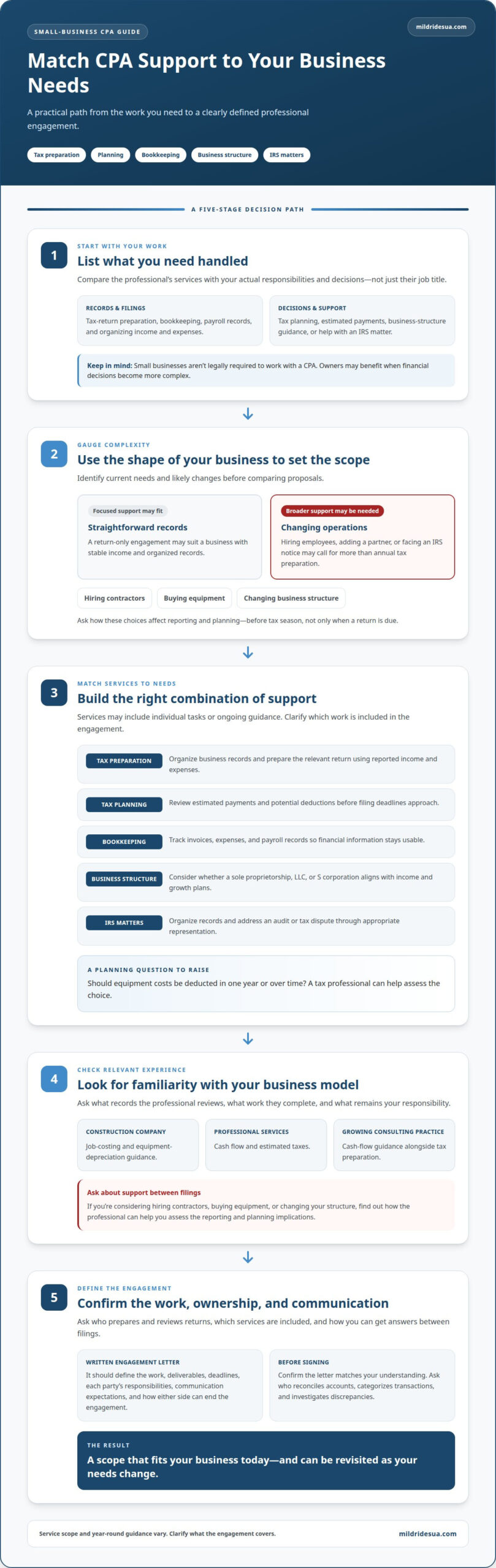
A small business may need more than an annual return. A tax professional can help prepare filings, review income and expenses, plan estimated payments, and assess business structure. For example, a growing consulting practice may need cash-flow guidance alongside tax preparation. Small businesses aren’t legally required to work with a CPA, but owners may benefit when financial decisions become more complex.
Start by listing the work you need and comparing it with each professional’s services. A return-only engagement may suit a business with straightforward records. A company hiring employees, adding a partner, or facing an IRS notice may need broader support. Identify your current needs and likely changes before comparing proposals.
CPA services for small businesses can include tax planning, preparation, bookkeeping, payroll, business formation guidance, and IRS representation. Their value depends on how well the work fits your circumstances. For instance, a business weighing a sole proprietorship against an S corporation can seek guidance on structure, income, and compliance. A professional can also help assess whether equipment costs should be deducted in one year or over time.
- Tax preparation: Organize business records and prepare the relevant return using reported income and expenses.
- Tax planning: Review estimated payments and potential deductions before filing deadlines approach.
- Bookkeeping: Track invoices, expenses, and payroll records so financial information stays usable.
- Business structure: Consider how a sole proprietorship, LLC, or S corporation aligns with income and growth plans.
- IRS matters: Help organize records and address an audit or tax dispute through appropriate representation.
Ask about experience with your business model, not just small businesses in general. A construction company may need job-costing and equipment-depreciation guidance, while a professional services firm may focus on cash flow and estimated taxes. Ask what records the professional will review, what work they’ll complete, and what remains your responsibility.
Also assess whether the professional can support decisions before tax season. If you’re considering hiring contractors, buying equipment, or changing your structure, ask how those choices affect reporting and planning. Compare the proposed scope with what you can reliably handle yourself. If bookkeeping takes time away from reviewing income and expenses, small-business bookkeeping can help establish consistent records for tax work.
Choose the scope deliberately. A business with stable income and organized records may need focused tax preparation, while changing operations can call for planning and ongoing accounting. Match the engagement to real business decisions and the work that supports accurate reporting and informed growth.
3. Evaluating industry experience and communication
Industry experience matters when an accountant understands how your business earns income, manages expenses, and keeps records. A real estate owner, for example, may face complex reporting and timing questions. Ask a prospective CPA to describe similar work and explain how that experience informs their review of your books, tax planning, and business structure.
Look beyond an industry list on a website. Describe a current decision, such as hiring employees, adding a service, or buying equipment. Ask what records the CPA would examine and what factors could affect the decision. A useful response connects your operations to specific accounting questions rather than relying on broad claims of expertise.
- Test familiarity: Explain how your business earns income and ask which records help assess it. For example, a business with project-based work may need clear records for each job.
- Discuss complexity: Describe a planned change, such as hiring staff or expanding operations. Ask how it could affect payroll records, estimated taxes, and cash flow.
- Clarify advice: Ask how the CPA would compare business-structure options as income and growth plans change. Look for a clear explanation of the considerations, not a one-size-fits-all answer.
- Request an example: Ask how they helped a business address a similar accounting challenge. Listen for the process, records reviewed, and reasoning behind the guidance.
Clear communication should make financial decisions easier to understand. Ask who will be your main contact, how to share records, and how the CPA explains questions or requested documents. If you receive an unfamiliar expense report, for example, you should understand which entries need clarification and what to do next.
Agree on how urgent questions are handled and what updates to expect during the year. A seasonal tax conversation may not address a new hire or unexpected income change promptly. Ask how the CPA connects discussions to your business activity and documents decisions that affect later filings. Clear expectations help both sides work from the same information.
Use a focused, realistic conversation to assess whether the working relationship fits. Explain your priorities, such as clearer cash-flow forecasting or better-organized receipts. Notice whether the professional asks relevant follow-up questions, explains technical terms plainly, and identifies useful records. A CPA who listens carefully can offer guidance based on your operations, not assumptions.
Finally, assess the CPA as a potential long-term partner. Ask how they revisit your needs when income, staffing, or business structure changes. Compare their answers with the support you expect, then document the agreed scope and communication process. This gives you a practical basis for judging fit before tax deadlines or business decisions create pressure.
4. Avoiding tax filing errors and IRS penalties
A careful filing process starts well before annual returns are filed with the IRS. Keep business income, expenses, payroll records, and supporting documents organized throughout the year. For example, match each sales deposit to invoices or sales reports, then investigate differences before preparing the return. Reliable records help your tax professional identify missing information and reduce avoidable corrections.
Use a repeatable review process rather than relying on memory at filing time. Reconcile bank and credit card statements with your books, and flag transactions without a clear business purpose. Keep receipts or other supporting records with expense entries. If a vehicle expense appears in your books, for example, make sure the records support the amount and reported business use.
- Confirm income: Compare sales records, payment processor summaries, and bank deposits. Follow up on amounts that don’t match.
- Review expenses: Check vendor names, business purpose, and supporting documents before claiming deductions.
- Check payroll information: Compare payroll records with the amounts used in the return.
- Track changes: Note changes in ownership, business structure, or operations that may affect filing details.
Before signing, review the business tax return line by line with your preparer. Taxpayers remain responsible for the information on their income tax returns, even when someone else prepares them. Confirm the business name, identifying details, income, expenses, and any elections or statements included. Ask for an explanation if a figure differs from your records.
A CPA’s review can help catch inconsistencies, but your own checks matter. Compare the final return with your bookkeeping reports and source documents. If reported income doesn’t match your books, pause and resolve the difference before approving the filing. Keep a copy of the filed return with its supporting records for future reference.
Timing and communication also affect accuracy. Give your tax professional complete records early enough to address questions, rather than sending scattered documents at the last moment. Promptly share updates about a new employee, equipment purchase, or change in business activity. These changes can affect filing requirements, and early discussion leaves more time to correct incomplete records.
Choose a preparer who explains review steps and answers questions clearly. Ask how they identify missing documents, handle corrections, and communicate filing status. A sound process can help you avoid preventable mistakes and save time for running your business. It may also reduce rework, though no review replaces your responsibility to read and understand the return before signing.
5. Choosing between a solo CPA and a firm
A solo CPA may offer direct access to one professional, while a firm may assign different people to preparation, review, or advisory work. Neither structure is automatically better. Compare who will handle your financial records, explain decisions, and represent your business if an IRS matter arises.
Ask a solo CPA what support is available during an absence and what would happen if the CPA became unexpectedly ill or died. Find out who could access your records, manage deadlines, and explain the status of ongoing work. A continuity plan matters if your business depends on one person for annual filing and time-sensitive questions.
A firm’s larger team may provide backup, but ask how it works in practice. Find out who prepares returns, who reviews them, and who answers your questions. If you meet one partner but work mainly with another accountant, clarify how information is shared. Defined responsibilities help prevent gaps and repeated explanations.
Ask how each option handles work that requires specialized qualifications. U.S. CPAs can represent clients in IRS proceedings, conduct external audits, and file audited financial statements with the Securities and Exchange Commission. Your business may not need every capability, but confirm that the professional assigned to your engagement is qualified for the work you require.
Should you choose a local CPA or an online accounting firm? Choose the arrangement that supports clear communication, secure record sharing, and timely access to the professional handling your work. A local meeting may suit owners who prefer in-person discussions, while online services can work when digital document exchange fits your routine.
Compare the practical workflow before deciding. Ask how you’ll submit records, receive questions, approve documents, and get updates. For example, if your business handles invoices and payroll in separate systems, find out who will reconcile the information and explain missing items. A reliable process makes responsibility for each task clear.
- Contact: Identify your primary contact and the backup person for urgent matters.
- Review: Ask who checks completed returns or financial statements before delivery.
- Records: Learn how documents are shared, stored, and returned when work ends.
- Scope: Confirm whether the engagement covers preparation, planning, representation, or audits.
Choose a solo CPA for direct continuity only when the backup plan is clear. Choose a firm when its team structure gives your business dependable coverage and defined accountability. If you need coordinated tax preparation and IRS representation, connect with a small-business tax advisor to discuss support aligned with your needs.
Mildrid Esua, CPA, PLLC: Tax Planning & Tax Preparation,Bookkeeping IRS Representation small business accounting Tax resolution unfiled tax, tax lien , payroll servies
Mildrid Esua, CPA, PLLC supports small businesses with tax planning and preparation, bookkeeping, and IRS representation. Turn to the firm for help organizing financial records, preparing business returns, or addressing an IRS matter.
For businesses facing unfiled tax returns, back taxes, or tax liens, the firm provides tax resolution services to address those issues. Payroll services and small-business accounting can support consistent financial management, while tax planning helps owners consider the implications of business changes.
The right next step depends on the work you need addressed. Gather relevant tax documents, bookkeeping records, or IRS correspondence so you can explain your situation and priorities clearly. Contact Mildrid Esua, CPA, PLLC to discuss your small-business tax needs.
Make your next tax decision with greater clarity
The right professional relationship should help you make informed choices as your business changes, not just close the books after year-end. When considering how to choose a CPA for my small business, focus on the relationship you need: clear explanations, defined responsibilities, and guidance that supports decisions before they become filing concerns.
Before taking the next step, write down the business questions you want addressed and gather the records that relate to them. That preparation can make an initial conversation more focused, whether you’re planning ahead or resolving a tax issue. Mildrid Esua, CPA, PLLC works with small businesses on accounting and tax matters, including tax resolution. Contact Mildrid Esua, CPA, PLLC to discuss your needs and identify a practical path forward.
With a good fit and clear expectations, you can approach future tax decisions with greater confidence and keep your attention on building your business.
Frequently Asked Questions
What does a CPA do for a small business?
A CPA can help a small business interpret financial information and make informed tax and accounting decisions. When considering how to choose a CPA for my small business, match the professional’s work to the decisions you face, such as reviewing a cash-flow forecast or preparing for a change in ownership. Depending on the engagement, a CPA may prepare returns, advise on business decisions, or represent the business in IRS matters. Define responsibilities before work begins.
What’s the difference between a CPA and an accountant?
A CPA is an accountant with a professional license issued through a state board; “accountant” alone doesn’t specify a particular credential. That distinction can matter if your business needs a professional authorized to handle specific tax or financial work. Ask which credentials the person holds and whether their qualifications fit your needs. For routine transaction tracking, the role and scope of work may matter more than the title.
How much does a CPA cost?
The price depends on the work involved and is provided after a quote request. Factors include the condition of your records, business structure, and level of ongoing guidance. A return based on organized records may require a different scope from work involving payroll records, multiple business activities, or IRS correspondence. Request a written description of included tasks and any separately billed work, so you can compare proposals by scope rather than headline price.
When should you hire a CPA?
Consider hiring a CPA when a business decision has tax or reporting implications you can’t confidently assess alone. Examples include launching a business, changing ownership, hiring employees, or receiving an IRS notice. A business planning a new service could seek advice before committing funds. Early guidance gives you more time to organize records and evaluate options than waiting until annual filing approaches.
What services should a CPA provide for a small business?
Choose services according to the decisions and administrative work your business actually faces. A CPA engagement might cover tax preparation, planning, bookkeeping oversight, payroll accounting, or IRS representation. For example, a business with payroll may need help aligning payroll records with accounting reports, while a new venture may prioritize formation and tax planning. Define each deliverable and who provides the underlying records before work begins.
What experience should a CPA have with my industry and business structure?
Relevant experience should reflect your transactions, reporting needs, and business structure. To decide how to choose a CPA for my small business, ask how the professional handles a situation like yours. A construction company, for instance, may need insight into job costs and equipment, while a professional practice may focus on cash flow. Ask what records inform the analysis and how recommendations adapt to changing circumstances.
How much does a CPA cost for a small business in the United States?
The price depends on the work involved and is provided after a quote request. Cost factors include business structure, bookkeeping quality, filing complexity, and whether planning or representation is included. For a useful comparison, describe your business activities and share the same scope with each prospective professional. Ask whether the quote covers only return preparation or also review, follow-up questions, and related work during the engagement.
How do CPA fees compare with bookkeeper, enrolled agent, and tax preparer fees?
The price depends on the work involved, the qualifications required, and the level of responsibility. A bookkeeper may focus on recording transactions, while a tax preparer may handle filing and an enrolled agent may provide tax representation. Compare proposals by deliverables, review, and representation scope, not job title alone. A lower fee may cover a narrower engagement.




Leave a Reply
Your email is safe with us.