

Choosing a business structure is more than a paperwork decision. It can shape how your Greensboro venture is taxed, how you meet ongoing obligations, and how you manage finances as the business grows. If you’re weighing an LLC, partnership, S corporation, or C corporation, business formation services Greensboro can help connect that choice to your goals before you begin operating.
It’s tempting to get the filing process underway quickly, but a decision made without considering tax and operating needs can create avoidable complexity. Start by understanding your options and how each may fit your circumstances.
This article covers the key considerations for choosing a structure, the formation and launch tasks to plan for, and how tax planning can inform your next steps. It also explains why formation is only the beginning: practical bookkeeping and payroll habits can keep records organized and support better business decisions over time. With guidance from a CPA, you can approach setup as a strategic business decision, not simply a registration task.
Key Takeaways
- Business formation connects ownership, taxes, and the way you plan to operate.
- Before forming a business in North Carolina, document ownership, business activity, expected income, and growth plans.
- Compare LLC, partnership, and corporation options by considering administration and tax treatment alongside your goals.
- After registration, plan practical next steps, including EIN considerations, tax accounts, bookkeeping, and payroll where relevant.
- Business formation services Greensboro can connect entity decisions with tax planning and operating practices through CPA guidance.
Business Formation in Greensboro: Why the Right Foundation Matters
Before opening a business, Greensboro founders face connected decisions: who owns the venture, what it will do, how it may earn income, and how its finances will be managed. These aren’t separate tasks. They influence one another. Business formation services Greensboro should address more than filing paperwork: a sound plan considers how to set up and operate the business, including its tax needs.
Business formation means choosing and establishing a legal and tax structure for your operations. It includes deciding how ownership will work, completing the applicable registration, and preparing for the financial and administrative routines that follow. The right approach depends on your circumstances. A solo consultant, a two-owner shop, and a company planning to add employees may have different needs, even if they operate in the same part of Greensboro, North Carolina.
Structure, tax treatment, ownership, and future plans belong in the same conversation. Co-owners, for example, should clarify how they will share responsibilities and decisions. A founder expecting to hire may need to plan for payroll and organized financial records. A structure that seems convenient at launch may not suit the business’s later goals. A CPA can connect these choices to tax planning and practical operating habits without promising a particular tax result.
Registration is one milestone, not the finish line. It doesn’t replace applicable tax responsibilities, licenses or permits tied to the business activity, or ongoing recordkeeping. A formation plan should account for those next steps so the business is prepared to operate, not simply registered.
What does business formation include?
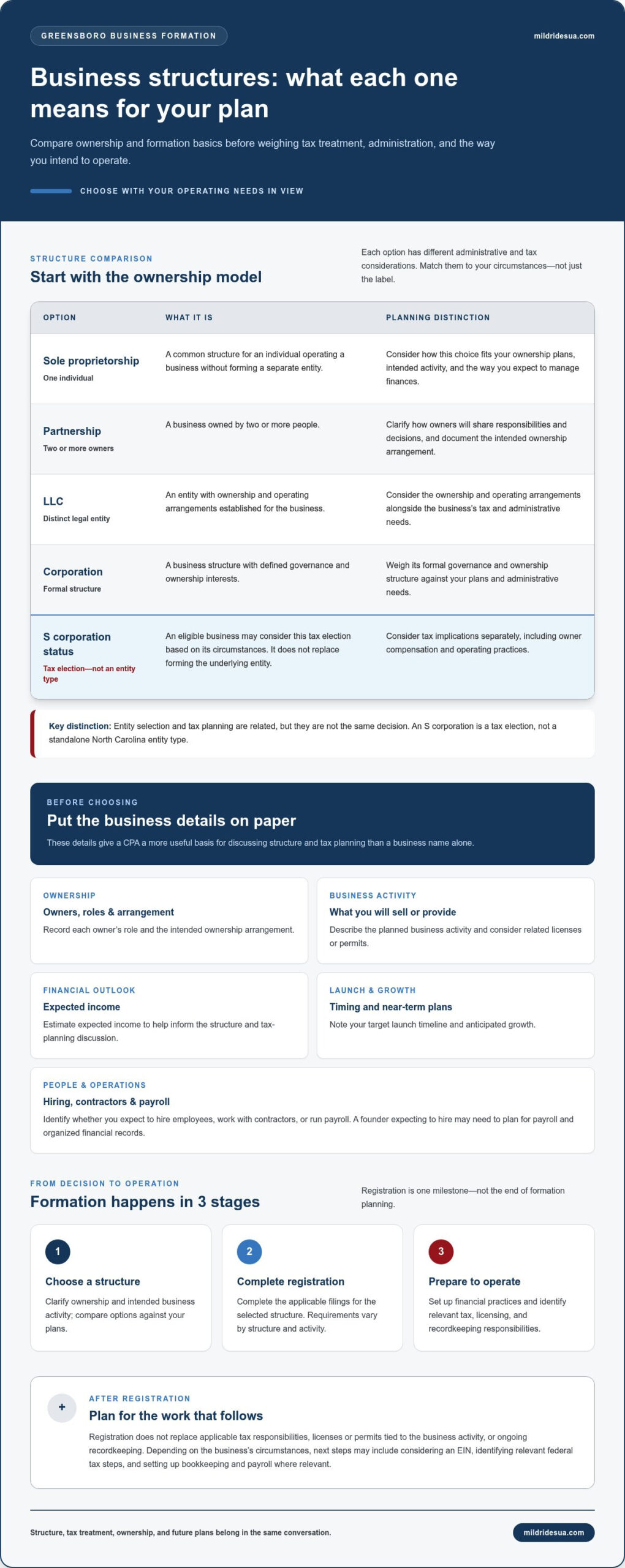
Think of formation in three stages: choose a structure, establish it through the applicable registration process, then prepare to operate. First, clarify ownership and the intended business activity. Next, complete the filings associated with the selected structure. Finally, set up financial practices and identify relevant tax or licensing responsibilities. Requirements vary by structure and activity, so there isn’t one formation path for every Greensboro venture.
Which business structures should Greensboro founders understand?
A sole proprietorship is a common structure for an individual operating a business without forming a separate entity. A partnership involves two or more owners. An LLC is a distinct legal entity with ownership and operating arrangements established for the business. A corporation has a more formal structure, including defined governance and ownership interests. Each option has different administrative and tax considerations. Assess those against your plans instead of choosing based on the label alone.
S corporation status is a tax election, not a standalone North Carolina entity type. Eligible businesses may consider an election based on their circumstances, but it doesn’t replace forming the underlying entity. The election’s tax implications deserve separate attention, along with owner compensation and operating practices. Understanding that distinction early helps keep entity selection and tax planning aligned.
How to Prepare for North Carolina Business Formation in Greensboro
Preparation makes formation more deliberate. Before submitting anything, organize the decisions that shape your business and separate those planning choices from official registration steps. This gives you a clearer picture of ownership, likely tax needs, and what the business must do after launch.
What information should you gather before choosing an entity?
Write down each owner’s role and intended ownership arrangement, along with what the business will sell or provide. Estimate expected income, note your target launch timeline, and describe near-term growth plans. Identify whether you expect to hire employees, work with contractors, or run payroll. These details give a CPA a more useful basis for discussing structure and tax planning than a business name alone.
Use this sequence to move from planning toward filing:
- Document the business plan. Record the owners, responsibilities, business activity, expected income, launch timing, and anticipated growth. Note any decisions that remain unresolved.
- Compare entity options. Consider how ownership, tax treatment, administrative needs, and your plans fit together. Don’t choose a structure solely because it seems familiar or easy to register.
- Review the business name. Identify a preferred name and consider whether it fits the business you intend to operate. Name review is a planning step; the official process and current requirements depend on the structure and filing.
- Complete the applicable state registration. Once the structure and related decisions are settled, follow the current instructions of the North Carolina Secretary of State. Forms and filing requirements can change, so use the state’s up-to-date guidance rather than an old checklist.
- Plan federal tax setup. Determine whether the business needs an Employer Identification Number and identify relevant federal tax steps. The IRS provides authoritative guidance for federal tax setup; requirements depend on the business’s circumstances.
What are the formation stages in North Carolina?
The broad sequence is structure selection, name review, state registration, and federal tax setup. These stages are related but not interchangeable: choosing an entity is a business decision, while registration is a formal filing. The North Carolina Secretary of State and the IRS provide guidance for their respective processes. Verify current forms, filing steps, and requirements with each agency before acting.
After filing, carry your formation decisions into day-to-day operations. Set up a way to track income and expenses, and plan for payroll if you expect employees. A tax-aware business formation discussion with a CPA can connect your preparation to the structure and operating practices you choose. That is the practical value of business formation services Greensboro: support that considers setup alongside the financial routines your venture will need.
LLC, Partnership, or Corporation? Compare Formation Choices and Tax Effects
Choosing a structure means balancing ownership, tax treatment, administration, and how you expect to run the business. No option automatically delivers the right tax outcome or removes every business risk. Use the comparison below to frame your decision, then consider how your ownership and operations may affect it.
| Structure | Ownership | General tax considerations | Administration and business goals |
|---|---|---|---|
| Sole proprietorship | One individual owns the business. | Business income is generally reported by the owner, subject to applicable tax rules. | Often straightforward to operate, but the owner and business are not separate legal entities. |
| Partnership | Two or more owners share the business under agreed arrangements. | Income is generally reported by the partners, with details depending on the partnership and each owner’s circumstances. | Owners should establish clear expectations for responsibilities, decisions, and sharing business results. |
| LLC | One or more members own the entity. | Tax treatment can vary based on the number of owners, elections, and other circumstances. | Offers a distinct legal structure with operating arrangements to consider; it may suit owners seeking flexibility in organizing the business. |
| Corporation | Shareholders own the corporation. | A C corporation generally has its own federal tax treatment. An eligible corporation may elect S corporation tax treatment. | Formal governance and recordkeeping matter. This structure may be relevant when ownership or business plans call for a corporate framework. |
How do LLCs and partnerships differ for a new business?
A partnership centers on shared ownership and the owners’ agreement about how the business will be managed. An LLC is a registered entity whose members establish operating arrangements. In either case, owners should think through decision-making, responsibilities, and how financial results will be handled. An LLC’s tax treatment isn’t determined by its name alone, and partnership tax treatment also depends on the facts and applicable rules. Neither structure guarantees protection against every liability.
For example, two founders may want to share ownership but have different roles or contributions. They should consider how those differences will be reflected in their arrangements, and how the business will maintain records and handle taxes. Those practical details matter alongside the entity choice.
When should a founder consider corporate tax treatment?
A C corporation and an S corporation are not interchangeable labels. C corporation taxation generally treats the corporation as a separate taxpayer, while S corporation status is a federal tax election available only to qualifying businesses that meet applicable requirements. An LLC may also be eligible to elect a different tax classification, depending on its circumstances. The choice should account for expected income, ownership, payroll, and ongoing compliance, not an assumed tax benefit in isolation.
For election-specific analysis, consult a detailed S corporation election guide and review the potential tax and operating considerations with a CPA. Business formation services Greensboro can help founders connect these structure comparisons with tax planning and the bookkeeping practices needed to support their chosen approach.
Greensboro Business Formation Checklist: Tax and Operations After Registration
Registration establishes the business, but it doesn’t automatically set up financial systems or resolve every tax and licensing responsibility. Treat the next steps as an operating checklist, not additional formation filings. What applies depends on your entity, business activity, and hiring plans, so verify current requirements with the relevant state and federal agencies.
What should you organize immediately after formation?
Good records begin with the first business transaction. Set up a consistent process for documenting income, expenses, invoices, receipts, and payments. Keep business and personal activity appropriately distinct, and retain records that explain the purpose of transactions. These habits help you understand cash flow and prepare useful information for tax reporting and planning.
Bookkeeping isn’t a one-time formation task. It is an ongoing practice that can help you monitor performance and maintain a clearer record of business activity. A practical checklist includes:
- Establish a recordkeeping routine. Decide how transactions will be recorded, categorized, and reviewed, and who will handle each task.
- Keep supporting documents organized. Retain invoices, receipts, and other records that help explain the business’s financial activity.
- Plan for payroll if hiring. If you expect to employ workers, identify the payroll processes and related tax responsibilities that may apply.
- Review records regularly. Routine reviews can help you spot missing information and give you a clearer picture of the business than a year-end scramble.
For a more detailed look at building this routine, the firm’s small-business bookkeeping guide explains how consistent records support day-to-day decisions.
When do tax accounts, payroll, and licenses enter the picture?
Tax setup depends on what the business does and how it is structured. An EIN is an important federal tax step for many businesses, particularly those with employees. Other federal or North Carolina tax registrations may apply based on the business’s activities. Confirm current requirements with the IRS and the North Carolina Department of Revenue rather than relying on a general checklist.
Licenses and permits also depend on the activity and location. North Carolina does not have one general statewide business license for every company, but specific activities may require state or local credentials. Greensboro has local requirements for certain businesses, including privilege licenses for taxicabs and businesses selling beer or wine, and permits for activities such as peddling or mobile food vending. Check current city and agency guidance to determine what applies before operating.
Payroll deserves early attention if you plan to hire. Your entity choice, worker arrangements, and tax responsibilities can affect the records and processes you need. Keep these decisions connected: payroll should fit the business’s actual operations and accounting routine.
Mildrid Esua, CPA, PLLC connects business formation decisions with tax planning, bookkeeping, and payroll considerations for businesses in Greensboro and surrounding communities, including High Point, Burlington, Kernersville, Jamestown, Oak Ridge, Summerfield, and Winston-Salem. Learn about business setup with a CPA and how to plan practical financial processes alongside your launch.
Business Formation Services in Greensboro: Build a Tax-Aware Plan with a CPA
Choosing an entity is more useful when it reflects the business you intend to build, not simply the form that seems easiest to file. Mildrid Esua, CPA, PLLC approaches formation as a connected business and tax decision, helping founders consider ownership, operations, and the financial practices that will support the company after setup. The goal is a thoughtful starting point, not a one-size-fits-all answer or a promised tax result.
What does CPA-guided formation support help clarify?
A CPA-guided discussion begins with your plans: who will own the business, what it will do, and how you expect it to develop. Those details help frame entity options and bring tax considerations into the decision early. The discussion can also connect your choices to bookkeeping, payroll, and future tax planning, so formation fits the way you expect to operate.
For example, a founder planning to bring in co-owners may need to clarify responsibilities and ownership arrangements. An owner expecting to hire may need to account for payroll processes. These considerations are part of formation planning because they help define the business and the systems it may need.
Mildrid Esua, CPA, PLLC supports owners as they evaluate entity options, establish the business, and develop operating practices aligned with the structure they choose. Formation support can work alongside small-business accounting, bookkeeping, payroll, tax planning, and S corporation election strategies. The appropriate combination depends on the business and its circumstances.
What happens when you take the next step?
Start by outlining the business, its owners, intended activity, expected income, launch plans, and near-term hiring or growth goals. You don’t need every decision finalized. A clear summary of what you know and what you’re still weighing gives the conversation a practical starting point.
CPA guidance can help organize those priorities into next decisions: which structures to evaluate, what tax considerations deserve attention, and what financial routines to plan for as operations begin. It can also connect a potential S corporation election with the broader tax and operating picture, rather than treating an election as a stand-alone shortcut. Your plan should reflect your circumstances. Don’t assume tax outcomes or liability protections based on an entity label alone.
For founders seeking business formation services Greensboro, Mildrid Esua, CPA, PLLC brings formation and ongoing small-business financial support into the same conversation. Bring your business outline and questions about ownership, taxes, or launch preparation. Discuss your business formation plans and take a considered next step toward building a strong foundation.
Set Your Business Up for the Decisions Ahead
Your formation plan can be a starting point, not a document you leave behind. As your business develops, new owners, hiring plans, or changes in how you operate may call for a fresh look at your tax approach and financial routines. Planning for those changes can help you make considered decisions as the company grows.
For founders seeking business formation services Greensboro, working with a CPA firm that also provides tax planning and small-business accounting can connect initial setup to the ongoing demands of ownership. Bookkeeping, payroll, and S corporation election strategies may become relevant at different stages, so consider them as part of a broader financial plan rather than isolated tasks.
Mildrid Esua, CPA, PLLC serves small businesses and individuals in Greensboro and nearby communities, including High Point, Burlington, Kernersville, Jamestown, Oak Ridge, Summerfield, and Winston-Salem. Discuss your Greensboro business formation plans and take a thoughtful next step toward building a business that’s ready to grow.
Frequently Asked Questions
Do I need a CPA to form a business in Greensboro?
A CPA typically isn’t required just to submit a formation filing, but CPA guidance can help you weigh financial and tax implications before choosing a structure. For example, a founder deciding whether to bring in a co-owner can discuss how ownership plans may affect tax planning and recordkeeping. Mildrid Esua, CPA, PLLC provides business formation support alongside tax planning and small-business accounting for founders in Greensboro and nearby communities.
Which business structure is best for a small business in North Carolina?
There isn’t one best structure for every small business. A solo owner, a partnership, and a company preparing to add owners may need different arrangements for decision-making, administration, and tax reporting. Start by considering who will own the business, how responsibilities will be shared, and what growth you anticipate. Then compare suitable structures with a CPA instead of choosing based on a label or a general claim about tax savings.
How do I register a business in North Carolina?
First identify the structure you plan to establish, then use current instructions from the North Carolina Secretary of State for applicable state registration. The specific filing depends on the entity, so don’t assume every business submits the same form. Check name requirements and filing details directly with the state before submitting. A Greensboro founder should also consider whether the business’s activity or location brings separate local permits or licenses into the launch plan.
What is the difference between an LLC and an S corporation?
An LLC is a legal entity formed under state law; S corporation status is a federal tax classification election available to qualifying businesses. An LLC may be eligible to elect S corporation tax treatment, but the election doesn’t turn it into a different state entity. The right comparison includes ownership, tax reporting, payroll, and administrative responsibilities. Discuss the business’s facts with a CPA before assuming an election will produce a particular tax result.
Do I need an EIN when forming a business?
An Employer Identification Number is a federal tax ID issued by the IRS. Many businesses need one, particularly those with employees, and it can also be relevant to other business and tax arrangements. Whether your situation requires an EIN depends on the structure and circumstances, so review current IRS guidance. Apply directly through the IRS if needed; the agency provides the EIN application at no charge.
Can a CPA help me choose a business structure?
Yes. A CPA can help assess how your ownership plans, expected income, business activity, and hiring expectations relate to tax treatment and accounting needs. For instance, an owner considering an S corporation election can examine payroll and ongoing recordkeeping as part of the broader decision, not just the potential tax classification. Business formation services Greensboro from a CPA firm can connect entity evaluation with tax planning and practical financial processes.
What should I do after registering my business in North Carolina?
Set up a dependable way to track business income, expenses, and supporting documents, and establish a routine for reviewing those records. Determine whether your business needs an EIN, tax accounts, permits, or payroll processes based on its structure, activities, and hiring plans. Keep a calendar for agency correspondence and recurring administrative tasks, and verify current requirements with the relevant agencies. A CPA can help turn these responsibilities into a manageable operating routine.




Leave a Reply
Your email is safe with us.