

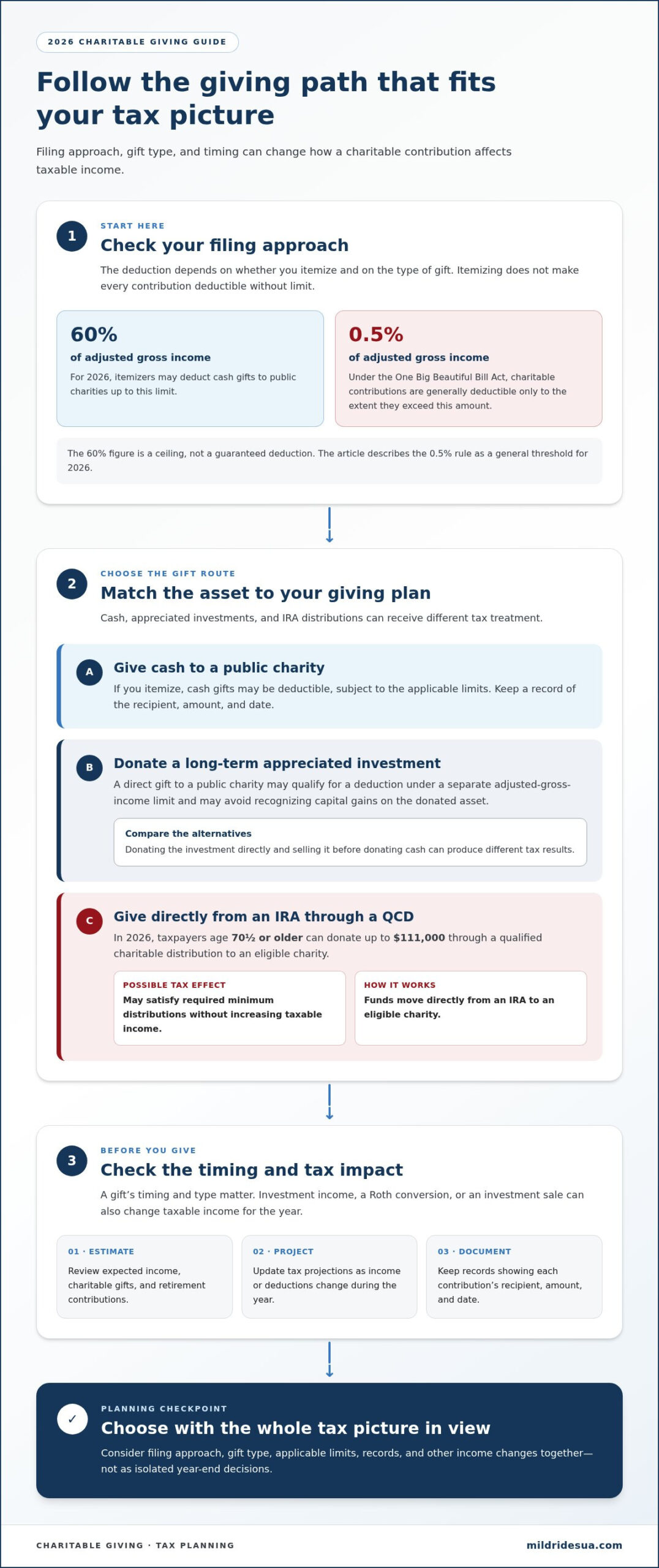
Charitable giving can lower taxable income, but the benefit depends on how you give and whether you itemize. In 2026, according to the Internal Revenue Service, itemizers may deduct cash gifts to public charities up to 60% of adjusted gross income; under the One Big Beautiful Bill Act, charitable contributions are generally deductible only to the extent they exceed 0.5% of adjusted gross income. Thoughtful tax planning for high earners can help make charitable gifts part of a broader strategy rather than an isolated year-end decision.
It’s reasonable to expect a generous gift to affect your tax bill, but the timing, type of asset, and tax treatment all matter. Giving appreciated investments or making a qualified charitable distribution may work differently from donating cash. A Roth conversion or investment sale can also change your taxable income for the year.
This article explains how charitable contributions, Roth conversions, tax-loss harvesting, and investment choices may shape your federal tax picture. You’ll learn the main rules and trade-offs to consider, helping you weigh immediate tax effects alongside longer-term financial goals.
Key Takeaways
- Match charitable gifts to your filing approach: according to the Internal Revenue Service, itemizers may deduct cash gifts to public charities up to 60% of adjusted gross income.
- Before converting traditional retirement funds to a Roth IRA, weigh the current-year tax on the converted amount against the potential for tax-free growth and qualified withdrawals later.
- Use tax-loss harvesting strategically: according to the Internal Revenue Service, net capital losses can offset capital gains, and up to $3,000 can be deducted against ordinary income annually.
- Review how investment interest and mutual fund purchase timing affect taxable income before making year-end portfolio decisions.
- Consider whether a qualified charitable distribution fits your charitable and retirement-income plans, since it may let an eligible IRA owner give directly to charity.
1. Charitable contributions and qualified charitable distributions
Charitable gifts can reduce taxable income, but the deduction depends on your filing approach and gift type. According to the Internal Revenue Service, U.S. itemizers may deduct cash gifts to public charities up to 60% of adjusted gross income. The limit is a ceiling, not a guaranteed deduction. Keep records showing the recipient, amount, and date of each contribution.
Donating appreciated investments may align charitable goals with wealth management. A direct gift of long-term appreciated assets to a public charity may qualify for a deduction, subject to a separate adjusted-gross-income limit, and may avoid recognizing capital gains on the donated asset. Compare this with selling the investment and donating cash, since the tax results differ.
Annual gift tax exclusions and education funding can work together. Under the 2025 annual exclusion, a person could give $19,000 per recipient without reporting gifts within that limit. The 2026 figures allow a married couple to give $38,000 to one recipient. A 529 plan contribution may be front-loaded with up to five years of annual-exclusion contributions. Qualified 529 plan distributions are tax-free, while contributions don’t receive a federal tax break.
Workplace retirement contributions can reduce current taxable income when made on a pre-tax basis. For 2026, employees can contribute up to $24,500 to a workplace retirement plan. Eligible participants age 50 or older can make an $8,000 catch-up contribution; those ages 60 through 63 can contribute an $11,250 catch-up amount. The 2026 IRA contribution limit is $7,500, with an additional $1,100 for contributors age 50 or older. Roth IRA contributions don’t offer the same current-year deduction as pre-tax contributions.
HSAs offer deductible contributions, tax-free growth, and tax-free withdrawals for qualified medical expenses. A 529 plan can support education goals, while deferred compensation may shift when income is received; payout terms and access restrictions affect its usefulness and risk.
When bonuses, investment income, charitable gifts, or retirement contributions change your expected tax picture, review estimated tax payments, withholding, and tax projections. Update projections during the year, then adjust withholding or estimated payments to reflect revised income and deductions.
A qualified charitable distribution can move funds directly from an IRA to an eligible charity. In 2026, taxpayers age 70½ or older can donate up to $111,000 through a qualified charitable distribution. The distribution can satisfy required minimum distributions without increasing taxable income. This can suit retirees who want to give from retirement assets rather than withdraw funds and donate afterward.
2. Roth IRA conversions
A Roth conversion moves eligible funds from a traditional IRA or retirement account into a Roth IRA. The converted amount generally becomes taxable income in the year of conversion. In return, future growth and qualified withdrawals are generally tax-free. The strategy changes when tax is paid rather than simply eliminating it.
Model a conversion before moving funds. Estimate your income for the year, add the proposed converted amount, then assess the effect on your federal tax picture. A large conversion can increase current-year income tax; a partial conversion can spread taxable income across different years. The right amount depends on income, available cash to pay the tax, and retirement goals.
There are no income limits for converting traditional IRA assets to Roth IRAs. That makes conversions a possible option for high earners who cannot contribute directly to a Roth IRA. A conversion must be completed by December 31 to count for the 2026 tax year. The converted amount also has a five-year holding period, so consider when you may need access to those funds.
Required minimum distributions add another planning factor. Traditional IRA required minimum distributions must begin at age 73. A conversion strategy can be considered before that point, alongside expected income and retirement withdrawals. Projecting several years together helps reveal whether converting funds earlier could help manage future taxable income. A Roth conversion still creates income tax in its conversion year, so include the tax payment in your cash-flow plan.
A backdoor Roth strategy typically involves making an after-tax contribution to a traditional IRA, then converting those assets to a Roth IRA. A mega backdoor Roth uses after-tax contributions to a 401(k), followed by conversion to a Roth IRA. The episode says eligible employees with a mega backdoor Roth option could contribute after-tax amounts beyond the elective limit, up to $66,000. Review plan rules and the tax consequences before choosing either approach.
These strategies suit different account types and circumstances. A conversion may appeal when you can pay the tax from funds outside the retirement account and expect to leave Roth assets invested. It may be less suitable when the additional taxable income disrupts other planned decisions. A careful tax projection can compare conversion amounts, timing, and available cash before you act. For a focused Roth conversion tax projection, compare the proposed transaction with your broader income plan.
3. Tax-loss harvesting
Tax-loss harvesting means selling an investment at a loss to offset realized capital gains. For example, selling an underperforming fund can create a loss to offset gains from another investment sale. This may reduce taxable gains for the year, but it also changes your portfolio. Consider whether a replacement investment still supports your allocation and long-term plan.
According to the Internal Revenue Service, taxpayers may deduct up to $3,000 in net capital losses against ordinary income annually, with additional losses carried forward. Losses first offset capital gains, then eligible remaining losses may offset ordinary income within that limit. Any excess can carry forward to offset capital gains or income in future years. Keep transaction records so reported proceeds and cost basis match your account statements.
The wash sale rule can disallow a loss for tax purposes when you sell and quickly repurchase a substantially identical investment. According to the Internal Revenue Service, the rule applies when the purchase occurs within 30 days before or after the loss sale. A substantially identical security bought by your spouse or a company you control during that window can also trigger the rule. Coordinate transactions across accounts, not just within one brokerage account.
Complex tax strategies carry risks when transactions are mistimed, misreported, or inconsistent with IRS rules. Wash-sale adjustments can affect the loss you claim, while capital gains and qualified dividends add investment income to your tax picture. Long-term capital gains may be taxed at 0%, 15%, or 20%, depending on income. The net investment income tax is 3.8% on applicable investment income above certain thresholds, according to the Internal Revenue Service.
Tax-loss harvesting and asset location address different parts of portfolio taxation. Harvesting uses realized losses to offset gains; asset location places investments in account types suited to their tax characteristics. Tax-efficient investments, such as broad-market ETFs and municipal bonds, may fit taxable accounts, while tax-inefficient investments may fit tax-advantaged accounts. Review the portfolio as a whole before moving assets between accounts.
Timing matters. Before selling, identify the gain or loss you plan to realize, review recent and planned purchases, and consider whether the sale changes your investment exposure. If replacing a holding, choose an investment that maintains your desired allocation without creating a wash sale. Track related purchases by your spouse and controlled companies, since those transactions can affect the same tax result.
A harvested loss may reduce taxes, but it doesn’t erase an investment decline or guarantee a lower total liability. Compare the expected tax effect with transaction costs, portfolio changes, and future gains. For high-income investors, a year-end review can bring capital gains, qualified dividends, account location, and available carryforwards into one coordinated decision.
4. Deductible investment interest and mutual fund purchase timing
Interest paid to borrow for taxable investments may be deductible up to net investment income for the year. For example, if borrowed funds buy income-producing securities, track the loan balance, interest paid, and related investment income separately. The deduction’s value depends on the amount of qualifying investment income you report. Keep lender statements and transaction records with your portfolio documents.
Mutual fund purchase timing can also affect taxable income. A fund may distribute dividends or capital gains to shareholders, including investors who bought shares shortly before the distribution. Before purchasing near a scheduled distribution, review its timing and expected tax treatment. The distribution may create taxable income even if you bought recently, so weigh the tax effect against your investment objective.
State residency can change the tax picture for people who live or work across state lines. Many states use 183 days of physical presence and residence as a factor in determining resident filing obligations. Keep travel records, housing details, and work locations organized by state. For 2026, the state and local tax deduction cap is $40,400 per household, and the higher cap begins phasing down above $505,000 of modified adjusted gross income.
Traditional IRA deductions depend on modified adjusted gross income and workplace-plan coverage. For 2026, a single taxpayer covered by a workplace plan can claim a full deduction at MAGI of $81,000 or less. The corresponding threshold is $129,000 for joint filers when both are covered, and $242,000 when one spouse is covered. Check filing status and coverage before treating an IRA contribution as deductible.
Mortgage interest and pass-through entity taxes require separate review. The mortgage interest deduction described here is limited to borrowing principal of up to $750,000. More than 34 states allow eligible small-business owners to reduce federal income tax through optional pass-through entity taxes. Confirm that reported mortgage balances and business tax elections match supporting records.
For 2026, federal tax brackets apply progressively, so each portion of taxable income falls within its applicable bracket. The standard deduction depends on filing status; compare it with eligible itemized deductions before choosing how to file. High income alone doesn’t determine the tax on every dollar, because deductions and the income type also affect taxable income.
Reporting errors can hide deductions or misstate investment income. Reconcile Form 1099 statements against brokerage activity, record investment-interest expenses, and confirm state withholding across each work location. Review IRA contribution treatment and mortgage interest before filing. A practical final step is to compare the return with prior-year schedules, then investigate changes in income, deductions, and portfolio transactions.
5. Qualified charitable distributions
A qualified charitable distribution (QCD) sends money directly from an eligible IRA to an eligible charity. The direct transfer matters: taking an IRA distribution personally and donating the proceeds afterward is a different transaction. For a QCD, the IRA custodian sends the funds to the organization, and the account owner keeps records of the transfer and recipient. Taxpayers must be at least age 70½ to make a QCD from an IRA.
A QCD can support charitable goals while shaping retirement income. An eligible transfer can satisfy required minimum distributions without increasing taxable income. This may matter when an IRA withdrawal would otherwise add to income used in other tax calculations. Plan the gift with the IRA custodian and charity, allowing time for the transfer to be completed within the intended tax year.
Donor-advised funds offer another way to organize giving. You contribute assets to the fund, then recommend grants to eligible charities over time. Donating appreciated stock or real estate directly to a donor-advised fund may provide a fair-market-value deduction while avoiding capital gains tax. Compare this with giving cash, especially if an asset has grown substantially and selling it first could create taxable gains.
Charitable deductions depend on the gift, the recipient, and whether you itemize. For 2026, itemizers may deduct cash gifts to public charities up to 60% of adjusted gross income, according to the Internal Revenue Service. The One Big Beautiful Bill Act generally allows itemized charitable contributions only to the extent they exceed 0.5% of adjusted gross income. Starting in tax year 2026, non-itemizers may deduct cash gifts up to $1,000 when filing singly, or $2,000 when filing jointly.
A charitable remainder trust may suit a different objective. It can spread income from selling appreciated assets and potentially reduce immediate capital gains tax while supporting charitable goals. The trust structure also affects how income reaches beneficiaries, so consider cash-flow needs, charitable intent, and estate plans together. Compare the trust with an outright gift or donor-advised fund as part of your planning.
Before transferring assets, identify the charity, asset ownership, cost basis, and intended tax year. Keep receipts, custodian statements, and transfer confirmations with federal tax records. A year-end review can also coordinate giving with retirement distributions and other income. Plan charitable gifts with tax considerations in view and align documentation with your wider financial decisions.
Mildrid Esua, CPA, PLLC: Tax Planning & Tax Preparation,Bookkeeping IRS Representation small business accounting Tax resolution unfiled tax, tax lien , payroll servies
Mildrid Esua, CPA, PLLC helps individuals and small businesses with tax planning and tax preparation. Turn to the firm when charitable giving, retirement account decisions, investment income, or business finances make your tax picture more complex. A coordinated review can connect current-year reporting with decisions that affect future taxable income, rather than treating each transaction in isolation.
For small-business owners, an accountant and tax advisor can help organize business records alongside personal tax considerations. If you’re dealing with unfiled returns, back taxes, or tax liens, the firm also provides tax resolution services and IRS representation. The next step depends on the issue you need to address and the records involved.
Contact Mildrid Esua, CPA, PLLC to discuss your tax planning needs, or visit mildridesua.com.
Build a tax strategy that keeps moving with you
The next step is to turn individual tax choices into a coordinated plan. Income, investments, retirement decisions, and business activity can shift during the year, so revisit your assumptions when a major financial change occurs. A forward-looking approach to tax planning for high earners connects those decisions with your broader priorities instead of treating tax preparation as a once-a-year task.
Mildrid Esua, CPA, PLLC offers tax planning and preparation, along with accounting and tax advisory support for small businesses. If an unresolved filing, tax lien, or back-tax issue is distracting you from future planning, the firm also provides tax resolution services. A focused conversation can clarify which tax matters need attention first and what records will support your next decisions.
Contact Mildrid Esua, CPA, PLLC to discuss your tax planning needs. With a clear starting point, you can approach the next financial decision with greater direction and confidence.
Frequently Asked Questions
Can charitable giving significantly impact my tax bill?
Yes, charitable gifts can affect taxable income, especially when planned alongside other deductions. Before giving, estimate your full-year income and itemized expenses, then compare cash with appreciated assets. For example, donating shares directly can avoid selling them first and recognizing a capital gain. Keep the charity’s acknowledgment and transfer records, and consider how the timing fits your cash-flow and giving plans.
Can high-income earners qualify for Roth IRA conversions?
Yes, there are no income limits for converting traditional IRA assets to a Roth IRA. The key consideration is the income tax triggered by the amount converted that year. Before acting, project your income and decide how to pay the tax without disrupting your cash reserves. A partial conversion can help manage the amount recognized in one year, while a full conversion shifts more taxable income into that year.
How do you leave a high tax state for a lower or no tax state?
Establishing a genuine change in residence involves more than changing your mailing address. Review where you live, work, spend time, and maintain important personal ties, then keep records that support the change. States may use physical presence and residence in determining filing obligations; many use 183 days as a threshold. For someone relocating from Greensboro, North Carolina, documenting the move and income earned in each state can help clarify filing responsibilities.
What Are the Most Effective Tax Planning Strategies for High-Income Earners?
The most effective approach coordinates income timing, retirement savings, investments, charitable plans, and estimated payments. Start by projecting income from wages, business activity, and investments, then identify decisions that could change taxable income. For example, a bonus or asset sale can affect whether a planned conversion or charitable contribution fits the year. Strong tax planning for high earners connects these choices with cash needs and long-term goals.
What Recent or Upcoming Tax Law Changes Are Relevant for High-Income Earners?
For tax year 2026, the One Big Beautiful Bill Act generally limits itemized charitable deductions to contributions exceeding 0.5% of adjusted gross income. The 2026 state and local tax deduction cap is $40,400 per household, with the higher cap beginning to phase down above $505,000 in modified adjusted gross income. These provisions can change the value of itemizing, so compare projected deductions with your filing approach.
What are some of the common tax planning mistakes that you see made?
Common errors include selling investments without checking the tax result, overlooking transactions across accounts, and failing to reconcile tax forms with financial records. A sale at a loss followed by a substantially identical purchase within the wash-sale window can affect the loss claimed. Other oversights include forgetting investment interest expenses or treating an IRA contribution as deductible without considering workplace-plan coverage and income.
What tax-advantaged retirement contributions can high earners make, including backdoor Roth strategies?
High earners can consider pre-tax workplace-plan contributions, deductible traditional IRA contributions when eligible, and Roth strategies. For 2026, the workplace-plan contribution limit is $24,500, and the IRA limit is $7,500. A backdoor Roth generally uses an after-tax traditional IRA contribution followed by conversion. A mega backdoor Roth uses after-tax 401(k) contributions and a subsequent Roth conversion, subject to the plan’s terms.
How can high earners use charitable giving, donor-advised funds, and qualified charitable distributions to reduce taxes?
Choose a giving method based on the asset, timing, and income goal. A donor-advised fund can receive a contribution now while grants to charities happen later. Donating appreciated assets directly can avoid recognizing capital gains on a sale. Eligible IRA owners can use qualified charitable distributions for direct gifts from retirement accounts. Keep transfer confirmations and charity records, and coordinate the gift with your retirement and estate plans.



Leave a Reply
Your email is safe with us.