

For North Carolina taxpayers, IRS payment plan options in NC include short-term plans and monthly installment agreements. According to the Internal Revenue Service, individuals may qualify for a short-term plan when they owe less than $100,000 in combined tax, penalties, and interest and can pay within 180 days; an online long-term plan may be available when they owe $50,000 or less and have filed all required returns. The right starting point depends on your balance, filing status, and ability to pay by the collection deadline.
Choosing an IRS payment plan is only part of the decision. You also need to know how to apply and whether your balance requires direct debit or allows payroll deduction. This guide explains the main eligibility thresholds, compares short- and long-term options, and outlines payment setup requirements so you can approach the IRS with a clearer plan.
Key Takeaways
- Compare your balance, filing status, and ability to pay by the collection deadline to narrow down a suitable repayment route.
- Find out whether your plan requires direct debit or allows payroll deduction, and gather the relevant payment details before applying.
- Choose an application method that fits your situation; online applications, Form 9465, and phone applications each have specific steps.
- Keep required returns filed and payments current after the plan starts to reduce the risk of default.
Am I eligible for an Installment Payment Agreement?
Eligibility depends on your balance, filed returns, ability to pay, and collection status. North Carolina state agreements are separate from IRS plans, so address each tax debt with the agency that assessed it.
Requesting an Agreement in North Carolina
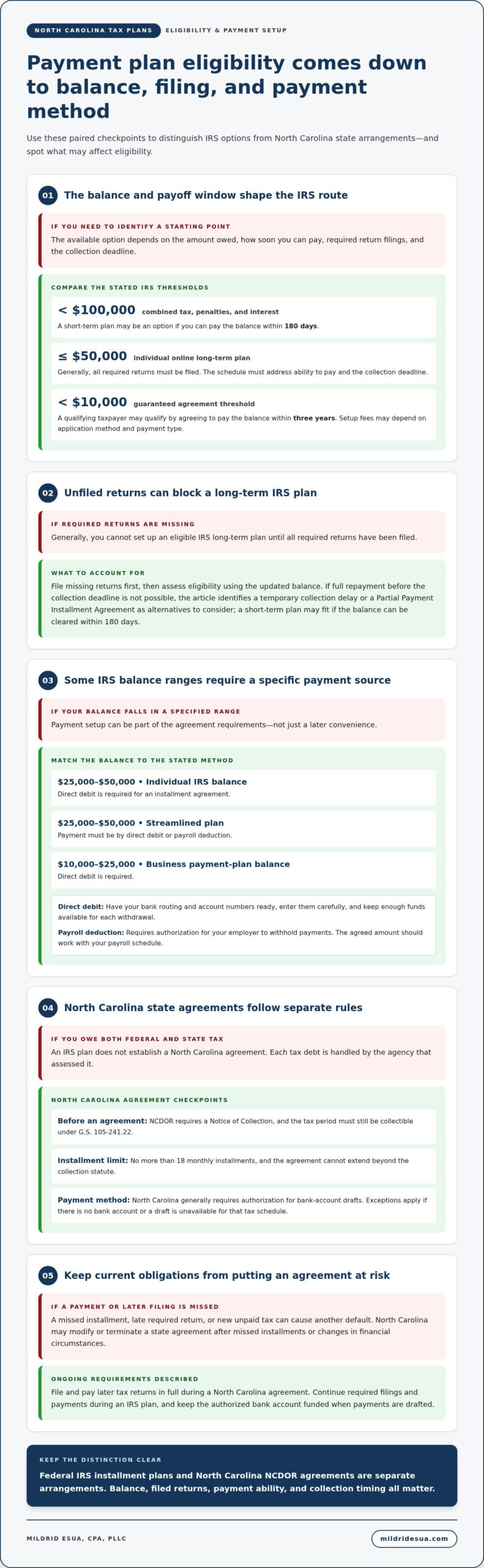
A North Carolina installment agreement is a state payment arrangement for eligible tax debt. NCDOR requires a Notice of Collection before it can establish an agreement, and the tax period must still be collectible under G.S. 105-241.22. Agreements may cover no more than 18 monthly installments and cannot extend beyond the collection statute. You must file and pay later tax returns in full during the agreement.
Guaranteed Agreements for Smaller Balances
A guaranteed installment agreement is an IRS arrangement for qualifying taxpayers with smaller balances. If you owe less than $10,000, you may qualify by agreeing to pay the balance within three years. The IRS may charge setup fees based on the application method and payment type.
A previous default doesn’t automatically rule out every option. A missed installment, late required return, or new unpaid tax can cause another default, so keep current obligations on track.
Long-Term Agreement Eligibility
A long-term installment agreement lets an eligible taxpayer pay an IRS balance through scheduled installments. For an online plan, individuals generally need a combined tax, penalty, and interest balance of $50,000 or less and must have filed all required returns. The payment schedule must address the taxpayer’s ability to pay and the collection deadline.
What are the eligibility requirements for an IRS long-term installment agreement? The key tests are the balance threshold, required return filings, and ability to pay within the collection period. If your balance or circumstances fall outside standard terms, the IRS may require financial information.
Unfiled Returns and Agreement Eligibility
Filing compliance means submitting all required tax returns before seeking an eligible IRS long-term plan. Can you set up an IRS payment plan if you haven’t filed all required returns? Generally, no. File missing returns first, then assess eligibility using the updated balance. Mildrid Esua, CPA, PLLC provides tax preparation and resolution support for unfiled returns.
Alternatives include an IRS short-term plan, a temporary collection delay, or a Partial Payment Installment Agreement. According to the Internal Revenue Service, the failure-to-pay penalty is capped at 25% of unpaid tax. A short-term plan may suit someone who can clear the balance within 180 days; a partial-payment arrangement may fit when full repayment before the collection deadline isn’t possible.
Changing an agreement can help address a shift in income or payment ability. What are the IRS installment agreement fees, and how can taxpayers reduce them? North Carolina may modify or terminate a state agreement after missed installments or changes in financial circumstances.
Direct debit or payroll deduction requirements
Direct debit is an automatic bank withdrawal for scheduled IRS installments. Payroll deduction sends payments from your wages through your employer. The required method can depend on taxpayer type and balance. Before applying, decide which account or payroll source can reliably cover each installment.
Direct Debit and Payroll Setup
For an individual balance from $25,000 to $50,000, the IRS requires direct debit for an installment agreement. Streamlined plans in that balance range require payment by direct debit or payroll deduction. Business payment-plan balances from $10,000 to $25,000 also require direct debit. These thresholds make payment setup part of eligibility, not simply a later convenience.
For direct debit, have your bank routing and account numbers ready. Enter them carefully when setting up the plan, then keep enough funds available for each withdrawal. Payroll deduction instead requires an authorization directing your employer to withhold payments. Choose this method only if the agreed amount works with your payroll schedule.
Financial Disclosure
A financial disclosure lists income, expenses, assets, and liabilities to help assess payment ability. The described IRS plans for individuals and out-of-business sole proprietors don’t require a financial statement. However, the IRS still decides whether to file a notice of federal tax lien. That decision is separate from the payment method, so an approved installment agreement doesn’t resolve lien questions by itself.
Trust fund taxes are employment taxes withheld from workers’ wages, such as income tax and Social Security and Medicare taxes. An IRS Simple Payment Plan doesn’t require a trust fund recovery penalty determination. For businesses, the payment route depends on the type of tax debt and assessed balance. Keep payroll filings and deposits organized, because new unpaid taxes can put an existing plan at risk.
North Carolina Collection Requirements
A Notice of Collection is the state notice required before NCDOR can establish an installment agreement. North Carolina generally requires taxpayers to authorize bank-account drafts under G.S. 105-241(a). Exceptions apply when a taxpayer has no bank account or a draft isn’t available for that tax schedule. If you owe both federal and state tax, set up each arrangement with the agency collecting that debt.
NCDOR applies state and federal refunds and North Carolina Education Lottery winnings to state tax debt during an agreement. Those offsets don’t count as scheduled installments. Continue filing and paying later returns in full, and maintain the authorized bank account for drafts. For payroll or bookkeeping records that affect payment setup, payroll services can support clearer account management.
Eligibility thresholds for IRS payment plans
IRS payment-plan eligibility depends on the balance owed, filing compliance, taxpayer type, and time available to pay. Different thresholds apply to short-term plans, Simple Payment Plans, and business debts, so identify the type of tax account before choosing an application route.
Short-Term Payment Plans
A short-term payment plan gives an eligible individual time to pay the full balance without monthly installments. According to the Internal Revenue Service, individuals may qualify if they owe less than $100,000 in combined tax, penalties, and interest and can pay within 180 days. This option can suit a taxpayer expecting funds soon, such as a scheduled business receivable or a tax refund.
Compare the payoff date with your cash flow before applying. A short-term plan has no setup fee, but interest and penalties continue until the balance is paid. If your expected funds won’t cover the full amount within the plan period, consider monthly installments instead of relying on a payoff date your income can’t support.
Simple Payment Plan Thresholds
A Simple Payment Plan is an IRS installment arrangement for eligible taxpayers who can pay by the collection deadline. Individuals may qualify with assessed tax, penalties, and interest totaling $50,000 or less, provided they are current with required filing and payment obligations. The plan does not require a collection information statement, which means applicants don’t submit that detailed financial disclosure.
The collection deadline matters as much as the balance. The IRS collection statute is generally 10 years from assessment, though certain actions can extend it. A longer payment schedule can add interest and penalties before payoff. Review the assessed balance, remaining collection time, and realistic installment amount together.
Business Payment Plan Thresholds
A business payment plan applies to tax debt assessed to a business, with eligibility shaped by tax type and balance. Businesses without trust fund taxes may qualify for a Simple Payment Plan when assessed tax, penalties, and interest total $50,000 or less. A qualifying business trust fund Simple Payment Plan requires an assessed balance of $25,000 or less and full payment by the collection deadline.
Some businesses with combined tax, penalties, and interest below $25,000 from the current and preceding tax year may pay monthly for up to 24 months. Sole proprietors and independent contractors generally apply as individuals. Businesses don’t qualify for a non-streamlined installment agreement, so distinguish business liabilities from an owner’s personal tax debt.
Other Eligibility Considerations
Payment-plan eligibility is separate from credit approval. The IRS doesn’t report installment agreements directly to credit bureaus, although a federal tax lien may affect financing. Before applying, confirm that required returns are filed, calculate the full assessed balance, and choose a payment amount your income can sustain. These steps help match your request to the right account and repayment threshold.
What are IRS payment plans?
IRS payment plans let eligible taxpayers pay federal tax debt over an agreed period. North Carolina taxpayers can compare IRS payment plan options in NC by considering the balance, filing status, payment method, and time remaining for collection.
Individual Short-Term Plans
A short-term payment plan gives an individual time to pay the full balance without a long-term installment schedule. According to the Internal Revenue Service, U.S. individual taxpayers may qualify for an IRS short-term payment plan if they owe less than $100,000 in combined tax, penalties, and interest. According to the Internal Revenue Service, individual taxpayers can use an IRS short-term payment plan to pay their balance within 180 days or less.
A short-term plan may work when you expect funds soon, such as revenue from a completed project. It has no setup fee, but penalties and interest continue until the debt is paid. Compare expected cash flow with the payoff deadline before choosing this option.
Simple Payment Plans for Individuals
A Simple Payment Plan is a long-term IRS arrangement with scheduled payments. For IRS online long-term payment plan applications, an individual taxpayer may qualify if they owe $50,000 or less in combined tax, penalties, and interest and have filed all required returns, according to the Internal Revenue Service. Payments must fit within the collection deadline, and longer repayment generally means more interest and penalties.
Individuals can apply through an IRS Online Account, by telephone, or using Form 9465 when online application isn’t available. Set a monthly amount that fits your budget while reducing the balance before collection expires. Continue filing required returns and paying new tax obligations as they come due.
Applying When the Balance Exceeds $50,000
A non-streamlined installment agreement is a negotiated payment arrangement for certain balances outside streamlined thresholds. Individuals and out-of-business sole proprietors already working with the IRS on a tax issue and owing $250,000 or less may propose monthly payments over the collection statute, usually 10 years. Businesses don’t qualify for this non-streamlined option.
If you owe more than $50,000 and can pay within ten years, Form 9465 can request an installment agreement. The IRS may require financial information to assess ability to pay. Organize income, expenses, assets, and liabilities before submitting your request. These details help distinguish among IRS payment plan options in NC when a standard online route doesn’t fit.
Business Trust Fund Plans and Online Management
A business trust fund Simple Payment Plan is an arrangement for qualifying assessed employment-tax debt. The assessed balance must be $25,000 or less, and the business must pay in full by the collection deadline. This plan doesn’t require a trust fund recovery penalty determination.
The IRS Online Payment Agreement tool also lets taxpayers manage an existing plan, including requesting a change. Review the updated monthly amount and withdrawal date after approval, then keep funds available in the bank account. A missed payment or new unpaid federal tax can cause the agreement to default.
Online payment plan applications
An online payment plan application lets eligible taxpayers request or manage an IRS agreement through the agency’s digital tool. For North Carolina taxpayers, applying online can simplify the federal request, but eligibility, payment method, and account details still need careful review.
Prepare Before You Apply
An IRS Online Account provides secure access to the payment-plan application. Individuals need an account and photo identification to create one. Before starting, gather your tax balance and filing details, along with your bank account information if you plan to use direct debit. Compare the proposed monthly payment with your available cash flow.
The IRS Online Payment Agreement tool is available daily from 5 a.m. to 12 a.m. Eastern time. Confirm that required returns are filed before applying for a long-term plan. The online long-term option generally requires an individual balance of $50,000 or less in combined tax, penalties, and interest.
Submit and Review the Request
After signing in, choose whether you’re requesting a new agreement or changing an existing one. Enter the requested tax and payment details, select a payment date, and review the terms before submitting. Applicants receive an approval decision immediately after completing an online application. Save the decision and payment schedule for your records.
For direct debit, enter the bank routing and account numbers exactly as shown by your financial institution. Check that the selected account can cover the scheduled withdrawal. If online application isn’t available for your circumstances, individuals can submit Form 9465, Installment Agreement Request.
Setup Fees and Existing Agreements
Online setup fees depend on the payment method. Low-income taxpayers may qualify for a fee waiver or reimbursement under applicable conditions. A short-term plan has no setup fee, though penalties and interest continue until the federal tax balance is paid.
Taxpayers can use the online tool to request a change to an existing payment agreement. Review the updated monthly amount and withdrawal date after approval, then keep funds available in the bank account. A missed payment or new unpaid federal tax can cause the agreement to default.
If IRS notices, unfiled returns, or a complex balance complicate your application, get help with IRS representation to organize the next steps.
Mildrid Esua, CPA, PLLC: Tax Planning & Tax Preparation,Bookkeeping IRS Representation small business accounting Tax resolution unfiled tax, tax lien , payroll servies
Mildrid Esua, CPA, PLLC helps individuals and small businesses address IRS debt through IRS representation and tax resolution services. Consider professional support if unfiled tax returns, tax liens, or an unaffordable proposed payment make it difficult to move forward. Reviewing filing obligations, balances, and payment options can clarify next steps and help you prepare for IRS communication.
For small businesses, tax planning, preparation, bookkeeping, and payroll services can support organized records and ongoing tax compliance. For individuals facing back taxes, tax resolution services can help address the outstanding issue and assess a path forward based on the account’s circumstances.
To discuss your tax situation, contact Mildrid Esua, CPA, PLLC or visit the firm’s website.
Build a Clear Path Forward
A payment arrangement is only one part of getting a tax account back on track. Keep future filings organized, make payments consistently, and address unresolved returns or notices before they create further complications. A deliberate plan can support steadier decisions for household finances and business operations.
Choosing among IRS payment plan options in NC can involve more than selecting a payment method. Mildrid Esua, CPA, PLLC provides IRS representation and tax resolution services, along with tax planning and preparation for individuals and small businesses. If unfiled returns, back taxes, or a tax lien are complicating your decisions, professional support can help you assess the issue and plan next steps.
Take the next step at a pace that fits your circumstances. Contact Mildrid Esua, CPA, PLLC to discuss your tax situation and move forward with greater clarity.
Frequently Asked Questions
What is the Minimum Monthly Payment for an IRS Installment Plan?
If you don’t propose another amount, the IRS typically calculates the minimum by dividing your balance by 72. The result is a starting point, not a personalized budget assessment. For example, compare the proposed installment with rent, payroll, and essential expenses before accepting the schedule. A payment that strains cash flow can make missed installments more likely, so consider affordability alongside the payoff timeline.
If I set up an IRS installment agreement form, can I change or stop it?
You can request a change to an existing IRS agreement, including through the Online Payment Agreement tool. A change may affect the payment amount or withdrawal arrangement, so review the revised terms before relying on them. Don’t simply stop a bank withdrawal or payroll deduction without addressing the agreement. Missed payments can lead to default. Contact the IRS through an appropriate channel to discuss changing or ending the arrangement.
What Happens If I Default on an IRS Payment Plan?
A missed installment, an overdue required return, or new unpaid tax can cause an IRS plan to default. If you receive a CP523 notice, contact the IRS no later than 30 days from the notice date. The IRS may charge a reinstatement fee when restoring a defaulted agreement. Address the notice promptly and review whether your payment amount still matches your current finances and filing obligations.
What Is the IRS Payment Plan Interest Rate?
The interest rate on unpaid federal tax is based on the short-term federal rate plus 3%. Because the short-term rate is a component, the resulting interest charge can change. Interest continues to accrue while a balance remains unpaid, including during an installment plan. Estimate the cost using your current account balance and payment timeline, rather than treating the scheduled installment as the total amount you’ll owe.
What is IRS Form 9465?
IRS Form 9465, Installment Agreement Request, is a form individuals can use to request an installment agreement. It can be useful when you can’t apply through the online system or need to make a request by mail. Complete the form with accurate tax and payment information, and consider direct debit details if you want automatic withdrawals. Keep a copy of the submitted request and any IRS response.
What are the eligibility requirements for an IRS short-term payment plan?
According to the Internal Revenue Service, an individual may qualify if the combined tax, penalties, and interest balance is less than $100,000 and can be paid within 180 days. This option is intended for a full payoff, not an ongoing monthly installment schedule. Consider whether funds will be available by the deadline, and account for interest and penalties that continue while the balance remains unpaid.
How do IRS payment plan interest and penalties accrue?
Interest and penalties can continue adding to an unpaid balance during repayment. When a return was filed on time and an installment agreement is in effect, the late-payment penalty accrues at 0.25% per month instead of up to 0.5% per month. The Internal Revenue Service states that the failure-to-pay penalty is capped at 25% of unpaid tax. Paying sooner reduces the time charges can accrue.
How do I apply for an IRS payment plan online or by phone?
Individuals can apply online through an IRS Online Account or by calling 800-829-1040. Creating an online account requires photo identification, and the online application provides an immediate approval decision after submission. Before starting, gather your balance and payment details. Businesses can apply for a Simple Payment Plan by calling 800-829-4933. Keep the application response and payment schedule with your tax records.




Leave a Reply
Your email is safe with us.