


A simple ownership structure at purchase can create unexpected complexity when you report rental income or sell the property. For foreign investors, foreign investment in US real estate tax advice starts with considering the full investment cycle, not just the acquisition. U.S. tax obligations can depend on who owns the property, how it is used, what income it generates, and the investor’s circumstances.
This guide outlines questions to address before acquiring U.S. real estate and practical steps for ongoing compliance and a future sale. You’ll learn how to compare ownership options, organize rental records, and consider how federal, state, and home-country tax rules may interact. The goal is to make informed decisions based on your circumstances rather than assume one structure fits every investor.
FIRPTA withholding also deserves attention during exit planning. It is important to distinguish withholding collected during a qualifying transaction from the final tax liability. Planning ahead can help you identify the records and decisions to address before closing, during ownership, and before a sale.
Key Takeaways
- Use foreign investment in US real estate tax advice to connect ownership, income reporting, ongoing compliance, and exit planning.
- Compare direct, LLC, and corporate ownership based on tax treatment, reporting, administration, and the planned sale.
- Keep organized records of rental income, expenses, property improvements, ownership, and any withholding or tax paid.
- FIRPTA withholding at a qualifying sale is not necessarily the seller’s final tax liability.
- Gather investor, property, entity, financing, and income information before closing to support coordinated cross-border planning.
Foreign investment in U.S. real estate: map the tax decisions before buying
Foreign investment tax advice means planning for U.S. tax consequences across the ownership cycle: acquiring and holding property, earning income, and eventually selling. The right questions depend on more than where you live. Tax status, property use, income, ownership structure, and relevant home-country rules can all affect the analysis.
The tax outcome depends on the facts, not nationality alone. A nonresident individual buying a rental home, a foreign entity investing in commercial property, and an overseas owner using a U.S. residence personally may face different tax and reporting considerations. Before closing, identify who will own the property, how it will be used, and what income or transactions you expect. This links the purchase decision to future compliance and disposition planning.
This video offers additional context on withholding and U.S. real estate transactions:
Which facts shape a foreign investor’s U.S. tax position?
Start by identifying the legal owner and how that owner is classified for tax purposes. An individual’s status, including whether they are treated as a nonresident alien, differs from the status of a foreign entity. Then clarify the property’s intended use: residential or commercial, personal use or rental. These details help determine which income and reporting questions to address before purchase.
Treaty provisions and home-country rules may also affect the overall picture. Their application depends on the investor’s circumstances and relevant jurisdictions. Review U.S. and home-country considerations together instead of assuming one automatically determines the other. This is where foreign investment in US real estate tax advice can help organize decisions before they become filing issues.
Which tax layers should investors consider?
At the federal level, U.S.-source income may bring income tax and related filing or information-return obligations. The details depend on the owner, income, and transaction. On a later sale, the Foreign Investment in Real Property Tax Act (FIRPTA) may require withholding in certain dispositions. That withholding is separate from the seller’s final tax liability.
State and local rules depend on where the property is located. An investment in North Carolina, for example, calls for attention to applicable state and local requirements. Property taxes are another distinct cost of owning real estate, separate from income tax and transaction withholding. Keep these obligations distinct in your plan while also accounting for possible home-country reporting.
Compare ownership structures before acquiring U.S. investment property
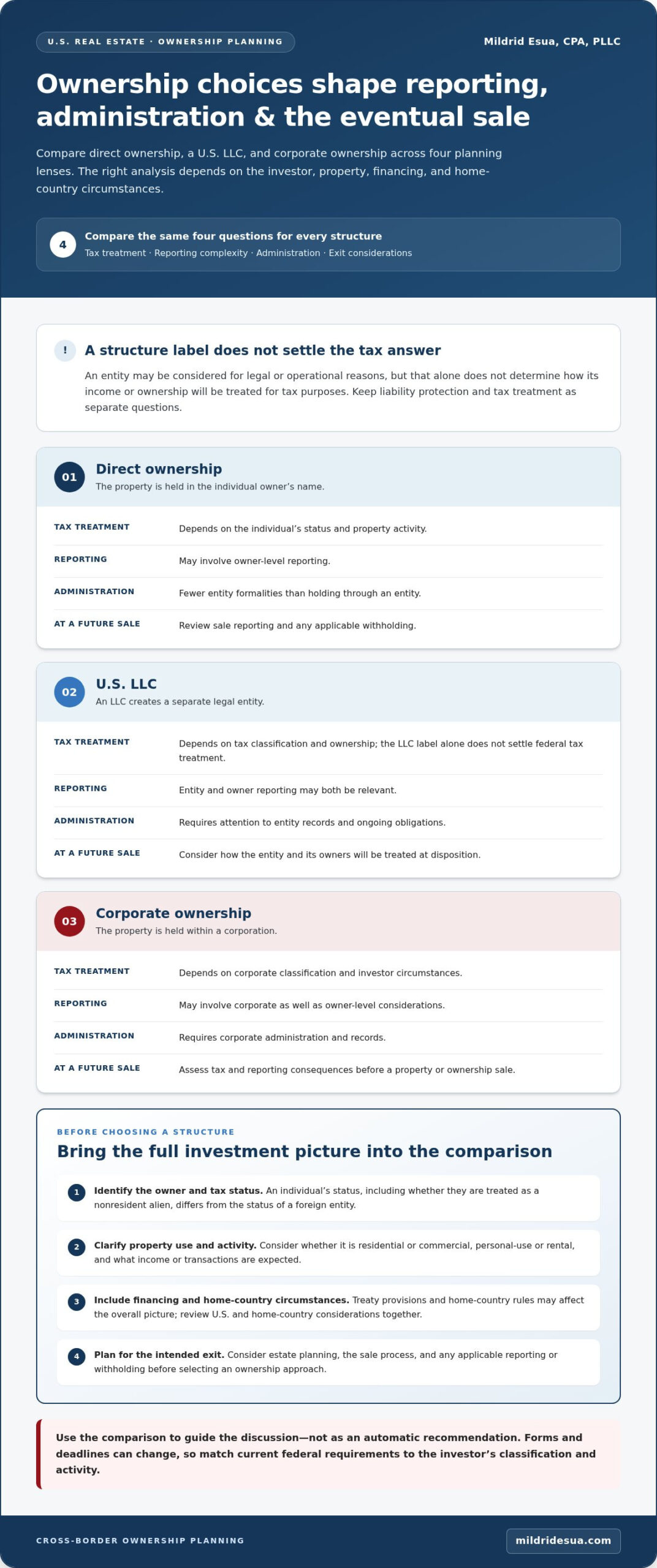
How you hold U.S. property can affect tax reporting, ongoing administration, and the practical steps involved in a future sale. Direct ownership, a U.S. limited liability company (LLC), and corporate ownership are options to compare, not automatic recommendations. The right analysis depends on the investor’s tax status, property, financing, and home-country circumstances.
Keep liability protection and tax treatment as separate questions. An entity may be considered for legal or operational reasons, but that alone does not determine how its income or ownership will be treated for tax purposes. Coordinated foreign investment in US real estate tax advice considers both questions alongside estate planning and the intended exit.
How do direct ownership, an LLC, and a corporation differ for tax planning?
With direct ownership, the property is held in the individual owner’s name. An LLC creates a separate legal entity, while corporate ownership places the property within a corporation. Those labels do not, by themselves, settle federal tax treatment. An LLC’s classification, the owner’s status, and the particular facts can affect reporting. Entity choices can also raise estate planning questions and affect the process for a future sale.
Use this comparison to structure the discussion, not to select an option without reviewing the details:
| Structure | Tax treatment | Reporting complexity | Administration | Exit considerations |
|---|---|---|---|---|
| Direct ownership | Depends on the individual’s status and property activity | May involve owner-level reporting | Fewer entity formalities than holding through an entity | Review sale reporting and any applicable withholding |
| U.S. LLC | Depends on tax classification and ownership | Entity and owner reporting may both be relevant | Requires attention to entity records and ongoing obligations | Consider how the entity and its owners will be treated at disposition |
| Corporation | Depends on corporate classification and investor circumstances | May involve corporate as well as owner-level considerations | Requires corporate administration and records | Assess tax and reporting consequences before a property or ownership sale |
Why coordinate entity and cross-border reporting?
A structure can introduce reporting at more than one level. Depending on the facts, the entity may have its own filing duties, while an individual owner may also need to report U.S. tax items. Forms and deadlines can change, so match current federal requirements to the investor’s classification and activity instead of relying on a generic checklist. The foreign-owned U.S. business tax compliance guide offers related context.
Plan for a future sale from the outset. FIRPTA withholding may apply to certain dispositions, and it is distinct from the final tax liability. The IRS explains relevant FIRPTA withholding requirements. Mildrid Esua, CPA, PLLC provides international tax planning to help connect entity decisions with ongoing compliance and exit planning. Explore cross-border tax guidance.
Plan for rental income, deductions, and recurring U.S. tax compliance
Owning a U.S. rental property can create recurring tax and filing responsibilities, not just a tax question when you sell. For a nonresident alien, U.S.-source rental income may generally be subject to withholding on a gross basis. A possible election under Internal Revenue Code section 871(d) can allow qualifying rental income to be treated as effectively connected with a U.S. trade or business and taxed on a net basis, with applicable deductions and graduated rates. Eligibility, election requirements, and tax results depend on the facts, so review current rules before relying on this treatment.
Annual rental-income compliance concerns operating income; sale-related tax and withholding are separate issues. FIRPTA withholding may apply to certain property dispositions. It does not replace rental reporting. The National Association of Realtors provides a real estate industry perspective on FIRPTA.
What rental records should a foreign property investor maintain?
Keep organized, property-specific records throughout each tax year. A clear paper trail supports reporting and gives your tax advisor the information needed to assess how each item should be treated. Separate records by property if you own more than one, and retain source documents rather than relying only on totals.
- Rental receipts: Record rent collected, payment dates, and related statements.
- Expenses: Save invoices, receipts, and proof of payment for property costs. Don’t assume every expense is deductible; its treatment depends on the facts and applicable rules.
- Improvements: Keep contracts and invoices for work that improves the property, separate from routine operating costs.
- Ownership and withholding: Retain purchase documents, entity records, and documents showing any tax withheld or paid.
Consistent records make it easier to distinguish current operating costs from property improvements and reconcile income and expenses when preparing returns. They can also help you explain how the property was used and who owned it during the tax year.
How do federal, state, and home-country reporting interact?
Federal filing obligations depend on the investor’s status, rental activity, and any applicable election. State obligations may also arise based on the property’s location and the activity conducted there. If the property is in North Carolina, consider state-level requirements alongside federal planning rather than treating them as an afterthought.
Home-country reporting and treaty provisions may affect how rental income is reported or how overlapping tax obligations are addressed. Their application is specific to the investor and relevant jurisdictions. Mildrid Esua, CPA, PLLC provides international tax services to help align U.S. rental reporting with the broader cross-border picture. That is a practical focus of foreign investment in US real estate tax advice: maintain reliable records, review the appropriate tax treatment, and plan for recurring filings before they come due.
Address the biggest misconception: buying property is not the only tax event
Signing the purchase documents is only one point in a property’s tax lifecycle. Rental operations may bring recurring reporting, while refinancing, transferring ownership, gifting, inheritance, or selling can raise new tax questions. Planning for these events in advance gives you time to understand how a proposed change could affect ownership, reporting, and a future exit.
FIRPTA withholding is not automatically the final amount of U.S. tax owed. It is a withholding mechanism that may apply to certain dispositions of U.S. real property by foreign persons. The final tax liability is determined through the applicable tax process and may differ from the amount withheld. That distinction is central to foreign investment in US real estate tax advice.
What should investors understand about FIRPTA before selling?
FIRPTA can require withholding in connection with a qualifying sale or other disposition, but the result is not identical for every transaction. The buyer’s intended use, the property, the parties, the transaction details, and any applicable exception can all matter. Do not assume that a general rate applies in every case.
In some cases, a seller may consider applying for a withholding certificate or filing a U.S. tax return to report the transaction and determine the final liability. Whether either step is appropriate, and what timing or documentation applies, depends on the facts and current rules. Review the transaction well before closing so withholding and reporting are not left until the last minute.
Which other ownership changes deserve advance tax planning?
A refinance, gift, inheritance, or change in legal ownership may affect more than the property’s financing or title. Depending on the circumstances, an event can raise questions about tax reporting, the owner’s status, the entity holding the property, or future disposition plans. Estate-tax consequences for foreign investors also require individual analysis. Avoid drawing conclusions from a general rule without reviewing current authority and the investor’s facts.
Tax planning can help assess potential U.S. tax impacts, but it does not replace legal advice on title, liability, or estate documents. Coordinate those perspectives before making a transfer or changing ownership. A plan that considers only the immediate transaction may miss its effect on later reporting or a sale.
For a sale or ownership change, organize property and entity records, transaction documents, and relevant tax filings early. Mildrid Esua, CPA, PLLC provides international tax services and FIRPTA withholding guidance to help investors plan for these connected obligations. Discuss FIRPTA and real estate tax planning as part of a forward-looking investment strategy.
Build a foreign investment tax advice plan with a cross-border CPA
A practical plan connects the purchase decision to rental operations, recurring filings, and a future sale. Before closing, review the proposed ownership structure and how the investor’s status, financing, property use, and home-country tax context affect the analysis. Then establish a compliance calendar based on actual filing responsibilities, rather than waiting until the first return is due.
What should investors prepare for an initial tax planning review?
Gather a concise set of records and questions so the review can focus on decisions that may still be shaped. Include:
- Investor details: Tax residency and status, relevant entity information, and home-country reporting context.
- Property plans: Purchase documents or available listing details, intended use, and whether the property will be rented, used personally, or held for another purpose.
- Financing information: Proposed loan terms and the identity of the borrower and property owner.
- Income expectations: Projected rental activity, anticipated expenses, and any expected withholding.
- Future changes: Plans or possibilities involving refinancing, ownership transfers, or a sale.
Bring available supporting documents, such as draft agreements, entity records, and property-related estimates. These help distinguish confirmed facts from assumptions and identify questions to resolve before the transaction proceeds. If your plans are still taking shape, note which decisions remain open so they can be addressed in the planning discussion.
How can an ongoing advisory relationship reduce compliance uncertainty?
Foreign investment in US real estate tax advice is most useful when it continues beyond acquisition. A coordinated process can connect ownership planning with bookkeeping, annual tax preparation, and reviews before significant changes or a sale. Continuity helps keep property records organized and gives annual filing work a stronger foundation.
For a property in North Carolina, planning may need to consider federal tax responsibilities alongside applicable state requirements and the investor’s home-country reporting. A cross-border CPA can review these layers together and match current forms, filing duties, and deadlines to the investor’s specific circumstances.
Mildrid Esua, CPA, PLLC provides international tax services, tax planning and preparation, and FIRPTA withholding guidance. This coordinated approach can help investors prepare for recurring compliance while keeping a future disposition in view, without assuming one ownership choice or tax approach fits every situation.
For tailored support with the tax decisions surrounding a U.S. property investment, discuss international tax planning with Mildrid Esua, CPA, PLLC.
Plan with the full investment lifecycle in view
A sound U.S. real estate investment plan looks beyond the purchase. Ownership structure can affect reporting and administration, rental income brings recurring compliance considerations, and a future sale may involve FIRPTA withholding that is not necessarily the final tax owed. Federal, state, and home-country rules also need to be considered together.
That is why foreign investment in US real estate tax advice is valuable before closing and throughout ownership. Reviewing investor status, property use, financing, and planned transactions early can help shape a practical approach to compliance and an eventual exit, without assuming one structure fits every investor.
Mildrid Esua, CPA, PLLC provides international tax services, including FIRPTA withholding guidance, along with tax planning, preparation, and IRS representation. Serving Greensboro, High Point, Burlington, Kernersville, Jamestown, Oak Ridge, Summerfield, and Winston-Salem, the firm can help coordinate tax considerations with your investment plans.
Plan your U.S. real estate tax strategy with Mildrid Esua, CPA, PLLC. With informed decisions and steady attention to compliance, you can move forward with greater clarity.
Frequently Asked Questions
Can a foreign investor buy real estate in the United States?
Yes, foreign investors can generally buy U.S. real estate, but ownership and tax considerations depend on the property, location, and buyer’s circumstances. State or local rules may affect particular property types or transactions, so review the location before committing. Consider how the purchase will be held, how the property will be used, and what U.S. reporting may follow. Addressing these questions before closing connects the acquisition with ongoing compliance.
Is rental income from U.S. real estate taxable for a foreign investor?
Generally, U.S.-source rental income may be subject to U.S. tax and filing requirements. For nonresident aliens, rental income can be subject to gross-basis withholding, while an available election under Internal Revenue Code section 871(d) may allow qualifying income to be taxed on a net basis. The applicable treatment depends on the owner and circumstances. Keep records of rent, expenses, and improvements, and review current rules before deciding how income should be reported.
Which ownership structure is best for foreign investment in U.S. real estate?
There is no single best structure for every foreign investor. Direct ownership, a U.S. LLC, and corporate ownership can differ in tax classification, reporting, administration, and how a future sale is handled. An LLC’s legal form alone does not determine its federal tax treatment. Compare options using the investor’s status, property, financing, estate-planning considerations, and home-country rules. Useful foreign investment in US real estate tax advice is tailored to those combined facts, not a blanket rule.
What is FIRPTA withholding when a foreign investor sells U.S. real estate?
FIRPTA is a federal withholding regime that may apply when a foreign person disposes of a U.S. real property interest. Withholding is generally collected as part of the transaction, but it is not automatically the seller’s final tax liability. The applicable amount and any exception depend on transaction and property details, among other facts. A seller may need to consider a withholding certificate or U.S. tax return to determine the final result.
Does a foreign investor have to file a U.S. tax return for rental property?
Possibly. A foreign investor’s U.S. filing responsibility depends on factors such as tax status, rental activity, ownership structure, and how the income is treated. A filing may be necessary even if tax was withheld or the property’s expenses reduce taxable income. State requirements may also depend on the property’s location and activity. Maintain rental and ownership records, then review the filing position and applicable deadlines before the relevant tax year’s returns are due.
Can a tax treaty change how U.S. real estate income is taxed?
A tax treaty may affect certain cross-border tax issues, but its impact depends on the specific treaty, income, investor, and circumstances. Do not assume a treaty removes U.S. tax or reporting obligations for real estate income. Home-country rules may also determine how U.S. income is reported or how potential double taxation is addressed. Review the relevant treaty and both countries’ rules together before relying on a particular treatment or filing position.
When should a foreign investor get U.S. real estate tax advice?
Get tax advice before acquiring the property, while ownership choices can still be evaluated, and revisit the plan before rental filings, refinancing, ownership transfers, or a sale. Mildrid Esua, CPA, PLLC provides international tax services, tax planning and preparation, IRS representation, and FIRPTA withholding guidance. The firm serves clients in Greensboro, High Point, Burlington, Kernersville, Jamestown, Oak Ridge, Summerfield, and Winston-Salem, helping coordinate U.S. tax considerations with cross-border circumstances.




Leave a Reply
Your email is safe with us.