

The strongest strategies to reduce self-employment taxes are grounded in how your business is structured and how its income is treated. The U.S. self-employment tax rate is 15.3%, and, under appropriate circumstances, an S corporation owner’s earnings above a reasonable salary aren’t subject to self-employment tax. Eligible self-employed people may also deduct health insurance premiums, which can lower taxable income.
It’s understandable to look for deductions that reduce your overall tax bill, but not every deduction lowers self-employment tax itself. Health insurance premiums, business expenses, and an S corporation election affect taxes in different ways, so the details matter. This guide explains how salary, earnings limits, tax rates, and health insurance premiums fit into practical strategies to reduce self-employment taxes.
You’ll also learn how deductible expenses affect business income and why an S corporation salary must be reasonable. Understanding how each option works can help you assess which choices may suit your business and plan with greater confidence.
Key Takeaways
- Separate deductions that reduce taxable income from choices that can affect self-employment tax itself.
- Assess whether an S corporation election fits your business, and determine a reasonable salary before considering how remaining earnings are treated.
- Understand how annual net business income and Social Security and Medicare rules shape your self-employment tax calculation.
- Review eligibility for deducting health insurance premiums for yourself and qualifying family members.
- Keep clear records of ordinary business expenses and distinguish business use from personal use when claiming deductions.
1. How can I reduce my self-employment taxes?
Start by separating deductions that reduce income tax from choices that affect self-employment tax itself. The distinction matters: business expenses can lower business profit, while some deductions change taxable income without changing earnings used to calculate Social Security and Medicare taxes. The Internal Revenue Service uses Schedule SE to calculate self-employment tax. A useful way to organize reduce self employment tax strategies is to identify which calculation each choice affects.
Eligible self-employed individuals may deduct health insurance premiums paid for themselves, their spouses, dependents, and children under age 27 at year-end, subject to eligibility rules. This deduction can reduce income subject to income tax, but generally doesn’t lower net earnings used to calculate self-employment tax. Keep premium statements and enrollment records to support the deduction. That distinction is central to comparing reduce self employment tax strategies with income-tax deductions.
A qualified home office may create another deduction when the space is used regularly and exclusively for business. The simplified method allows $5 per square foot for up to 300 square feet, with a maximum deduction of $1,500. Measure the dedicated workspace and retain records showing its business use. A room used personally as well as for work doesn’t meet the exclusive-use test.
Self-employed taxpayers may deduct 50% of the self-employment tax paid when calculating adjusted gross income. This is often described as deducting the employer half, because self-employed people cover both sides of Social Security and Medicare contributions. It reduces income subject to income tax, not the self-employment tax already calculated. Don’t record this adjustment as a business expense on Schedule C.
Retirement-plan contributions may affect taxable income, but their effect on self-employment tax depends on the circumstances. Similarly, the Internal Revenue Service says eligible taxpayers may deduct up to 20% of net business income through the qualified business income deduction, subject to income phase-outs and limitations. That deduction affects income tax, not self-employment tax.
Estimated tax payments help cover income and self-employment taxes during the year, but they are payments toward the tax bill rather than deductions that lower taxable income. Payments are generally made in four installments annually. Safe-harbor thresholds include 90% of current-year tax or 100% of prior-year tax, rising to 110% for higher-income taxpayers. The underpayment penalty is currently 8% of underpaid tax.
Keep receipts, invoices, bank statements, mileage logs, and records showing each expense’s business purpose. For vehicle use, note the date, miles driven, and business reason. Legal tax strategies depend on accurate records and eligible deductions. Claiming personal expenses as business costs can invite scrutiny. Comparing strategies to reduce self-employment tax against your records helps keep deductions grounded in actual business activity.
2. S corporation election and reasonable salary
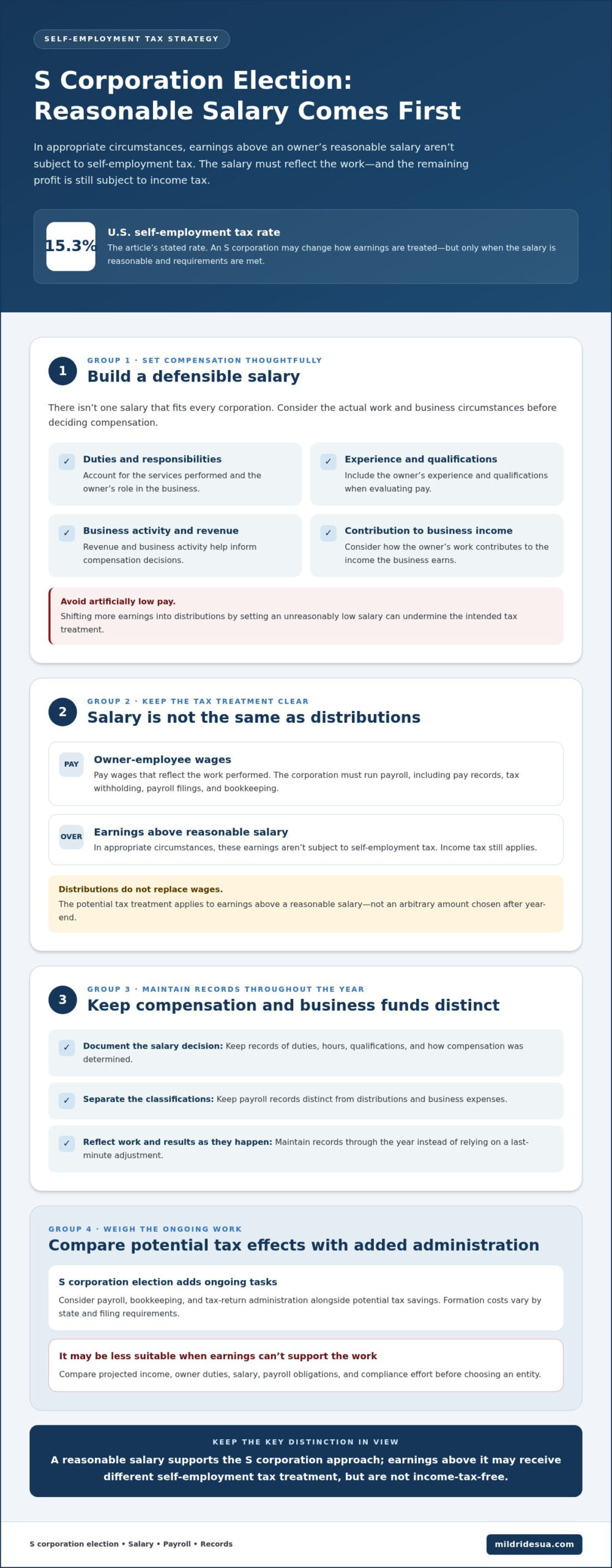
An S corporation election can change how business earnings are treated for self-employment tax. In appropriate circumstances, earnings above an owner’s reasonable salary aren’t subject to self-employment taxes. That doesn’t make the remaining profit tax-free: income tax still applies. Compare potential tax effects with the added payroll and filing work.
Reasonable salary is central to the analysis. The corporation should pay an owner-employee wages that reflect the work performed, responsibilities, experience, and business activity. Setting an artificially low salary to shift more earnings into distributions can undermine the intended tax treatment. Document the owner’s duties, hours, qualifications, and compensation decisions to support the amount.
For example, an owner who manages daily operations performs a different role from someone who provides limited oversight. Evaluate the services actually performed before setting compensation. There isn’t one salary that fits every corporation: revenue, duties, and the owner’s contribution to business income all inform the analysis.
The corporation must also run payroll for wages paid to its owner-employee. This means coordinating pay records, tax withholding, payroll filings, and bookkeeping, rather than simply transferring business cash as needed. Keep payroll records separate from distributions and business expenses. Clear classifications show how compensation was determined and how funds were paid.
Distributions aren’t a substitute for wages. In appropriate circumstances, the potential self-employment tax treatment applies to earnings above a reasonable salary, not an arbitrary amount selected after year-end. Maintain records throughout the year so compensation reflects the work and business results, rather than relying on a last-minute adjustment.
What are the costs and administrative requirements of forming an LLC or electing S corporation status? Formation costs vary by state and filing requirements, while an S corporation election adds payroll, bookkeeping, and tax-return administration. Consider these ongoing tasks alongside potential tax savings. An election may be less suitable when the business’s earnings can’t support the added work.
Before choosing an entity, compare projected income, owner duties, salary, payroll obligations, and compliance effort. A tax professional can model the difference between current treatment and an S corporation structure, then coordinate the election with payroll and tax preparation. S corporation election and self-employment tax planning can help align the structure with the business’s actual operations.
3. Self-employment tax rates and earnings threshold
According to the Internal Revenue Service, a self-employed person with net annual business income of more than $400 owes self-employment taxes. This threshold makes accurate profit calculations important, even when a business is small or part-time. Track business income and eligible expenses separately, then calculate the resulting net earnings used for the tax computation.
The self-employment tax rate is 15.3%, covering Social Security and Medicare. That rate consists of a 12.4% Social Security component and a 2.9% Medicare component. The Social Security portion of self-employment tax is subject to an annual earnings limit. The Medicare component does not share that Social Security earnings limit.
For a sole proprietor, business profit is the starting point for calculating self-employment tax. An eligible home office deduction or other valid business expenses may reduce profit, which can also reduce earnings subject to this tax. Keep income records and receipts organized to support and accurately classify each expense. A deduction should reflect actual business use, not personal spending.
High earners may also owe the Additional Medicare Tax at a 0.9% rate. The stated thresholds are $200,000 for single filers and $250,000 for married couples filing jointly. These thresholds concern the additional Medicare tax, not the basic 15.3% self-employment tax rate. Include filing status and other income in tax planning because they affect whether the additional tax applies.
Business structure can change how earnings are treated. For example, an S corporation owner-employee’s wages and remaining business earnings may receive different self-employment tax treatment when the salary is reasonable. Partners should also distinguish business income from wages or other income reported separately. The entity’s tax treatment determines which calculations apply.
For a practical estimate, organize your records in sequence: total business income, subtract eligible business expenses, and identify the resulting net profit. Then apply the relevant Social Security and Medicare rules, including the annual earnings limit and any Additional Medicare Tax threshold. Retirement contributions may affect income taxes, but they don’t automatically change the self-employment tax calculation.
Review the calculation alongside estimated tax payments, rather than waiting until filing season. A business tax estimate should account for net profit, filing status, other income, and whether Social Security earnings have reached the limit. Update the estimate when income or expenses change. This disciplined process helps you make informed decisions without confusing income-tax deductions with self-employment tax savings.
4. Self-employed health insurance premiums
Eligible self-employed individuals may deduct health insurance premiums paid for themselves, their spouses, dependents, and children under age 27 at year-end. This deduction can reduce income subject to income tax, but it generally doesn’t reduce the net earnings used to calculate Social Security and Medicare self-employment tax. Treat it as an income-tax deduction, not a direct reduction of self-employment tax liability.
Start by organizing premium statements and payment records for the tax year. Separate health insurance premiums from medical expenses, business expenses, and other insurance payments. Then identify whose coverage each payment supports: the owner, spouse, dependent, or qualifying child. This classification makes it easier to calculate the eligible amount and support the deduction when preparing the return.
The age test for children is specific: a child must be under age 27 at year-end. Keep records showing the coverage period and the person covered, especially when family members have separate policies. For example, if an owner pays premiums covering a spouse and a qualifying child, record those payments separately from the owner’s own coverage.
Eligibility rules still apply, so don’t assume every premium payment qualifies simply because the policy covers a business owner. Review the policy, payment history, and taxpayer’s circumstances before claiming the deduction. The amount claimed should match documented premiums paid for eligible coverage, not an estimate or the policy’s full annual cost if someone else paid part.
Timing and payment records matter. Match each premium payment to the period and coverage it represents, then retain insurer statements, receipts, and bank records. If payments come from multiple accounts, reconcile them before preparing the return. This creates a clear record of the amount actually paid and helps distinguish eligible premiums from unrelated household or medical spending.
Coordinate the deduction with estimated tax planning. Premiums may reduce income-tax liability, while self-employment tax is calculated separately from the income-tax deduction. A change in premium payments can therefore affect your income-tax estimate without producing the same change in Social Security or Medicare tax. Keep the calculations distinct when reviewing quarterly payments.
For a sole proprietor, careful bookkeeping keeps health coverage payments visible without misclassifying them as ordinary operating expenses. An S corporation owner should also coordinate coverage and tax reporting with the entity’s payroll and records. In either structure, document covered individuals, payment amounts, and policy information before filing, then use those records to support the deduction.
5. Which business expenses can self-employed people deduct to reduce taxable income?
For a sole proprietor, Schedule C is where business income and deductible expenses are generally reported. Eligible expenses reduce taxable business profit, and that lower profit can also affect the self-employment tax calculation. Claim costs connected to business activity and keep records showing what each purchase supported.
Common categories include office rent, supplies, equipment, telephone calls, and business vehicle costs. For phone and internet bills, deduct only the business-use portion, not personal use. For example, divide a shared phone bill using reasonable records of business and personal use instead of claiming the entire cost as a business expense.
Vehicle deductions can use either the standard mileage rate or the actual expenses method. The 2025 standard mileage rate for business driving is $0.70 per mile, plus eligible tolls and parking fees. Record the date, miles driven, and business purpose for each trip. If using actual expenses, keep receipts and identify the business-use share of vehicle costs.
Equipment and other business assets require careful treatment. Assets purchased for more than $2,500 may qualify for depreciation deductions over time under IRS depreciation schedules, reported on Form 4562. Section 179 may allow a business owner to deduct the entire cost of an eligible asset in one year. Compare the available treatment with projected income before choosing how to claim an asset.
Meals need a clear business connection. Self-employed individuals may deduct part or all of eligible business-related meal costs, and records should identify the participants and business purpose. A receipt alone may not explain how the expense supported the business, so add a brief note while the meeting details are fresh.
Startup costs have their own treatment. Eligible startup expenses may be deducted up to $5,000 in the first year; amounts exceeding the first-year deduction limit are treated as capital expenses that may be amortized over 15 years. Keep invoices and notes explaining how each cost relates to starting the business.
Inventory also requires accurate timing. Cost of goods sold is generally deducted when the product is sold, not simply when inventory is purchased. Match purchase records to sales records so the deduction follows the goods through the business.
Consistent bookkeeping brings these rules together: categorize each expense, retain receipts, and note its business purpose. Improve small business bookkeeping to keep expense records organized and support informed tax preparation.
Mildrid Esua, CPA, PLLC: Tax Planning & Tax Preparation, Bookkeeping, IRS Representation, Small Business Accounting, Tax Resolution, Unfiled Tax, Tax Lien, Payroll Services
Mildrid Esua, CPA, PLLC helps small businesses coordinate tax planning, preparation, and bookkeeping. If you’re weighing deductions, reviewing business records, or preparing tax filings, organized accounting can clarify how income and expenses are recorded. That foundation also supports informed decisions about estimated payments and tax obligations.
Turn to the firm when self-employment tax questions connect with broader business accounting, payroll, or IRS concerns. Services include tax planning and preparation, bookkeeping, small business accounting, payroll, and IRS representation. For unresolved tax matters, tax resolution services address issues such as unfiled returns and tax liens.
Careful planning connects current tax decisions with the records needed for future filings. Contact Mildrid Esua, CPA, PLLC to discuss your business’s tax and accounting needs, or visit mildridesua.com.
Build a tax plan that keeps pace with your business
Tax decisions work best as part of an ongoing business plan, not as last-minute filing adjustments. As your income, responsibilities, or business structure changes, revisit how you track business activity and make tax decisions. Regular reviews help you act deliberately and keep your records aligned with your business’s direction.
Use strategies to reduce self-employment tax as a framework for informed planning, rather than treating any single deduction or entity choice as a complete solution. Mildrid Esua, CPA, PLLC connects tax planning and preparation with small business accounting, helping you manage business records and tax obligations as related parts of one plan.
When you’re ready to discuss the next steps for your business, contact Mildrid Esua, CPA, PLLC. A thoughtful plan can give you a clearer foundation for moving forward with confidence.
Frequently Asked Questions
How can I reduce my self-employment taxes?
Start by separating decisions that affect self-employment tax from deductions that mainly affect income tax. Review business costs for legitimate expenses, then assess whether your business structure and owner compensation merit tax planning. Keep personal and business transactions separate, especially shared expenses such as internet or vehicle use. Clear records help support deductions and prevent you from treating a lower income-tax bill as an equal reduction in self-employment tax.
How is self-employment tax calculated in the United States, including current rates and income limits?
According to the Internal Revenue Service, a self-employed person with net annual business income of more than $400 owes self-employment taxes. The rate is 15.3%, comprising 12.4% for Social Security and 2.9% for Medicare. The Social Security portion applies to the first $160,200 of self-employed earnings. An additional Medicare tax of 0.9% applies above $200,000 for single filers or $250,000 for married couples filing jointly.
How can an S corporation election reduce self-employment taxes, and what counts as reasonable compensation?
In appropriate circumstances, an S corporation owner’s earnings above a reasonable salary aren’t subject to self-employment taxes. Reasonable compensation reflects the owner’s actual services, responsibilities, experience, and contribution to the business. Document duties and compensation decisions, then keep payroll records separate from distributions. For a small business owner in Greensboro, tax planning should account for payroll administration and income-tax treatment, not just the potential self-employment tax effect.
Can health insurance premiums and health savings account contributions reduce taxes for self-employed people?
Eligible self-employed people may deduct health insurance premiums for themselves, spouses, dependents, and children under age 27 at year-end, subject to eligibility rules. This deduction can lower income subject to income tax, but it generally doesn’t reduce earnings used to calculate self-employment tax. Health savings account contributions are a separate tax matter, so don’t assume they qualify under the health insurance premium deduction. Keep payment and coverage records for each item.




Leave a Reply
Your email is safe with us.