


Contrary to popular belief, the legal clock on delinquent returns never runs out, because the statutory assessment period doesn’t even begin until a return is officially submitted. If you are wondering how long can you go without filing taxes, the stark reality is that the IRS holds the authority to pursue unfiled years indefinitely.
It’s completely natural to feel paralyzed by the fear of aggressive enforcement, compounding interest, or the chaos of disorganized financial records spanning multiple neglected years. Leaving back taxes unaddressed creates heavy emotional strain, turning an administrative oversight into an escalating threat to your financial security.
Unlike standard reactive responses that wait for an adversarial IRS notice, an orderly, proactive strategy puts you back in command of your balance sheet. In this guide, you will discover the critical statutory rules governing delinquent filings, how to halt compounding penalties, and the exact steps to protect refunds before statutory windows close. Here is your structured roadmap to resolve unfiled taxes safely and regain lasting peace of mind.
Key Takeaways
- Understand the legal boundaries of how long can you go without filing taxes, including the strict three-year statutory window that permanently forfeits unclaimed refunds.
- Identify how monthly failure-to-file penalties accumulate ten times faster than failure-to-pay assessments, compounding alongside daily interest to escalate total liability.
- Learn how automated information return matching and inter-agency state reporting systematically flag non-filers long before revenue officers reach out.
- Master the structured compliance framework under IRS Policy Statement 5-133, which generally requires filing only the last six delinquent years to restore good standing.
- Discover how proactive representation from a licensed CPA shields your assets from aggressive enforcement while creating an orderly roadmap to sustainable tax relief.
How Long Can You Go Without Filing Taxes Legally?
Legally speaking, you cannot skip filing for even a single tax year if your gross income crosses the statutory annual threshold. Many taxpayers wrestling with overdue paperwork wonder how long can you go without filing taxes before civil liabilities cross into criminal territory. The legal distinction centers on intent: an innocent failure to file driven by hardship or poor recordkeeping is treated civilly, whereas a purposeful illegal attempt to conceal earnings constitutes criminal evasion.
To better understand the mechanics of unfiled tax timelines and practical exposure, watch this informative breakdown:
Annual Income Thresholds and Mandatory Filing Rules
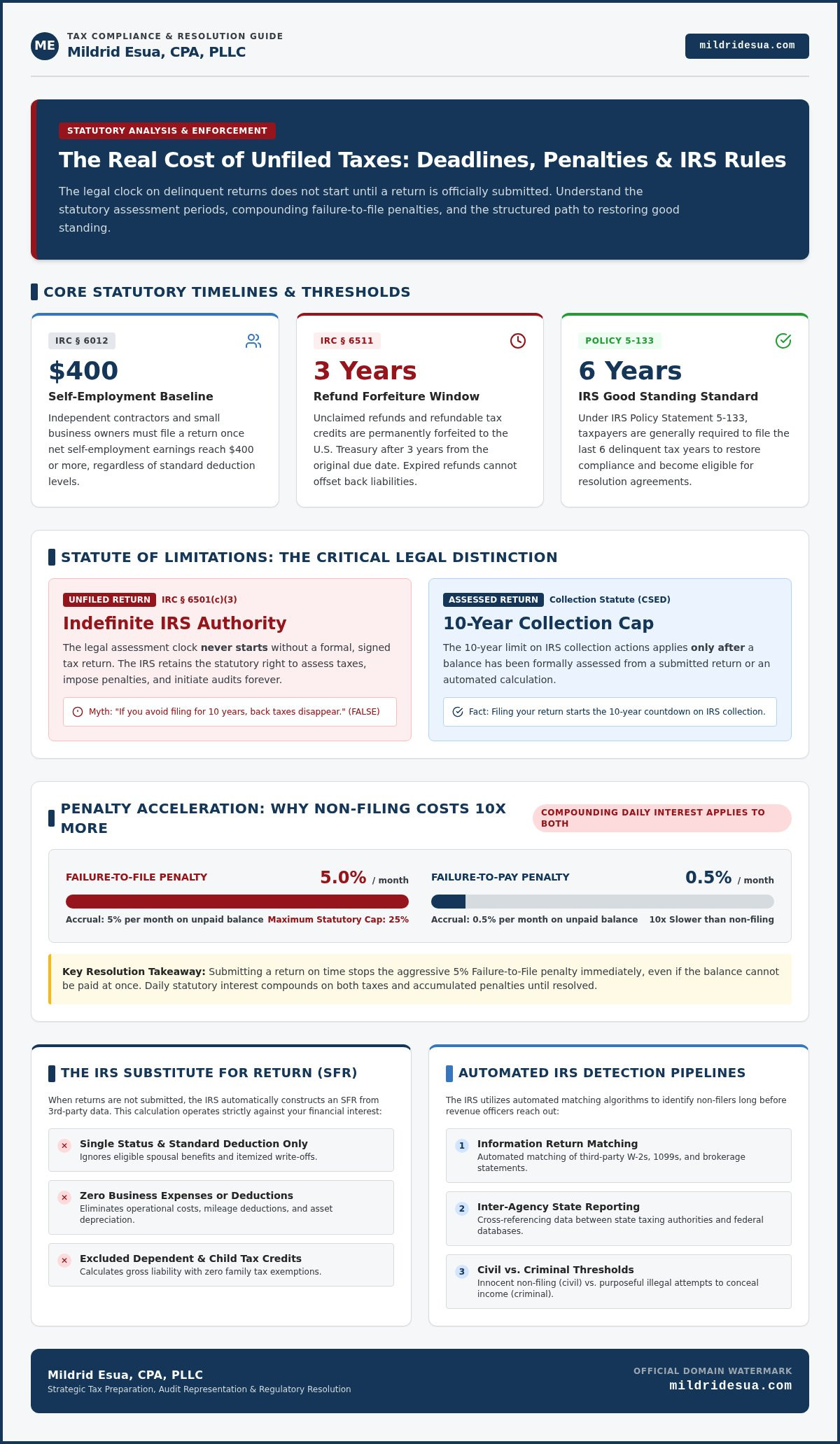
Under Internal Revenue Code Section 6012, statutory mandatory filing rules dictate that every individual exceeding specific gross income thresholds based on filing status and age must submit an annual tax return. Independent contractors and small business owners face a much lower standard; anyone with net self-employment earnings of $400 or more must file a return. Even if your earnings drop below these statutory baselines, submitting a return remains essential to claim refundable tax credits or retrieve withheld wages.
The 3-Year Rule: Forfeiting Refunds and Tax Credits
Delaying your filing carries an irreversible financial forfeiture. Under IRC § 6511, taxpayers must file a claim for credit or refund within three years from the time the return was due. Once that strict three-year statutory window lapses:
- Your unclaimed refund permanently becomes the property of the U.S. Treasury.
- You forfeit all eligibility for refundable credits tied to that specific tax year.
- You cannot roll expired historical refunds forward to offset subsequent active tax liabilities.
The Statute of Limitations Myth on Unfiled Returns
A widespread misconception is that unfiled back taxes eventually expire under a statute of limitations. While the IRS faces a ten-year limit to collect assessed balances, IRC § 6501(c)(3) establishes that no assessment clock begins until you file a formal, signed return. Consequently, asking how long can you go without filing taxes reveals an open-ended reality: the agency retains indefinite statutory authority to assess taxes, levy penalties, and audit your records until your delinquent returns are formally submitted.
The True Costs and Hidden Penalties of Neglected Taxes
Taxpayers evaluating how long can you go without filing taxes often measure risk in terms of detection. In reality, the financial damage begins within days of missing the deadline. Compounding penalties and statutory interest quietly erode your wealth long before an agent contacts you.
Failure-to-File vs. Failure-to-Pay Penalties
The IRS penalizes non-filing far more aggressively than non-payment. According to the statutory guidelines for the Failure to File Penalty, the agency levies a 5% monthly charge on unpaid taxes, up to a maximum cap of 25%. In contrast, the failure-to-pay penalty accrues at just 0.5% per month. Submitting your return on time immediately stops that punishing 5% assessment, even if you cannot pay the balance immediately. Compounding the burden, daily statutory interest compounds on both the unpaid tax and accumulated penalties, rapidly expanding your underlying liability.
Substitute for Return (SFR): How the IRS Taxes You Unfavorably
When returns remain delinquent, the IRS does not simply wait. The agency eventually prepares an automated Substitute for Return (SFR) using third-party W-2s, 1099s, and brokerage statements. This administrative calculation acts entirely against your interests:
- Assigns a standard deduction and single filing status, ignoring eligible spousal benefits.
- Eliminates all industry-specific business deductions, mileage expenses, and depreciation.
- Excludes dependent credits and child tax exemptions.
The resulting SFR creates an artificially inflated balance, leaving you legally liable for thousands of dollars in phantom tax debt you do not actually owe.
Aggressive Collection Actions: Liens, Levies, and Travel Bans
Once an arbitrary SFR balance is assessed, the IRS collection cycle activates automatically. The agency issues formal CP504 notices warning of imminent statutory asset seizures. From there, automated federal tax liens attach to commercial real estate, accounts receivable, and personal property, freezing your borrowing capability. Left unaddressed, enforcement escalates to bank levies, wage garnishments, and State Department passport revocations for seriously delinquent tax debt.
Engaging professional tax resolution services enables you to replace hostile SFR filings with accurate, deduction-rich returns, effectively halting administrative collection actions before severe damage occurs.
IRS Detection Methods: How Long Until the Agency Catches Up?
Silence from the IRS is never proof that you slipped through the cracks; it simply reflects administrative processing lag. When assessing how long can you go without filing taxes before enforcement strikes, remember that federal data systems operate continuously. While taxpayers entitled to a refund must claim it within 3 years or lose it forever, the agency’s systems maintain indefinite memory of your unfiled earnings.
Automated Data Matching and Information Returns Processing
The IRS relies on Information Returns Processing (IRP), an automated framework that cross-examines incoming third-party forms against individual taxpayer accounts. Employers file W-2s, brokerage firms submit 1099-Bs, and merchant processors transmit 1099-K payment summaries directly to federal databases. When automated algorithms detect substantial income with no corresponding return, your profile gets flagged. Discovery is an automated certainty, not a matter of chance.
State and Federal Tax Agency Data-Sharing Networks
Federal examiners do not operate in a vacuum. Under formal coordination agreements, state departments of revenue share audit findings and local non-filer lists directly with the IRS. For business owners across North Carolina’s Triad region, including Greensboro and Winston-Salem, neglecting state filings routinely triggers federal inquiries. County deed recordings, commercial licensing boards, and state sales tax reporting constantly feed this shared surveillance network.
The IRS Notice Escalation Sequence Explained
Once non-filing is flagged, the agency follows an automated, escalating sequence of formal correspondence:
- CP515 and CP518 Notices: Written inquiries identifying missing tax periods and demanding an immediate response or completed return.
- Notice of Deficiency (CP3219N): A formal letter sent via certified mail proposing an arbitrary tax assessment based strictly on gross third-party figures.
- Final Notice of Intent to Levy: The final administrative alert granting 30 days before federal bank seizures or wage garnishments begin.
Initiating voluntary compliance before a formal notice arrives preserves critical procedural rights. Proactive submission restores your standing as a cooperative taxpayer, unlocking penalty relief and flexible settlement structures that vanish once aggressive enforcement begins.
Strategic Roadmap to Catching Up on Years of Back Taxes
Facing multiple delinquent years often creates operational paralysis. When taxpayers consider how long can you go without filing taxes, they frequently assume they must reconstruct decades of lost records. Fortunately, federal administrative rules provide an orderly, manageable pathway back to compliance.
The IRS Six-Year Rule (Policy Statement 5-133)
Internal Revenue Manual Policy Statement 5-133 outlines the primary administrative enforcement standard: “Taxpayers delinquent in filing returns should be requested to file such returns for the current tax year plus the preceding five tax years.” Unless an examiner flags substantial tax fraud or prior substitute returns, filing the last six calendar years generally satisfies the agency’s requirement to bring you into good standing. This policy prevents endless historical reconstruction, allowing you to focus your financial resources where they matter most.
Reconstructing Missing Books and Financial Documentation
Restoring compliance without historical paperwork requires a methodical three-step sequence:
- Pull Official Transcripts: Request IRS wage and income transcripts to see exactly what 1099s, W-2s, and investment proceeds were reported under your tax ID.
- Rebuild Operational Ledgers: Reconcile historical commercial bank statements and credit card files to capture deductible business expenses, mileage, and capital outlays.
- Perform Forensic Reconstruction: Partner with a Triad CPA to reconstruct missing financial ledgers, ensuring every lawful deduction is verified before submission.
Strategic Relief: Penalty Abatement and Repayment Structures
Once your returns are prepared chronologically on proper historical forms, you can pursue formal relief structures. The IRS offers First-Time Penalty Abatement if you maintained clean compliance for the three years prior to your earliest unfiled return. For unexpected life interruptions like serious illness or family hardship, submitting a formal Reasonable Cause petition can eliminate thousands of dollars in penalties. Finally, establishing current filing compliance opens the door to streamlined installment agreements, allowing you to settle lingering balances on predictable monthly terms.
Take charge of your financial standing today by exploring professional back taxes and IRS tax relief solutions tailored to resolve multi-year delinquencies safely.
Achieving Sustainable Tax Resolution with Mildrid Esua, CPA
Resolving multi-year tax delinquencies requires far more than basic form-filling; it demands vigilant, credentialed advocacy. If you have been wondering how long can you go without filing taxes before severe enforcement hits, the answer lies in stepping out of uncertainty through proactive representation. Mildrid Esua, CPA, PLLC acts as a strategic architect, transforming overwhelming federal liabilities into clear, manageable compliance plans.
Local North Carolina CPA Representation vs. National Call Centers
Unlike national tax relief mills that route your sensitive records to remote telemarketers, working with a regional practitioner ensures direct, personal accountability. Our practice provides dedicated IRS representation across North Carolina’s Triad region, serving clients in Greensboro, High Point, and Burlington. We understand the complex interplay between federal tax disputes and parallel actions initiated by the North Carolina Department of Revenue, coordinating both agencies to shield your business from disjointed enforcement.
Comprehensive Resolution Services: From Transcript to Final Agreement
Our firm provides end-to-end stewardship throughout the resolution process, serving as an authoritative barrier between you and aggressive collection agents:
- Direct Representation: We step in to secure your comprehensive master transcripts, halting direct IRS communications and protecting your assets from unexpected levies.
- Deduction-Maximizing Preparation: We reconstruct accurate historical accounting records, ensuring every legitimate operational deduction and allowable credit is properly applied.
- Structured Negotiations: We present and negotiate formal settlement options, including Partial Payment Installment Agreements or Offers in Compromise, tailored to your documented ability to pay.
Transitioning from Back-Tax Crisis to Forward-Looking Wealth Preservation
True financial recovery extends beyond resolving past liabilities. Once delinquent filings are brought into full compliance, we transition your business from defensive crisis management to long-term wealth preservation. We implement disciplined bookkeeping rhythms to prevent recurring quarterly delays, and we structure business operations into optimized frameworks, such as S Corporation elections, to minimize ongoing self-employment liabilities.
If you are facing mounting penalties or unanswered IRS inquiries, explore our comprehensive guide on expert tax resolution in North Carolina to understand your statutory options. Rather than waiting for automated collection letters to dictate your financial future, schedule a confidential consultation with Mildrid Esua, CPA, PLLC to restore your tax compliance with confidence.
Take Decisive Action to Reclaim Your Financial Future
When considering how long can you go without filing taxes, the decisive takeaway is clear: waiting only compounds interest, invites arbitrary substitute assessments, and risks the permanent forfeiture of owed refunds. Under established federal policies, restoring good standing is far more structured and achievable than most taxpayers realize, particularly when focusing strategically on the past six delinquent years.
You don’t have to confront federal revenue officers alone. As a licensed North Carolina CPA credentialed for direct IRS representation, Mildrid Esua provides specialized guidance on multi-year unfiled returns, financial reconstruction, and penalty mitigation. Serving Greensboro, High Point, Winston-Salem, and surrounding communities, our practice replaces persistent anxiety with clear, actionable solutions tailored to your unique circumstances.
Schedule a confidential consultation with Mildrid Esua, CPA, PLLC today to halt aggressive enforcement, safeguard your assets, and step forward into lasting financial security.
Frequently Asked Questions
Can you go to jail for not filing taxes for several years?
Incarceration is rare and applies almost exclusively to intentional, fraudulent evasion rather than ordinary delinquency. The vast majority of taxpayers wondering how long can you go without filing taxes face administrative civil penalties and compounding interest rather than criminal indictment. The IRS focuses its resources on securing voluntary compliance and establishing formal repayment terms, reserving criminal prosecution under IRC § 7203 for cases involving deliberate concealment or affirmative deceit.
How many years of unfiled tax returns does the IRS require?
Under IRS Policy Statement 5-133, the agency typically requires taxpayers to file the current tax year plus the preceding five years to restore full compliance. Preparing six consecutive years of returns satisfies the administrative threshold needed to qualify for installment agreements or penalty relief programs. The IRS reserves the right to examine earlier unfiled periods only when substantial fraud, egregious non-compliance, or high-dollar Substitute for Return assessments exist.
What happens if I haven’t filed taxes and the IRS owes me a refund?
Failing to file when the government owes you money does not trigger late-filing penalties, but it carries a severe forfeiture deadline. Internal Revenue Code § 6511 dictates that you must claim your refund within three calendar years of the original filing deadline. Once that statutory window closes, your unclaimed funds permanently become the property of the U.S. Treasury, and you cannot credit expired refunds toward subsequent tax balances.
What is an IRS Substitute for Return (SFR) and can it be replaced?
A Substitute for Return is an automated assessment the IRS compiles using third-party W-2 and 1099 records when a taxpayer neglects to file. Because an SFR grants only the standard deduction with single filing status and excludes all business expenses, the resulting tax assessment is artificially inflated. You can replace an SFR by submitting an accurate, original return that claims legitimate deductions, thereby reducing the arbitrary balance.
Will filing back taxes immediately trigger an in-person IRS audit?
Submitting delinquent returns does not automatically provoke an audit; the agency’s primary operational objective is simply restoring compliance. When considering how long can you go without filing taxes, bringing your accounts up to date voluntarily reduces audit exposure compared to remaining an active non-filer. Working with a licensed Triad CPA ensures your historical submissions are supported by documentation, preventing red flags that might prompt localized field examinations.
Can penalties on unfiled tax returns be waived or reduced?
The IRS provides specific relief pathways that allow qualifying taxpayers to abate accumulated penalties. First-Time Penalty Abatement offers administrative forgiveness if you maintained clean filing compliance for the three preceding tax periods. Additionally, taxpayers in Greensboro and Winston-Salem who experienced unavoidable disruptions, such as severe health crises or natural disasters, can file formal Reasonable Cause petitions to eliminate assessed failure-to-file and failure-to-pay charges.
How do I get my W-2s and 1099s if I lost my records?
You can retrieve historical third-party reporting documents directly from the IRS by ordering Wage and Income Transcripts. These official agency records reveal the exact compensation, contract payouts, and withholding amounts transmitted to federal databases by your past employers and financial institutions. A credentialed CPA serving Burlington and High Point can pull these transcripts across multiple delinquent tax years, laying the foundation for bookkeeping reconstruction.




Leave a Reply
Your email is safe with us.