

What if the financial records you rely on to scale your North Carolina startup are actually quietly inviting an IRS audit? For many entrepreneurs in the Piedmont Triad, the line between sustainable growth and a compliance crisis is often thinner than it appears. It is easy to overlook the subtle bookkeeping mistakes small businesses make when you are focused on the daily demands of operations. You likely feel the weight of impending 2026 tax deadlines and the constant pressure to ensure every expense is classified correctly to avoid unnecessary penalties.
We understand that managing your complex financial interests requires more than just reactive data entry; it demands a philosophy of vigilant stewardship. In this strategic guide, you will discover how to identify critical errors before they lead to scrutiny and learn the precise methods for transforming your books into a powerful tool for informed decision-making. We will preview the essential steps to achieve audit-proof records, maximize your legitimate deductions, and gain the cash flow visibility necessary for long-term stability. By moving beyond manual processes and embracing a proactive advisory approach, you can protect your business’s future and focus on the upward trajectory of your success.
Key Takeaways
- Understand why reactive bookkeeping poses a significant threat to business longevity and how to transition toward a model of strategic financial management.
- Learn to identify and rectify the common bookkeeping mistakes small businesses make, focusing on the critical dangers of commingling personal and business finances.
- Discover the hidden compliance risks associated with S Corp salary tracking and payroll management that often trigger avoidable IRS scrutiny.
- Explore how to integrate professional stewardship with automation to move beyond simple data entry and gain true visibility into your cash flow.
- Recognize the fundamental difference between a transactional bookkeeper and a strategic growth partner who safeguards your interests through vigilant oversight.
The High Cost of ‘Good Enough’ Bookkeeping for Small Businesses
In 2026, reactive bookkeeping has emerged as the primary threat to small business longevity. Unlike a proactive strategy, “good enough” record-keeping creates a false sense of security that masks deep-seated financial vulnerabilities. Many Greensboro entrepreneurs overlook the invisible costs of bad data, such as missed tax credits or inflated operational expenses, which slowly erode profit margins over time. This approach is one of the most frequent bookkeeping mistakes small businesses make, often leading to a cycle of financial uncertainty that takes a heavy psychological toll. The weight of not knowing if you can meet payroll or if an unexpected tax bill will arrive creates a persistent background noise of stress that distracts from core operations.
True financial health requires adhering to foundational bookkeeping principles while layering on strategic oversight. It’s the difference between simple data entry and comprehensive financial management. While a data entry clerk looks at what happened yesterday, a strategic partner looks at how those numbers influence your ability to scale tomorrow. To better understand how modern software tools support these goals, watch this helpful tutorial:
More Than Just Numbers: Bookkeeping as Business Strategy
Transitioning from a transactional mindset to a consultative partnership allows you to view your ledger as a roadmap rather than a chore. For firms in High Point, accurate records drive better decision-making by revealing true product costs and seasonal cash flow trends. When you understand the exact margin on every service or product, you stop guessing and start leading with confidence. By acting as a Strategic Architect, we ensure your financial framework is built to withstand rapid growth. This level of involvement transforms your books from a static document into a dynamic asset that informs every hire and investment you make, ensuring your expansion is supported by hard data.
The Ripple Effect: From Messy Books to IRS Audit
The IRS doesn’t choose audits at random; they target specific inconsistencies in small business filings that suggest deeper systemic issues. Identifying the common bookkeeping mistakes small businesses make before they escalate into a full-scale inquiry is essential for survival. Often, the link between unfiled returns and poor daily record-keeping is undeniable. When your daily ledger is neglected, the risk of misclassifying expenses or underreporting income skyrockets, creating red flags that automated IRS systems are designed to catch. Maintaining professional oversight acts as a preventive shield, ensuring you never have to seek expert tax resolution North Carolina due to avoidable administrative failures. Consistent stewardship keeps your records audit-proof and your focus firmly on the future.
The ‘Big 3’ Technical Bookkeeping Mistakes to Fix Today
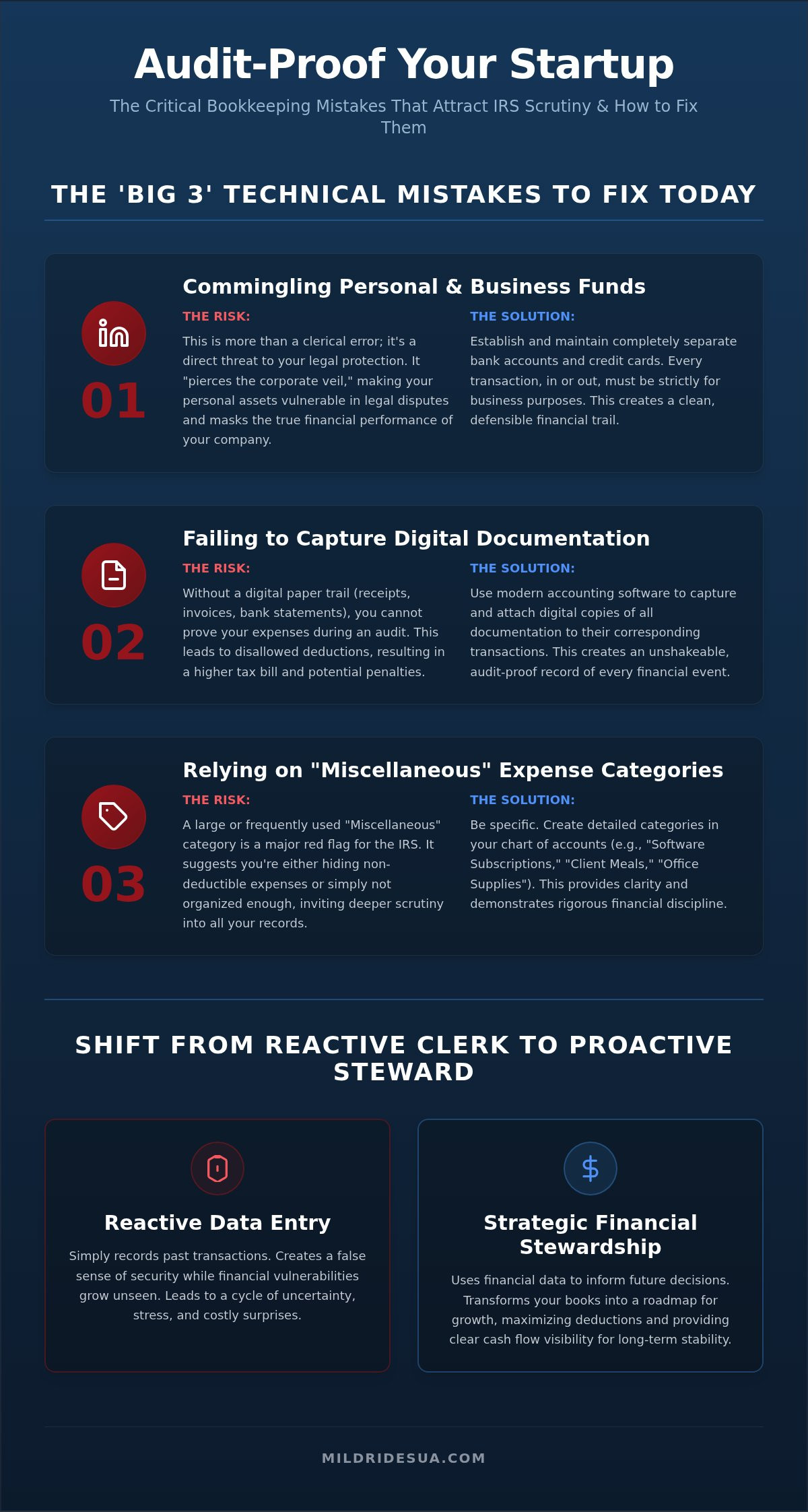
Technical precision serves as the bedrock of your defense against federal scrutiny. Unlike general administrative tasks, financial record-keeping requires a rigorous adherence to structural boundaries that many entrepreneurs overlook in the haste of daily operations. One of the most pervasive bookkeeping mistakes small businesses make involves treating the business ledger as a flexible extension of personal finances. This lack of discipline creates a cluttered trail that is difficult to untangle during an audit and masks the true performance of your enterprise. Beyond the ledger, failing to capture digital documentation and relying on “Miscellaneous” expense categories creates significant gaps in your financial narrative.
Piercing the Corporate Veil: The Legal Risk of Commingling
Mixing personal and business funds is more than a clerical nuisance; it is a direct threat to your legal protections. When you pay for personal groceries with a business card or deposit client checks into a personal account, you risk “piercing the corporate veil.” This legal concept allows creditors or the IRS to argue that your LLC or corporation is not a separate entity, potentially exposing your personal assets to business liabilities. For Greensboro business owners, maintaining a clean separation is essential. We recommend utilizing dedicated business credit cards and strictly processing all owner draws through formal distributions. Establishing these boundaries now demonstrates the foresight required for long-term stability and protects the “shield” your business structure was designed to provide.
The Reconciliation Gap: Catching Errors Before the IRS Does
Many owners assume that because their software syncs with their bank, their books are accurate. However, skipping monthly bank reconciliations is a dangerous oversight. Software automation often misses duplicate transactions, fails to account for outstanding checks, or incorrectly categorizes bank transfers as income. Without the oversight of a Vigilant Guide, these discrepancies compound over time, leading to inflated profit reports and overpaid taxes. Professional monthly bookkeeping for small businesses provides a critical safety net, ensuring that every penny on your statement matches your ledger before the year-end crunch begins.
Finally, the habit of dumping unclear transactions into “Miscellaneous” accounts is a significant red flag. The IRS views these accounts as hiding places for non-deductible personal expenses or undocumented payments. Coupled with a failure to track digital receipts, this creates a situation where deductions are easily disallowed during an inquiry. Transitioning to a system of proactive bookkeeping for small businesses ensures that every transaction is justified with documentation and categorized with strategic intent, transforming your records into an audit-proof asset. This methodical approach replaces the chaos of “good enough” with the clarity of professional stewardship.
Hidden Risks: Payroll, S Corp Compliance, and Tax Liens
While technical errors are frustrating, compliance failures in payroll and corporate structure are often catastrophic. These are the bookkeeping mistakes small businesses make that move beyond messy ledgers and into the territory of legal jeopardy. The IRS treats payroll taxes as “trust fund” money, meaning they view these funds as belonging to the government from the moment you withhold them. Failing to remit these payments is seen as a breach of fiduciary duty rather than a simple clerical oversight. Missing a single payment often triggers an immediate cascade of notices, aggressive penalties, and eventually, the filing of a federal tax lien that can paralyze your operations.
Similarly, failing to account for 1099 contractor reporting requirements remains a persistent vulnerability for growing firms. For the 2026 tax year, the reporting threshold for third-party settlement organizations remains over $20,000 in gross payments and more than 200 transactions. However, the traditional requirement to issue 1099-NEC forms for services over $600 still demands precise manual tracking that software often fails to manage without expert oversight. When your bookkeeping lags, these deadlines pass unnoticed, leaving you vulnerable to failure-to-file penalties that compound your tax liability.
S Corp Bookkeeping: The Key to Self-Employment Tax Reduction
Strategic tax management requires precise tracking of owner-draws versus W-2 salary. Utilizing an S Corp election for self employment tax reduction is only effective if your records support a “reasonable salary” for shareholders. Inaccurate tracking leads to distribution errors that trigger audits, as the IRS looks for owners attempting to bypass payroll taxes through excessive distributions. A proactive partner ensures your salary-to-distribution ratio remains defensible and compliant with current 2026 standards, protecting your tax savings from being reclaimed during an inquiry.
When Bookkeeping Fails: Navigating IRS Tax Liens
Chronic errors are the root cause of unfiled tax returns, which serve as the primary catalyst for IRS tax liens. Unlike a simple unsecured debt, a lien is a public claim against your property that can ruin your credit and prevent you from securing the capital needed to scale in the Piedmont Triad. Resolving payroll tax debt in North Carolina requires a methodical approach to back taxes and liens that begins with clean records. Professional representation is essential in these moments. It transitions you from a defensive, reactive posture to a structured resolution, ensuring that your business survives the scrutiny and regains its long-term stability.
Building a Proactive System: Automation vs. Professional Oversight
The efficacy of your financial infrastructure depends on more than just the software you purchase. While platforms like QuickBooks offer impressive automation, they are tools rather than comprehensive strategies. One of the recurring bookkeeping mistakes small businesses make is assuming that a software subscription replaces the need for professional judgment. In 2026, where 98% of accounting professionals globally utilize AI according to Karbon, the value of technology is undeniable. However, technology without stewardship often leads to a “garbage in, garbage out” scenario that can quietly derail your compliance and obscure your true profitability.
Establishing a weekly financial review rhythm ensures that your digital document management stays current. With a median small business logging approximately 9.3 receipts per week, as reported by ExpenseBot in July 2026, falling behind for even a month creates a significant backlog. A proactive system utilizes software to capture this data while relying on a Vigilant Guide to interpret it. By avoiding the common bookkeeping mistakes small businesses make through a disciplined workflow, you protect your long-term stability and ensure your records are always audit-ready.
The Myth of ‘Set It and Forget It’ Accounting Software
Automation excels at routine data entry but struggles with the nuances of tax law and complex classifications. For instance, AI might categorize a transaction based on a merchant name while missing the context that determines if it is a deductible expense or a capital asset. This is where human oversight becomes essential. Unlike a purely automated approach, a consultative partnership uses software as a bridge to deeper advisory services. We ensure your automation rules are working for you, not against you, by performing regular audits of your digital ledger to maintain intellectual and advisory depth in your reporting.
A 4-Step Workflow for Clean Books
A methodical cadence transforms your records from a source of stress into a strategic asset. We recommend following this structured progression to maintain clarity:
- Step 1: Weekly receipt capture and categorization. Use mobile apps to snap photos of receipts immediately, preventing the loss of documentation for the median $33 transactions typical of small firms.
- Step 2: Monthly bank and credit card reconciliation. Verify that your software’s digital feed matches your actual bank statements to catch duplicate entries or missing transfers that automation often overlooks.
- Step 3: Quarterly financial statement review with a CPA. Analyze your Profit & Loss and Balance Sheet to identify trends and adjust your budget before the next quarter begins.
- Step 4: Annual strategic tax planning and projection. Use your clean data to forecast liabilities and implement year-end strategies that minimize your tax burden.
When the complexity of your operations begins to outpace your internal capacity, it’s time to transition to a small business accountant Charlotte who can provide the high-level oversight your growth requires. Professional stewardship ensures your system remains robust while you focus on the trajectory of your business.
From Chaos to Clarity: Partnering with a Strategic CPA
The difference between a transactional bookkeeper and a Strategic Tax Partner lies in the depth of involvement and the focus on future challenges. While a traditional bookkeeper focuses on recording past events, a strategic partner acts as an architect for your future financial stability. This proactive stewardship is the most effective way to eliminate the bookkeeping mistakes small businesses make, ensuring your ledger is a customized roadmap for growth rather than a source of stress. By establishing a year-round advisory relationship, you move beyond the “tax season crunch” and into a model of continuous financial clarity that supports long-term business stability.
Vigilant Stewardship for Your Business Future
Mildrid Esua, CPA, PLLC acts as a protective and forward-looking ally for startups across the Piedmont Triad. Unlike a distant clerk who only appears at year-end, our firm provides a sense of vigilant stewardship that keeps your complex interests managed with constant attention. This high-level expertise is essential for navigating the intellectual and advisory nature of modern business growth. We stay continuously engaged with your records to ensure that every transaction aligns with your broader strategic goals. The transition from the persistent weight of financial anxiety to the calm confidence of informed decision-making allows you to lead your business with strategic intent. This partnership provides the intellectual rigor necessary to transform your books into a powerful asset for leadership and ownership.
Greensboro’s Choice for Comprehensive Financial Oversight
Entrepreneurs in Greensboro, High Point, and Winston-Salem face a unique regulatory environment that demands localized expertise. We combine deep knowledge of North Carolina tax laws and business formation with high-level tax resolution services to provide a steady hand in a complex environment. Our approach is deeply invested in your long-term trajectory, offering more than just basic industry terms or transactional data entry. We provide:
- Customized accounting solutions tailored to the specific needs of Piedmont Triad firms.
- Strategic S Corp election guidance to minimize self-employment tax liabilities.
- Expert IRS representation for back taxes, liens, and the resolution of unfiled returns.
- A methodical cadence of year-round oversight that keeps your records audit-proof.
By integrating professional bookkeeping with proactive tax planning, we ensure your business is built on a foundation of clarity and compliance. Taking the first step toward audit-proof financial records is not just about avoiding penalties; it’s about securing the resources you need to scale. Secure your business future with professional bookkeeping in Greensboro and experience the difference that strategic stewardship makes for your growth.
Securing Your Financial Foundation for Future Growth
True stability is found when you stop looking backward at past errors and start looking forward with a strategic architect by your side. Unlike a transactional service, a consultative partnership provides the foresight needed to navigate the evolving 2026 tax landscape with confidence. By addressing the common bookkeeping mistakes small businesses make, such as commingling funds or neglecting monthly reconciliations, you move beyond mere data entry and into a position of high-level oversight. Implementing a methodical review rhythm and ensuring professional stewardship over your automation protects your company’s intellectual and advisory depth.
As S Corp election specialists and experts in IRS representation, Mildrid Esua, CPA, PLLC remains a dedicated growth partner for firms in Greensboro, High Point, and Winston-Salem. We’re ready to help you navigate future challenges with intellectual rigor and tailored care. Schedule a Strategic Consultation with Mildrid Esua, CPA, PLLC today to secure your business’s future and transform your financial complexity into informed decision-making. You’ve built your business with passion; let’s protect it together with professional stewardship.
Frequently Asked Questions
What is the most common bookkeeping mistake for new small businesses?
The most pervasive bookkeeping mistakes small businesses make involve commingling personal and business finances. This practice complicates your ledger and threatens the legal “shield” of your LLC or corporation. For entrepreneurs in Greensboro and Winston-Salem, maintaining separate accounts is the first step toward audit-proof records. Without clear boundaries, you risk losing tax deductions because the IRS may disqualify expenses that lack a dedicated business trail, leading to unnecessary financial exposure and administrative complexity.
Can I use my personal bank account for business if I track everything?
Utilizing a personal bank account for business operations is highly discouraged, regardless of how meticulously you track your receipts. This behavior risks “piercing the corporate veil,” which can expose your personal assets to business liabilities in a legal dispute. Professional stewardship requires a dedicated business account to establish a clear, defensible financial history. This separation simplifies your monthly reconciliations and ensures that your Greensboro firm remains compliant with federal standards while projecting a high level of professional intent.
How often should I reconcile my business bank accounts?
You should reconcile your business bank accounts at least once per month to ensure your digital records match your actual cash flow. For high-volume firms in High Point, a weekly reconciliation rhythm is often more effective for catching duplicate transactions or bank errors early. Regular reconciliation acts as a vital safety net, preventing small discrepancies from compounding into significant financial gaps that could trigger IRS scrutiny during a routine filing or a more intensive audit.
Is accounting software like QuickBooks enough for a small business?
Accounting software serves as a powerful bridge for data entry, but it is not a substitute for strategic financial oversight. While tools like QuickBooks automate routine tasks, they cannot interpret complex tax laws or provide the vigilant stewardship needed for long-term stability. Software often miscategorizes transactions, leading to some of the common bookkeeping mistakes small businesses make. Professional advisory services ensure your data is accurate and categorized with strategic intent, transforming basic software output into a reliable management asset.
What happens if I make a mistake on my business tax return?
Errors on a business tax return typically result in accuracy-related penalties, interest on underpaid amounts, and a heightened risk of a comprehensive IRS audit. If the mistake involves payroll taxes or S Corp distributions, the consequences can escalate to federal tax liens against your property. Correcting these errors requires filing amended returns and potentially seeking expert IRS representation to resolve disputes. Proactive bookkeeping prevents these administrative failures by ensuring your initial filings are grounded in verified, audit-proof data.
How do I fix years of messy bookkeeping and unfiled taxes?
Fixing years of neglected records requires a methodical approach to tax resolution and professional bookkeeping. We begin by reconstructing your financial history through bank statements and receipts to bring your ledger into compliance. This process is essential for resolving unfiled tax returns and mitigating the risk of liens or levies in the Piedmont Triad. Our firm provides the intellectual rigor needed to transition from financial chaos to a steady state of clarity and long-term stability.
What specific records do I need to keep for an S Corp?
S Corp shareholders must maintain precise records of W-2 payroll, owner distributions, and documentation justifying a “reasonable salary.” The IRS closely monitors the ratio between salary and distributions to ensure owners aren’t bypassing self-employment taxes. You should also preserve corporate minutes and a detailed balance sheet to support your business structure. This level of customization ensures your Greensboro firm maximizes tax savings through an S Corp election without inviting the scrutiny associated with improper salary tracking.
When should a small business hire a professional CPA for bookkeeping?
A small business should transition to professional CPA oversight when the complexity of operations begins to distract from core growth or when you face IRS disputes. If you are spending more than a few hours a week on manual entry or feel uncertain about your tax liability, professional stewardship is necessary. Partnering with a Strategic Architect early in your journey ensures your financial foundation is built for expansion in Greensboro, High Point, or Winston-Salem.