

Self-employment tax is not merely an annual obligation you scramble to settle every April; it is an active, year-round cash flow strategy. If you find yourself asking how to pay taxes when self-employed without triggering steep IRS penalties or draining your reserves, you aren’t alone. Untangling fluctuating revenue from complex state and federal rules often turns routine business management into a source of constant friction.
We recognize how exhausting it feels to balance daily operations while trying to separate ordinary income tax from the 15.3% self-employment tax rate, especially when disorganized receipts make deduction tracking chaotic. Unlike reactive filing approaches that treat taxes as a seasonal surprise, this 2026 guide provides a clear framework for complete financial control. You’ll master quarterly estimated payment schedules, build a disciplined system for business write-offs, and discover how advanced entity structuring can legally protect your hard-earned revenue. Ahead, you’ll find the step-by-step roadmap required to turn tax compliance into a predictable, growth-oriented advantage.
Key Takeaways
- Distinguish between ordinary income tax brackets and the mandatory 15.3% SECA rate to accurately anticipate your true liabilities.
- Master how to pay taxes when self-employed across the four quarterly deadlines using Form 1040-ES and digital platforms like IRS Direct Pay.
- Implement the IRS safe harbor rules to shield your enterprise from unexpected underpayment penalties despite fluctuating monthly revenues.
- Leverage Section 162 ordinary and necessary business expenses through disciplined bookkeeping to systematically decrease your taxable net profit.
- Identify when your net business earnings justify an S Corp election to legally reduce your self-employment tax burden and protect operating cash flow.
Understanding Your Self-Employed Tax Obligations: Income Tax vs. SECA
Transitioning from a traditional W-2 role to business ownership reshapes your entire financial framework. While corporate employees see taxes automatically withheld from each paycheck, independent operators shoulder the full burden directly. Learning how to pay taxes when self-employed begins with separating two distinct federal assessments: ordinary federal income tax and the Self-Employment Contributions Act (SECA) tax.
Traditional payroll splits Social Security and Medicare obligations evenly between worker and employer. When you work for yourself, you embody both roles at once. You must remit the employee portion alongside the employer match out of your operating revenue. Fortunately, the tax code provides strategic relief: you can claim an above-the-line deduction for the 50% employer-equivalent share of your SECA liability. This critical adjustment reduces your adjusted gross income before federal income tax brackets apply, tempering your overall assessment.
The Breakdown of the 15.3% Self-Employment Tax Rate
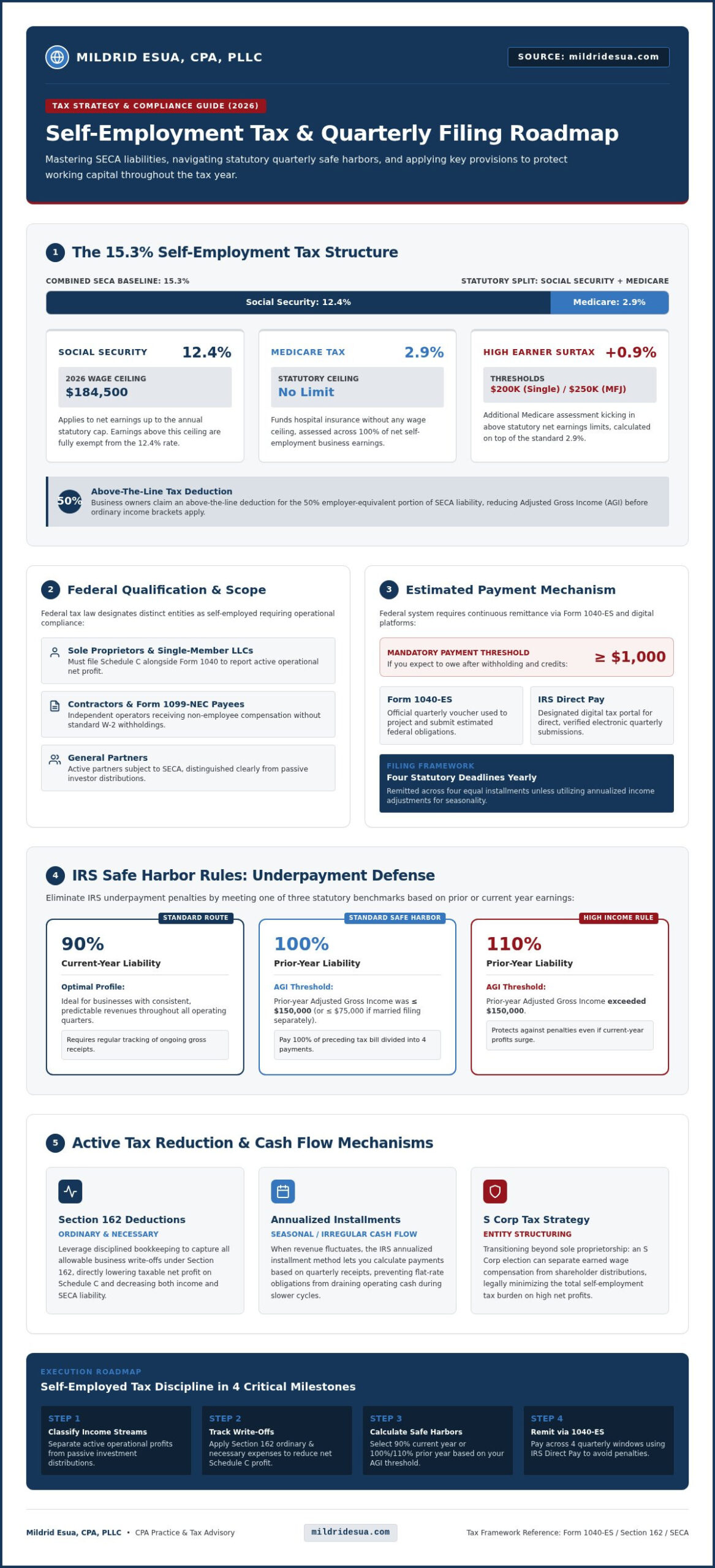
The standard SECA assessment totals 15.3% of your net self-employment earnings, structured across two dedicated programs:
- Social Security (12.4%): Applies to net earnings up to the annual statutory cap of $184,500 for the 2026 tax year. Earnings above this ceiling are exempt from the 12.4% assessment.
- Medicare (2.9%): Funds hospital insurance without any wage ceiling, applying across all net business earnings.
- Additional Medicare Tax (0.9%): Applies to self-employment earnings exceeding statutory thresholds ($200,000 for single filers; $250,000 for married couples filing jointly).
Who Qualifies as Self-Employed for Federal Tax Purposes?
Federal tax law categorizes anyone operating a trade or business as a sole proprietor, independent contractor, or general partner as self-employed. If you receive client compensation documented on Form 1099-NEC, or run a single-member LLC, you must file a Schedule C alongside your annual return.
Clarity here is paramount. Active operational earnings differ fundamentally from passive investor distributions, such as real estate returns or corporate dividend payments, which avoid SECA assessments entirely. Understanding this distinction is an essential foundation when evaluating how to pay taxes when self-employed while preserving baseline operating capital.
Calculating Estimated Quarterly Payments and Navigating Safe Harbor Rules
The United States operates on a pay-as-you-go tax system. The government expects tax revenue continuously throughout the year rather than in one lump sum at year-end. If you expect to owe at least $1,000 in federal liabilities after accounting for any withholding and credits, mastering how to pay taxes when self-employed requires projecting and remitting quarterly payments using Form 1040-ES.
To avoid underpayment penalties, you don’t need to predict your exact year-end income down to the penny. The internal revenue code provides clear statutory safe harbors. As outlined on the IRS Self-Employed Individuals Tax Center, fulfilling these benchmarks ensures you satisfy IRS compliance, regardless of how your ultimate revenue unfolds.
Meeting IRS Safe Harbor Thresholds
To shield your business from unexpected penalties, structure your cumulative annual payments around these defined thresholds:
- 90% of Current-Year Liability: Ideal if your annual revenues remain consistent and predictable across operating quarters.
- 100% of Prior-Year Liability: Remit the full amount of your preceding year’s total tax bill in four equal payments if your adjusted gross income (AGI) was $150,000 or less ($75,000 if married filing separately).
- 110% of Prior-Year Liability: Required if your prior-year AGI exceeded $150,000. Paying 110% of that benchmark protects you against penalties even if your current-year profits surge.
Managing Irregular and Seasonal Freelance Cash Flow
Equal quarterly installments present a severe liquidity challenge if your revenue fluctuates from month to month. Remitting flat quarterly amounts during a slow season drains baseline working capital. In these situations, the IRS annualized income installment method provides relief. It allows you to calculate and remit estimated payments based strictly on what you earned during each specific accounting window.
A sound operational strategy is setting aside 25% to 30% of net profit into a separate business tax account immediately upon receiving client payments. Accurate monthly tracking makes calculating these dynamic quarterly payments straightforward. Connecting regular bookkeeping directly to your filings provides the clear data needed to make informed distributions, ensuring you never face surprise penalties. For customized quarterly projections, partnering with an accountant and tax advisor for small businesses creates a proactive structure that keeps your cash flow secure.
How to Pay Self-Employment Taxes Step-by-Step in 2026
Executing your quarterly payments demands a consistent administrative rhythm. Missing a filing window incurs statutory interest charges that quietly eat into your margins. When mapping out how to pay taxes when self-employed across 2026, mark these four federal deadlines on your operational calendar:
- Quarter 1 (January 1 to March 31): April 15, 2026
- Quarter 2 (April 1 to May 31): June 15, 2026
- Quarter 3 (June 1 to August 31): September 15, 2026
- Quarter 4 (September 1 to December 31): January 15, 2027
Step 1: Determine Net Schedule C Profit
Begin by calculating your gross receipts and subtracting all legitimate ordinary business expenses. Because Self-Employment Tax applies strictly to 92.35% of your net operational profit, maintaining clean financial ledgers is non-negotiable. Maintain strict separation between personal funds and your business checking accounts. Relying on structured monthly bookkeeping for small businesses ensures you capture every allowable expense, preventing you from overpaying on quarterly estimates.
Step 2: Submit Federal Payments Online via EFTPS or Direct Pay
Skip physical paper vouchers. Remitting funds electronically creates an indisputable digital audit trail through the following process:
- Access IRS Direct Pay or log into the Electronic Federal Tax Payment System (EFTPS).
- Select “Estimated Tax” and designate “1040-ES” as your payment reason.
- Select the 2026 tax year and verify your Social Security Number or Employer Identification Number (EIN).
- Download the digital confirmation receipt immediately. Store this confirmation in your permanent records to ensure seamless cross-checks during year-end filing.
Step 3: Complete Corresponding State Estimated Tax Payments
Federal remissions resolve only one side of your liability. For instance, North Carolina entrepreneurs must reconcile state obligations alongside their federal vouchers. Access the North Carolina Department of Revenue (NCDOR) eServices portal and file your individual estimated payments using Form NC-40.
State deadlines mirror the federal calendar exactly. Aligning both state and federal workflows within the same quarterly review guarantees complete statutory protection across every jurisdiction where you operate.
Maximizing Allowable Deductions to Lower Your Taxable Net Income
Every legitimate deduction you identify directly lowers your Schedule C bottom line, slashing both your ordinary income tax and your 15.3% SECA liability. Many entrepreneurs assume that claiming the personal standard deduction prevents them from deducting business expenses. In reality, business write-offs occur above the line directly on Schedule C. They reduce your gross revenue before you ever calculate personal deductions on Form 1040.
Under Internal Revenue Code Section 162, every claimed business expense must meet two legal standards: it must be ordinary (customary in your trade) and necessary (helpful and appropriate for your business). Defending these write-offs against audit scrutiny requires strict contemporaneous records. Maintaining dedicated receipt archives and mileage trackers transforms ambiguous outlays into audit-proof tax shields. For North Carolina business owners seeking comprehensive structure, implementing principles from 2026 strategic tax planning ensures you capture every legal dollar available.
Essential Ordinary and Necessary Operating Expenses
To reduce your self-employment income legally, establish structured tracking for routine operational expenditures:
- Home Office Deduction: Deduct dedicated workspace used exclusively and regularly for administrative operations. Choose between the simplified rate ($5 per square foot up to 300 square feet) or the actual expense method allocating proportional rent, utilities, and insurance.
- Vehicle Mileage: Track business travel using contemporaneous logs reflecting the IRS standard mileage rate: 72.5 cents per mile from January 1 through June 30, 2026, and 76 cents per mile from July 1 through December 31, 2026.
- Operating Overhead: Write off necessary business tools, including specialized software subscriptions, website hosting, client invoicing platforms, and digital marketing campaigns.
Above-the-Line Write-Offs and Retirement Strategies
Once you calculate your Schedule C net profit, additional adjustments further shelter your income from higher tax brackets. Self-employed taxpayers can deduct 100% of their health, dental, and qualified long-term care insurance premiums for themselves and their families, provided they lack access to an employer-subsidized plan.
Establishing a qualified retirement plan provides another powerful lever when refining how to pay taxes when self-employed. For the 2026 tax year, you can contribute up to $72,000 into a SEP-IRA (capped at 25% of net adjusted compensation) or maximize a Solo 401(k) with an employee elective deferral of up to $24,500. These strategic vehicles defer substantial tax liabilities while building personal net worth. To build a customized deduction and retirement strategy that protects your margins, schedule a tax planning and tax preparation review with our CPA team today.
Beyond Sole Proprietorship: When to Adopt an S Corp Tax Strategy
Operating as a default sole proprietorship or single-member LLC offers simplicity during the early stages of business ownership. However, as your net earnings climb, remitting the flat 15.3% SECA tax on every single dollar of profit quickly becomes financially punitive. Unlike traditional corporate models that view compliance merely as a filing obligation, forward-thinking operators eventually restructure how they take income. Mastering how to pay taxes when self-employed at higher revenue tiers means moving beyond basic Schedule C reporting into proactive entity structuring.
Filing an entity classification election via IRS Form 2553 transforms how your enterprise distributions are taxed. Under an S Corporation election, you occupy two distinct financial roles: an operating employee and an equity shareholder. You pay yourself a market-rate W-2 salary, which remains subject to standard payroll withholding. Any remaining company profits can then be distributed to you as shareholder distributions. These distributions are entirely exempt from the 15.3% self-employment tax, generating substantial annual cash savings that stay inside your business.
Evaluating the S Corp Election Threshold
The transition to an S Corp is not universally advantageous from day one. It introduces administrative overhead, including corporate payroll processing, state franchise reporting, and separate Form 1120-S corporate returns. Generally, this strategy becomes financially advantageous once your annual net profit consistently surpasses $60,000 to $80,000.
At this earnings threshold, the payroll tax savings on your distributions significantly outpace the annual costs of corporate maintenance. Reviewing our comprehensive S Corp election guide helps pinpoint the exact moment your profit margins justify this legal reclassification.
Establishing Reasonable Compensation and Compliance
The IRS actively audits S Corporation owners who depress their W-2 wages to avoid payroll taxes. Tax law requires shareholder-employees to draw a reasonable salary based on geographic market rates, professional experience, and operational responsibilities.
Setting an arbitrarily low salary invites severe IRS scrutiny and back-tax assessments. Working closely with an experienced Greensboro CPA ensures you document a defensible compensation methodology while preserving substantial distribution savings. By shifting from reactive self-employment payments to structured S Corp management, you convert routine compliance into a vigilant, long-term wealth preservation engine.
Transform Your Self-Employed Tax Strategy Into a Growth Asset
Mastering how to pay taxes when self-employed requires shifting from reactive annual stress to continuous, proactive financial oversight. Protecting your hard-earned business revenue comes down to three deliberate habits: remitting timely quarterly estimated payments under safe harbor rules, capturing every legitimate Section 162 operating deduction through disciplined bookkeeping, and transitioning to an S Corporation structure once your net profitability warrants it.
You don’t have to navigate these evolving federal rules and state compliance mandates in isolation. As a licensed North Carolina Certified Public Accountant practice serving Greensboro, High Point, Winston-Salem, and Charlotte, our team provides vigilant stewardship across every season of your business. We pair comprehensive bookkeeping and IRS representation with aggressive, customized tax planning that shields your operating cash flow from surprise penalties.
Take full control of your liabilities and build lasting enterprise stability. Partner with Mildrid Esua, CPA, PLLC for strategic self-employed tax planning and move your venture forward with complete financial confidence.
Frequently Asked Questions
What happens if I miss a quarterly estimated tax deadline as a self-employed professional?
The IRS assesses an underpayment penalty alongside interest charges on your unpaid balance from the original due date until settled. These charges accrue daily under IRC Section 6654. If you miss a deadline, remit your payment immediately to minimize mounting interest. Taxpayers who experience unusual disruptions or federally declared disasters can work with a licensed CPA to petition the IRS for reasonable-cause penalty abatement.
How much should I set aside from every 1099 paycheck for taxes?
When mapping out how to pay taxes when self-employed, setting aside 25% to 30% of your net profit from every client payment is the standard financial baseline. This reserve accounts for the mandatory 15.3% SECA tax alongside ordinary federal and North Carolina income taxes. Moving this allocation immediately into a dedicated business tax savings account protects your day-to-day operating capital from unexpected liquidity crunches.
Can I pay my self-employment taxes once a year instead of quarterly?
You can remit your full tax liability during annual spring filing, but the IRS will assess underpayment penalties if you owe $1,000 or more. The federal government enforces a pay-as-you-go system, requiring quarterly remittances to cover liabilities as you earn them. An annual lump-sum payment only avoids penalties if your total tax bill falls below the $1,000 statutory safe harbor threshold.
Do I have to pay self-employment tax if my business operated at a loss?
No, you do not owe self-employment tax if your enterprise generates a net loss or earns less than $400 in net profit. SECA tax applies strictly to positive net Schedule C income. Even with an operational loss, filing your federal return remains vital. Documenting legitimate business losses lets you offset other taxable income streams or carry deductions forward to reduce future liabilities.
What is the difference between Form 1099-NEC and Schedule C?
Form 1099-NEC reports the gross, untaxed compensation a client paid to your business, while Schedule C calculates your actual net taxable business earnings. Clients issue Form 1099-NEC to document independent contractor payments of $600 or more. In contrast, you file Schedule C alongside Form 1040, tallying all gross revenues and subtracting ordinary business expenses to establish net profit.
Can I write off my health insurance premiums if I work for myself?
Yes, self-employed individuals can deduct 100% of their medical, dental, and qualified long-term care insurance premiums directly on Schedule 1 of Form 1040. This above-the-line adjustment lowers your adjusted gross income, though it cannot exceed your net self-employment profit. To qualify, neither you nor your spouse can be eligible for an employer-subsidized health plan through separate employment.
How does an S Corp election reduce self-employment taxes?
An S Corp election minimizes tax burdens by separating business earnings into an officer W-2 salary and shareholder profit distributions. Standard payroll taxes apply only to your reasonable salary, while remaining business distributions bypass the 15.3% SECA tax. For growing enterprises across Greensboro and the Piedmont Triad earning over $60,000 in net profit, this structure safeguards significant cash flow.




Leave a Reply
Your email is safe with us.