

What if your annual tax obligation wasn’t a seasonal crisis that drained your cash reserves, but a calibrated tool for your next phase of expansion? You’ve likely felt the sting of an unpredictable tax bill that suddenly stalls your momentum in Greensboro or High Point. It’s frustrating to work tirelessly for growth only to see your hard-earned capital diverted by complex regulations or confusion over S Corp versus LLC structures.
Unlike a traditional reactive approach, proactive tax planning for small business serves as a vigilant guide, turning complexity into a clear financial roadmap for 2026. This guide will show you how to lower your annual tax liability and secure the peace of mind that comes from meticulous IRS compliance. We’ll examine the specific 2026 benchmarks, including North Carolina’s 3.99% personal income tax rate and the $184,500 Social Security wage base, while detailing how to leverage the 20% Qualified Business Income deduction to fuel your business’s long-term trajectory.
Key Takeaways
- Learn why shifting from backward-looking preparation to forward-looking strategy prevents the hidden “tax gap” from eroding your business capital.
- Master the fundamentals of tax planning for small business to optimize your entity selection and protect your quarterly cash flow from unpredictable liabilities.
- Discover how an S Corp election can specifically reduce self-employment tax burdens for businesses operating throughout Greensboro and High Point.
- Establish a methodical 12-month financial cadence that replaces seasonal stress with year-round fiscal clarity and audit-ready IRS compliance.
- Identify the critical moments to seek professional IRS representation to resolve back taxes, ensuring your long-term stability remains uncompromised.
Why Reactive Tax Preparation Fails Small Businesses
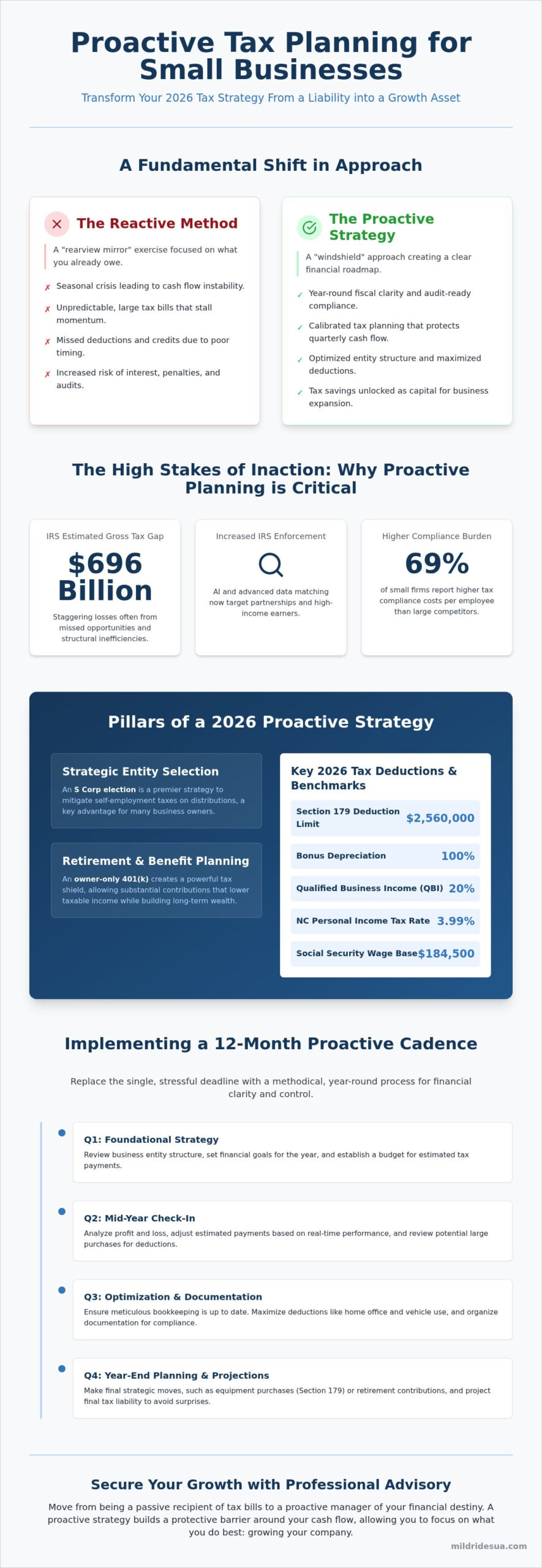
Many business owners in the Piedmont Triad treat taxes as a rearview mirror exercise. They hand over a box of receipts in March and hope for the best. Unlike this traditional, reactive method, tax planning for small business focuses on the windshield. A tax preparer tells you what you already owed; a tax planner tells you how to keep more of what you earn before the year even ends. This distinction is the difference between surviving tax season and using it to fund your next expansion.
The IRS estimates the gross tax gap at $696 billion, a staggering figure that often stems from missed opportunities or structural inefficiencies. In 2026, the stakes are higher than ever. The IRS has significantly increased enforcement through AI and advanced data matching, specifically targeting partnerships and high-income earners. If you’re reactive, you aren’t just missing out on savings. You’re inviting a level of scrutiny that could’ve been avoided through vigilant stewardship. By employing legal methods to minimize tax liability, you transition from financial anxiety to a position of informed decision-making.
The Cost of the ‘Once-a-Year’ Mentality
Waiting until the April 15 deadline to consider your tax position is a recipe for cash flow instability. Reactive filing frequently leads to missed Section 179 deductions or a failure to optimize the 20% Qualified Business Income deduction. When you ignore estimated payments, you don’t just pay what you owe. You pay interest and penalties that erode your profit margins. The IRS estimated out-of-pocket tax compliance costs for businesses reached $133.3 billion in 2024, and 69% of small firms report facing higher compliance costs per employee than larger competitors. Effective tax planning for small business relies on meticulous, year-round bookkeeping. Without real-time data, an advisor is simply guessing rather than guiding.
Proactive Planning as a Growth Strategy
Think of tax savings as a zero-interest investment in your own future. When you reduce your liability through foresight, you unlock capital to hire a new team member in Greensboro or upgrade equipment in your High Point facility. A strategic architect doesn’t just look at the tax code; they look at your long-term business trajectory. We help you move from being a passive recipient of tax bills to a proactive manager of your financial destiny. This steady hand ensures that complex regulations become a platform for stability rather than a source of recurring stress. It’s about building a protective barrier around your cash flow so you can focus on what you do best: growing your company.
The Technical Pillars of Small Business Tax Planning
Effective tax planning for small business represents the deliberate, legal optimization of your commercial structure and financial transactions to protect your bottom line. It’s the intellectual process of arranging your affairs so that you pay only what is legally required, and not a penny more. Unlike simple compliance, which merely records history, technical tax planning acts as a strategic architect for your future. Your business entity serves as the foundation of this architecture. Whether you operate as an LLC, an S Corp, or a C Corp, each structure offers distinct levers to manage your liability. For instance, the S Corp election remains a premier strategy for High Point entrepreneurs seeking to mitigate self-employment tax on their distributions. To understand the baseline requirements, the IRS Tax Guide for Small Business provides the regulatory framework, but true optimization requires a more tailored, forward-looking approach.
Optimizing Business Deductions for 2026
In 2026, the Section 179 deduction limit is set at $2,560,000, with a phase-out threshold starting at $4,090,000. This allows for the immediate expensing of qualifying equipment, which is a significant advantage for capital-intensive businesses in the Piedmont Triad. Additionally, 100% bonus depreciation remains available for qualifying property placed in service this year. A tax deduction is a strategic tool for liquidity that preserves your cash flow by reducing your taxable income base. North Carolina entrepreneurs should also look closely at home office and vehicle deductions, ensuring they meet the strict exclusive and regular use tests to withstand IRS scrutiny. Leveraging these deductions effectively requires a steady hand and precise documentation.
Retirement and Benefit Planning
Integrating retirement planning into your business model is more than a personal savings goal; it’s a powerful tax shield. An owner-only 401(k) allows for substantial contributions that lower your taxable income while building long-term personal wealth. For those managing a team, Health Reimbursement Arrangements (HRAs) can provide tax-advantaged health benefits that are fully deductible for the business. By linking personal wealth management with business tax efficiency, you create a unified financial strategy that protects your interests on both fronts. If you’re unsure which vehicle fits your 2026 goals, consulting with a specialized tax advisor for small businesses can clarify the path forward and ensure your decisions align with current federal and state regulations.
Strategic Entity Selection and NC Compliance
Choosing your legal structure is the most consequential decision you’ll make in the lifecycle of your company. While many entrepreneurs begin as a standard LLC for its simplicity, this choice can become a liability as revenue scales. In 2026, with the federal C-Corporation tax rate holding steady at 21% and the personal income tax rate in North Carolina set at 3.99%, the math behind entity selection has shifted. Sophisticated tax planning for small business involves analyzing how these rates intersect with your specific growth goals. Unlike a basic filing service, a vigilant guide examines your long-term stability by evaluating whether your current structure still serves your interests or if a transition is necessary to protect your capital.
The S Corp Strategy for Self-Employment Tax
The S Corp election remains a powerful lever for High Point and Greensboro firms looking to mitigate the 15.3% self-employment tax. By splitting your income between a “reasonable salary” and shareholder distributions, you effectively shield a portion of your earnings from the Social Security and Medicare tax. In 2026, the Social Security wage base has risen to $184,500, making this strategy even more critical for high-earning owners. It’s not a one-size-fits-all solution; you must balance your salary high enough to satisfy IRS scrutiny while low enough to maximize your savings. For a technical breakdown of these revenue thresholds and the filing requirements, consult our S Corp Election for Self-Employment Tax: 2026 Guide.
Navigating North Carolina Tax Nexus
Compliance in the Piedmont Triad requires more than just federal awareness. The North Carolina Department of Revenue maintains strict oversight on pass-through entities, and having employees in Burlington or Winston-Salem can create a tax nexus that complicates your filing requirements. You must stay vigilant against local franchise taxes and potential state-level audits that often target payroll errors. For businesses with international ties, understanding FIRPTA withholding and cross-border compliance is essential to avoid significant IRS penalties. We act as your strategic architect, ensuring that every local and international obligation is met with precision. This proactive stewardship transforms tax planning for small business from a legal burden into a stable foundation for expansion, allowing you to operate with the calm confidence that your compliance is managed by experts.
Implementing a 12-Month Proactive Strategy
A year-round advisory relationship transforms the tax code from an annual threat into a manageable variable. In Q1, we analyze your previous year’s outcomes to establish a precise tax budget for 2026. This initial phase sets the tone for a year of stability rather than surprises, positioning our firm as a vigilant guide for your financial journey. By Q2, we perform a mid-year financial review to calibrate estimated tax payments against actual revenue. This ensures you don’t overpay or face the underpayment penalties that often trap reactive business owners. Unlike the seasonal rush that characterizes traditional accounting, this methodical approach to tax planning for small business provides a clear financial roadmap for the months ahead.
Q3 shifts the focus toward optimization through strategic asset purchases and retirement plan contributions. Conducting a thorough equipment review during the third quarter allows you to maximize Section 179 benefits before the year-end supply chain crunch. Finally, Q4 involves “harvesting” deductions and making final liability projections before the December 31 cutoff. This methodical arc ensures that by the time January arrives, your filing is a mere formality of a strategy already successfully executed. This continuous engagement in tax planning for small business protects your cash flow and fuels your business growth without the friction of last-minute adjustments.
The Role of Clean Books in Planning
Real-time financial visibility is the bedrock of proactive stewardship. Monthly bookkeeping is non-negotiable because it provides the data necessary to make informed decisions before a tax year closes. Integrating payroll management within this framework prevents common errors, such as miscalculating payroll tax obligations which can account for over 10% of total payroll expenses for many small firms. For localized support that integrates with your tax strategy, our team provides Monthly Bookkeeping for Small Businesses in Greensboro & High Point to keep your data audit-ready and your growth trajectory steady.
Quarterly Milestones for NC Owners
Navigating the 2026 calendar requires precision and foresight. S-Corporations and Partnerships must observe the March 16 deadline, while C-Corporations and Sole Proprietorships follow the April 15 timeline. Your quarterly strategy sessions should include a review of North Carolina’s 3.99% personal income tax impact and any changes in local sales tax rates, which range from 4.75% to 7.5% across the Piedmont Triad. A robust checklist for these sessions includes verifying payroll tax compliance, reviewing profit and loss statements, and adjusting for any new R&D expensing rules. This consistent cadence of tax planning for small business keeps your operations resilient against shifting regulations. If you’re ready to move beyond reactive filing, you can schedule a strategic consultation with our tax advisors to build your 2026 roadmap.
Securing Your Growth with Professional Advisory
Professional advisory is more than a luxury; it’s a defensive barrier for your company’s longevity. Unlike traditional firms that appear only when deadlines loom, Mildrid Esua, CPA, PLLC provides the continuous engagement necessary to navigate a shifting regulatory environment. In 2026, the complexity of IRS enforcement requires a partner who understands the specific economic pulse of the Piedmont Triad. Whether you’re managing a growing medical practice in Winston-Salem or navigating digital asset transactions, your strategy must be as dynamic as the markets you serve. A growth partner acts as a vigilant guide, ensuring that your long-term stability is never compromised by short-term oversight. The transition to proactive tax planning for small business is the most effective way to ensure your 2026 projections become a reality.
From Tax Resolution to Tax Planning
Many owners are paralyzed by past errors, such as unfiled returns or tax liens, which consume the mental energy needed for expansion. Seeking professional IRS representation is the first step in reclaiming your financial narrative and restoring your credibility with taxing authorities. By addressing these legacy issues, you clear the structural debris that prevents sophisticated tax planning for small business. You can find a detailed framework for this process in our guide on Expert Tax Resolution in North Carolina. Once your slate is clean, we transition from defense to offense, implementing strategies that aggressively protect your future income and optimize your 2026 cash flow. A clean financial history is the essential foundation for any aggressive tax reduction strategy.
The Mildrid Esua Advantage in Greensboro
Our firm operates as a strategic architect for those who value long-term stability over short-term fixes. We specialize in the nuances that generalist firms often overlook, including the specific needs of medical professionals and the intricate compliance requirements for crypto investors. This consultative approach ensures that your 2026 strategic roadmap is not just a document, but a living part of your business operations. We remain deeply invested in the trajectory of the businesses we serve, providing a steady hand in a complex financial world. Unlike transactional services, our commitment is to your total financial health, bridging the gap between bookkeeping and high-level advisory. To begin designing your proactive growth strategy and securing your business’s future, Schedule a consultation for strategic tax planning today.
Architecting Your Path to 2026 Financial Stability
Mastering your fiscal destiny requires moving beyond the annual stress of tax deadlines to embrace a philosophy of constant readiness. You’ve seen how proactive entity optimization and a disciplined 12-month cadence transform your tax obligations into a powerful growth engine. By integrating comprehensive bookkeeping with forward-looking strategy, you ensure that every dollar remains aligned with your long-term expansion goals in Greensboro and High Point. Unlike a traditional reactive approach, this methodical stewardship protects your cash flow from the friction of unpredictable liabilities.
Robust tax planning for small business is the foundation of a truly durable enterprise. Whether you require expert IRS representation to resolve past complexities or seek proactive S Corp strategies to optimize your current distributions, a dedicated guide ensures your interests are managed with constant attention. It’s time to transition from financial uncertainty to a position of strategic intent and calm confidence. Secure your business’s financial future with strategic tax planning from Mildrid Esua, CPA, PLLC. Your vision for growth deserves a financial structure designed for stability and success.
Frequently Asked Questions
What is the difference between tax planning and tax preparation?
Tax planning is the proactive, forward-looking strategy used to minimize future liability, while tax preparation is the backward-looking process of filing returns based on past events. Preparation ensures you meet current legal obligations; however, planning creates the structural advantages that protect your cash flow. Unlike a one-time filing, tax planning for small business is a continuous engagement that aligns your financial decisions with the 2026 tax code to maximize long-term stability.
How can an S Corp election reduce my self-employment tax in 2026?
An S Corp election allows you to categorize your income into a reasonable salary and shareholder distributions. In 2026, while the Social Security wage base has risen to $184,500, only the salary portion is subject to the 15.3% self-employment tax. By optimizing this split, business owners in High Point and Greensboro can shield a significant portion of their earnings from these taxes, effectively reinvesting those savings back into their own operations.
Does my small business need a CPA for bookkeeping and taxes?
While basic software handles entries, a CPA provides the intellectual depth needed to integrate your bookkeeping with a high-level tax strategy. This integration ensures your financial records are audit-ready and that every transaction is categorized to maximize 2026 deductions. For firms in the Piedmont Triad, having a CPA act as a growth partner prevents the payroll errors and missed opportunities that often arise when bookkeeping and tax planning are treated as separate functions.
What are the specific North Carolina tax benefits for small businesses?
North Carolina offers a highly favorable tax climate, featuring a personal income tax rate of 3.99% for 2026 and a corporate rate that is actively phasing out. Businesses in Burlington and Winston-Salem also benefit from a combined state and local tax burden that remains lower than the national average. These local advantages, combined with proactive federal strategies, allow North Carolina entrepreneurs to maintain higher liquidity and fuel faster local expansion compared to peers in higher-tax states.
How do I resolve unfiled tax returns before starting a new tax plan?
You must resolve outstanding compliance issues through professional IRS representation before implementing a forward-looking strategy. Our firm specializes in tax resolution services, helping you manage back taxes and unfiled returns to clear your financial slate. Once these historical hurdles are cleared, we can transition from defensive resolution to offensive tax planning for small business, ensuring your 2026 roadmap is built on a stable foundation of total IRS compliance.
Can proactive tax planning help me avoid an IRS audit?
While no strategy can entirely eliminate the possibility of an audit, proactive planning significantly reduces your risk profile by ensuring total accuracy and robust documentation. The IRS increasingly uses AI to identify inconsistencies in small business filings. By maintaining year-round bookkeeping and following established legal structures, you present a transparent financial history that withstands scrutiny. This vigilant stewardship provides peace of mind and protects your business from the disruptions of unexpected federal inquiries.
What international tax services do small businesses typically need?
Small businesses with global interests often require specialized guidance on FIRPTA withholding and cross-border compliance to avoid steep penalties. International tax services ensure that foreign sellers and domestic firms with overseas transactions meet all reporting requirements accurately. We act as a strategic architect for these complex scenarios, managing the intersection of domestic and international tax codes so your global expansion remains both legally compliant and fiscally optimized for long-term stability.
How much can I expect to save with a strategic tax plan?
Your specific savings depend on your business structure, annual revenue, and the strategic application of deductions like Section 179 or the QBI deduction. While we never promise specific refund amounts, a customized plan typically identifies significant capital that would otherwise be lost to overpayment or structural inefficiencies. By aligning your business with the latest 2026 regulations, you transform tax compliance into a measurable strategic advantage that directly enhances your bottom-line liquidity.




Leave a Reply
Your email is safe with us.