


What if the most significant obstacle to your U.S. real estate closing isn’t the buyer’s financing, but a 15% cash seizure by the IRS that could take months to recover? For many foreign sellers, the sudden realization that a massive portion of their gross sale price will be withheld feels like an unexpected tax on their hard earned equity. It’s a common frustration to watch your liquidity evaporate at the closing table, leaving you to wait for a refund that may take nearly a year to arrive.
We believe that your capital should work for you, not sit idle in a government account. This guide explores how to strategically utilize FIRPTA withholding exemptions to protect your cash flow and align your withholding with your actual tax liability. By understanding the nuances of the 2026 regulations, you can transform a reactive tax burden into a managed financial outcome. We’ll detail the specific eligibility requirements for withholding certificates, the rigorous documentation needed for Form 8288-B, and the proactive timeline required to secure IRS approval before your transaction concludes. Understanding these mechanisms ensures that you maintain control over your investment proceeds while staying in full compliance with international tax laws.
Key Takeaways
- Learn why the default 15% withholding on gross sales often exceeds your actual tax liability and how to reclaim your capital through strategic planning.
- Identify specific FIRPTA withholding exemptions, including the $300,000 residence exception and the critical use of IRS Form 8288-B for high-value transactions.
- Evaluate the cost-benefit ratio of applying for a withholding certificate to avoid the typical year-long delay associated with traditional IRS refund cycles.
- Master the essential steps for compliance, from securing your U.S. Taxpayer Identification Number to calculating an accurate adjusted basis for your property.
- Discover how a dedicated international tax partner in North Carolina provides the vigilant stewardship needed to manage complex cross-border real estate filings.
Understanding FIRPTA and the Necessity of Strategic Exemptions
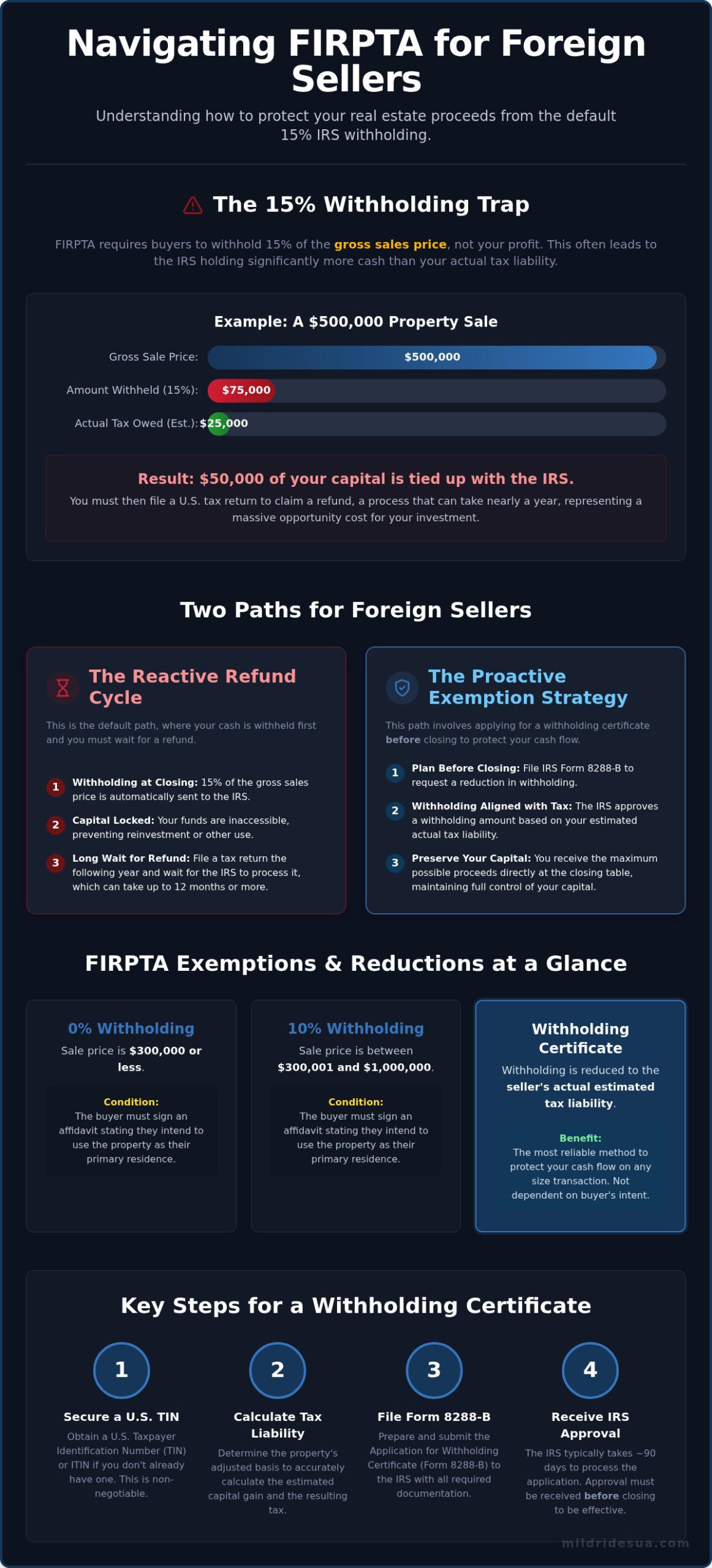
The Foreign Investment in Real Property Tax Act (FIRPTA) serves as a federal enforcement mechanism rather than a final tax assessment. It functions as a placeholder, ensuring that the IRS collects an estimated payment on capital gains before a foreign seller exits the U.S. market. By default, the law requires the buyer to withhold 15% of the gross sales price, a figure that often bears little resemblance to the actual tax liability. This isn’t a tax on your profit; it’s a withholding on the entire transaction value, which can lead to significant financial strain if not managed proactively.
While the 15% rate is the standard, certain conditions allow for a reduction. For instance, the rate may drop to 10% if the property is sold for more than $300,000 but not more than $1,000,000, provided the buyer signs an affidavit intending to use the home as a primary residence. If the sales price is $300,000 or less and the buyer has the same intent, the withholding can be eliminated entirely. However, relying on buyer intent is risky. Strategic FIRPTA withholding exemptions, such as the Withholding Certificate, offer a more reliable way to align the IRS’s requirements with the actual tax you owe, protecting your proceeds from unnecessary seizure.
To better understand this concept, watch this helpful video:
The 15% Withholding Trap: Why Liquidity Matters
Unlike domestic sellers who settle their tax obligations during the annual filing season, foreign sellers face an immediate drain on their proceeds at closing. Because the withholding is calculated on the gross sales price, it’s entirely possible for the IRS to seize a sum that exceeds your actual profit. This tied-up capital represents a massive opportunity cost. Instead of reinvesting that cash or paying down other debts, you’re forced into a reactive cycle of waiting for a refund that can take over a year to process. A proactive exemption strategy shifts the focus from recovery to protection. We position ourselves as a growth partner, helping you secure a Withholding Certificate so your liquidity remains intact when the deal closes.
Who Qualifies as a Foreign Person Under 2026 Rules?
Determining your status is the first step in managing these obligations. In 2026, the IRS defines a foreign person as a non-resident alien individual, a foreign corporation, or a foreign trust. This classification often confuses sellers who assume their physical presence or visa status exempts them. The substantial presence test remains the primary metric, calculating the days you’ve spent in the U.S. over a three-year period to determine if you’ve crossed the 183-day threshold. It’s a common misconception that holding a green card automatically triggers FIRPTA; in fact, lawful permanent residents are generally treated as U.S. persons. We act as a vigilant guide, ensuring you don’t overpay due to a simple misunderstanding of your residency status.
Primary FIRPTA Withholding Exemptions and Exceptions
While the default 15% withholding represents a significant financial hurdle, the IRS provides several established pathways to mitigate this burden. Navigating these FIRPTA withholding exemptions requires a proactive stance, as waiting until the closing date to address them is often too late. By leveraging the specific IRS guidelines on FIRPTA exemptions, sellers can ensure that the funds held at closing reflect their true tax obligations rather than a generalized percentage of the gross sales price.
Beyond simple price-based reductions, exemptions also apply to non-recognition transactions, such as 1031 tax-deferred exchanges. If you’re reinvesting proceeds into another U.S. property, a Non-Recognition Notice may allow you to bypass withholding entirely. Similarly, in “zero gain” situations where a property is sold at a loss, it’s illogical to prepay a capital gains tax that won’t exist. In these complex scenarios, we act as your strategic architect, preparing the necessary documentation to prove to the IRS that no tax is due, thereby protecting your investment capital from unnecessary seizure.
The $300,000 Residential Use Exception
The most common route for smaller transactions is the residential use exception. If the sales price is $300,000 or less, the withholding is eliminated if the buyer intends to use the property as a residence. However, the requirements are strict: the buyer must reside in the home for at least 50% of the days the property is occupied during each of the first two 12-month periods following the transfer. Many buyers hesitate to sign the required residency affidavit because it shifts the legal liability to them. If they fail to meet the residency threshold, the buyer becomes responsible for the unpaid tax, plus interest and penalties. We help sellers navigate these delicate negotiations to ensure all parties understand the risks and requirements.
Withholding Certificates (IRS Form 8288-B)
For high-value transactions that don’t meet the residence exception, IRS Form 8288-B is the gold standard for liquidity protection. This application allows the seller to request a reduction in withholding based on the “Maximum Tax Liability” calculation. Instead of losing 15% of the gross sale, you only withhold the actual amount of tax expected on the gain. To be effective, this application must be submitted to the IRS on or before the date of transfer. When filed correctly, the closing agent can hold the 15% in escrow rather than remitting it to the IRS, allowing for a much faster release of funds once the certificate is issued. If you’re concerned about how these rules impact your specific transaction, consulting with an accountant and tax advisor can provide the clarity needed to secure your proceeds.
Exemption vs. Refund: A Strategic Cost-Benefit Analysis
Choosing between a proactive exemption and a reactive refund is a decision that impacts your long-term investment trajectory. While some sellers prefer the simplicity of the default process, they often underestimate the severe timeline involved. A typical IRS refund requires you to wait until the following calendar year to file a 1040-NR, followed by several months of processing. In practice, this means your capital could be inaccessible for 12 to 18 months. By exploring FIRPTA withholding exemptions early in the transaction, you prioritize liquidity over administrative convenience.
Liquidity and Opportunity Cost
The time value of money is a central pillar of our advisory methodology. Consider a foreign investor selling a residential property in Winston-Salem for $500,000. Without a strategic intervention, the buyer must withhold 15%, or $75,000, from the gross proceeds. If this sum remains with the IRS for over a year, the seller loses the ability to deploy those funds into new ventures, pay down high-interest debt, or simply earn market returns. Mildrid Esua, CPA, PLLC acts as a vigilant guide in this analysis, helping you weigh the upfront professional costs of a withholding certificate against the potential loss of investment income. We treat your capital with the same stewardship we’d apply to our own, ensuring every dollar is positioned for growth rather than stagnation.
IRS Processing Times in 2026
As of late 2026, the IRS continues to manage a high volume of international filings. Current estimates for Withholding Certificate approval generally range from 90 to 120 days. This creates a critical timing window for sellers. According to IRS Exceptions from FIRPTA Withholding, the application must be submitted by the date of transfer to be valid. If the IRS hasn’t issued a determination by the closing date, the withholding agent is authorized to hold the funds in an interest-bearing escrow account rather than remitting them immediately. This “90-day rule” is a tactical advantage; it keeps the funds within the transaction’s reach while the IRS reviews the 8288-B queue. For Greensboro investors with urgent capital needs, we also evaluate the “Early Refund” option. This allows for a refund request before the annual tax season if a certificate was applied for but not received by the time of the sale, providing a middle ground for those caught in processing delays.
Step-by-Step Process for FIRPTA Exemption Application
Securing FIRPTA withholding exemptions isn’t just about filling out a form; it’s a synchronized effort between the seller, the buyer, and the IRS. Unlike a standard domestic sale, the timeline begins weeks before you reach the closing table. Missing a single step in the order of operations can lead to the immediate remittance of your funds to the IRS, making recovery a much longer ordeal. We act as your strategic architect, ensuring each phase of the application is executed with precision to keep your capital within your reach.
The ITIN Hurdle: Don’t Let it Stall Your Sale
An Individual Taxpayer Identification Number (ITIN) is the foundational requirement for any 8288-B application. You can’t apply for a withholding certificate without one. Because the standard ITIN application process can be slow, we utilize the “expedited” process specifically reserved for real estate transactions. As a Certified Acceptance Agent (CAA), we verify your identity documents locally in Greensboro, eliminating the need to mail your original passport to the IRS. This vigilant stewardship ensures your application is “IRS-ready” from day one, preventing the common delays that cause many foreign sellers to miss the filing deadline.
Once your identification is in place, the next phase involves a rigorous calculation of your property’s adjusted basis. This includes the original purchase price plus capital improvements and qualified selling expenses. By determining your maximum tax liability with a CPA, you provide the IRS with the justification needed to reduce or eliminate the 15% withholding. This data is then formalized on Form 8288-B and must be submitted to the IRS no later than the date of the property transfer.
Working with Escrow and Title Companies
Communication is the final piece of the puzzle. You must notify the buyer and the escrow agent that an application is pending. This notification is legally significant; it pauses the buyer’s requirement to remit the withheld funds within 20 days of the sale. Instead, the title company in Greensboro holds the funds in escrow until the IRS issues a final determination. We manage the cross-referencing between Forms 8288-A and 8288-B to prevent administrative errors that often lead to “lost” funds within the IRS system. Following up with the IRS is a continuous engagement we maintain until the certificate is issued and the funds are released from escrow.
If you’re preparing for a sale in the Piedmont Triad, our firm provides the international tax services necessary to navigate these complex filings with confidence and protect your liquidity.
Why a FIRPTA Accountant is Essential for Foreign Sellers in North Carolina
Engaging a specialized CPA in Greensboro transforms your tax compliance from a reactive burden into a managed strategic advantage. While the IRS forms may seem straightforward, the interplay between federal FIRPTA regulations and North Carolina state tax obligations requires a high level of professional depth. We act as a growth partner, ensuring that your application for FIRPTA withholding exemptions doesn’t just satisfy a checklist but actively protects your liquidity. A local advisor understands that a property sale in Winston-Salem or High Point is often part of a larger financial trajectory, requiring vigilant stewardship to mitigate the risk of IRS penalties and interest.
The journey doesn’t end when the withholding certificate is issued. A critical, often overlooked step is the filing of the final 1040-NR return. This return must accurately reflect the results of your withholding certificate to ensure you aren’t overtaxed or flagged for an audit. Unlike a distant clerk who only processes paperwork, we maintain continuous engagement throughout the entire tax year. We reconcile the credits from your Form 8288-A with your actual liability, ensuring that every dollar of your investment is accounted for and that any remaining funds are returned to you as quickly as possible.
Beyond the Form: Strategic Long-Term Tax Planning
FIRPTA compliance is rarely an isolated event; it’s a component of your broader U.S. investment strategy. For foreign investors looking to expand their portfolio in the Piedmont Triad, we provide foresight into more sophisticated ownership structures. This might include evaluating the benefits of LLCs or understanding how an S Corp Election for Self-Employment Tax: 2026 Guide could impact your future business ventures. By aligning your current sale with your long-term goals, we help you build a foundation of stability and clarity that supports future acquisitions and growth.
Local Expertise for Global Clients
Having a local Greensboro CPA provides a distinct advantage when navigating the specific requirements of North Carolina closing attorneys and title companies. We’ve managed numerous cases where our proactive methodology saved sellers from a 15% liquidity crisis by securing withholding certificates well before the 20-day remittance deadline. This seasoned expertise is vital for maintaining momentum in a complex transaction. If you’re ready to protect your proceeds and ensure full compliance with international tax laws, Schedule a FIRPTA Consultation with Mildrid Esua, CPA to discuss your specific transaction needs.
Advancing Your U.S. Investment Strategy with Confidence
Navigating the complexities of international tax law requires more than just administrative accuracy; it demands a strategic architecture that prioritizes your liquidity. By shifting from a reactive refund mindset to the proactive pursuit of FIRPTA withholding exemptions, you ensure that your capital remains under your control rather than sitting idle in a government account. Success in these transactions hinges on the precise execution of the ITIN application and the timely filing of Form 8288-B, steps that transform a potential cash flow crisis into a managed financial outcome.
We stand ready to act as your vigilant guide, providing the intellectual depth and advisory care necessary to navigate the 2026 tax landscape. Our commitment to your long-term stability ensures that your cross-border interests are protected at every stage of the closing process. As your strategic growth partner for foreign investors, we offer expert IRS representation and specialized international tax compliance to secure your interests. Your journey as a foreign investor in the U.S. should be defined by informed decisions and strategic foresight. We look forward to supporting your next successful transaction.
Secure Your Sale Proceeds: Consult Our FIRPTA Experts Today
Frequently Asked Questions
Can I avoid FIRPTA withholding if I sell my US property at a loss?
Yes, you can reduce the withholding to zero if your maximum tax liability is nothing. However, this isn’t automatic. You must file Form 8288-B before closing to secure one of the FIRPTA withholding exemptions. Without this certificate, the buyer must still withhold 15% of the gross sales price even if you’re losing money. We help sellers in Greensboro document their adjusted basis to prove a zero gain to the IRS.
How long does it take for the IRS to approve a FIRPTA Withholding Certificate in 2026?
The IRS generally takes between 90 and 120 days to process a Withholding Certificate application in 2026. Because this often exceeds the typical real estate closing window, we advise starting the process as soon as a contract is signed. If the certificate is pending at closing, the funds are held in escrow by the title company rather than being sent immediately to the IRS, protecting your liquidity while the government reviews your case.
What happens if I don’t have an ITIN at the time of the sale?
You can’t finalize a withholding reduction without an ITIN. If you lack one, you must submit an ITIN application alongside your Form 8288-B. While this doesn’t stop the sale, it can complicate the process if not handled by a Certified Acceptance Agent. We assist foreign investors in High Point with expedited ITIN processing to ensure their FIRPTA withholding exemptions are processed without administrative rejection due to missing identification numbers.
Does the buyer have any liability if they don’t withhold the full 15%?
The buyer holds absolute legal responsibility as the withholding agent. If they fail to withhold the required 15% and the IRS determines the tax was due, the buyer is personally liable for the full amount plus interest and penalties. This is why closing attorneys in Winston-Salem are incredibly strict about FIRPTA compliance. We act as a vigilant guide for both parties to ensure the buyer feels secure while the seller pursues a legal reduction.
Can a 1031 exchange eliminate the need for FIRPTA withholding?
A 1031 exchange can eliminate the immediate need for withholding through a “Notice of Non-Recognition.” To qualify, you must follow strict IRS procedures and provide the buyer with a written statement under penalty of perjury. This notice informs the buyer that no gain is recognized on the transfer. However, if the exchange fails or includes “boot,” some withholding may still be required. Our firm ensures your exchange documentation aligns with federal requirements.
Is the 15% withholding based on the profit or the total sales price?
The 15% withholding is calculated based on the gross sales price, not your profit. If you sell a property for $600,000, the buyer must withhold $90,000 regardless of whether your profit was $10,000 or $200,000. This is the “trap” that catches many foreign sellers off guard. By applying for a withholding certificate, we help you shift that calculation so it’s based on your actual maximum tax liability instead of the total transaction value.
What is the difference between a FIRPTA exception and an exemption?
A FIRPTA exception is a statutory rule that applies automatically if certain criteria are met, such as the $300,000 residential use rule. An exemption or reduction typically refers to the process of obtaining a Withholding Certificate from the IRS. While exceptions are faster, they are limited in scope. For high-value transactions in Burlington, an exemption through Form 8288-B is often the only viable path to protect your proceeds from the default 15% rate.
Do I still need to file a US tax return if I was granted a withholding certificate?
Yes, filing a U.S. tax return is mandatory even if the IRS granted you a withholding certificate. The certificate only manages the prepayment of tax at the time of sale. You must still file Form 1040-NR the following year to report the final gain or loss and reconcile your account with the IRS. We provide continuous engagement, handling both the initial withholding reduction and the final year-end filing to ensure your compliance is complete.




Leave a Reply
Your email is safe with us.