


Most foreign investors view filing as a seasonal chore, but for the non-citizen, tax compliance is actually a year-round exercise in strategic architecture. It’s natural to feel a sense of dread when faced with the threat of double taxation or the complexities of the substantial presence test. At Mildrid Esua, CPA, PLLC, we provide specialized US tax services for foreigners that transform these anxieties into a clear roadmap for financial stability. Whether you’re holding domestic real estate or managing international business interests, you deserve a vigilant guide who treats your wealth with professional stewardship.
You’ve likely felt the weight of uncertainty regarding FIRPTA withholding or the precise documentation required for an ITIN. We understand these pressures and are here to ensure you don’t just meet IRS requirements, but optimize them through proactive planning. This guide explores the 2026 tax landscape, including the increased $132,900 Foreign Earned Income Exclusion and the latest IRS identity consistency checks. You’ll learn how to leverage tax treaties to minimize liability and why having a local Greensboro partner is your best defense against regulatory overreach.
Key Takeaways
- Determine your 2026 tax residency status by applying the Substantial Presence Test to avoid unintended taxation on your worldwide income.
- Leverage expert US tax services for foreigners to correctly categorize income as effectively connected or passive, ensuring accurate reporting on Form 1040-NR.
- Navigate the complexities of FIRPTA withholding to protect your equity and manage the mandatory 15% withholding during Greensboro real estate transactions.
- Master the 2026 compliance roadmap, including new IRS identity consistency checks and critical filing deadlines, to mitigate the risk of costly penalties.
- Transition from seasonal filing to a year-round strategic partnership that safeguards your financial trajectory and provides vigilant stewardship of your US interests.
Understanding US Tax Residency: Resident vs. Non-Resident Alien
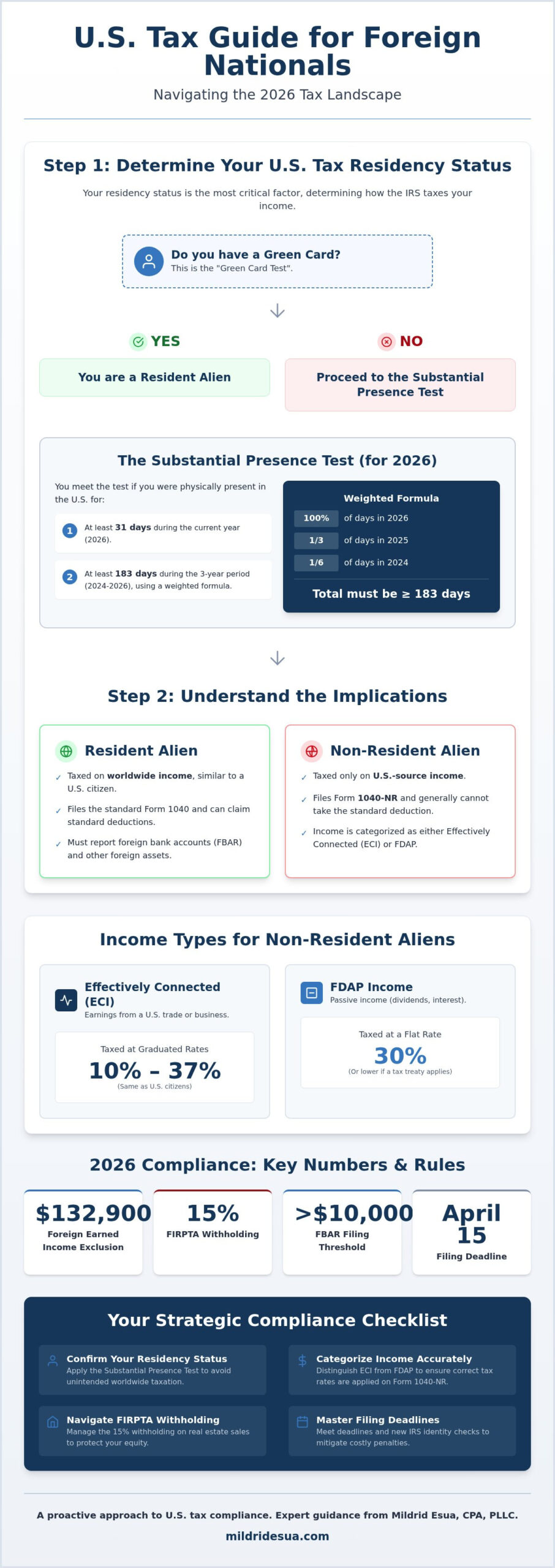
Determining your tax residency isn’t a matter of personal preference; it’s a legal classification with profound consequences for your global wealth. The IRS categorizes foreign nationals into two primary groups: Resident Aliens and Non-Resident Aliens. Unlike a standard domestic filing, Understanding US Tax Residency requires a deep dive into your physical presence and immigration status. Resident Aliens are taxed on their worldwide income, just like US citizens. Conversely, Non-Resident Aliens generally only face taxation on income sourced within the United States.
The “Green Card Test” is the most straightforward path to residency. If you’ve been granted lawful permanent residence at any point during the 2026 calendar year, the IRS views you as a resident. This status demands a proactive approach to reporting foreign bank accounts and overseas investments. For many, this is where specialized US tax services for foreigners become essential to prevent the IRS from overreaching into assets held in your home country. We act as a vigilant guide, ensuring that your transition to US residency doesn’t result in unnecessary exposure of your global interests.
The Substantial Presence Test Explained
If you don’t have a Green Card, you might still be classified as a resident under the Substantial Presence Test. To meet this criteria for 2026, you must be physically present in the US for at least 31 days in the current year and 183 days over a weighted three-year period. You count all days of presence in 2026, one-third of the days in 2025, and one-sixth of the days in 2024. Greensboro professionals on H-1B visas often fall into this category quickly. However, certain students on F-1 visas or teachers on J-1 visas may qualify as “exempt individuals” who don’t count their days toward the test for a specific duration, providing a temporary shield against worldwide taxation.
Dual-Status Aliens and Part-Year Residency
Transition years are particularly complex and require a strategic architect to manage correctly. If you arrive in or depart from the US mid-year, you may be classified as a “Dual-Status Alien.” This means you’re treated as a Non-Resident for part of the year and a Resident for the remainder. You generally can’t take the standard deduction, which is $16,100 for single filers in 2026, if you’re a Non-Resident Alien at any point during the year. We leverage tax treaties to prevent double taxation during these transition periods. Effective management of these shifts requires more than just reactive bookkeeping; it requires a steady hand to navigate the transition into the Greensboro community while maintaining global compliance.
Essential US Tax Obligations for Foreign Nationals and Investors
Once you’ve established your residency status, the focus shifts to the specific nature of your income and the resulting reporting requirements. For non-resident aliens, the IRS distinguishes between income that is effectively connected to a US trade or business and income that is passive. This distinction is the cornerstone of any effective strategy involving US tax services for foreigners. Unlike standard domestic filings, where all income is generally grouped together, foreign investors must meticulously categorize every dollar to avoid significant overpayment or IRS scrutiny.
Non-resident aliens primarily use Form 1040-NR to report their US-source income. For the 2025 tax year filed in 2026, the deadline is April 15. If you’re a resident alien living in Greensboro, your obligations expand to include the disclosure of foreign financial assets. The Foreign Bank Account Report (FBAR) is a critical requirement if the aggregate value of your foreign accounts exceeded $10,000 at any point during the calendar year. We act as a vigilant steward, ensuring these disclosures are handled with the precision required to avoid the heavy penalties associated with non-compliance.
FDAP vs. Effectively Connected Income (ECI)
Fixed, Determinable, Annual, Periodical (FDAP) income typically includes passive earnings like dividends, interest, and royalties. By default, the IRS applies a flat 30% tax rate to FDAP income. In contrast, Effectively Connected Income (ECI) is taxed at graduated rates ranging from 10% to 37% for the 2026 tax year. Business owners in the Piedmont Triad must be particularly careful with how they characterize their earnings. For instance, rental income from US property is usually FDAP unless you make a specific election to treat it as ECI. This choice is vital when managing FIRPTA Withholding, as it directly impacts your final tax liability and your ability to claim a refund of withheld funds.
The Importance of ITINs for Foreign Filers
If you don’t qualify for a Social Security Number, an Individual Taxpayer Identification Number (ITIN) is your primary tool for US tax compliance. You’ll need an ITIN to open a US bank account, claim tax treaty benefits, or file a 1040-NR. Navigating the Form W-7 application process requires more than just filling out boxes; it demands an understanding of the specific documentation the IRS requires to verify your identity. Errors here can stall real estate transactions or delay the release of withheld funds for months. Securing these identifiers through specialized international tax services ensures that your administrative foundation is solid from the start.
Tax treaties represent one of the most powerful tools for optimizing your liability. These agreements can often reduce the 30% flat tax on dividends or interest to 15% or even 0%, depending on your country of residence. Claiming these benefits isn’t a passive process; it requires an active filing of Form W-8BEN or similar disclosures. We provide the strategic depth to ensure you aren’t leaving money on the table through excessive withholding. North Carolina residents and business owners operating across multiple jurisdictions can find additional cross border tax advice tailored to the 2026 regulatory landscape to further optimize their global tax position.
FIRPTA Withholding: Navigating Real Estate Sales as a Foreigner
Selling real estate in the United States as a foreign person involves more than just finding a buyer; it requires managing a significant tax prepayment mechanism known as FIRPTA. The Foreign Investment in Real Property Tax Act ensures the IRS captures potential capital gains taxes by mandating that 15% of the gross sales price be withheld at the time of closing. Unlike domestic sellers who settle their tax liabilities during the following year’s filing season, foreign sellers in Greensboro face an immediate and substantial impact on their liquid proceeds. We serve as a vigilant guide, helping you navigate these requirements to ensure that your equity remains protected throughout the transaction.
It’s vital to understand that this withholding is not the final tax owed but a security deposit held by the government. For a comprehensive look at how these rules apply to various property types, our International Real Estate Tax & FIRPTA: 2026 Guide provides the strategic depth needed for high-value transactions. For broader context on how the IRS views these sales, IRS Publication 519, U.S. Tax Guide for Aliens offers additional regulatory background. Relying on specialized US tax services for foreigners allows you to move beyond reactive compliance and into a space of proactive financial stewardship.
Applying for a FIRPTA Withholding Certificate
You don’t have to accept the full 15% withholding if your actual tax liability is significantly lower. By filing Form 8288-B, you can request a withholding certificate that reduces or eliminates the amount held at closing based on the actual gain realized. Timing is everything. You must submit this application on or before the day of the closing. When the IRS receives a timely application, the 15% is held in an escrow account rather than being sent immediately to the IRS, allowing for a much faster recovery of your funds once the certificate is issued. Our team acts as your strategic architect, preparing the necessary documentation to align with your closing timeline.
Exemptions to FIRPTA Withholding
Several scenarios allow for a complete exemption from these withholding requirements. The most common is the “residence exemption,” where the property sells for $300,000 or less and the buyer intends to use it as a primary residence. If the sales price is between $300,001 and $1,000,000 and the buyer intends to live there, the withholding rate may be reduced to 10%. Additionally, certain foreign corporations may qualify for entity-level exemptions if they’ve made a specific election to be treated as a domestic corporation for tax purposes. Proving these exemptions requires rigorous documentation. We provide the steady hand necessary to verify these statuses and prevent the IRS from overreaching into your real estate proceeds.
2026 Compliance Roadmap: Deadlines and Avoiding IRS Penalties
A tax calendar is more than a list of dates; it’s a strategic blueprint for wealth preservation. For the 2025 tax year filed in 2026, the primary deadline for Form 1040-NR and 1040 filers is April 15, 2026. Unlike many generic providers who only focus on this spring date, we recognize that non-resident aliens living outside the United States often have until June 15, 2026, to submit their returns. Missing these windows triggers immediate failure-to-file penalties, which can quickly erode the profitability of your US investments. Effective US tax services for foreigners require this level of granular foresight to prevent avoidable financial friction.
The 2026 filing season introduces the new IRS Identity Consistency Check. This protocol cross-references foreign addresses and names with extreme precision to detect discrepancies. This change means that even minor clerical errors could flag your return for an audit or delay your refund indefinitely. To manage these heightened risks, our Tax Compliance for Foreign-Owned US Business: 2026 Guide outlines the rigorous documentation required to satisfy these new enforcement standards. We operate as your vigilant guide, maintaining a year-round watch over your filing status so you’re never caught off guard by shifting regulatory demands.
FBAR and FATCA: The Disclosure Burden
Reporting your income is only half the battle; disclosing your assets is where many foreign nationals face the greatest risk. If the aggregate value of your foreign financial accounts exceeded $10,000 at any point during 2025, you must file FinCEN Form 114, also known as the FBAR. Additionally, resident aliens with specified foreign financial assets exceeding certain thresholds must file Form 8938 under FATCA regulations. The IRS distinguishes between “willful” and “non-willful” non-compliance, with penalties for the former reaching as high as 50% of the account balance. For NC residents and businesses navigating these overlapping international obligations, our 2026 cross border tax advice for NC residents and businesses provides a comprehensive framework for managing FBAR, FATCA, and BEPS 2.0 requirements. We provide the intellectual rigor necessary to categorize your assets correctly and ensure every disclosure is bulletproof.
Streamlined Filing Procedures for Catching Up
If you’ve discovered past-due filing obligations, there’s a path back to compliance that doesn’t involve catastrophic penalties. The IRS Streamlined Foreign Offshore Procedures offer a form of amnesty for taxpayers whose failure to report was non-willful. This program allows you to catch up on unfiled returns and FBARs while potentially avoiding the most severe fines. At Mildrid Esua, CPA, PLLC, we specialize in these complex tax resolution cases, acting as a steady hand to guide you through the disclosure process. If you’re facing unfiled taxes or a tax lien, our professional IRS representation can help restore your standing with the authorities and secure your financial future.
Choosing a Specialized CPA: Why Greensboro Residents Trust Mildrid Esua
Navigating the intersection of local business operations and international tax treaties requires more than a standard tax preparer; it demands a strategic architect who understands the specific economic landscape of the Piedmont Triad. Unlike high-volume, online-only firms that prioritize transactional speed over customized care, we offer a steady hand to residents in Greensboro, High Point, and Winston-Salem. Our US tax services for foreigners are built on the philosophy that your financial trajectory deserves vigilant stewardship, not just a seasonal check-in. This local proximity allows us to address the unique challenges faced by foreign investors and business owners in North Carolina while maintaining a sophisticated grasp of global compliance standards.
Choosing a local partner means your complex interests are managed with constant attention and high-level expertise. We don’t just look backward at your previous year’s earnings; we look forward to anticipate how shifting regulations might impact your future growth. For those seeking a protective and forward-looking ally, our 2026 US Tax Compliance Guide for International Clients serves as an essential resource for maintaining stability in an unpredictable environment.
Proactive Partnership vs. Transactional Service
We position ourselves as a growth partner rather than a distant clerk. This means we’re continuously engaged with your long-term stability, identifying potential risks before they manifest as IRS penalties. You’ll have direct access to Mildrid Esua, CPA, for complex decision-making, ensuring that your interests are managed with constant attention. This consultative approach creates a sense of calm confidence, knowing that a seasoned expert is navigating the future challenges of your portfolio. We prioritize active verbs and momentum, moving you from a state of confusion to one of strategic intent.
Integrated Small Business and International Tax
For foreign entrepreneurs launching startups in NC, the administrative burden can be overwhelming. We integrate small business accounting with international expertise, offering strategic advice on business formation and S Corp elections for foreign residents. While many firms struggle with the overlap of domestic payroll and foreign ownership reporting, we provide a seamless solution that covers everything from bookkeeping to complex IRS representation. We help you move from a state of complexity to informed decision-making, ensuring that your Greensboro-based business is built on a foundation of full compliance and optimized tax liability. Our work is intellectually rigorous, designed to support the long-term trajectory of the visionary leaders we serve.
Securing Your Global Financial Legacy in 2026 and Beyond
The 2026 tax landscape demands more than just checking boxes; it requires a proactive methodology that transforms compliance into a competitive advantage. Foresight is your best asset. Mastering the nuances of residency status and navigating the high-stakes environment of FIRPTA withholding are essential steps for any foreign investor. By shifting from a reactive mindset to one of strategic architecture, you protect your assets from unnecessary IRS overreach and ensure long-term stability. Unlike traditional seasonal services, our approach provides year-round stewardship of your domestic and international interests.
At Mildrid Esua, CPA, PLLC, we provide the steady hand and intellectual rigor needed to manage your complex obligations. Our Greensboro office offers a unique blend of local vigilance and global reach, ensuring your US tax services for foreigners are handled with constant attention. We’re committed to being your growth partner, helping you transition from complexity to informed decision-making. Schedule a Strategic Tax Consultation with Mildrid Esua, CPA today to optimize your 2026 tax liability. Your financial future in the United States deserves the protection of a seasoned expert who stays continuously engaged.
Frequently Asked Questions
Do I need to file a US tax return if I am not a US citizen?
You must file a US tax return if you earn US-sourced income or satisfy the Substantial Presence Test. Resident aliens generally file Form 1040 to report worldwide earnings; non-resident aliens utilize Form 1040-NR for income effectively connected to a US business. Navigating these requirements demands specialized US tax services for foreigners to ensure every disclosure is accurate. Failing to report can result in the loss of legitimate deductions or significant IRS penalties.
What is the difference between an ITIN and an SSN for tax purposes?
An SSN is issued to citizens and authorized workers, while an ITIN is strictly for tax processing for individuals ineligible for an SSN. Both serve as your unique identifier with the IRS. You’ll need one of these numbers to claim treaty benefits, open bank accounts, or file your annual returns. We act as a vigilant guide, helping you navigate the Form W-7 application process to secure your ITIN without administrative delays or errors.
How does a tax treaty affect my US tax obligations as a foreigner?
Tax treaties function as strategic agreements between the US and other nations to reduce or eliminate double taxation. These treaties often lower the standard 30% withholding rate on passive income like dividends or royalties to 15% or less. To claim these benefits, you must proactively file Form W-8BEN or similar disclosures. We analyze these treaties to architect a tax plan that minimizes your global liability while maintaining full compliance with current regulations.
Will I be taxed twice on my income earned outside the US?
You generally won’t face double taxation because the IRS provides mechanisms like the Foreign Tax Credit and the Foreign Earned Income Exclusion. For the 2026 tax year, the exclusion amount has increased to $132,900. These tools allow you to offset US tax obligations with taxes paid to your home country. Our consultative approach ensures these credits are applied correctly, protecting your global wealth from redundant taxation through meticulous and proactive reporting.
What happens if I sell US real estate as a foreign person?
Selling US real estate triggers a mandatory 15% withholding on the gross sales price under the FIRPTA regulations. This withholding acts as a prepayment of the capital gains tax you might owe. You’re required to file a US tax return to calculate the actual gain and claim any over-withheld funds. We provide the expertise to manage this process, including applying for withholding certificates to reduce the amount held at the time of your closing.
Can a foreigner own a US LLC and how is it taxed?
Foreigners can certainly own a US LLC, which the IRS typically treats as a pass-through entity for tax purposes. This means the profits flow directly to you and are taxed at graduated rates if the income is effectively connected to a US business. However, foreign-owned LLCs face strict reporting requirements, such as Form 5472. We provide the intellectual rigor to manage these disclosures, ensuring your business structure remains a stable and compliant vehicle for growth.
What is the deadline for foreigners to file their US taxes in 2026?
The primary deadline to file Form 1040-NR and settle any tax debt is April 15, 2026. However, if you’re a non-resident alien living outside the United States, your filing deadline is extended to June 15, 2026. You can also request an extension to file until October 15, though this doesn’t extend the time to pay. Our US tax services for foreigners include year-round monitoring to ensure you meet these critical dates without financial friction or penalties.
How can I get help with unfiled tax returns from previous years?
You can regain compliance through IRS amnesty programs like the Streamlined Foreign Offshore Procedures if your failure to file was non-willful. This process allows you to catch up on three years of tax returns and six years of FBARs with reduced or waived penalties. Mildrid Esua, CPA, PLLC acts as a steady hand during these complex tax resolution cases. We provide professional IRS representation to resolve back taxes and restore your financial standing.