


A single reporting error shouldn’t be the price of your global ambition. While many North Carolina entrepreneurs view international compliance as a defensive hurdle, the most resilient global players treat it as a strategic foundation for long-term stability. You’re likely feeling the pressure of 2026’s shifting landscape, where a simple oversight in FBAR reporting or a misunderstanding of North Carolina’s new 2.00% corporate tax rate can trigger aggressive IRS penalties. It’s exhausting to feel caught between conflicting jurisdictions while facing the impersonal, high-cost structures of Big 4 firms that don’t prioritize your specific mid-sized needs.
This guide provides the expert cross border tax advice necessary to secure your assets and maintain vigilant compliance with both US and foreign authorities. We’ll demystify the 2026 thresholds for FATCA, explain the “Side-by-Side” implementation of BEPS 2.0, and show you how to leverage legal treaties to minimize liability. By moving from reactive filing to proactive stewardship, you’ll gain the peace of mind that comes from having a dedicated local partner protecting your interests across every border.
Key Takeaways
- Understand how the 2026 regulatory shift, including North Carolina’s transition to a 2.00% corporate tax rate, impacts your global financial stability.
- Secure your international assets by implementing professional cross border tax advice that bridges the gap between IRS requirements and foreign jurisdiction laws.
- Identify the specific triggers requiring specialized planning, from FIRPTA withholding for foreign sellers to complex FBAR reporting thresholds for local residents.
- Move beyond the “reactive clerk” model by partnering with a strategic architect who anticipates future tax hurdles rather than simply filing backward-looking forms.
- Establish a systematic framework for documentation to meet 2026 reporting deadlines and protect your interests from heavy non-compliance penalties.
Navigating the Complexities of Cross Border Tax Advice in 2026
Effective cross border tax advice represents the sophisticated coordination of financial obligations across multiple sovereign jurisdictions. It’s much more than a seasonal reporting requirement; it’s a protective shield for your global assets. In 2026, this coordination has become essential as the IRS and foreign authorities have increased their data-sharing capabilities. For North Carolina residents, the challenge lies in balancing local tax advantages, such as the state’s 2.00% corporate tax rate, with rigid federal international mandates. A “Strategic Architect” doesn’t just record your history; they design a forward-looking roadmap that anticipates shifts in global policy before they impact your bottom line.
The rise of digital nomadism and remote work has fundamentally changed the 2026 landscape. Many Greensboro and Winston-Salem professionals now earn income through foreign entities or hold assets in overseas accounts without realizing they’ve triggered complex filing requirements. Unlike a traditional reactive accountant, a proactive partner identifies these triggers early. This stewardship ensures that your international expansion or remote lifestyle remains a source of growth rather than a source of legal friction.
Why International Tax Compliance is a Moving Target
Global tax treaties are constantly evolving to address the realities of a digital economy. Understanding the foundational principles of international taxation is the first step in recognizing how residence-based systems interact with territorial rules. In 2026, the implementation of the BEPS 2.0 “Side-by-Side System” introduces new nuances for US-parented groups, requiring a higher level of intellectual rigor to manage. Transparency is no longer optional, as foreign banks now provide the IRS with unprecedented access to account data. As your vigilant guide, I maintain a constant watch over these regulatory shifts to ensure your strategy remains resilient against international policy changes.
The Consequences of Mismanaged Cross-Border Filing
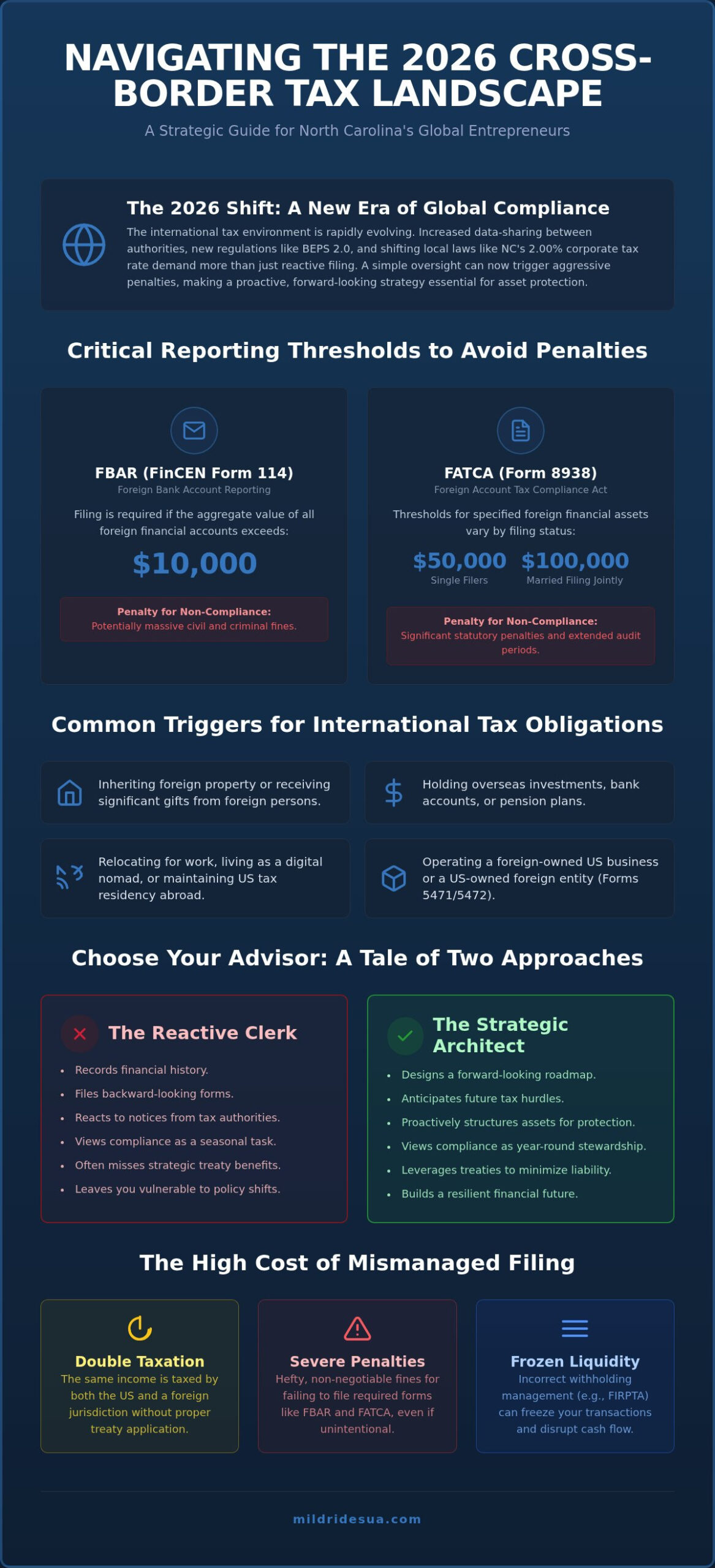
The risks of uncoordinated filing are severe and often irreversible. Without the precise application of legal treaties, you face the very real threat of double taxation, where the same dollar is taxed by both the US and a foreign jurisdiction. The financial impact of oversight is equally daunting. For the 2026 tax year, the IRS continues to enforce strict penalties for failing to disclose foreign assets. Consider these common risks:
- FBAR Penalties: Failing to file FinCEN Form 114 when aggregate foreign accounts exceed $10,000 can result in massive fines.
- FATCA Non-Compliance: Missing the $50,000 threshold for single filers or $100,000 for married couples leads to significant statutory penalties.
- Withholding Errors: Incorrectly managing FIRPTA or other cross-border payments can freeze your liquidity.
If you’re already facing a dispute, professional IRS representation is your most effective tool for resolution. We don’t just fill out forms; we advocate for your interests and seek relief from liabilities that stem from complex jurisdictional conflicts.
Essential Scenarios Requiring Specialized International Tax Planning
Providing expert cross border tax advice starts with identifying the specific events that trigger international reporting obligations. For North Carolina residents, these triggers often involve inheriting foreign property, holding significant overseas investments, or relocating for work while maintaining US tax residency. Unlike standard domestic filings, tax compliance for foreign owned US business entities requires a deeper level of coordination to manage information returns like Form 5472 and Form 5471. Our firm acts as a protective ally, ensuring that these complex financial transitions don’t result in punitive IRS oversight or missed opportunities for treaty based relief.
The difference between domestic and international filing lies in the sheer volume of disclosure required. While a local business focuses on income and expenses, a foreign owned entity must report transactions with related parties and maintain meticulous records of global ownership structures. This level of scrutiny demands more than a reactive clerk; it requires a strategic architect who understands how local NC business incentives interact with federal international mandates. By establishing a compliant foundation early, you protect your long term trajectory from the friction of unexpected audits.
FIRPTA Withholding for Foreign Sellers of NC Real Estate
When a foreign person sells real property in North Carolina, the buyer is generally required to withhold 15% of the gross sales price under the Foreign Investment in Real Property Tax Act. This isn’t a final tax liability but a security deposit held by the IRS, which can create significant liquidity issues for the seller during a closing. Navigating an international real estate tax FIRPTA scenario requires precise documentation to either reduce this withholding amount or expedite a refund. A specialized FIRPTA withholding accountant can prepare the necessary withholding certificates, often shortening the time it takes to recover excess funds from the government.
Inbound and Outbound Business Expansion Strategies
Global expansion brings immense opportunity, yet it also introduces sophisticated reporting demands that can catch local firms off guard. Greensboro businesses opening overseas branches must weigh the benefits of various entity structures against their total global tax footprint. For example, many entrepreneurs are surprised to learn that an S Corp election is generally unavailable if any shareholder is a non-resident alien, a mistake that can lead to the loss of pass-through tax status. This is why professional tax planning for international clients is indispensable during the early stages of formation.
Whether you’re managing a domestic entity with global reach or you’re a resident alien with assets abroad, following the IRS Tax Guide for U.S. Citizens and Resident Aliens Abroad is vital for staying within legal boundaries. Relying on generic filing services often leads to missed foreign tax credits or forgotten disclosures that trigger automatic penalties. Securing specialized cross border tax advice ensures your expansion is built on a stable, compliant foundation. If you’re navigating these shifts, a consultation with a Greensboro international tax advisor can clarify your next steps and protect your global interests.
Evaluating Your Global Strategy: Specialist CPA vs. Generalist
Selecting a partner for cross border tax advice isn’t just about filing forms; it’s about choosing a level of risk management that matches your global footprint. Unlike a generalist accountant who focuses on domestic balance sheets, a specialist acts as a strategic architect for your international interests. The difference often comes down to the “reactive clerk” model versus the “proactive growth partner” approach. A clerk records what happened in the past, while a partner anticipates how 2026 shifts, like the implementation of BEPS 2.0, will affect your future cash flow and liability.
For businesses in Greensboro and Winston-Salem, having a local advocate with high-level international training provides a unique advantage. You don’t have to sacrifice the personalized attention of a local firm for the intellectual depth of a global consultancy. This year-round advisory relationship ensures that your strategy remains steady, even when seasonal tax deadlines pass. By maintaining continuous engagement, we can identify opportunities for tax optimization that a seasonal preparer would likely overlook.
The Pitfalls of DIY International Tax Software
Standard tax software is designed for the masses, which means it often lacks the logic to identify complex treaty-based return positions. These automated tools frequently miss the nuances of FBAR and FATCA reporting, where the aggregate value of accounts determines your liability. Relying on an algorithm can lead to significant oversights that trigger automated IRS flags. Instead of generic software “help,” seeking specialized US tax services for foreigners ensures your disclosures are accurate and strategically sound. Software can’t provide the vigilant stewardship required to protect global assets from aggressive penalty regimes.
Questions to Ask Your Cross-Border Tax Advisor
To ensure you’re working with a vigilant guide, you should vet your advisor with specific, high-stakes questions. Start by asking:
- “How many clients do you currently represent with assets in [your specific foreign jurisdiction]?”
- “What is your successful resolution rate for international IRS disputes or penalty abatements?”
- “How do you coordinate with the IRS International Business Tax Resources to stay ahead of 2026 regulatory changes?”
- “Can you demonstrate how you’ve used tax treaties to prevent double taxation for a client in my industry?”
A true partner should provide more than data entry; they should offer a clear vision for your long-term stability. If an advisor can’t explain the “why” behind a reporting requirement, they’re likely acting as a clerk rather than a strategist. Your global growth deserves the protection of an expert who stays continuously engaged with the evolving landscape of international law.
Staying ahead of international tax deadlines requires a methodical framework rather than a reactive scramble. For 2026, the complexity of global reporting means that documentation must be gathered in real-time. A systematic approach begins with robust monthly bookkeeping for small businesses in the Greensboro and High Point areas. This continuous engagement ensures that every foreign transaction is categorized correctly, providing the transparency needed to satisfy both the IRS and state authorities. Unlike traditional annual filing, this proactive stewardship allows us to catch potential reporting triggers long before they become liabilities.
Providing expert cross border tax advice involves more than just filling out forms; it’s about building a documentation trail that withstands scrutiny. You’ll need to maintain records of the highest value of all foreign bank accounts, details of foreign pensions, and documentation for any overseas business interests. By organizing these records monthly, you transform a complex year-end burden into a streamlined process that protects your global financial stability.
FBAR and FATCA: Navigating the Reporting Maze
The reporting thresholds for 2026 are precise and non-negotiable. You must file FinCEN Form 114 (FBAR) if the aggregate value of your foreign financial accounts exceeds $10,000 at any time during the calendar year. The deadline for this filing is April 15, 2026, with an automatic extension to October 15, 2026. It’s vital to distinguish this from Form 8938 (FATCA), which focuses on foreign financial assets. For single US residents, the FATCA threshold is $50,000 on the last day of the year or $75,000 at any point. For married couples filing jointly, these limits increase to $100,000 on the last day of the year or $150,000 at any point. Missing these dates can trigger catastrophic penalties that far outweigh the cost of professional guidance.
Treaty-Based Return Positions and Withholding
Strategic use of US tax treaties can significantly reduce or even eliminate withholding on foreign-sourced income. To claim these benefits, you must typically file Form 8833, which discloses your treaty-based return position to the IRS. Proactive planning is required to access these benefits because treaty positions must be established and documented before the tax year concludes to be fully effective. If you want to ensure your global assets are protected from unnecessary double taxation, contact our international tax services team to begin your 2026 compliance strategy today.
Mildrid Esua, CPA: Your Vigilant Guide in Greensboro and Beyond
Mildrid Esua, CPA, PLLC stands as a sophisticated alternative to the impersonal, high-cost service models of the Big 4 accounting firms. Based in Greensboro, our firm combines the intellectual depth of a global consultancy with the personalized care of a local growth partner. We serve residents and businesses across High Point, Winston-Salem, and Burlington, providing the vigilant stewardship necessary to manage financial interests that span several borders. Unlike a transactional service provider, we operate as your Strategic Architect, designing a robust financial framework that balances your global ambitions with the specific tax advantages of North Carolina, such as the 2.00% corporate tax rate in 2026.
In the complex environment of 2026, where federal international mandates and state incentives intersect, you need an advisor who stays continuously engaged. We don’t just react to past financial events; we look forward to anticipate jurisdictional challenges before they result in IRS friction. Our commitment is to translate intricate international laws into clear, informed decision-making for our clients. By acting as a steady hand in a complex environment, we ensure that your global financial trajectory remains stable and secure.
Customized Solutions for Global Growth
Every business trajectory is unique, and your tax plan should reflect your specific milestones. We specialize in tailoring international tax strategies that align with your long-term growth objectives. For instance, we carefully evaluate the integration of an S Corp election for self employment tax within your broader global structure. This level of foresight ensures that your domestic entity remains tax-efficient while satisfying the reporting requirements of foreign jurisdictions. By focusing on stability and clarity, we help you navigate business formation and expansion without the fear of non-compliance penalties.
Securing Your International Financial Future
Protecting your global assets requires a steady hand and a proactive methodology. Our firm identifies potential risks, such as shifts in BEPS 2.0 implementation or changes in FBAR thresholds, long before they impact your liquidity. This “Vigilant Guide” approach provides the peace of mind that your interests are being managed with constant attention and high-level expertise. If you’re seeking expert cross border tax advice that prioritizes your long-term stability over seasonal filing, we’re ready to act as your protective ally. Schedule a consultation with our Greensboro office today to secure your international financial future and move forward with confidence.
Securing Your International Legacy with Strategic Stewardship
Navigating the 2026 international landscape requires more than just filling out forms; it demands a philosophy of continuous engagement and precise coordination. You’ve seen how shifting federal mandates and North Carolina’s evolving tax environment create a complex intersection that can’t be managed through generic software or reactive filing. By prioritizing vigilant stewardship, you protect your global assets from the friction of IRS penalties and the drain of unnecessary double taxation. It’s about moving from a state of uncertainty to one of informed, strategic intent.
Choosing the right cross border tax advice means partnering with a specialist who understands the nuances of specialized FIRPTA withholding knowledge and possesses the intellectual depth to provide expert IRS representation for international disputes. We combine a dedicated local Greensboro presence with high-level global expertise to ensure your interests are managed with constant attention. It’s time to move beyond the role of a reactive clerk and embrace a strategic architecture for your wealth.
Secure your global financial interests with a Strategic Tax Consultation and gain the clarity needed to grow without boundaries. Your international financial future is too important to leave to chance; let’s build a foundation that supports your long-term stability and success.
Frequently Asked Questions
Do I need to report my foreign bank account if it has less than $10,000?
No, you don’t need to file an FBAR if the aggregate value of all your foreign accounts remains below $10,000 throughout the entire year. However, it’s vital to calculate the combined peak balance of every account rather than looking at them individually. Even if one account is small, its contribution to the total could trigger a reporting requirement. We monitor these balances year-round to ensure you stay within legal boundaries without unnecessary filing.
How does the US-Canada tax treaty affect my remote work income in 2026?
The US-Canada tax treaty primarily serves to prevent double taxation by establishing which country has the primary taxing rights over your remote work income. In 2026, most Greensboro residents working for Canadian firms can use the treaty to claim foreign tax credits or exemptions. This coordination requires sophisticated cross border tax advice to ensure you aren’t overpaying in one jurisdiction while failing to satisfy the other. We help you navigate these treaty-based positions with precision.
What is the penalty for failing to file a FIRPTA withholding certificate?
Failing to properly manage FIRPTA requirements can lead to the IRS holding 15% of the gross sales price indefinitely. Beyond the lost liquidity, the IRS may assess interest and penalties on the buyer for failing to withhold or on the seller for inaccurate disclosures. Our firm specializes in preparing these certificates to expedite your refund and ensure full compliance. This proactive approach prevents the government from holding your capital longer than necessary during real estate transactions.
Can I claim a foreign tax credit for taxes paid to another country?
Yes, you can generally claim a foreign tax credit on your US return for income taxes paid to another country on the same earnings. This credit reduces your US tax liability dollar-for-dollar, which is a critical tool for avoiding the burden of double taxation. Unlike a simple deduction, the credit is often more beneficial for your long-term stability. We analyze your global income streams to maximize these credits while adhering to the rigorous IRS documentation standards.
Does an S Corp election affect my ability to have foreign shareholders?
Yes, making an S Corp election strictly prohibits non-resident aliens from holding shares in your business. If a foreign person acquires stock, your S Corp status is immediately terminated, which can lead to significant back taxes and the loss of pass-through benefits. This is a common pitfall for local NC firms seeking global investment. We act as your strategic architect to evaluate alternative entity structures that support your growth without compromising your tax efficiency.
What is the difference between FBAR and FATCA reporting requirements?
FBAR reporting focuses on foreign bank and financial accounts once their aggregate value exceeds $10,000. In contrast, FATCA reporting covers a broader range of foreign financial assets and has much higher thresholds, such as $50,000 for single residents. While FBAR is filed with FinCEN, FATCA is part of your annual IRS tax return. Understanding these distinctions is essential for maintaining vigilant stewardship over your global reporting obligations and avoiding catastrophic penalties.
How can cross-border tax advice help me avoid double taxation on real estate?
Expert cross border tax advice identifies specific treaty provisions that protect your real estate investments from being taxed twice. We apply foreign tax credits and cost basis adjustments to ensure that the taxes paid in a foreign jurisdiction are correctly recognized on your US return. This level of strategic depth is especially important for Greensboro residents selling overseas property. Our proactive methodology ensures that your real estate gains contribute to your wealth rather than being lost to jurisdictional conflicts.
What documents do I need to prepare for an international tax consultation?
You should gather your peak annual balances for all foreign accounts, foreign tax returns, and any documentation regarding overseas income or property sales. It’s also helpful to provide records of any business interests or trusts held outside the United States. These documents allow us to conduct a thorough analysis and design a customized compliance strategy. Having this information ready ensures our initial consultation focuses on high-level strategic planning rather than basic data collection.