


What if the most significant threat to your global wealth in 2026 isn’t a volatile market, but a single overlooked disclosure on an IRS form? For many, the fear of staggering FBAR or FATCA penalties is a constant shadow, often coupled with the frustration of seeing 15% of a property sale’s proceeds vanished into FIRPTA withholding. You might find yourself questioning whether you’ve inadvertently crossed the threshold into US tax residency, a confusion that can lead to costly reactive measures. Effective tax planning for international clients requires more than just filling out forms; it demands a philosophy of vigilant stewardship and a proactive partnership that anticipates shifts in the regulatory environment before they impact your bottom line.
We understand that you’re looking for stability and clarity in an increasingly complex fiscal landscape. This guide provides a comprehensive roadmap for your US tax compliance, designed to protect your interests through strategic foresight. You’ll learn how to handle cross-border complexities while utilizing tax treaty benefits to minimize your total liability. We’ll preview the essential steps to transform your tax position from a source of anxiety into a well-managed component of your growth strategy, ensuring you remain audit-ready and confident in your financial trajectory.
Key Takeaways
- Identify the nuanced distinctions between immigration status and tax residency to protect your global income from unnecessary US taxation.
- Discover why strategic entity selection serves as the essential foundation for tax planning for international clients aiming for long-term asset protection.
- Master the complex reporting requirements of FBAR, FATCA, and FIRPTA to safeguard your wealth against high-stakes IRS penalties.
- Learn how a proactive, year-round advisory relationship can transform your tax obligations into a streamlined component of your global growth strategy.
- Explore how local Greensboro expertise provides a strategic advantage for international investors navigating the North Carolina real estate market.
Defining Your US Tax Status: Resident vs. Non-Resident Aliens
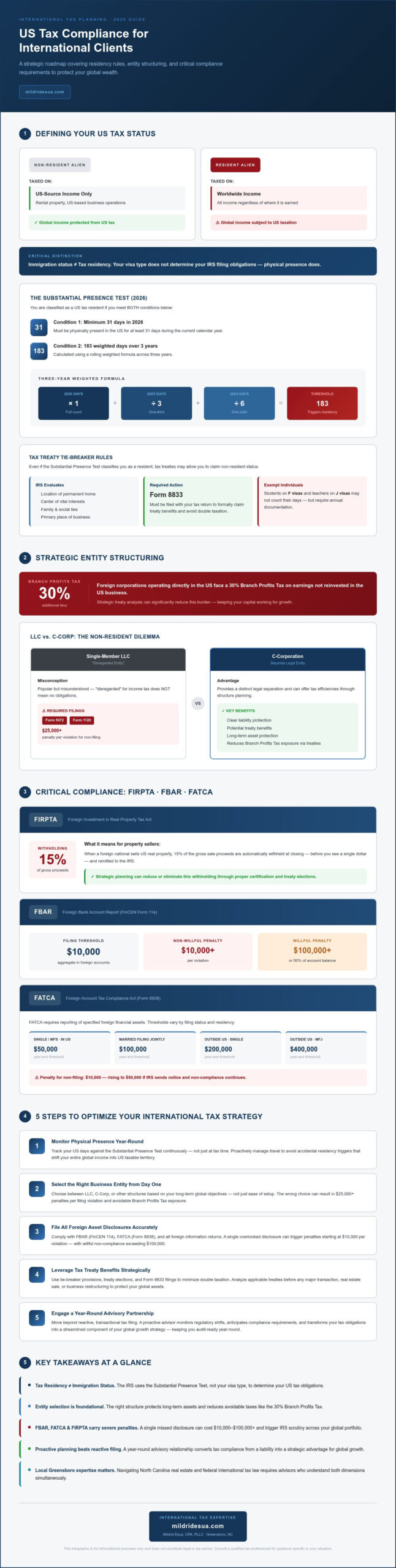
Understanding the boundary between non-resident and resident alien status is the primary pillar of effective tax planning for international clients. While immigration status focuses on your legal right to remain in the country, tax residency focuses on the IRS’s right to claim a portion of your global wealth. Unlike immigration law, which may grant you a multi-year visa, tax law operates on a rigid, rolling calendar that can change your filing requirements without warning. A proactive partnership with a tax advisor ensures you don’t inadvertently cross these thresholds, as the shift from non-resident to resident status fundamentally alters your financial obligations.
The distinction is critical because your status determines the scope of your tax liability. Resident aliens are subject to US taxation on their worldwide income, regardless of where it’s earned. In contrast, non-resident aliens are generally only taxed on income derived from US sources, such as rental property or business operations physically located within the United States. Maintaining vigilant stewardship over your physical presence in the country is the only way to manage this risk effectively. For 2026 tax purposes, the Substantial Presence Test is the definitive mechanism used by the IRS to determine if an individual has spent enough time in the US to be treated as a resident for tax reporting. Foreign nationals navigating these rules for the first time will benefit from reviewing a comprehensive overview of US tax services for foreigners to understand how compliance and strategy intersect.
The Substantial Presence Test Explained
The IRS uses a specific three-year weighted formula to calculate residency. To meet the test, you must be physically present in the US for at least 31 days during 2026 and a total of 183 days over a three-year period. This total is reached by adding all your days in the current year, one-third of your days in 2025, and one-sixth of your days in 2024. Strategic tax planning for international clients involves monitoring these counts year-round to prevent an accidental residency trigger. Certain groups, such as students on F visas or teachers on J visas, may qualify as exempt individuals whose days do not count toward this total, but these exceptions require precise documentation and annual filings to remain valid.
Tax Treaty Tie-Breaker Rules
When the Substantial Presence Test classifies you as a resident but you maintain deep roots in your home country, tax treaties may provide a “tie-breaker” solution. These international agreements allow you to claim non-resident status if you can prove a closer connection to another jurisdiction. The IRS evaluates factors like the location of your permanent home and your center of vital interests, which includes your family, social ties, and primary place of business. To successfully invoke these protections, you must file Form 8833 with your tax return. This filing is a high-level advisory requirement that notifies the IRS you are claiming treaty benefits to avoid double taxation on your global assets.
Strategic Structuring for Foreign-Owned US Businesses
Choosing the right business entity isn’t merely a legal formality; it’s the fundamental cornerstone of tax planning for international clients. A traditional, reactive approach often leads to business owners selecting a structure based on ease of setup, only to face punishing tax consequences later. Unlike these transactional services, our proactive methodology involves architecting a structure that aligns with your long-term global objectives. For foreign corporations operating directly in the US, the Branch Profits Tax can impose an additional 30% levy on earnings not reinvested in the US business. However, through strategic treaty analysis, this burden can often be significantly reduced, ensuring your capital remains a tool for growth rather than a casualty of avoidable taxation.
Managing tax compliance for foreign owned US business requires constant attention to shifting IRS regulations. Our role as your growth partner is to ensure that your entity choice provides both fiscal efficiency and robust protection against international tax disputes.
LLC vs. C-Corp: The Non-Resident Dilemma
For many non-resident investors, the single-member LLC is a popular but misunderstood choice. While the IRS views it as a “disregarded entity,” it still triggers rigorous disclosure requirements, including Form 5472 and Form 1120. Failing to file these can result in penalties starting at $25,000 per violation. Conversely, a C-Corp provides a distinct protective layer. It blocks the owner from direct personal IRS exposure and handles its own tax liabilities at the 2026 corporate rate. This structure is often preferred by those who wish to keep their global assets separate from their US operations, providing a level of clarity that simplified structures cannot match.
S Corp Election and Self-Employment Tax for Residents
Once an international client achieves resident alien status, new doors for optimization open. While non-resident aliens are barred from S Corp ownership, resident aliens in Greensboro can utilize this structure to reduce self-employment tax. By bifurcating income into a reasonable salary and shareholder distributions, you can protect a portion of your earnings from the 15.3% self-employment tax. This strategy requires a steady hand to navigate the “reasonable salary” requirements, ensuring your compensation stands up to IRS scrutiny. If you’re transitioning your residency status, consulting with a specialized international tax advisor can help you time these elections for maximum benefit.
Navigating Critical Compliance: FIRPTA, FBAR, and FATCA
Compliance for cross-border assets requires more than just checking boxes at year-end. It demands a vigilant guide who anticipates reporting requirements before they become liabilities. For many, the intersection of US real estate and global financial accounts creates a perfect storm of complexity. Effective tax planning for international clients relies on a year-round advisory relationship to ensure that every transaction and every foreign account is disclosed accurately to the IRS. Without this continuous engagement, investors often find themselves reacting to penalties rather than preventing them.
FIRPTA Withholding on Real Estate Sales
When a foreign person sells US real property, the buyer is generally required to withhold 15% of the gross sales price. This is a significant liquidity drain, as the withholding often exceeds the actual tax due on the gain. Unlike a reactive approach that simply accepts this loss of cash flow, we work with clients to apply for a Withholding Certificate. This document, when filed correctly, allows the IRS to reduce or eliminate the withholding based on the actual tax liability expected from the sale. Navigating international real estate tax FIRPTA rules is particularly vital for investors in the North Carolina market. Having a FIRPTA withholding accountant involved early in the transaction ensures that all forms are submitted before the closing date, protecting your capital from being held by the IRS for months.
FBAR and FATCA: Reporting Global Assets
Reporting requirements extend far beyond physical property. If you have a financial interest in or signature authority over foreign financial accounts, you may need to file FinCEN Form 114, commonly known as an FBAR. This requirement triggers when the aggregate value of those accounts exceeds $10,000 at any time during the calendar year. While the FBAR is a Treasury Department requirement, FATCA (Form 8938) is an IRS requirement for reporting specified foreign financial assets. The thresholds for FATCA are generally higher and vary based on your residency and filing status.
Penalties for non-compliance are severe. A non-willful failure to file an FBAR can lead to penalties that adjust for inflation, often exceeding $15,000 per violation. Willful violations are even more damaging, potentially resulting in the greater of $100,000 or 50% of the account balance. Comprehensive tax planning for international clients involves a meticulous review of global holdings to distinguish between these forms and ensure every disclosure is made with strategic intent. North Carolina residents and businesses operating across jurisdictions can find detailed guidance on managing these obligations in this 2026 cross border tax advice guide for NC residents and businesses. We act as your growth partner, managing these complexities so you can focus on expanding your global portfolio.
5 Steps to Optimize Your International Tax Strategy
Moving from the labyrinth of compliance to the clarity of informed decision-making requires a shift in perspective. Unlike a standard tax preparer who merely records history, a growth partner acts as a strategic architect for your wealth. Proactive tax planning for international clients ensures that every cross-border dollar is positioned for maximum efficiency. The Foreign Tax Credit serves as a non-refundable credit that reduces your US tax bill based on the income taxes you have already paid to a foreign jurisdiction on the same income. By integrating these tools, you transform tax from a static expense into a manageable variable.
To optimize your position for 2026, follow these five strategic steps:
- Conduct a comprehensive treaty eligibility review to identify reduced withholding opportunities.
- Validate all withholding documentation, specifically the W-8 series forms, to prevent automatic 30% tax grabs.
- Analyze the benefit of Foreign Tax Credits versus the Foreign Earned Income Exclusion for your specific income mix.
- Synchronize the timing of global income and expense recognition to avoid liquidity-draining tax mismatches.
- Maintain year-round stewardship with a dedicated tax advisor who understands both Greensboro local rules and global requirements.
Leveraging Double Taxation Treaties
The US maintains a network of treaties that can drastically reduce withholding rates on passive income. For instance, dividend or royalty payments that might normally face a 30% flat tax can often be reduced to 15%, 10%, or even 0% depending on your home country. To secure these benefits, you must provide a correctly completed Form W-8BEN for individuals or W-8BEN-E for entities. A common pitfall occurs when these forms are outdated or contain technical errors. This leads to automatic maximum withholding that is difficult and time-consuming to recover from the IRS. If you’re ready to move beyond reactive filing, schedule a consultation with our international tax specialists to architect your 2026 strategy.
Utilizing Foreign Tax Credits and Deductions
The primary defense against double taxation is the strategic use of Foreign Tax Credits. While the Foreign Earned Income Exclusion (FEIE) allows you to exclude a portion of your income from US tax, the FTC is often more flexible for high-net-worth individuals with diverse revenue streams. The goal is to align the timing of foreign tax payments with US tax liabilities. If you pay taxes in the UK, Canada, or Germany in a different fiscal quarter than the US, you may face a temporary tax mismatch. This eats into your liquidity. Effective tax planning for international clients involves managing these dates with precision to ensure you aren’t paying the same tax dollar twice.
Local Expertise for Global Interests: Why Greensboro Clients Choose Mildrid Esua
Unlike global firms that offer detached, high-level advice, Mildrid Esua, CPA, PLLC provides a sophisticated blend of local presence and international depth. We act as a Strategic Architect for your financial future, ensuring that your North Carolina business operations align perfectly with complex federal cross-border mandates. For entrepreneurs and real estate investors in the Triad, strategic tax planning is not a seasonal event; it’s a year-round commitment to stability and asset protection. Our firm bridges the gap between local market opportunities and the rigorous demands of the IRS, positioning you for long-term growth while maintaining a defensive posture against regulatory risk.
Effective tax planning for international clients requires a partner who stays continuously engaged with your financial trajectory. By choosing a Greensboro-based advisor, you gain the advantage of a growth partner who understands the local economic landscape while possessing the high-level expertise needed to navigate international tax treaties and reporting requirements.
Greensboro-Based IRS Representation
Managing expert tax resolution in North Carolina requires a seasoned advocate who understands the nuances of international reporting. If you’re facing challenges with unfiled returns, FBAR penalties, or federal tax liens, our firm provides proactive representation that commands respect. Our approach is rooted in vigilant stewardship; we don’t just react to IRS notices. Instead, we architect comprehensive solutions to address back taxes and disputes, protecting your global reputation and financial standing. Having local representation during an audit or resolution process ensures that your interests are managed with constant attention and strategic intent, providing a steady hand in a complex environment.
Continuous Engagement: Beyond the Tax Season
Maintaining transparency across borders is impossible without a foundation of accurate, real-time data. Our monthly bookkeeping services provide the clarity needed to monitor your US-source income and ensure all international disclosures are supported by rigorous documentation. This methodical rhythm of communication allows us to conduct quarterly reviews, adjusting your strategy for 2026 regulatory changes before they impact your bottom line. We invite you to move from the anxiety of the unknown to the confidence of informed decision-making. To begin architecting your tailored strategy, schedule an international tax consultation and discover the peace of mind that comes with professional stewardship.
Securing Your Global Legacy Through Strategic Foresight
The transition into 2026 demands more than just standard compliance; it requires a philosophy of vigilant stewardship over your international assets. By mastering the nuances of residency status and architecting business structures that prioritize long-term stability, you move from a position of risk to one of strategic advantage. Success in the US market isn’t just about the investments you make, but how you protect them from the complexities of FIRPTA withholding and the high stakes of global reporting requirements. Effective tax planning for international clients serves as the bridge between your current holdings and your future growth goals.
Our firm stands ready as your growth partner, offering specialized FIRPTA withholding expertise and Greensboro-based IRS representation to navigate even the most intricate disputes. We don’t just file returns; we design proactive strategies that ensure your global interests are managed with constant attention and professional depth. To begin building a more secure financial trajectory, schedule your strategic international tax consultation with Mildrid Esua, CPA. Your path to clarity and long-term stability starts with a single, informed decision. We look forward to helping you navigate the future with confidence.
Frequently Asked Questions
Do I have to pay US taxes if I am not a US citizen?
Non-citizens are generally required to pay US taxes on any income derived from US sources, such as rental properties, business operations, or dividends. If you spend enough time in the country to meet the Substantial Presence Test, the IRS treats you as a resident alien. This means you’re taxed on your worldwide income. Proactive tax planning for international clients helps distinguish which income streams are taxable to avoid unnecessary fiscal leakage.
What happens if I forget to file an FBAR for my foreign bank accounts?
Forgetting to file an FBAR can lead to staggering financial penalties, even if the omission was unintentional. For 2026, non-willful penalties can exceed $15,000 per violation. If the IRS deems the failure willful, the fine can reach the greater of $100,000 or 50% of the account balance. We act as a vigilant guide to ensure all foreign financial interests are disclosed accurately, protecting you from these aggressive enforcement actions.
How can a foreign investor avoid the 15% FIRPTA withholding?
Foreign investors can reduce or eliminate the 15% FIRPTA withholding by applying for a Withholding Certificate from the IRS before the sale closes. This certificate proves that your actual tax liability on the gain is lower than the standard withholding amount. Unlike a reactive approach that leaves capital tied up for months, our team manages the application process early. This ensures you retain more of your proceeds at the time of closing.
Can a foreign-owned LLC be taxed as an S Corp?
A foreign-owned LLC can only elect S Corp status if the owner qualifies as a US resident alien for tax purposes. The IRS strictly prohibits non-resident aliens from being shareholders in an S Corporation. If you’ve achieved residency, this election can be a powerful tool for reducing self-employment taxes. However, if you’re a non-resident, attempting this election can lead to immediate disqualification and potential tax penalties for the entity.
What is the difference between a resident alien and a non-resident alien for tax purposes?
The primary difference lies in the scope of income the IRS can tax. Resident aliens are taxed on their global income from all sources, while non-resident aliens are generally only taxed on income earned within the United States. Residency is determined by the Green Card test or the Substantial Presence Test. Understanding this distinction is a cornerstone of tax planning for international clients, as it dictates your entire filing strategy and disclosure requirements.
How do tax treaties help international clients in North Carolina?
Tax treaties provide a strategic shield against double taxation by allowing you to claim reduced withholding rates on interest, dividends, and royalties. For international clients in Greensboro, these treaties often provide tie-breaker rules that can protect global income from US taxation even if you spend significant time in the state. By properly documenting treaty benefits on Form 8833, you ensure that your US investments remain profitable and compliant with international law.
Is there a penalty for late filing of international information returns?
Yes, the IRS imposes some of its harshest penalties for the late filing of international information returns. These penalties often start at $25,000 per violation and can escalate quickly. Common forms that trigger these fines include:
- Form 5471 for foreign corporations
- Form 5472 for foreign-owned US corporations or LLCs
- Form 3520 for foreign gifts or trusts
Our proactive methodology ensures every required disclosure is submitted on time to protect your capital.
Why do I need a specialized CPA for international tax planning instead of a general one?
International tax law is a highly specialized field that requires a Strategic Architect rather than a generalist. A general CPA may not be familiar with the nuances of treaty tie-breaker rules, FIRPTA withholding certificates, or the intricate disclosure requirements for foreign-owned LLCs. We provide a consultative approach and technical expertise, acting as a forward-looking ally who understands how your US operations impact your global financial stability and growth. Non-citizens seeking a structured starting point can also explore our dedicated 2026 US tax compliance and strategy guide for foreigners to better understand the full scope of their obligations before engaging an advisor.